
Doubling the Accuracy of AlphaFold 3: MoleculeMind Conquers Challenging Antibody Design
Traditional antibody discovery typically relies on animal immunization or exhaustive “carpet bombing” screenings across massive antibody libraries.
A recent technical report released by MoleculeMind offers an entirely different paradigm.
Centered on its de novo AI protein design platform, MMDesign, the report spans 19 design campaigns across 18 distinct targets, covering two molecular modalities: nanobodies (VHH) and cyclic peptides:
- With only 9 to 50 candidate molecules tested per project, 18 projects successfully yielded experimentally confirmed binders, achieving an extraordinary project success rate of 94.7%;
- All 6 tested GPCR targets succeeded, with top-performing binders consistently reaching nanomolar affinity;
- In secondary design rounds conducted on 6 targets with prior hits, 5 projects demonstrated further gains in design metrics;
- Several candidate molecules also demonstrated excellent preliminary developability and sequence novelty.
These findings demonstrate that MMDesign has transitioned from “technological breakthrough” to “systematic validation”: a single, unified “generation–screening–validation” workflow consistently clears wet-lab validation across diverse targets and modalities with only a handful of candidates.
Having undergone three iterative updates within six months, MMDesign is turning high-efficiency hit generation into a repeatable, industrial-grade engineering capability.
For AI-driven drug discovery, true core value is multifaceted:
Can candidate pools sent for wet-lab screening be leaner while maintaining higher hit rates after molecular generation? This is a matter of efficiency.
Can candidate molecules achieve superior affinity, developability profiles, and sequence novelty? This is a matter of quality.
Equally critical is the ability to bypass known binders altogether, designing molecules directly from functional requirements rather than modifying pre-existing templates. Unlocking targets that lack established precedent is precisely where de novo design derives its fundamental advantage over traditional template-based optimization.

Bringing “Mass Screening” into the In Silico Realm: Scoring Hits with Just Dozens of Molecules Tested per Project
AI de novo design circumvents the conventional trial-and-error cycle across vast combinatorial libraries. Researchers simply specify the target and desired binding epitope, and the AI generates molecular sequences directly in digital space.
Yet generating sequences is only the first hurdle. The true technological watershed lies in accurately triaging tens of thousands of generated sequences down to the mere dozens genuinely worthy of wet-lab synthesis and testing.
MMDesign standardizes this process into an end-to-end “generation–screening–validation” workflow:
The platform first generates tens of thousands of candidate molecules in silico. It then applies a multi-tiered evaluation pipeline—combining structural reliability, sequence naturalness, and statistical physics—to narrow the candidate pool to just 9 to 50 molecules per project (with a median of only 21). Ultimately, 18 out of 19 projects yielded verified binders, achieving a 94.7% project success rate. Across all 453 tested candidates, 139 were experimentally confirmed as binders, translating to an overall candidate hit rate of 30.7%.
Two benchmark metrics are at play here: 94.7% measures project success—whether at least one functional binder was identified—while 30.7% reflects the candidate hit rate among all experimentally screened molecules. Globally, both figures rank in the top tier of de novo antibody design.
Notably, 15 projects yielded at least two distinct binders (nearly 80%), ensuring that R&D teams not only secure viable molecules but also have the luxury to compare and optimize across multiple viable candidates.
For pharmaceutical companies, eliminating low-value candidates early in the computational phase allows valuable experimental resources to concentrate on high-potential molecules, marking a true paradigm shift from brute-force screening to precision design.
A Clean Sweep Across Six GPCRs: Cracking the Toughest Membrane Protein Nuts
If a 94.7% success rate proves efficiency, the GPCR campaigns provide undeniable proof of raw technological prowess.
G-protein-coupled receptors (GPCRs) represent one of the most therapeutically vital target families in drug discovery, yet developing antibodies against them has historically posed formidable challenges. As transmembrane proteins, GPCRs exhibit intricate structures and high conformational plasticity, coupled with sparse extracellular regions accessible for antibody binding. Consequently, GPCRs are widely recognized as one of the toughest nuts to crack in de novo antibody design.
According to the report, MMDesign performed de novo design against six GPCR targets—CCR7, CCR8, EP2, GPR68, NK3R, and A2AR—and successfully generated experimentally validated binders across all six.
Under bio-layer interferometry (BLI) assay conditions, candidate hit rates across the targets ranged from 12.1% to 100%. The top-performing binders for all six targets achieved nanomolar affinities, with the best dissociation constant ($K_D$) for GPR68 reaching 12.1 nM.
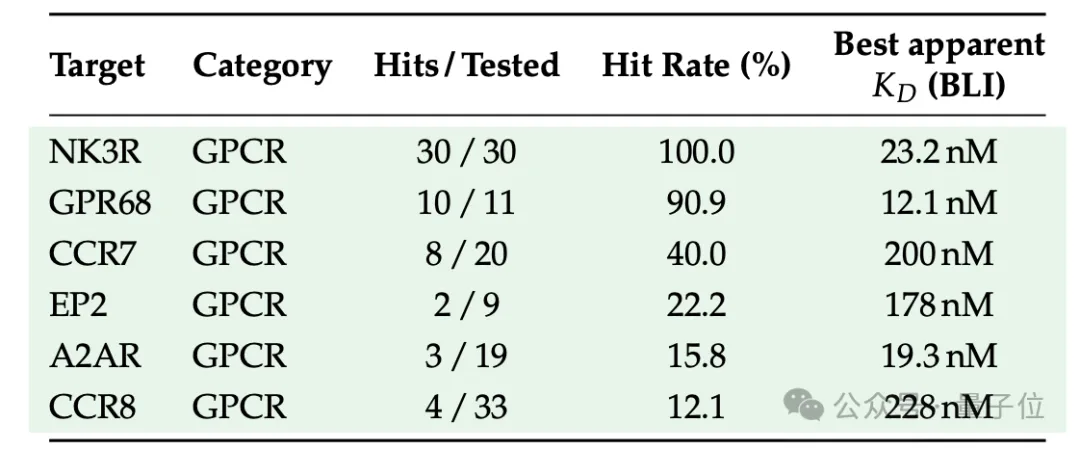
Two results stand out in particular: all 30 tested candidates for NK3R were confirmed binders, achieving a 100% hit rate; while 10 of the 11 candidates tested for GPR68 were successful hits.
Even more compelling evidence emerged from tackling targets with “no prior precedent”:
Across 5 GPCR targets in the Thera-SAbDab database (PL132) lacking any documented therapeutic antibody precedent, 53 out of 89 tested designs successfully bound their targets, yielding a candidate hit rate of 59.6%.
This highlights the fundamental distinction between de novo design and precedent-based engineering: the AI must operate completely free of reference templates, solving a “closed-book” problem guided solely by the target structure and functional objectives. A hit rate of 59.6% demonstrates that even when confronted with complex membrane protein targets devoid of precedent, the platform can carve out novel discovery avenues and conquer long-standing bottlenecks in conventional R&D.
Enabling Multi-Round Optimization and Cross-Modality Expansion
When biopharmas evaluate long-term partnerships with technology platforms, the core consideration is generalizability and reusability: Can candidates be iteratively optimized after initial design? Can the workflow translate smoothly when switching to different molecular modalities?
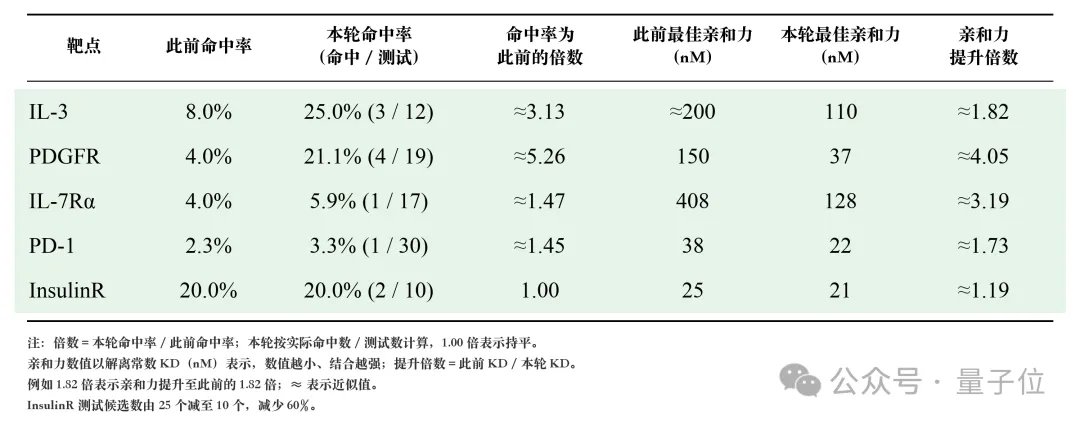
The report delivers a resounding yes: MMDesign initiated secondary design rounds for 6 targets that had already yielded binders, and 5 of them achieved further leaps in hit rates, peak affinity, or overall performance metrics.
Take PDGFR as an example: candidate hit rates jumped from 4.0% to 21.1%, while the best $K_D$ improved from 150 nM to 37 nM—a fourfold gain in affinity. This confirms the platform’s capacity for continuous iterative refinement to yield progressively superior molecules for the same program.
At the same time, the platform’s scope has successfully expanded across molecular modalities. In cyclic peptide design experiments, 16 out of 21 candidates hit for the MDM2 project, a 76.2% hit rate with a best $K_D$ of 13.7 μM; for PD-L1, 11 of 28 candidates bound successfully, with a best $K_D$ of 40.2 μM.
Unlike nanobodies, cyclic peptides are constrained by macrocyclic backbones and involve markedly different conformations and design rationales, yet the workflow executed seamlessly.
Together, multi-round design optimization and cross-modality reusability validate the maturity of the platform’s systematic capabilities, demonstrating that its technology is rapidly progressing from isolated breakthroughs to standardized, systemic delivery.
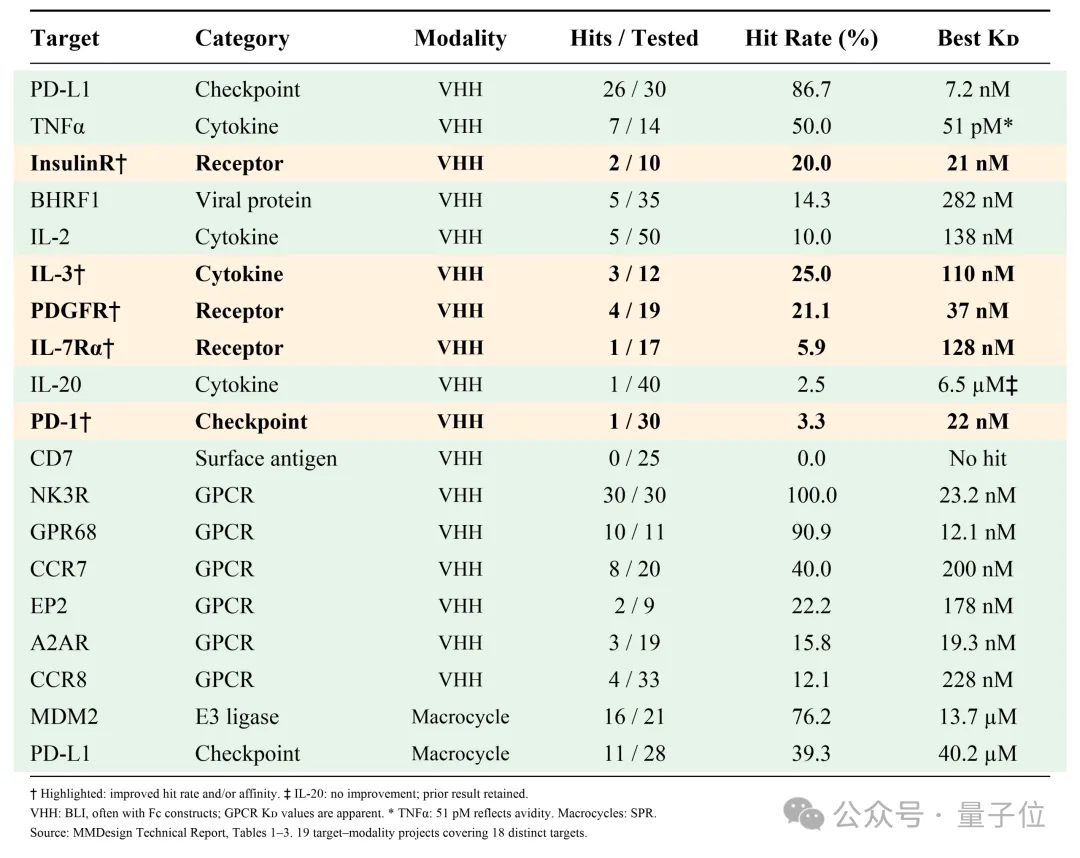 △ Summary of validation results
“Binding” Is Merely the Starting Point: Clearing Developability and Novelty Hurdles
In drug discovery, high-affinity binding is only an admission ticket. A lead molecule with genuine clinical translational potential must clear multiple developability hurdles: stable expression, low aggregation propensity, and absence of off-target or non-specific binding.
The report reveals that MMDesign fronts these critical criteria into the computational evaluation phase: in 10 mL CHO cell culture expression assays, selected VHH-Fc candidates demonstrated robust expression titers; multiple purified candidates were predominantly composed of monomeric main peaks with minimal aggregation propensity; and a tested subset exhibited low non-specific binding against surrogate antigens, including insulin and double-stranded DNA.
This indicates that while driving toward binding activity, the platform simultaneously co-optimizes the critical physicochemical properties required for downstream development.
Furthermore, sequence novelty serves as pivotal proof of true template-free de novo design.
MMDesign’s generative mechanism does not rely on mining antibody sequence databases for known molecules as starting points. Cross-referencing against authoritative databases such as PDB, OAS, and SAbDab revealed that designed molecules across multiple targets diverged substantially from known antibodies in their antigen-binding regions, with key CDR3 loops in some candidates adopting entirely novel conformations.
Generating de novo sequences tailored strictly to functional requirements not only unlocks previously intractable target spaces but also provides robust protection for circumventing existing IP landscapes and building proprietary pipelines.
Twice the Accuracy of AlphaFold 3: A Structural Foundation Powering “AI Bio-Infrastructure”
For downstream de novo design to pick winners accurately, upstream algorithms must see microscopic structures with crystal clarity.
MMFold, MoleculeMind’s proprietary all-atom structure prediction model, serves as the core structural foundation empowering MMDesign.
On the authoritative FoldBench benchmark for antibody-antigen complex structure prediction across all 172 complex interfaces, MMFold achieved a Top-1 high-quality prediction success rate of 39.0%—roughly double that of AlphaFold 3 (19.8%). Its overall Top-1 success rate reached 70.9%, rising to 76.7% for Top-5, with a Top-5 high-quality success rate of 44.2%.
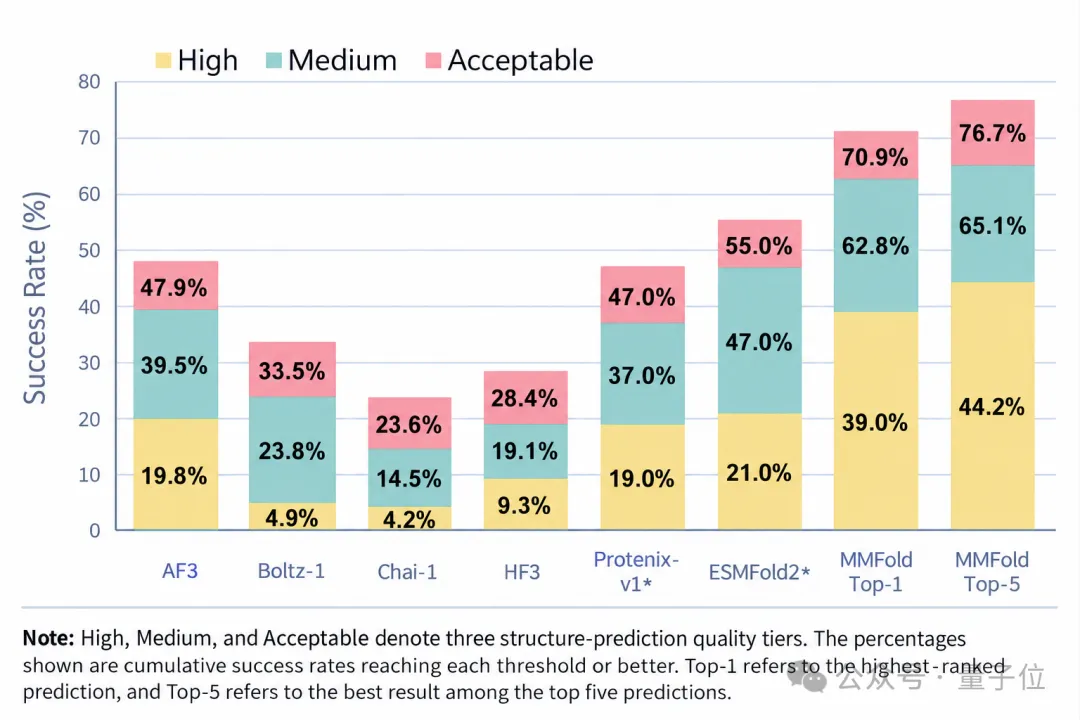 △ Structure prediction results on all 172 antibody-antigen interfaces in FoldBench
On the shared subset of 160 interfaces evaluated against publicly reported benchmarks for OpenDDE and Protenix-v2, MMFold achieved a Top-1 high-quality success rate of 39.4%, outperforming OpenDDE (33.0%) and Protenix-v2 (28.2%). Its Top-5 high-quality success rate further increased to 45.0%, with an overall success rate of 78.8%.
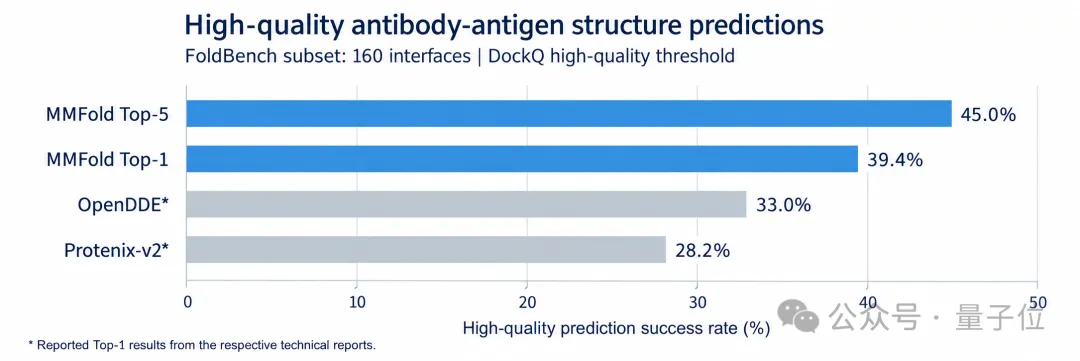 △ Structure prediction results on the shared subset of 160 interfaces in FoldBench
The value of high-precision structure prediction extends far beyond benchmark leaderboards; it provides a rigorous, physically grounded basis for virtual screening and candidate prioritization. Only by accurately resolving complex structures can algorithms pinpoint the most promising molecules within vast computational search spaces.
Powering MMDesign is MoleculeMind’s integrated AI technology infrastructure stack spanning protein generation, structure prediction, molecular design, and molecular dynamics simulation:
The multimodal protein foundation model NewOrigin (Darwin) provides foundational representation capabilities; MMDesign orchestrates de novo generation and candidate triage; MMFold focuses on precision structure prediction; QuantaMind performs dynamic simulations; and MoleculeOS, an AI-native R&D operating system, seamlessly integrates algorithmic models into drug discovery pipelines—forging a complete closed-loop ecosystem of “generation–computation–experimentation–iteration.”
From “Isolated Hits” to “Reliable Reproducibility”: AI Molecular Design Enters Industrial Deployment
Jinbo Xu, founder of MoleculeMind, remarked:
“The true significance of this expanded evaluation lies in transforming one-off design successes into a reproducible, scalable R&D capability. The long-term value of AI in biologics discovery goes beyond performance breakthroughs in individual models; it hinges on the seamless synergy between proprietary foundation models, generative design, computational evaluation, and wet-lab validation—establishing precision molecular design as a durable technological infrastructure capable of tackling diverse R&D challenges.”
From isolated hits to systematic multi-target, cross-modality validation, and from core algorithmic advances to industrialized R&D workflows, MMDesign’s latest report elevates the industry’s central question from “Can AI design molecules?” to “Can AI reliably deliver high-quality, reproducible lead molecules?”
By uniting design efficiency (lean candidate pools with high hit rates), molecular quality (high affinity coupled with drug-like developability), and template-free innovation against challenging targets, the platform cements a solid foundation for industrial reproducibility—propelling AI molecular design into a true productivity engine for complex drug discovery.
- MoleculeMind MMDesign Technical Report: https://zenodo.org/records/23321531