
Making Infrastructure a Permanent Buff
Heng Yu reports from the Office
QbitAI Report
When will embodied AI have its “ChatGPT moment”?
Perhaps it will be the moment everyone sees GPT-6 Astra command a robot across domains with just a single line of API code.
OpenAI remains formidable, taking the lead in proving to the world that AI’s general capabilities are not only astonishing, but still far from their ceiling.
The good news: the algorithmic “engine” performs beyond everyone’s imagination, and AI models continue to ride in a speeding supercar.
The bad news: the engineering infrastructure tasked with translating instructions into physical actions is still a bumpy, muddy dirt road…
The more capable models become, the more urgently we need reliable, full-featured embodied infrastructure to seamlessly catch every breakthrough in frontier algorithms.

Recently, LimX Dynamics updated the second version of the technical report for its open-source engineering infrastructure, FluxVLA Engine.
Compared to the initial release in September, V2 incorporates online reinforcement learning (Online RL) post-training experiments and significantly broadens its coverage across simulation benchmarks and real-robot deployments.
The report highlights:
- On the simulation side, 14 policies were integrated into a unified LIBERO closed-loop evaluation; on RoboCasa GR-1, RoboTwin, and RoboDojo, 8 policies each were integrated and evaluated.
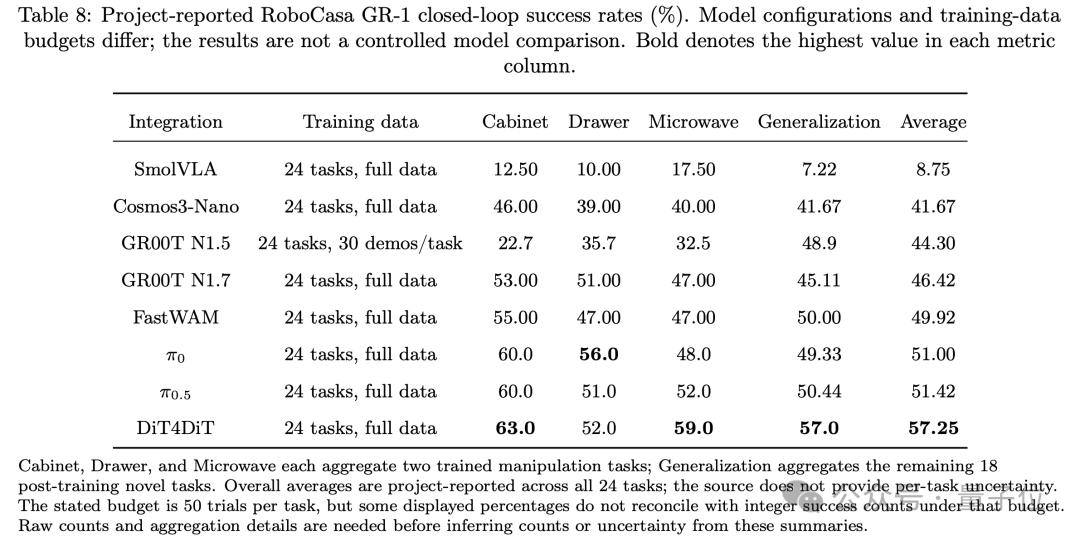
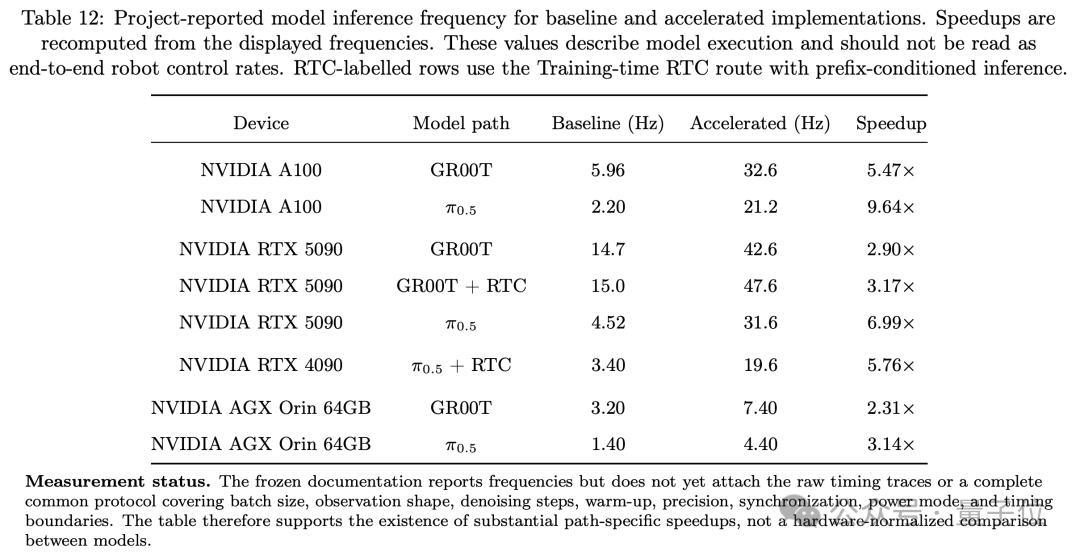
- On the inference side, empirical benchmarks across 8 model-and-hardware configurations demonstrate that the optimized models achieved 2.31× to 9.64× improvements in inference frequency.
- On the hardware adaptation side, covering diverse physical hardware platforms including ALOHA, Rebot, dual-arm Franka, and LimX Dynamics’ proprietary full-sized humanoid robot, LimX Oli, the report thoroughly validates the entire deployment pipeline from model checkpoint directly to real-world closed-loop execution.
Online reinforcement learning is also a primary highlight of this update.
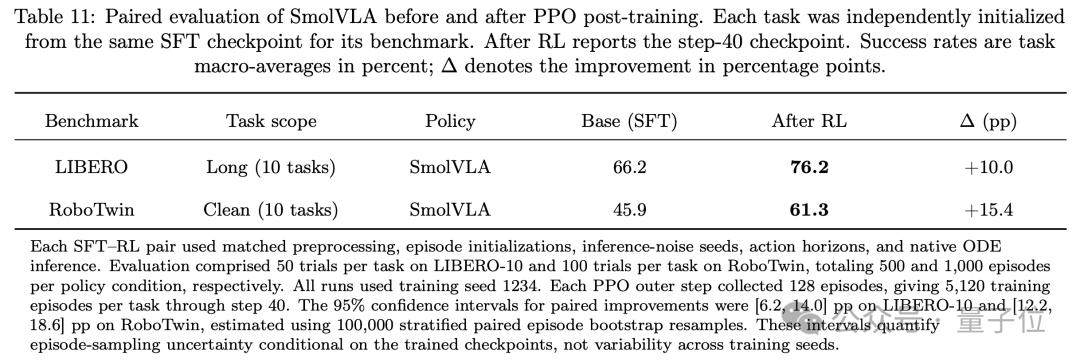
Taking SmolVLA as an example, across two paired experiments, online RL post-training boosted its success rates on LIBERO-10 and RoboTwin Clean (across 10 tasks) by 10.0 and 15.4 percentage points, respectively.
Since being open-sourced on April 8 this year, FluxVLA Engine has continuously expanded its model support, evaluation recipes, and real-robot deployment capabilities.
In LimX Dynamics’ own words, the core value of FluxVLA Engine lies in: making underlying engineering capabilities truly reusable, freeing valuable R&D talent from the endless grind of “configuring environments and modifying interfaces,” and paving a clear, solid path for advanced models to land in the physical world.
Moving Beyond “Workshop-Style” Wheel Reinvention: Building a “Standard Assembly Line” for Embodied R&D
Why is embodied AI R&D so costly in both capital and human labor?
A major reason is the industry’s severe lack of standardized components. For most R&D teams, almost every new experiment feels like a one-off “siloed project.”
The primary objective of FluxVLA Engine is to upgrade this workshop-style, repetitive scaffolding into a standardized industrial assembly line—Wei Zhang, Founder and CEO of LimX Dynamics, likens FluxVLA Engine to an assembly line for embodied models.
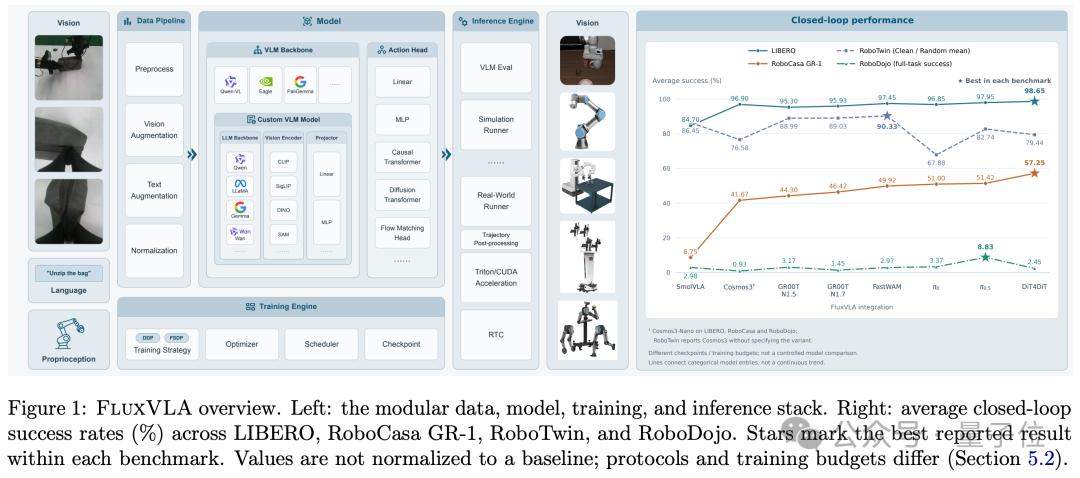
To ensure this pipeline is sufficiently robust and practical, the team designed the underlying architecture around four core engineering principles:
- Unified Configuration (All-in-One): Say goodbye to messy, redundant launch scripts. A unified configuration manifest manages key parameters across data, models, training, evaluation, and deployment.
- Decoupled Modularity: Using registry mechanisms and standardized interfaces, vision-language backbones, action heads, datasets, and training strategies are modularized into standard building blocks, supporting both flexible composition and native policy implementations.
- Deployment-Oriented System Optimization: Moving beyond ideal laboratory setups, inference acceleration, RTC (real-time action chunk coordination), and trajectory post-processing are seamlessly integrated into the runtime pipeline from day one.
- End-to-End Experiment Reproducibility: Configurations, model checkpoints, and execution trajectories for every experiment are completely preserved, ensuring that successes can be traced and failures can be diagnosed.
What is particularly notable is that since its open-source release in April this year, FluxVLA Engine has maintained a rapid pace of evolution and active maintenance.
A look back at its fast-paced iteration over the past six months demonstrates its strong engineering vitality:
- April 8: FluxVLA Engine officially open-sourced
- June 22: Established the minimal inference pipeline for whole-body mobile manipulation on the LimX Oli humanoid robot
- June 30: Added support for real-robot inference on single- and dual-arm Franka setups
- September 9: Integrated GR00T N1.7
- September 16: Published the first technical report on arXiv
- October 15: Expanded evaluation support for RoboDojo
- October 22: Released the V2 technical report, adding online RL post-training, alongside extended simulation and real-robot evaluations
Technical Report:
https://arxiv.org/abs/2609.17210
GitHub:
https://github.com/FluxVLA/FluxVLA
Hugging Face:
https://huggingface.co/limxdynamics/FluxVLAEngine
Powered by this steady track record of iterations, the platform’s capabilities have expanded from merely “trainable and evaluable” to now being “deployable on real robots with closed-loop data feedback.”
For R&D teams, adopting FluxVLA Engine is like having a dedicated engineering vanguard behind them, constantly upgrading infrastructure and pushing boundaries forward.
Bridging the Full Pipeline: How One Engine Unifies Training, Evaluation, and Deployment
Currently, technical roadmaps in embodied AI are undergoing intense turbulence before reaching convergence.
Diffusion policies may dominate today, only to be supplanted tomorrow by flow matching or world action models. If every architectural pivot requires tearing down and rebuilding existing engineering assets from scratch, even industry giants will suffer severe setbacks.
The only way to avoid the “start-over-with-every-new-model” dilemma is to completely decouple low-level engineering infrastructure from high-level algorithms.
In other words, the industry urgently needs an engineering foundation capable of adapting to any change while staying consistent.
FluxVLA Engine is precisely such an open-source platform: it unifies the entire “training, evaluation, and deployment” pipeline, ensuring that a team’s accumulated engineering work is never wiped out.
Its concrete implementation can be analyzed across three core dimensions:
1. Standardization at the Data and Model Levels
To run models with disparate features and architectures on the same assembly line, the primary prerequisite is standardizing underlying data formats and interface protocols.
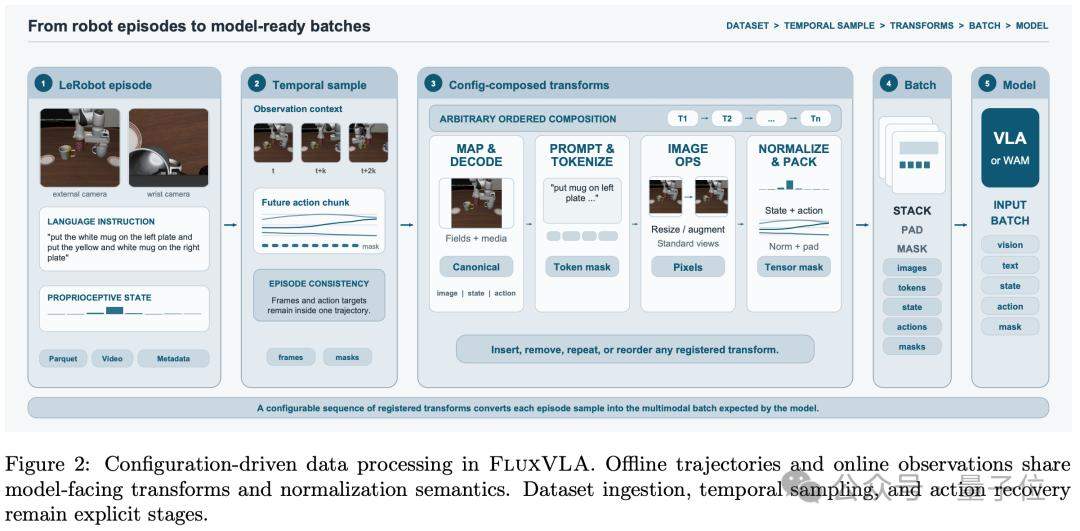
At the data level, raw trajectories collected from diverse robot embodiments and simulation environments undergo explicit conversion and standardized cleaning, organized into a unified structure compatible with the LeRobot specification (including Parquet files, video sequences, and corresponding metadata).
At the same time, technical conventions such as camera view ordering, action representations, and normalization statistics are rigorously aligned.
Once processed, this data can either be co-trained within a single pipeline or retain independent preprocessing and normalization rules by group. Whether in training or inference, the system adheres to unified model inputs and action semantics via dedicated data entry points.
In embodied AI R&D, data is the most expensive core asset; mitigating data depreciation risks and boosting reuse efficiency are themselves high-value, industry-wide cost-reduction measures.
The same philosophy extends across the model level.
The platform currently features deep integration with mainstream VLM, VLA, and WAM architectures, including Qwen-VL, GR00T, the π series, and DreamZero.
Different model types can not only preserve their native network backbones, but also seamlessly plug into training, evaluation, and physical deployment via standardized interfaces.
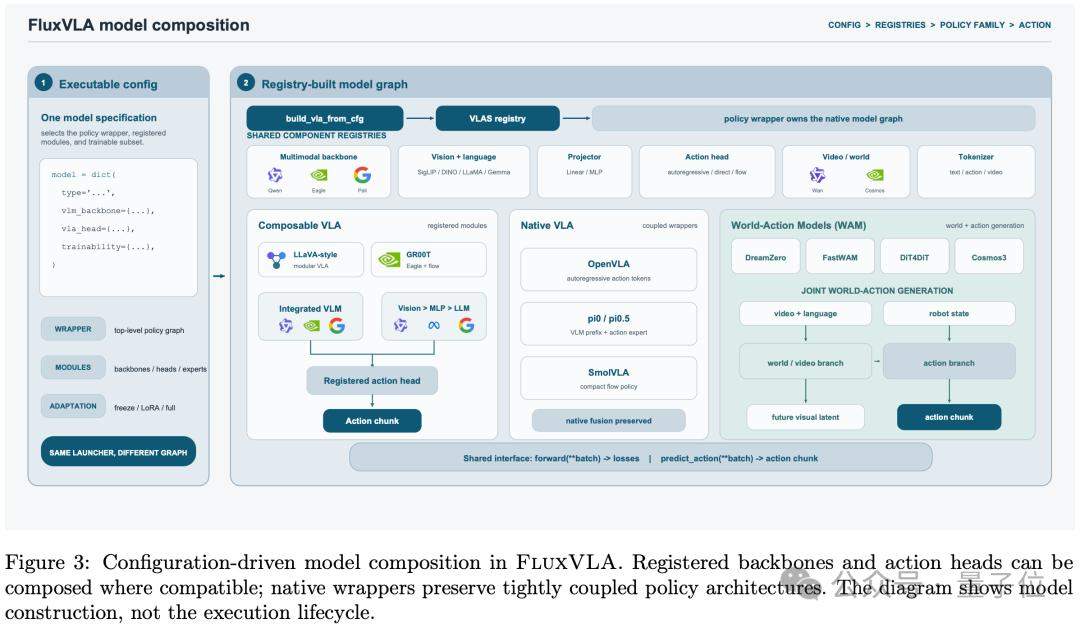
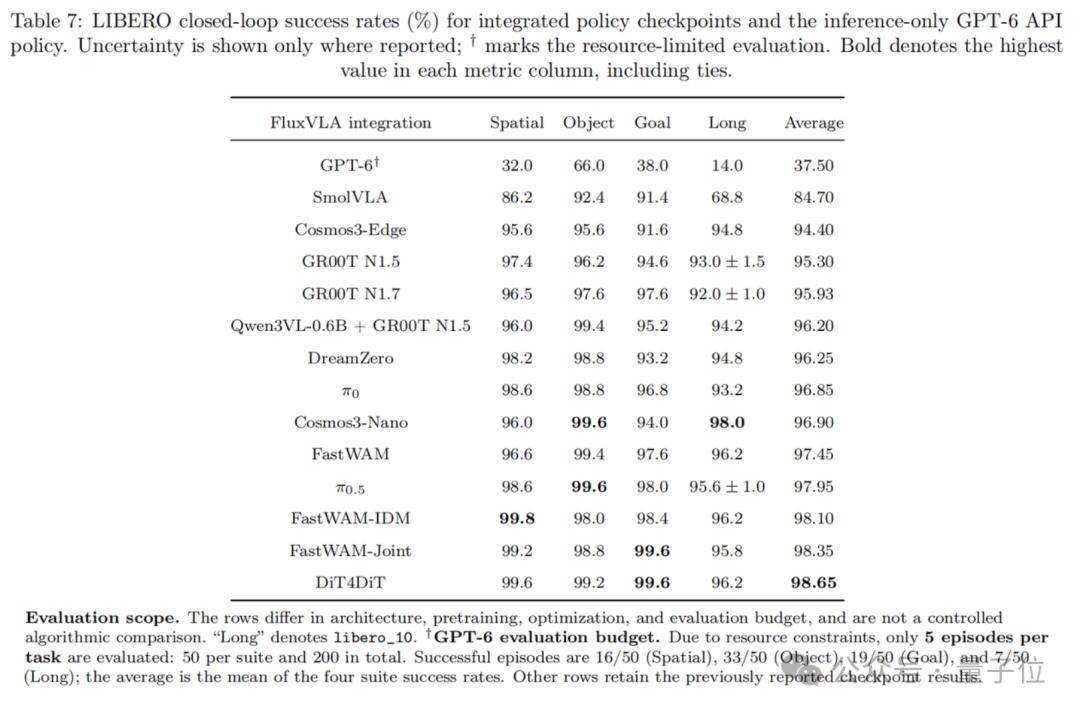
The side-by-side benchmarking of 14 policies showcased in the report is direct proof of this universal decoupling capability.
These 14 policies span virtually all current mainstream paradigms: compact VLAs, flow matching policies, modular VLM + action heads, world action models, and even cloud-based API-accessible models requiring no local weights like GPT-6 Astra, along with recently added support for MiniMax-M3.1-Flash.

Under the benchmark settings in the report, 11 of the 13 local checkpoint policies achieved an average success rate exceeding 95% on LIBERO (e.g., DiT4DiT reached 98.65% and π0.5 reached 97.95%).
This means that when a new model is dropped in the industry, while other teams are spending all night troubleshooting environments and converting data formats, teams leveraging a standardized infrastructure can immediately jump into downstream development.
2. Empowered by Online Reinforcement Learning (Online RL)
Models trained solely via imitation learning through supervised fine-tuning (SFT) resemble students who memorize practice questions by rote—they quickly falter when encountering unseen perturbations and unexpected edge cases.
To endow models with true robustness and generalization, they must engage in closed-loop trial and error within environments, which calls for online reinforcement learning.
However, online RL requires tight coordination among environment interaction sampling, policy updates, and distributed cluster training. This causes engineering complexity to skyrocket, posing an insurmountable hurdle for many teams.
FluxVLA Engine offers an efficient engineering solution: by deeply integrating RLinf, FluxVLA Engine enables compatible flow matching policies to plug and play directly into online interactive training workflows, eliminating the heavy overhead of repeatedly adapting models and data pipelines.
In paired simulation experiments, all tasks across benchmarks originated from the same SmolVLA SFT checkpoint before undergoing task-specific PPO post-training.
After 40 outer-loop iterations, the average task success rate on LIBERO-10 surged from 66.2% to 76.2%, and on RoboTwin Clean across 10 tasks, it climbed from 45.9% to 61.3%—marking substantial gains of 10.0 and 15.4 percentage points, respectively.
This demonstrates that the platform has successfully built an engineering fast track from an “imitation learning baseline” to “online interactive performance boosts”—even lightweight, smaller-parameter models can unlock remarkable action capabilities through high-quality closed-loop exploration.
3. Microscope-Level Fine-Grained Evaluation
Traditional evaluation mechanisms often lack transparency: engineers cannot observe the model’s exact bottlenecks during execution, and the system typically returns nothing more than a cold, scalar success rate.
The V2 report substantially broadens both the breadth and depth of simulation evaluations:
- RoboTwin added support for 8 policies, providing benchmark data under both Clean and Random (randomly perturbed) environments;
- RoboDojo conducted a “comprehensive health check” on 8 policies spanning 42 tasks and up to 2,100 trials per model.
The former contrasts performance between the two conditions to clearly illustrate how well models adapt to environmental variations. The latter not only records overall task completion, but tracks phase-by-phase progress bars throughout, plotting multi-dimensional capability radar charts across five dimensions: generalization, memory, precision, long-horizon planning, and open-instruction following.
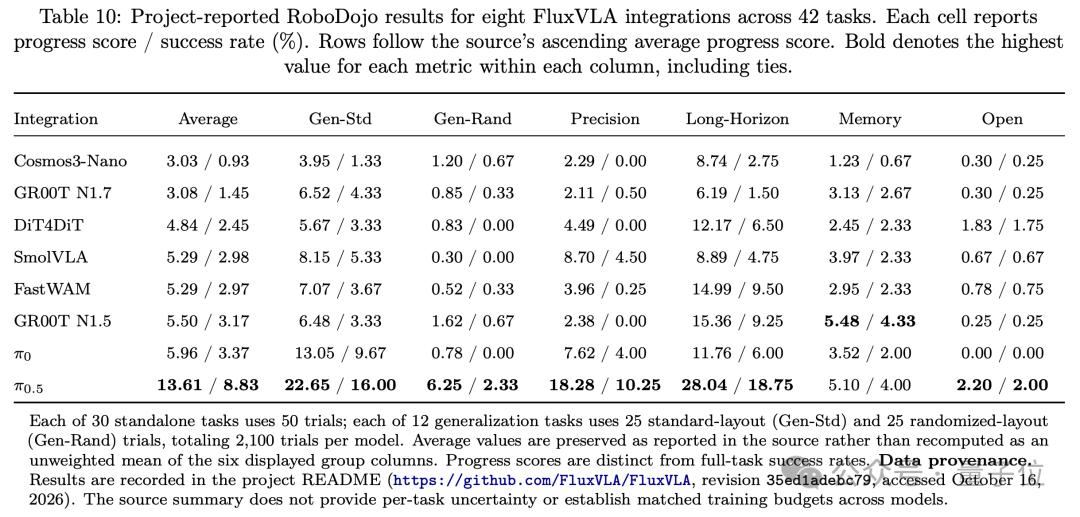
Such fine-grained evaluations dramatically improve the efficiency of debugging.
For example, in folding clothes or picking up blocks, a failure might occur after the model has executed the first three stages flawlessly, jittering only during the final “place in box” step.
By analyzing “phase progress” alongside the “final success rate,” teams can quickly pinpoint the root cause: whether perception failed in visual recognition, planning stalled in long-horizon reasoning, or execution lacked fine-grained control.
Evaluation without causal attribution is no different from blindly tuning black boxes. This traceable, pinpoint-accurate evaluation framework helps engineering teams apply targeted remedies, avoiding the wasteful treadmill of blindly hoarding data and burning compute on dead ends.
Crossing the Chasm: From “High Sim Scores” to “Real-Robot Work”
The sim-to-real gap has long been a primary bottleneck in deploying embodied AI.
Embodied models typically adopt action chunking (predicting a sequence of actions at once), which are then executed sequentially by the robot. During this process, neural network inference takes non-trivial time, while the robot’s low-level hardware control loops must maintain high-frequency, real-time operation.
If the next chunk of actions is generated before the previous one finishes executing, phase misalignment and stuttering can easily occur between consecutive chunks. Moreover, even when model outputs are numerically sound, they must strictly comply with physical constraints on joint velocities, accelerations, and trajectory smoothness imposed by the hardware.

To eliminate stutter and jitter during real-world deployment, FluxVLA Engine builds a highly reliable systems engineering solution:
Tactic 1: Deep Kernel Acceleration Boosting Inference Throughput up to 9.64×
Without modifying model weights, FluxVLA Engine deeply reconstructs low-level inference pipelines for models such as GR00T and π0.5, slashing redundant GPU memory copies and operator scheduling overhead to the absolute minimum.
Across the 8 model-hardware configurations tested, system-level optimizations consistently boosted inference frequencies by 2.31× to 9.64×:
- On NVIDIA A100: π0.5’s inference frequency jumped from 2.20 Hz to 21.2 Hz, achieving a 9.64× speedup;
- On the AGX Orin edge platform (64GB): GR00T increased from 3.20 Hz to 7.40 Hz, while π0.5 rose from 1.40 Hz to 4.40 Hz.
Crucially, this acceleration maintains extreme fidelity:
Numerical alignment validation on the GR00T action head shows that accelerated action outputs have a cosine similarity exceeding 0.99999 with original floating-point results, with a maximum absolute error of only ~0.02.
By unlocking compute potential purely through systems engineering, model accuracy is preserved losslessly without requiring additional hardware investments.
Tactic 2: Action Buffer “Shock Absorption” for Seamless Command Stitching
Beyond computational inference efficiency, temporal continuity at the execution level is equally vital.
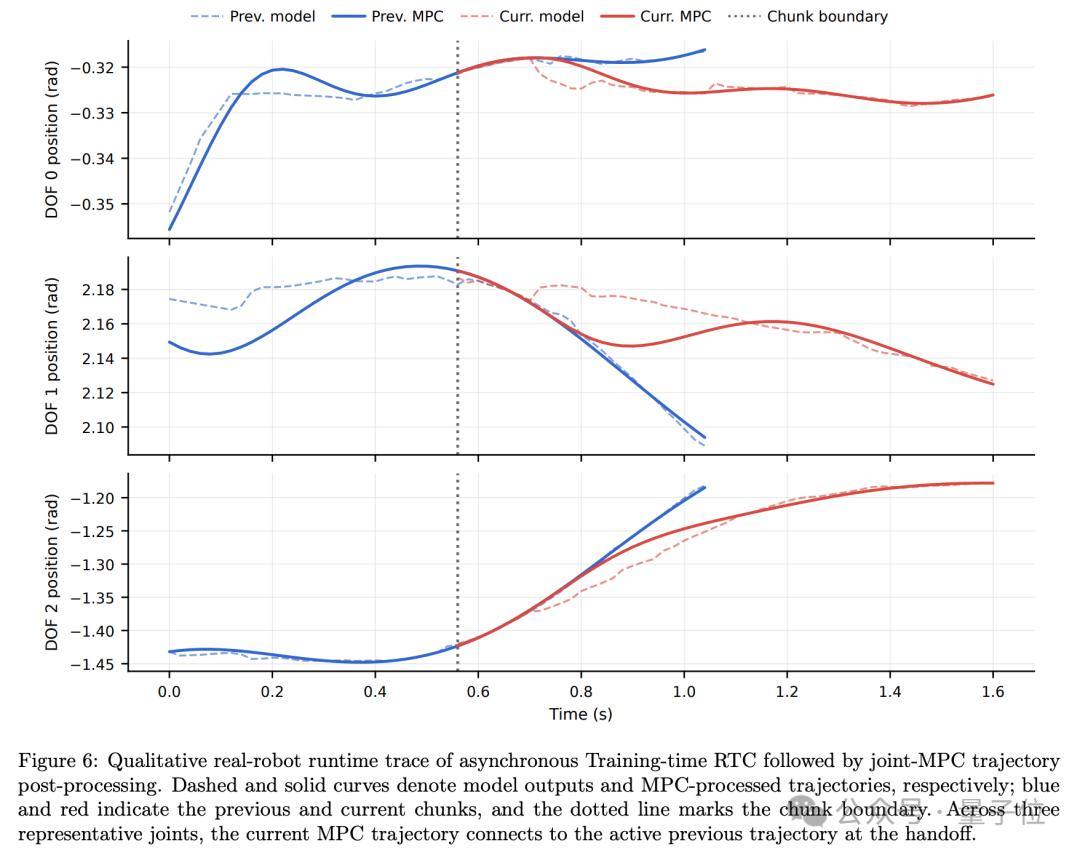
FluxVLA Engine introduces a Real-Time Chunking (RTC) mechanism. Its core logic is to use the terminal state of the currently executing action chunk to dynamically constrain the starting segment of the newly predicted trajectory. Like a zipper, it smoothly stitches together action chunks across different inference cycles, eliminating hardware shocks caused by abrupt transitions.
Subsequently, a trajectory post-processing module applies kinematic filtering and smoothness constraints, ensuring that every command dispatched to the servo motors falls strictly within physical limits and remains smooth.
Inference acceleration tackles generation latency, while RTC and post-processing resolve the spatio-temporal mismatch between prediction and execution. Together, they dramatically lower the engineering barrier to adapting algorithms to hardware, protect costly robotic hardware, and endow the robot’s physical motions with human-like smoothness and coordination.
Tactic 3: “Universal Socket” Cross-Embodiment Transfer for Closed-Loop Real-World Data
In real-robot deployment, FluxVLA Engine adopts a cleanly decoupled two-layer architecture: the Runner, responsible for high-level policy scheduling, and the Operator, responsible for low-level driver interfacing.
Specifically, the Runner focuses on model inference management, action dispatch queues, and end-to-end state machine operations; the Operator handles low-level sensor data acquisition, industrial fieldbus protocol parsing, and the dispatch of low-level control commands. Operating independently yet collaboratively, the two establish a standardized engineering pathway for transferring policies across diverse robot embodiments and closing the loop on real-world data feedback.