
The Future of the Firm | OpenAI
The Intelligence Age
How AI will enter the org chart—beneath us, beside us, and between us.
By Hemanth Asirvatham and Elliott Mokski
Authors’ note: This is the second piece in our series on the Next Economy, part of a new platform bringing together independent voices exploring the future of AGI. The views expressed here are solely our own and do not represent the positions of OpenAI or our colleagues.
Both of us were just 24 when we started managing our own teams at OpenAI. Then again, once you see who’s on our teams, you probably won’t find it all that impressive.
By all conventional rules, we should have been grunts. At 24, you’re supposed to be at the bottom of the corporate ladder, taking meeting notes and drafting the occasional memo. Only after years of grinding through the daily mundane chores are you (hopefully) granted broader scope.
But the path we took—and the trajectory of many young people today—is shifting. We entered the workforce with “employees” already at our beck and call. These direct reports work around the clock, with no regard for weekends or holidays. They excel at all kinds of grunt work, and we even have International Math Olympiad gold medalist-level experts on call to consult. These new subordinates still make mistakes, but they are getting smarter by the day, learning our preferences while we learn how to manage them.
Neither of us clawed our way up the traditional corporate ladder; instead, management responsibilities came down to meet us where we stood. This essay explores our experience of this shift, as well as the other ways firms may reorganize as we cross into the Intelligence Age.
When AI enters a company, where does it land? We see three archetype scenarios:
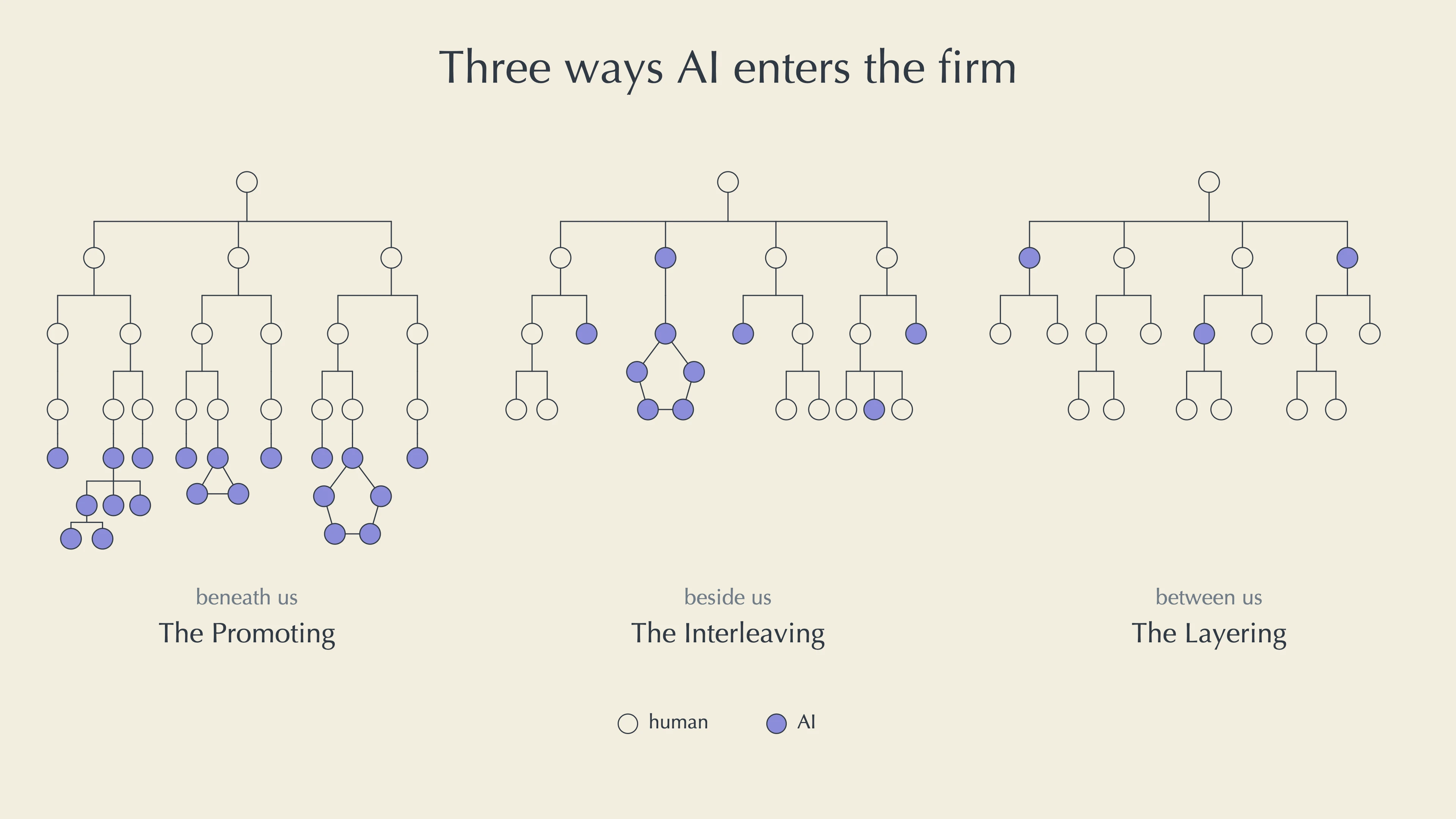
Beneath us. Everyone stays in their current seat, while a brand-new “basement” of AI labor emerges underneath. All of us become managers. We start with assistants, graduate to chiefs of staff, and ultimately have an entire micro-company reporting to each of us. Everyone gets a promotion.
Beside us. AI is slotted directly into the org chart as a kind of “coworker” alongside humans, reporting directly to existing human managers and executives. At first, it only takes over specific tasks or disjointed roles; over time, it absorbs broader functions and climbs higher up the reporting chain.
Between us. This is the most counterintuitive dynamic: humans at the top, humans at the bottom, and AI in the middle. It coordinates and monitors work, executing the executives’ vision while identifying and recognizing the unique contributions of enterprising employees.
Reality will rarely fit neatly into any single model, but we believe facets of all three scenarios will play out. In fact, all three are already unfolding in subtle ways today.
We are not focused here on outright, total automation, but rather on the transitional economy. We are interested in what these “chimeric firms” will look like as AI continues to improve and deeply integrates into existing organizations.
In our view, hybrid firms are conceptually vital because translating AI into tangible productivity gains doesn’t happen overnight. When models can only handle subsets of tasks, frontline workers closest to the work find it easiest to adopt. But once models can shoulder broad business functions end-to-end, senior leadership can deploy them directly. As we see it, more capable AI is actually easier to adopt: where companies once had to learn the technology, the labor itself is now learning the company—even onboarding itself.
In the sections that follow, we unpack each of these three emerging organizational architectures, then examine what they mean for the future of red tape, worker agency, firm size, and the compensation gap.
The Promoting
The first scenario appears the least disruptive. Here, workers remain in their original seats, keep their existing reporting lines, and superficially do the same jobs they have always done. On paper, today’s org chart looks indistinguishable from this future one.
The real shift happens underneath us. Below every individual contributor (IC), a new workforce of AI labor reports directly to each of us. A “basement” is added beneath our org chart, and all of us become managers.
At first, this basement is fairly rudimentary. Each of us has only one or two agents at our disposal. Rather than seasoned veterans, they feel more like eager yet clumsy interns, requiring constant supervision and endless course-correction. Our expectations are modest: send an email here, draft a memo there, answer a Slack message in between. Just like junior human hires, their initial autonomy and trust are strictly constrained.
But as models continue to evolve, our agents take on more tasks with far less human intervention. They begin to collaborate with one another. You might have managerial AIs and worker AIs, accountants and legal specialists, all working in concert at your command. By this stage, you are no longer hand-holding an intern; your entire workflow has evolved into a veritable small company with its own org chart—and you sit on the board of this micro-firm.
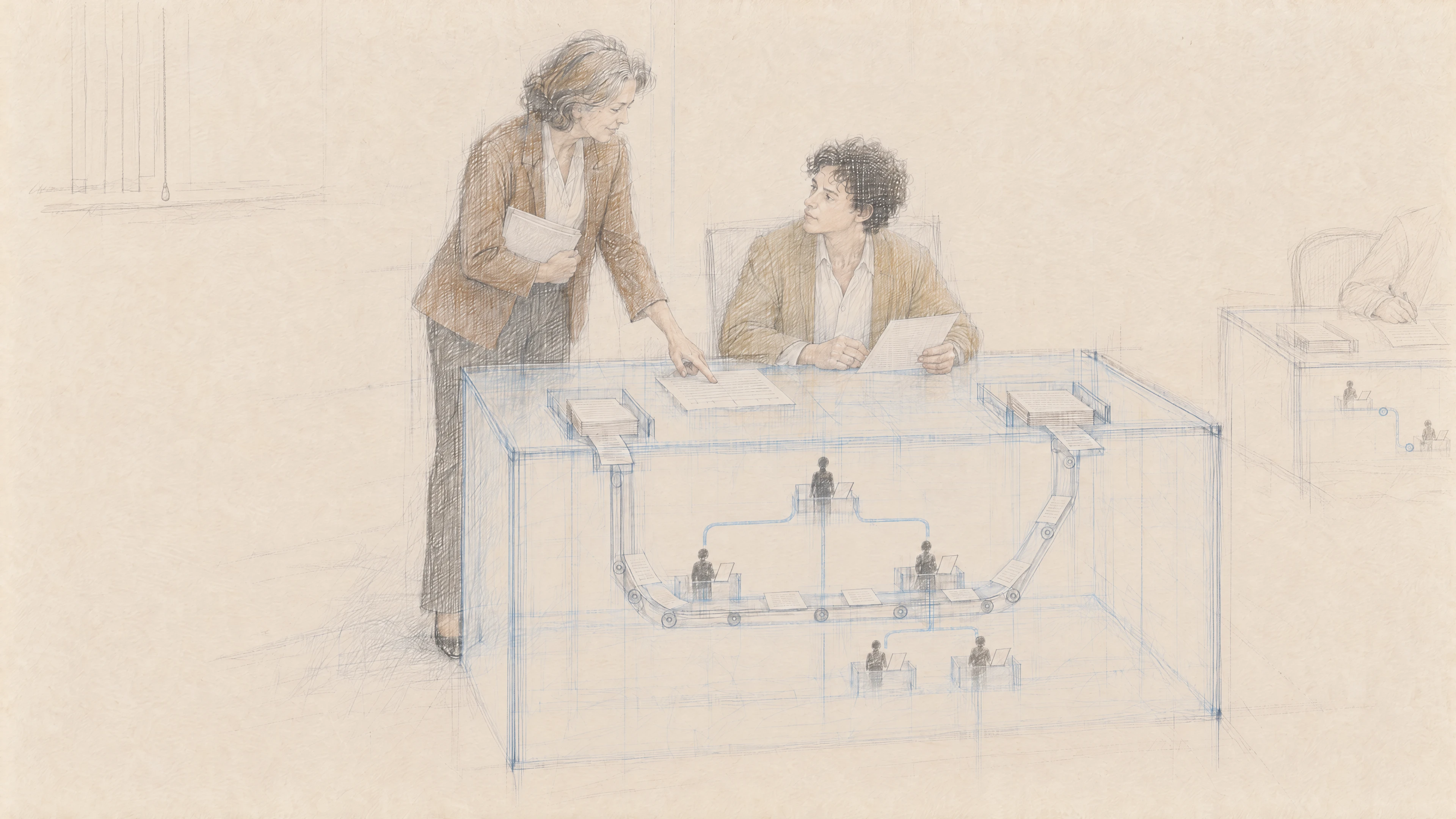
Jace still handles accounting for the company, but he no longer spends his days clicking around spreadsheets. Those mundane tasks are now handled by his agent direct reports. Jace’s day-to-day looks much more like what his manager did a few years ago. And his manager, in turn, now oversees a vastly expanded scope.
Jace’s daily routine has changed completely; it now centers on communication, coordination, and creativity. He works fewer hours, yet finds the work far more challenging. His career has unlocked broader horizons, allowing him to stand out through leadership and vision that previously had no outlet.
The accounting team hasn’t shrunk, because…