
Latent Space Podcast
Paul Copplestone and Ant Wilson on Building Backends for AI Agents
swyx
Oct 28 · 77 min
I first met Paul Copplestone and Ant Wilson in Singapore, right after they graduated from Y Combinator as the breakout startup of YC S20. Six years later, we finally got them on the podcast! This is their first joint podcast appearance after scaling an open-source, fully remote company from scratch to a $10B valuation.
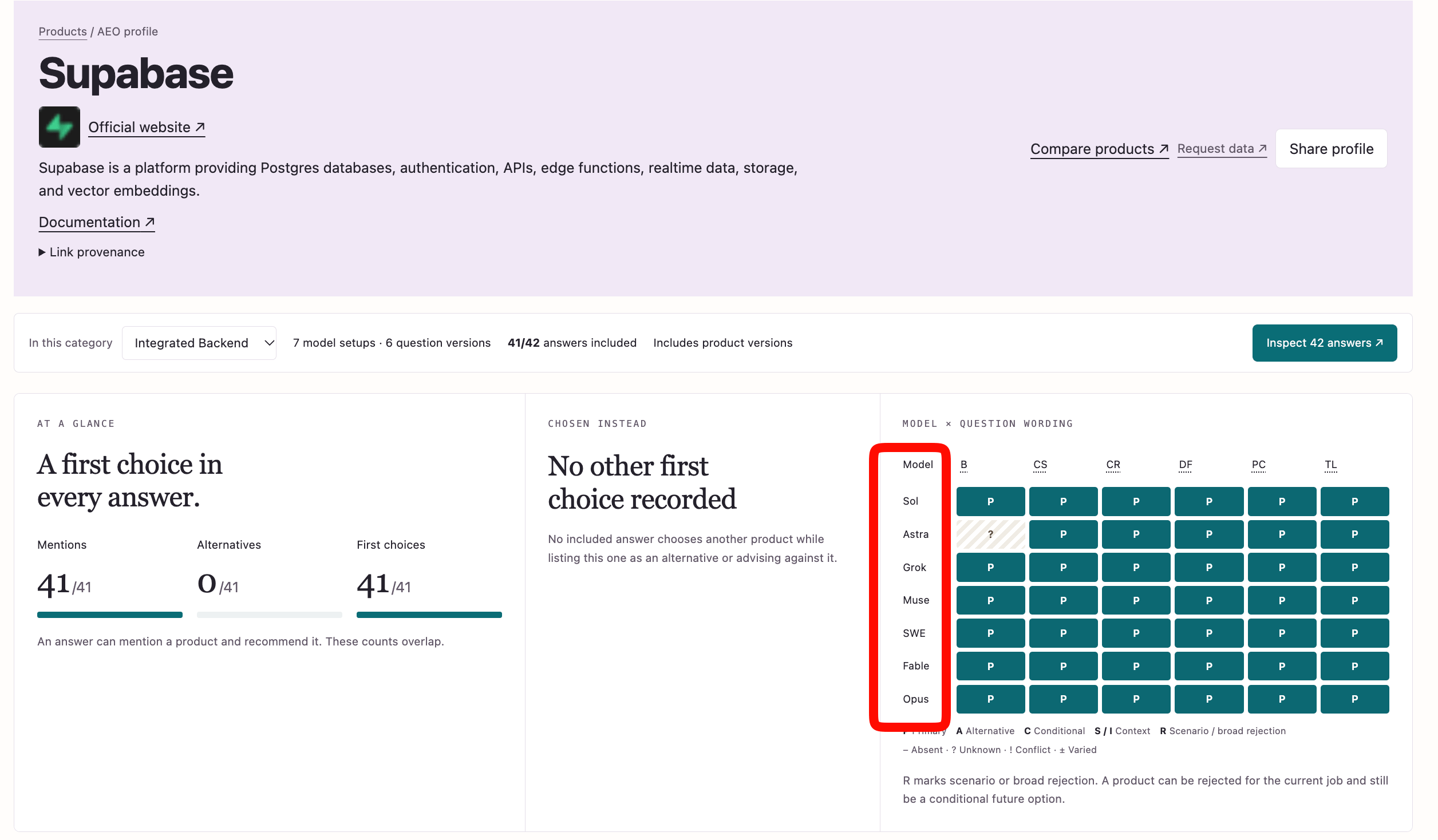
The title of this episode is a question I’ve been trying to answer myself: Why do agents love Supabase so much? There’s no shortage of managed databases today, and the hosted Postgres landscape is fiercely competitive. Being familiar to models certainly helps with distribution, but it doesn’t fully explain all the heavy lifting required to turn generated application code into a truly working program. Yet, when I run my frontier AEO tracker, virtually every frontier model—from Astra to Fable to Muse—overwhelmingly ranks Supabase as the top pick for app backends (as well as a leading contender for managed databases).
At the Select conference, Supabase grouped its announcements into three pillars: Build, Operate, and Scale.
The features that caught my attention the most were surprisingly practical: spinning up a local backend without Docker, maintaining the desired database schema in Git, and running compute right next to the database. Each one eliminates tedious chores developers have had to deal with for years. And with the rise of agents, these frictions have become impossible to ignore.
Watch the full conversation with my opening commentary →
Giving Agents a Readable Backend
My favorite devtool launches are the ones that make me think: this is exactly what I’ve been wishing for. The new alpha runtime for running Supabase locally without Docker is one of those. I personally use Colima instead of Docker Desktop, but even so, removing a dependency on the path to a working database is a huge win. For human developers, local environment setup is just a tiny fraction of the weekly workflow; but for an agent that needs to spin up and test environments repeatedly, this friction compounds hundreds or thousands of times.
Declarative schemas represent an even more forward-looking philosophy. The SQL workflows we’re used to accumulate history over time: create a schema, then run migration after migration. Declarative representations, on the other hand, provide agents with a description of the desired end state as files that they can inspect and modify right alongside application code.
In my commentary, I compared this to a “Terraform moment” for databases. Keeping the desired state in Git means an agent can read, modify, fork, and work with it as just another part of the repo. Human developers benefit just as much: the backend becomes far easier to understand without having to reconstruct the entire history of changes.
This is what I find most satisfying about this “agent-friendly” direction. These are improvements I’ve always wanted as a developer; making them useful for agents just gives teams another reason to finally build them properly.
Compute Shouldn’t Just Be a Bullet Point
I think Supabase Compute, currently in private alpha, might be flying under the radar. An application doesn’t just need a place to store results—it needs a place to run tasks. Even with a database, you still need an execution environment for document chunking, generating embeddings, or handling other long-running workloads.
Paul and Ant discussed running containers right alongside the database. This eliminates the disconnect between bootstrapping an app and actually operating it: there are fewer separate services to configure, connect, and explain to an agent. Edge functions are great, but they can’t handle every type of workload.
The operational layer is equally critical. Logs, health checks, connection details, and context help agents understand what they’re modifying. Even if a model can run SQL, it still needs to know what the database contains, how the app uses that data, and what went wrong when things break. Supabase’s [operations announcements](https://supabase.com/blog/select-2026-operate-with-confidence?utm_source=latent.space&utm_medi