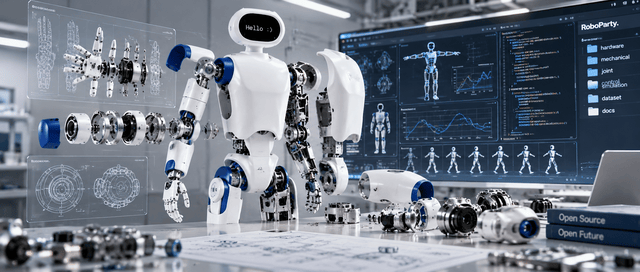
Complete Blueprints of Humanoid Robot Open-Sourced! From Actuators to Algorithms, Download and Build It Yourself
A humanoid robotics company is tearing down the technological black box once and for all.
Open-sourcing a humanoid robot is no small feat. From mechanical structures and electrical systems to joint control and motion algorithms, hardware and software are intricately intertwined. In the past, while some robots claimed to be “open source,” developers often only received an SDK, a handful of APIs, or isolated algorithm snippets.
Want to modify joint control? You have nowhere to start. Want to adjust the mechanical structure? Blueprints are unavailable. Want to deploy custom-trained models onto physical hardware? Low-level interfaces stand in your way.
Now, the open-source movement in humanoid robotics is pushing into the deepest layers of hardware.
The company behind this move is RoboParty. Recently, RoboParty officially unveiled the RP1, a full-stack open-source humanoid robot.
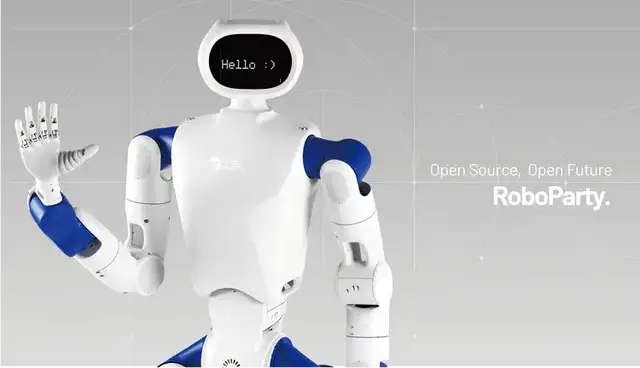
From mechanical drawings, electrical systems, and proprietary joint modules to low-level control, simulation, training, and deployment, RoboParty aims to present the entire R&D pipeline of humanoid robotics—hardware through software—to developers. This is what fundamentally sets “full-stack open source” apart from merely offering an SDK or partial code releases.
Developers can not only invoke existing robot functions directly, but also dive into the lower layers to investigate its underlying locomotion mechanisms, and even rebuild and modify them from scratch.
The motion capabilities of RP1 itself are equally impressive:
Standing at 135 cm tall with configurations ranging from 24 to 30 degrees of freedom (DoF), it flexibly adapts to diverse scenarios including education, scientific research, data collection, touring, and entertainment. Currently, RP1 has demonstrated a robust suite of real-world dynamic motions, such as continuous walking, human motion tracking, push recovery, and rapid fall recovery.

Powering these movements are RoboParty’s proprietary ROMOMO joint modules, along with a comprehensive motion control and training toolchain.
With solid real-world dynamic performance on one hand and low-level technology fully handed over to developers on the other, the possibilities for innovation have vastly expanded. Yet, moving from open-source code to practical deployment still involves several critical milestones.
Humanoid Robots: Why Open Up the Lowest Layers Completely?
Even under the banner of “open source,” the depth of openness across humanoid robotics varies dramatically.
For instance, suppose a research team wants to explore an entirely new gait algorithm. If the manufacturer only exposes high-level APIs, researchers are restricted to issuing basic locomotion commands and tweaking high-level parameters. Once their work touches motor response dynamics, low-level drive control, or joint kinematics and physical structures, they remain entirely beholden to vendor technical support.

If experimental results fall short of expectations, it is exceedingly difficult for researchers to isolate the root cause: Is the policy undertrained? Are the joints lagging in dynamic response? Or is there a dynamics mismatch between the simulation model and the physical robot (the Sim-to-Real Gap)? Layers of technological black boxes make end-to-end diagnosis an uphill battle.
The sincerity of a robot’s “open source” claims hinges on how deep developers are permitted to intervene.
Exposing only an SDK keeps developers at the level of basic API calls. Opening up control algorithms allows them to explore motion generation and execution logic. Opening mechanical CAD files, electrical schematics, joint designs, embedded firmware, and simulation/training toolchains expands the scope of R&D and experimentation exponentially.
This is the core rationale behind RP1’s emphasis on “full-stack open source.”
For research institutions, autonomy in exploration is vital. Algorithms with smooth gaits in simulations and papers can easily lose stability when deployed on physical robots. Subtle discrepancies in joint torque response, fieldbus communication protocols, control loop frequencies, or even mechanical zero-calibration references (the 0° joint datum) can make or break an experiment.

Without access to low-level engineering data, researchers must waste immense effort repeatedly adapting to the hardware platform, leaving many frontier projects throttled by proprietary hardware black boxes.
Embodied AI companies face similar pain points. Today, innovations in Vision-Language-Action (VLA) models, world models, and highly dynamic locomotion policies are surging. Yet while models excel in simulated environments, their real-world deployments often disappoint. For example, a policy planning an obstacle traversal might execute flawlessly in simulation, only to fail on hardware due to actuator latency or dynamic non-linearities. Is the issue rooted in the high-level policy or low-level execution error? Only when sensor telemetry, control loops, and hardware feedback are transparently observable and tunable can engineers accurately diagnose the problem.
Higher education engineering programs are in even more urgent need of deeply open platforms. Conventional teaching is often confined to calling APIs to trigger preset routines. Yet grasping the core principles of modern robotics engineering and control requires far more than surface-level API calls. Only by actively modifying low-level control laws, replacing components, and redesigning mechanical subsystems can education and research yield practical, hands-on insights.
Research labs seek autonomy, embodied AI companies demand rapid iteration, and universities require hands-on practice. These three needs converge on a single goal: making the robotic platform serve research objectives, rather than letting research directions be constrained by vendor-defined boundaries.
RoboParty envisions the RP1 serving as precisely this: an open R&D foundation offering end-to-end autonomy.
From Actuators to Algorithms: How Much Does RP1 Actually Open Source?
In official technical demos, RP1 not only walks, runs, and jumps stably, but—when paired with visual perception—can also perform parkour obstacle clearing, autonomous stair climbing, terrain-adaptive gait planning, rapid self-recovery after falling, real-time human motion tracking, and instant stabilization following severe external disturbances.

Underlying these high-dynamic motions is the precise coordination of hardware and software subsystems.
Take push recovery as an example: the control system must estimate body pose in real time and quickly regenerate motion plans; the joint modules must respond to high-frequency torque commands; and the hip, knee, and parallel ankle mechanisms jointly define the viable envelope for posture recovery. Fall recovery is even more challenging, involving complex full-body contact dynamics: shock absorption across contact points, coordinated bursts of joint torque, and the dynamic shifting of the center of mass (CoM)—every step demands holistic, full-stack co-design.
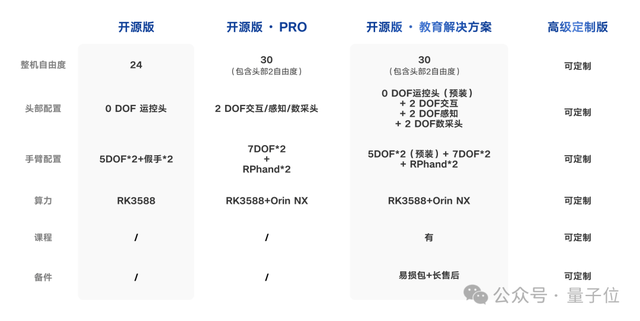
RP1 offers two hardware configurations:
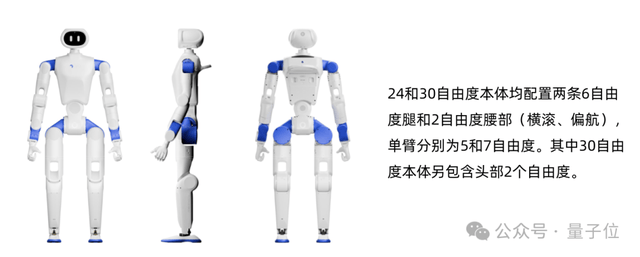
- Open-Source Edition: Features 24 active degrees of freedom (DoF);
- Open-Source Edition Pro: Upgraded to 30 active DoF (including 2 DoF for the head and 7 DoF for each arm), making it well-suited for cutting-edge research in high-DoF bimanual collaborative manipulation.
Furthermore, RP1’s head interaction module and end-effectors support modular customization to adapt to varied operational needs.
At the hardware level, high-performance joint modules serve as the cornerstone of the robot’s powertrain.
RP1 is powered by RoboParty’s proprietary ROMOMO integrated rotary actuators. According to official specs, this series boasts a nominal peak torque range of 25 to 160 N·m, utilizing a standardized 48V power supply and high-bandwidth CAN-FD bus communication.
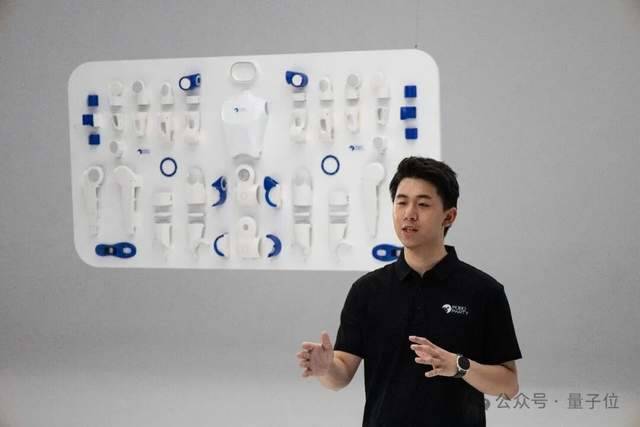
RoboParty founder Yi Huang showcasing core RP1 components
The broad torque span accommodates the distinct mechanical loads across joints: hip and knee joints must support the full body weight and withstand dynamic impacts, demanding extreme torque density; arm and wrist joints prioritize lightweight construction, compact footprints, and high-frequency dynamic response. ROMOMO adopts an inner-rotor brushless motor paired with an NGW planetary reducer, where low rotor inertia ensures rapid dynamic response, while the planetary gearbox balances high torsional stiffness, shock overload tolerance, and cost-effective manufacturing.
The mechanical kinematics have also been carefully engineered.
RP1 employs a non-intersecting hip joint and a parallel ankle joint configuration. In the parallel ankle, dual pushrod actuators differentially couple to drive foot pitch and roll. This design reduces distal moving mass while substantially improving transient load-bearing capacity during foot strike.

In addition, the joint modules utilize standardized clamp collars and internal hollow-shaft cable routing, greatly simplifying maintenance and disassembly while preventing cable entanglement and wear during large-range body movements.
Currently, RP1 has officially open-sourced core assets including its URDF, MJCF, and 3D mesh models. Developers can immediately access the robot’s kinematic chains, dynamic parameters, and link topologies, plugging them seamlessly into mainstream simulators for locomotion control research. Documentation covering joint axis distribution, travel limits, assembly manuals, and electrical system architectures has also been organized and released. Deeper engineering assets—including native CAD files, Bills of Materials (BOM), and PCB design files—will be released in phased rollouts per the repository roadmap.
For low-level software architecture, RP1’s embedded firmware is built on a Hardware Abstraction Layer (HAL) and unified communication interfaces, centrally orchestrating motor actuators, IMUs, and the Battery Management System (BMS).
High-level policies generate joint target setpoints at high frequency, while low-level drivers handle fieldbus communication, closed-loop execution, and real-time streaming of encoder position, velocity, and torque feedback. The software stack operates on a 500 Hz low-level servo control loop and a 50 Hz high-level policy inference loop, allowing developers to investigate the dynamic mapping between high-level policies and electromechanical responses via standardized actuator control interfaces.
For locomotion policy training, RoboParty has concurrently open-sourced hhtools (human-humanoid-tools), a motion retargeting toolkit. This tool accurately maps human kinematic data captured from mocap or vision systems to the robot’s kinematic topology. By accounting for joint limits, ground contacts, and dynamic feasibility constraints, it smooths and optimizes trajectories to produce high-fidelity robot reference motions.
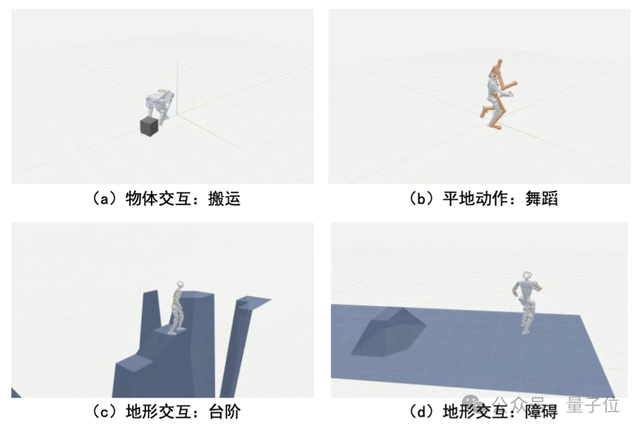
hhtools motion retargeting examples: carrying, dancing, step climbing, and obstacle clearing
The resulting trajectories can be directly fed into reinforcement learning simulation pipelines, trained, fine-tuned with domain randomization, and seamlessly deployed onto the physical robot. This enables developers to participate in the entire closed loop: from motion mapping and simulation policy iteration to real-world hardware validation.
Simultaneously, RoboParty is developing the PartyOS open software foundation.
At present, System0—the core foundation responsible for low-level locomotion control—is partially open-sourced, comprising hhtools, MimicLite, and the UFO project dedicated to high-dynamic self-recovery research. The UFO framework is specifically optimized for push recovery and fall self-recovery, supporting multiple robotic hardware platforms including RP1. Meanwhile, System1 and System2, which handle high-level intent parsing and embodied agent skill orchestration, remain under active development.
To accommodate rigorous physical testing, RP1 features standardized state feedback, sensor telemetry streaming, and motion logging mechanisms, making it easy for developers to evaluate discrepancies between commanded setpoints and physical metrics. In terms of hardware engineering, RP1 supports hot-swappable batteries, modular quick-release mechanisms, and standardized maintenance protocols. It also allows hot-swapping different head sensors, hand effectors, and edge compute carrier boards to match specific research goals, providing robust engineering support for sustained, high-intensity scientific research.

RP1 standard wrist flange interface and three interchangeable end-effectors
Tearing Down Technological Black Boxes: Ecosystem Building Enters a Critical Stage
Technological progress in robotics has long flourished on open-source software. Ecosystems like ROS have eliminated massive amounts of redundant low-level software development. Today, the open-source movement is reaching deeper into mechanical designs, motor drives, and firmware. Core hardware assets once locked down by industry leaders are transforming into shared technical dividends for the entire community.
Prior to RP1, RoboParty introduced the open-source prototype robot RPO, which garnered roughly 2,600 GitHub stars. With the release of RP1, this openness expands into a mature, full-stack robotic system.
RoboParty has structured its technology roadmap around a tripartite framework:
- Open Body: Open-sourcing robot chassis and core component designs, including RPO, RP1, the ROMOMO joint series, and the RP Hand dexterous hand;
- PartyOS: A unified toolchain ecosystem integrating locomotion control, multimodal perceptual interaction, and Whole-Body Control (WBC);
- Developer Ecosystem: Connecting geek developers, academic research institutions, and embodied AI companies to foster collaborative innovation.
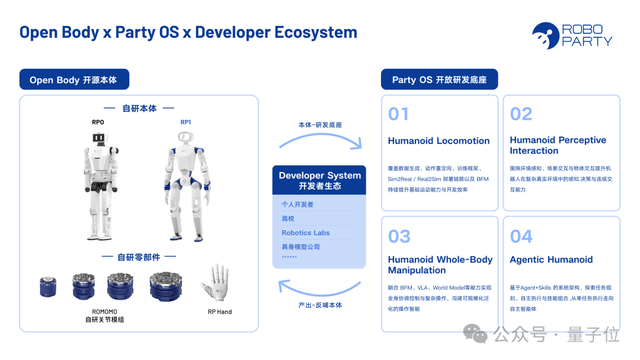
Under this ecosystem, algorithm companies can deploy proprietary embodied control policies directly onto standard RP1 units for physical generalization testing. Meanwhile, hardware and mechatronics researchers can focus on novel actuators or transmission redesigns, validating their feasibility rapidly against an established system architecture. This dramatically cuts the time spent on low-level hardware adaptation and lets teams focus resources directly on their core research challenges.
This is especially vital for the embodied AI sector today. For years, model benchmarking has been hindered by fragmented hardware platforms and disparate dynamic characteristics; identical control policies often produce vastly different outcomes across different physical robots. If the industry can converge on unified hardware benchmarks, training pipelines, and evaluation metrics, the reproducibility and objective comparability of frontier research will improve considerably.
Open-sourcing is only the first step of a long journey.
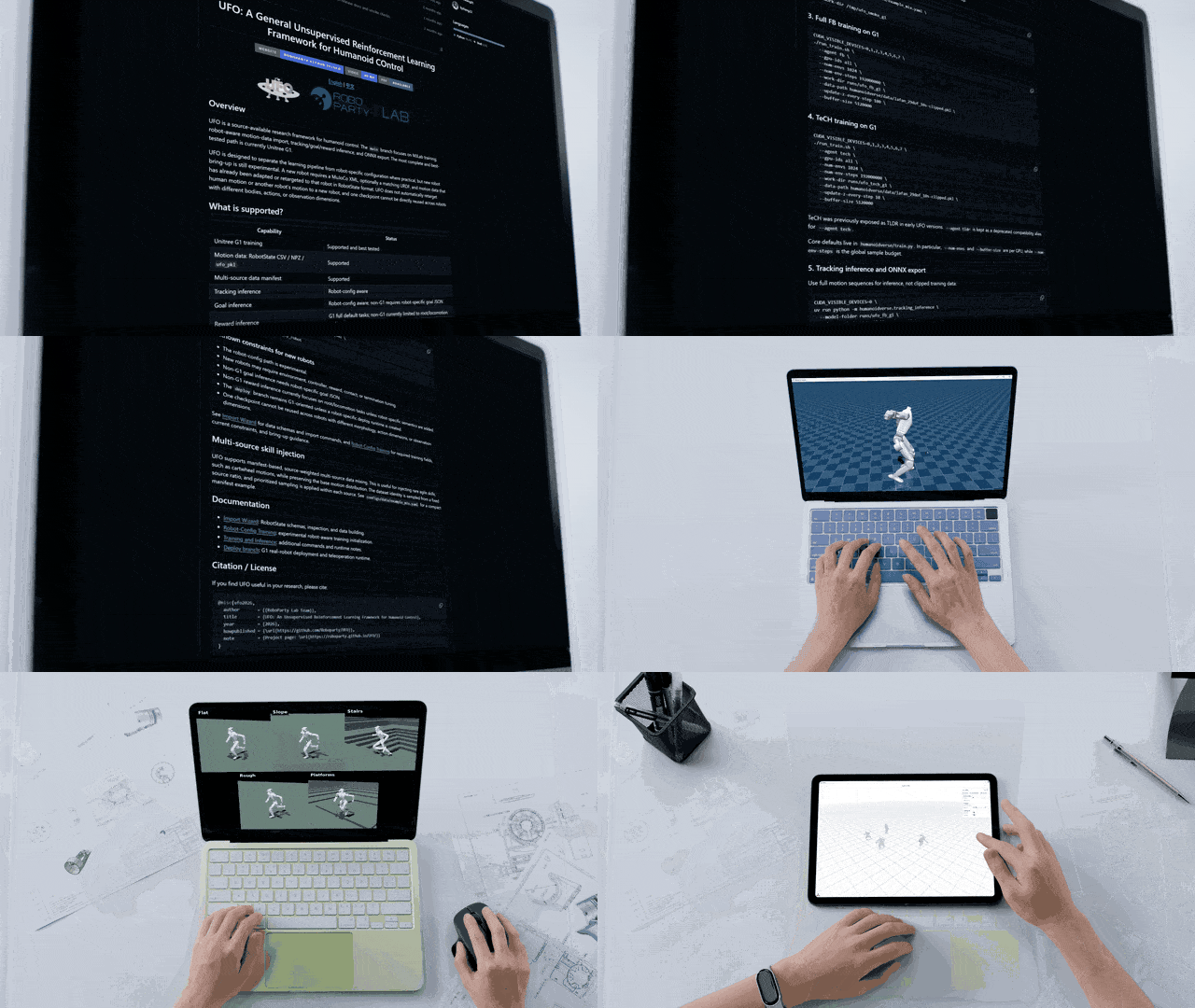
The thoroughness of documentation, repository maintenance cadence, technical support during hardware failures, barriers to replication, and licensing terms governing derivative works and commercialization will all serve as pivotal tests for the platform’s long-term health and vitality.
From RPO to RP1, RoboParty has laid the groundwork for an “Open Body + Toolchain Base + Developer Community” architecture. Whether this sparks a flourishing industrial ecosystem will depend on how deeply industry developers adopt it and how fast high-quality engineering assets accumulate.
Humanoid robotics has always been a capital-intensive, high-barrier hard-tech domain requiring the seamless integration of mechanical engineering, electronics, algorithms, and embedded systems. Releasing design files and control source code does not automatically remove the hurdles of manufacturing costs and precision assembly. However, it provides the community with a transparent, highly extensible foundation, enabling future R&D to stand on mature shoulders and iterate continuously.

The exploration radius of any single company is inherently limited. As more foundational technologies transition from proprietary silos to open collaboration, the humanoid robotics industry can finally minimize reinventing the wheel—pooling collective strength to accelerate embodied AI into the physical world.
RP1 Open-Source Resources & Closed Beta Channels
- RP1 Open-Source Repository: https://github.com/Roboparty/RP1
- Technical White Paper: https://roboparty.com/documents/roboto-01
RoboParty has opened a closed-beta co-creation application for teams and developers with real-world R&D scenarios who can actively contribute product feedback and iterations. Selected teams are eligible for exclusive developer pricing.
- Closed Beta Co-Creation Application: https://roboparty.com/beta/RP1