Tackling Long-Tail Scenarios with Zero Human-in-the-Loop: Real-World In-Store Testing
Heng Yu reporting from the Office
QbitAI | Official Account: QbitAI
Because a small shelf hook was partially obscured by a price tag, a robot “working” in a convenience store missed on its first attempt to hang merchandise.
Previously, this situation would have required an engineer’s intervention: diagnosing the fault, modifying the code, collecting additional demonstration data, and retraining the robot.
But this robot was different—it figured out a new solution on its own.
By reviewing previous execution logs, it realized that the limited resolution of its head camera, combined with the tag obstruction, made it difficult to pinpoint the exact location of the small hook.
The Agent swiftly adjusted its execution strategy: first commanding the left hand to move closer to the target and using its wrist camera for a close-up visual assist; once the precise location was confirmed, the right hand smoothly completed the hanging task.

More importantly, beyond identifying the problem and finding a solution independently, the robot codified this successful experience for future use.
This mechanism—enabling a robot to autonomously detect issues, dynamically adjust strategies, and retain learned experiences during operations—is powered by Genie Master, the newly unveiled embodied agent framework from AgiBot.
This marks the fourth release in AgiBot’s recent “AI WAVE” technical series. This time, AgiBot is among the first in the industry to bring Physical RSI (Physical Recursive Self-Improvement) into real-world convenience store business workflows.
Powered by Genie Master, the AgiBot Genie G2 robot operates in a live convenience store environment without human demonstration or manual tuning. It autonomously analyzes failure causes, adapts action strategies, and accumulates task experience, achieving continuous end-to-end self-evolution with zero human-in-the-loop.
This also marks the industry’s first leap beyond simulation environments and constrained laboratory toy settings to validate Physical RSI in an actual commercial environment.
How does Genie Master’s autonomous evolutionary loop work? And what transformations will it bring to the large-scale commercial deployment of humanoid robots?
What Is Genie Master?
To understand how the robot achieves “autonomous enlightenment,” one must first examine its foundational pillar: Genie Master.
Put simply, Genie Master is an embodied agent framework designed to bridge the cognitive reasoning of high-level Agents with the physical motion execution of low-level robots.
It not only lets the Agent smoothly invoke various hardware capabilities and interpret physical feedback from the real world, but also autonomously orchestrates follow-up actions and targeted practice based on task progress.
Whenever a robot exposes a capability gap during execution, that issue is fed directly into an autonomous improvement workflow.

Evidently, Genie Master focuses on building a continuous post-deployment self-evolution mechanism—encompassing real-time environmental perception and dynamic adjustments during execution, as well as post-task experience consolidation and low-level action policy iteration.
AgiBot designed this framework to address a persistent industry pain point.
It is well known across the industry that when robots enter real commercial settings, they inevitably encounter long-tail corner cases that were never covered during training.
Whether it involves action execution failures, unstable posture, or excessive task duration, conventional approaches require algorithm engineers on-site to inspect logs, rewrite logic, record more demonstration data, or retrain models.
The more diverse the scenarios and complex the tasks, the higher the marginal cost of downstream R&D and ongoing maintenance.
If every new requirement demands manual troubleshooting and tuning from scratch, technical iteration stalls, making scalable cross-scenario generalization impossible.
In short: For embodied AI to scale commercially, it must shift from passive fine-tuning reliant on human teleoperation to an autonomous self-evolution paradigm where robots diagnose and resolve their own issues.
Genie Master delegates this entire process to the Agent.
By entrusting problem diagnosis, simulated practice, and performance evaluation to the Agent, Genie Master enables robots to master new skills independently, drastically shortening the delivery cycle from “customer specifies a new need” to “robot masters the skill.”
Beyond hook restocking, the Genie Master-powered robot demonstrated versatile capabilities across diverse, complex environments in live convenience store trials.
According to AgiBot, the Genie Master R&D team has integrated item sorting, restocking shelves, environmental cleaning, error recovery, and multi-robot collaboration into standard operational workflows, continually exploring autonomous closed-loop improvement in commercial settings.
Autonomous Off-Peak “Extra Practice”: Bridging the Brain and Cerebellum
Letting robots self-evolve on the job sounds straightforward in theory.
Yet why had this concept largely remained stuck in academic demonstrations, with few teams realizing it in production workflows?
The core challenge lies in the stringent technical prerequisite for both high-level experience retention and low-level policy internalization:
Abstract planning from the reasoning “brain” must map precisely onto physical movements, while state and physical feedback from the executing “cerebellum” must stream back to the brain in real time.
To bridge the divide between the “brain” and the “cerebellum,” Genie Master introduces a foundational architecture:
The Embodied Execution Protocol (EEP).

EEP establishes a standardized communication interface between the Agent and the physical hardware across four key dimensions:
- Capability Interface: Provides the Agent with real-time awareness of available action primitives and skill boundaries;
- Guidance Interface: Allows the Agent to issue fine-grained spatial hints, object references, and multimodal linguistic constraints to low-level execution modules;
- Feedback Interface: Streams millisecond-level telemetry on physical interaction states back to the Agent;
- Continuity Interface: Tracks task progress and dependencies across multi-robot fleets, enabling dynamic task scheduling and seamless state resumption after interruptions.
Powered by EEP and coupled with temporal alignment mechanisms, the high-level Agent can dynamically refresh guidance instructions based on environmental feedback. Concurrently, the underlying base action policy executes precise manipulations using real-time sensory observations and semantic constraints, continuously reporting back scene observations and subtask progress.
In embodied AI systems, self-evolution becomes viable only when reasoning, planning, motion control, and physical feedback are deeply coupled.
EEP serves as this critical bridge, providing a unified standard for autonomous experience gathering and policy updating.
With this foundation in place, autonomous “extra practice” during deployment becomes possible.
During standard convenience store operations, if a robot detects recurring task failures, unstable control, or execution timeouts (exposing a “capability gap”), the Agent does not simply throw an error and freeze. Instead, it schedules targeted reinforcement practice during off-peak hours or after closing.
What to practice, how to train, what metrics define success, and how to recover from collisions or dropped items—all are orchestrated and validated autonomously by the Agent. The real commercial deployment site thus transforms into a live proving ground that constantly feeds iterative training samples back into the system.
Dual-Track Evolution: Decision-Making Experience vs. Action Policy Iteration
Once the closed loop of issue detection and autonomous practice is established in the field, how does the robot convert training results into permanent capabilities?
Genie Master adopts a dual-track evolutionary approach:
Harness RSI, focusing on rapid accumulation of high-level decision-making heuristics and rules; and Policy RSI, focusing on deep parameter updates to low-level end-to-end action policy models.
First, Harness RSI.
Its core mechanism keeps underlying model weights and hardware interfaces frozen, rapidly enhancing execution quality and efficiency by optimizing prompts, memory mechanisms, and task orchestration logic.
During routine inference, the system preserves the full lifecycles of both successes and failures. Through asynchronous offline reflection and memory graph synthesis, execution trajectories are transformed into targeted prior guidance, termination criteria, error recovery branches, and multi-robot collaboration rules. These function like a dynamically updated “error logbook” stored in long-term memory, ready to be mounted dynamically when corresponding scenarios arise.
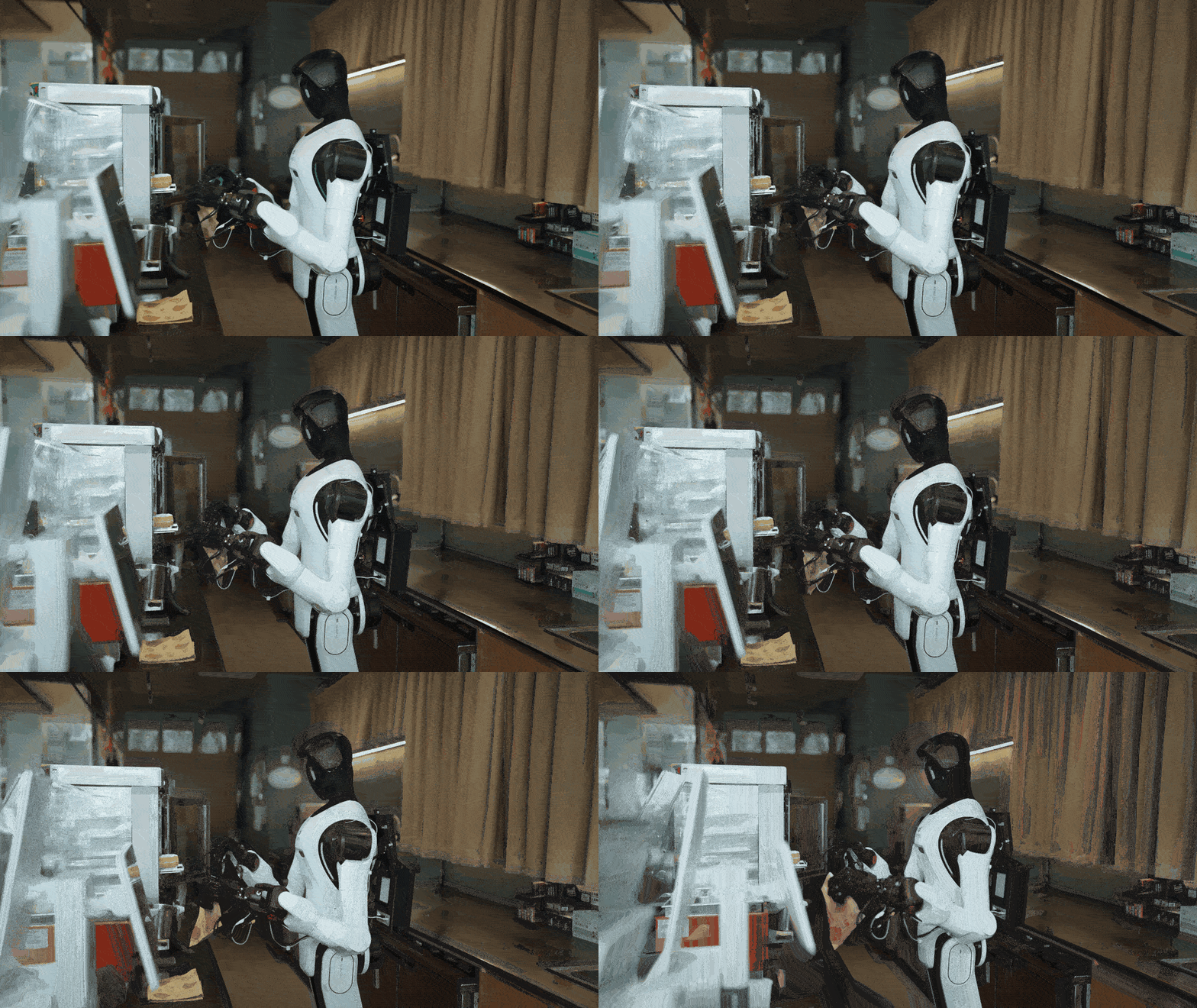
The shelf-hook case mentioned earlier is a prime example of Harness RSI.
Initially, the success rate for the micro-hook task was dismal. Reviewing failure logs, the Agent diagnosed the root cause: “Insufficient global resolution from the head camera, exacerbated by price tag occlusion, prevents accurate 3D localization of the hook.”
The Agent then synthesized a composite action pipeline: “First perform a close-range visual check with the left wrist camera, then execute the hook placement with the right hand.” It stored this as a standardized decision flow. When encountering similar visual occlusions in the future, the robot immediately retrieves this experience and completes the task smoothly.
However, an “error logbook” primarily addresses high-level decisions. When faced with the millisecond-level latency and high-precision stability demands of real-world hardware control, critical motor skills must be ingrained as “muscle memory.”
This is where Policy RSI comes into play.
Policy RSI comprehensively collects high-value interaction trajectories generated across autonomous operation, remote human teleoperation/takeover, and error recovery. Data filtering, sample weighting, and Hindsight Relabeling enhance data quality and density. Then, through supervised fine-tuning, imitation learning, or reinforcement learning, it directly updates the low-level action policy, baking the optimizations directly into the neural network weights.
Take the store’s “takeout bag anti-tangling” task: interaction data from untangling handles, trajectory retraction, and posture corrections are filtered and used for incremental training of the low-level policy model, significantly boosting robustness against deformable object disturbances.
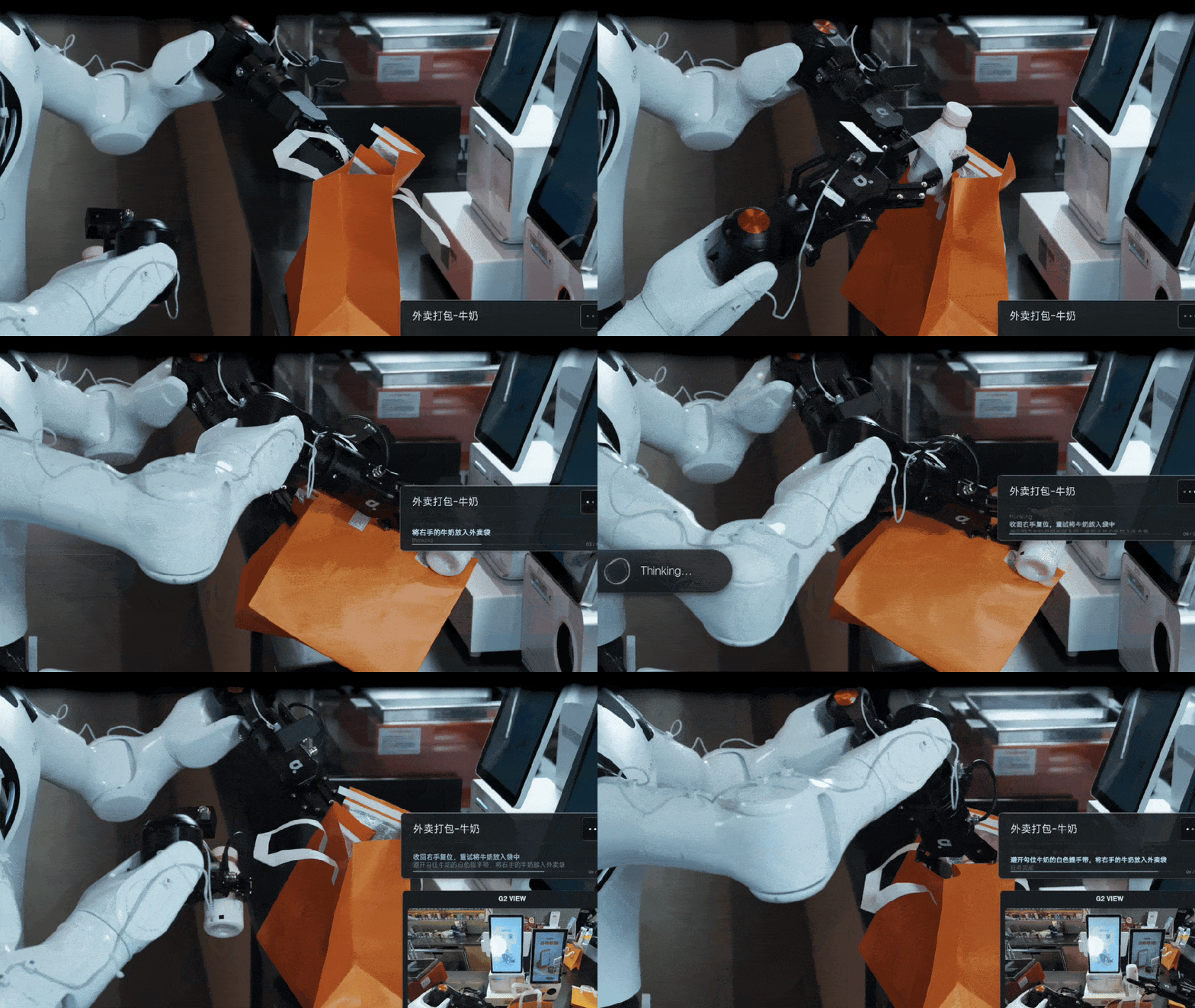
Through Policy RSI, the system continually absorbs insights from physical interactions, achieving smoother motor control and stricter instruction alignment.
Importantly, this framework does not entirely exclude humans: Policy RSI still supports ingesting human takeover demonstrations in highly complex scenarios, and final policy deployment is gated by rigorous data cleaning pipelines and convergence validation.
Crucially, these two evolutionary pathways do not operate in silos—they interlock as a self-reinforcing flywheel:
- Harness RSI handles high-level experience retention and structured organization, helping the system diagnose failure modes, design training regimes, and quickly boost immediate task performance;
- Policy RSI trains low-level action policies on high-value real-world data, solidifying frequent, high-difficulty maneuvers into deterministic motor primitives.
Reinforcing each other, they complete a virtuous cycle spanning operational testing, defect diagnosis, autonomous practice, knowledge synthesis, and model internalization. With this architecture, AgiBot aims to ensure that with every operational cycle, the system’s efficiency in self-diagnosis, sample selection, and skill evolution climbs to a higher plateau.
Empowering the model’s ability to recursively improve its own capabilities, and extracting exponential generalization gains from the same hardware and software footprint—this is the core value proposition of Recursive Self-Improvement (RSI).
From “Frozen at Factory” to “In-Service Self-Evolution”
Looking beyond convenience store tasks to the broader trajectory of embodied AI, AgiBot’s Genie Master is ushering in a new paradigm for real-world deployment.
From an R&D paradigm perspective, it breaks the traditional deadlock where embodied systems are “frozen at the factory and updated only via recalls/patches,” propelling the industry toward a dynamic paradigm of “continuous growth in active deployment.”
When on-device systems can independently discover solutions for new skills on-site, the delivery cycle—from initial customer requirements to production-ready performance—shrinks dramatically.
On the commercial front, this clarifies the most challenging economic equation.
As robots become increasingly proficient through real-world work, the amortized cost of hardware and intelligent systems drops while capability compounds.
When scaling horizontally across more retail stores or multi-category scenarios, the marginal costs of secondary development and deployment will follow a decisive downward trajectory.
And this continuously declining marginal cost curve is the foundational logic for embodied intelligence to penetrate trillion-dollar industrial and consumer markets.

Looking back at AgiBot’s “AI WAVE” series launched on October 22, Genie Master—as the fourth major release—serves as a pivotal linchpin in its full-stack embodied technology matrix. It seamlessly anchors upstream foundation models and full-stack AI capabilities into real commercial workflows.
Of course, elegant architectural designs on paper must ultimately face the ultimate test of the messy physical world.
On November 2, AgiBot will kick off a livestreamed “24-Hour Continuous Operation Trial in a Real Convenience Store.”
Six AgiBot Genie G2 robots will form a collaborative fleet, working continuously in an unscripted, live commercial operating environment to face the ultimate test of physical long-tail scenarios.