
In just one week since going open-source, it has garnered over 1,000 GitHub Stars, surpassed 1 million views on X, and been featured on Today’s News.
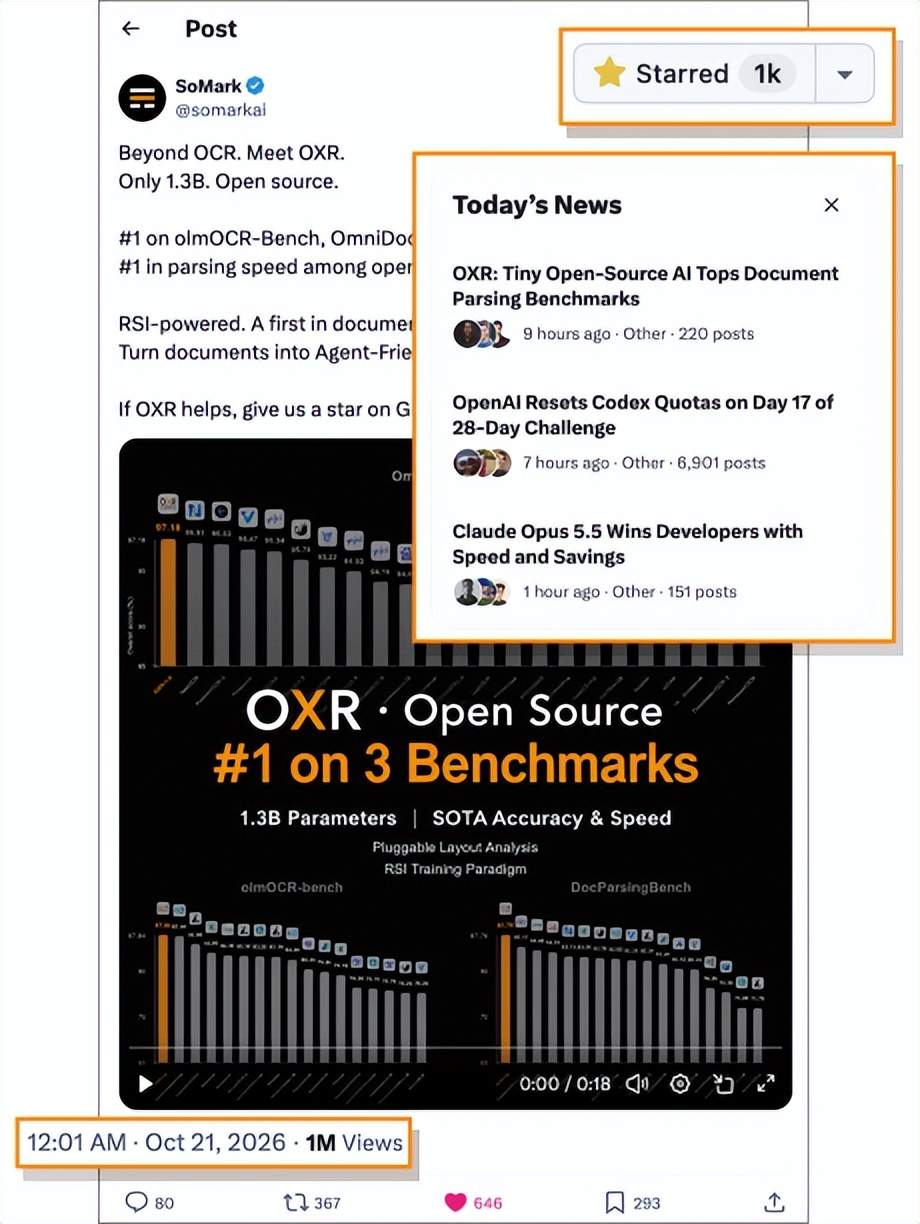
The document parsing arena has welcomed a fiercely competitive new contender.
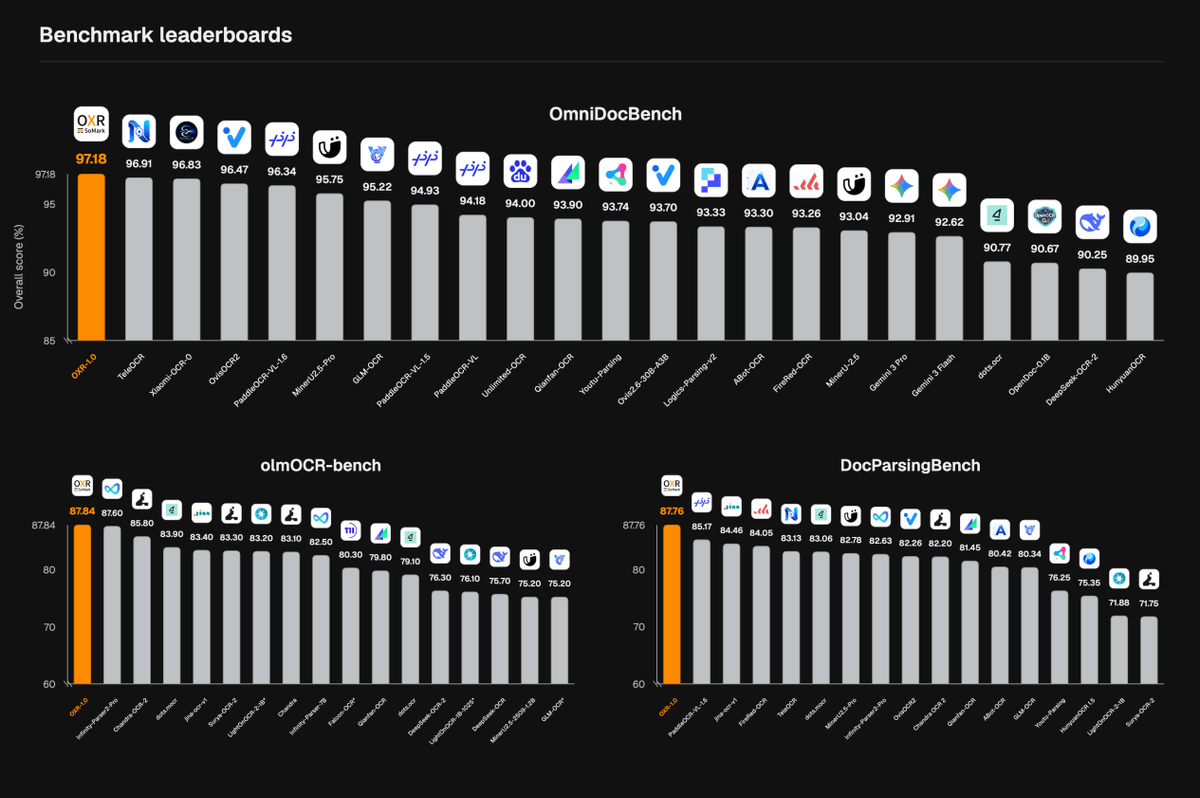
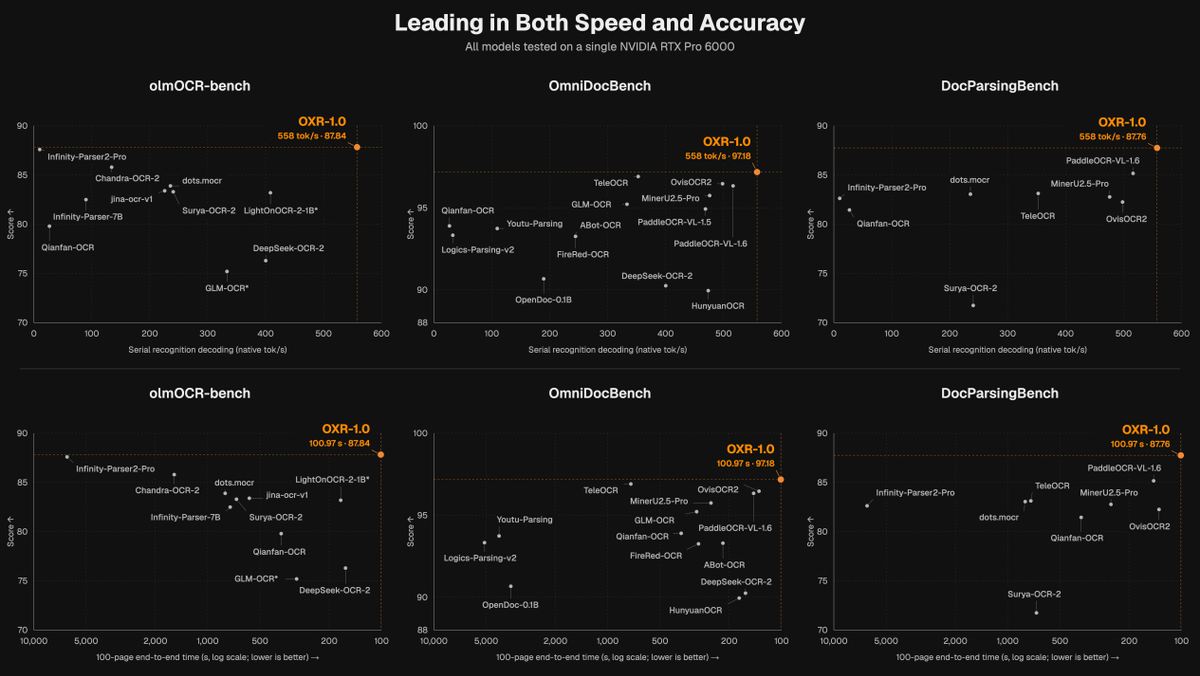
OXR is officially open-sourced: with a primary model of just 1.3B parameters, it claims the top spot across three authoritative benchmarks—OmniDocBench, olmOCR-Bench, and DocParsingBench. Its full document parsing speed also outperforms fellow contenders PaddleOCR-VL-1.6 and MinerU2.5-Pro, pushing both precision and efficiency to the peak for lightweight models.
The team behind the model, SoMark, is a Chinese startup deeply rooted in document intelligence. Having consistently refined their parsing capabilities around their flagship product SoMark, they have now officially released the open-source model OXR.
OXR stands for Optical Everything Recognition. Leaping from OCR to OXR, its capabilities extend far beyond text alone. OXR can not only parse 13 types of complex document elements—including tables, formulas, and chemical equations—but also accurately reconstruct reading orders in multi-column layouts, outputting Markdown and JSON formats while preserving complete layout coordinate data. This transforms complex unstructured documents into high-quality data ready for direct Agent consumption.
1. High-Precision Parsing: Dominating Three Global Benchmarks
According to evaluation results released by the team, OXR achieved outstanding scores of 97.18, 87.84, and 87.76 on OmniDocBench, olmOCR-Bench, and DocParsingBench respectively, ranking first globally across all three.
Beyond impressive benchmark scores, OXR’s real-world performance on complex documents is even more compelling.
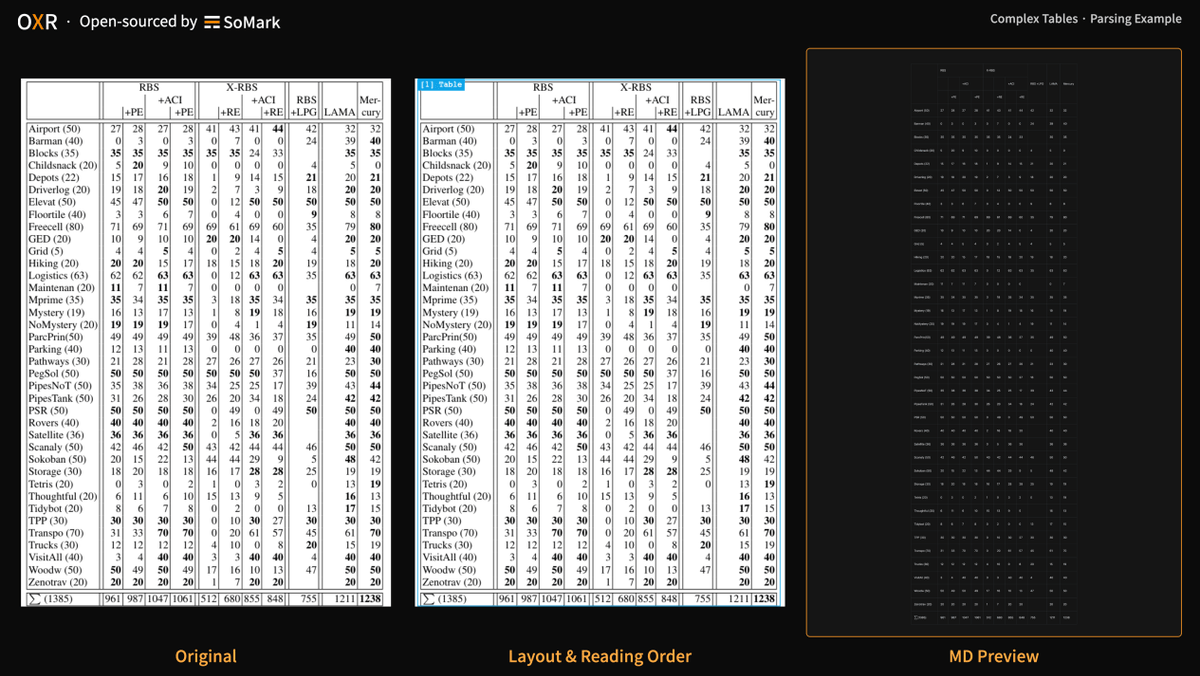
When dealing with complex tables spanning multiple rows and columns, correctly recognizing text is merely the first step. If row-column alignments or merged cells shift out of place, the data loses its original semantic context. OXR preserves table structures intact and converts them into HTML format, greatly facilitating downstream data presentation and processing.
Scientific documents present even greater parsing challenges: mathematical formulas are filled with intricate superscripts, subscripts, and deeply nested structures, while chemical literature includes elaborate reaction schemes and molecular structure diagrams. OXR standardizes mathematical formulas into LaTeX, converts chemical equations into mhchem format, and translates chemical structural formulas into SMILES strings—turning static graphics on a page into searchable, computable structured representations.
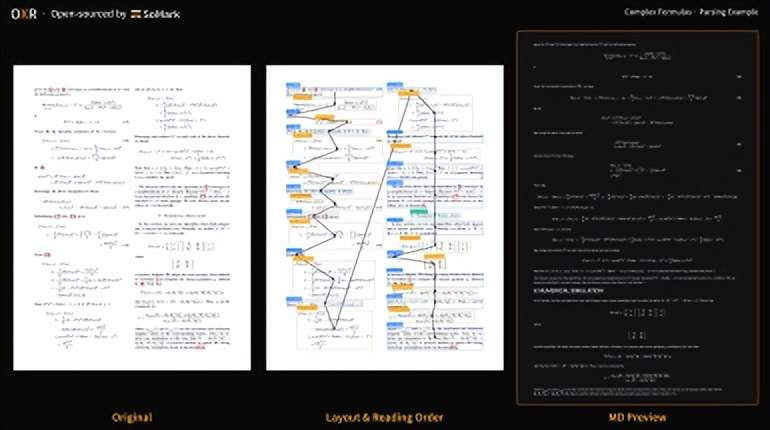
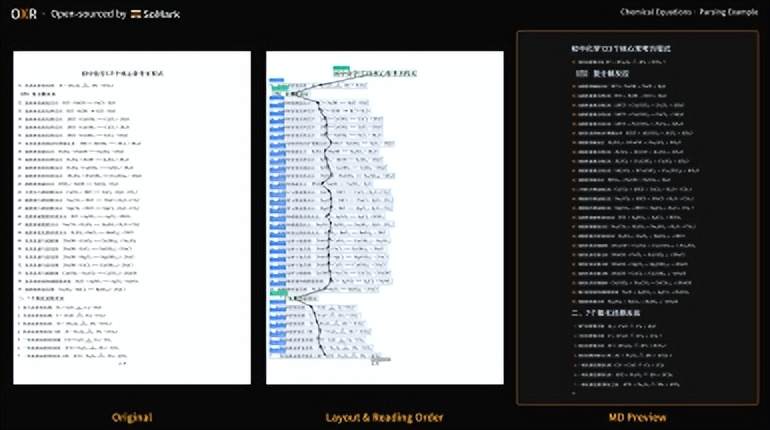
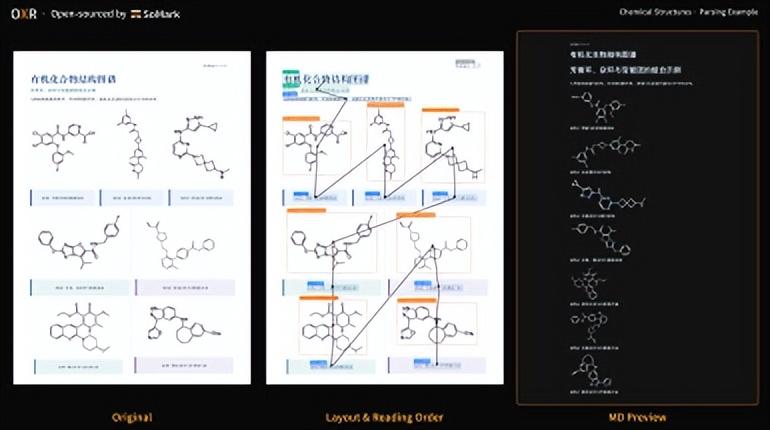
In multi-column academic papers, newspapers, and exam sheets, reading order represents another major pain point. Even if a model accurately recognizes text within each region, any column hopping or confusion between main text and side notes will completely disrupt the original semantics. While recognizing content, OXR accurately determines the reading order and provides precise layout coordinates, perfectly retaining the location information of content within the original page.
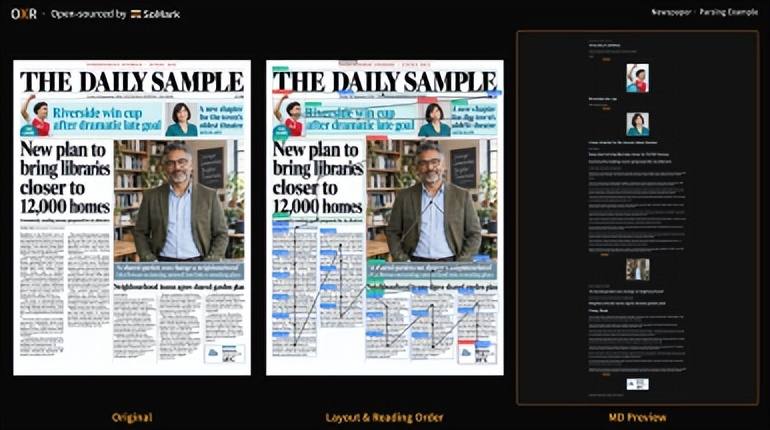
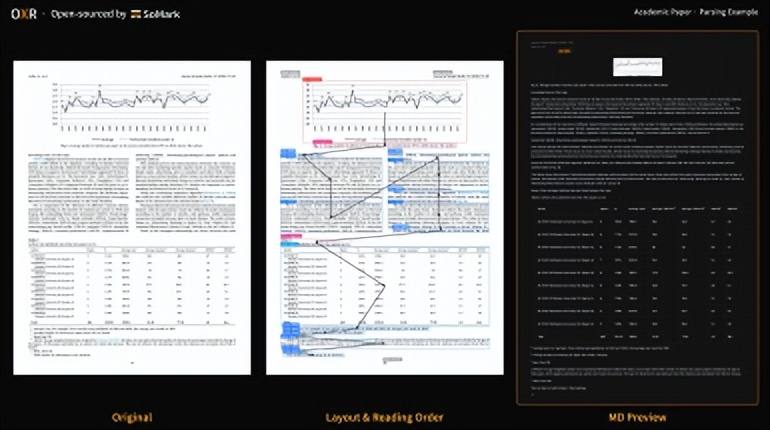
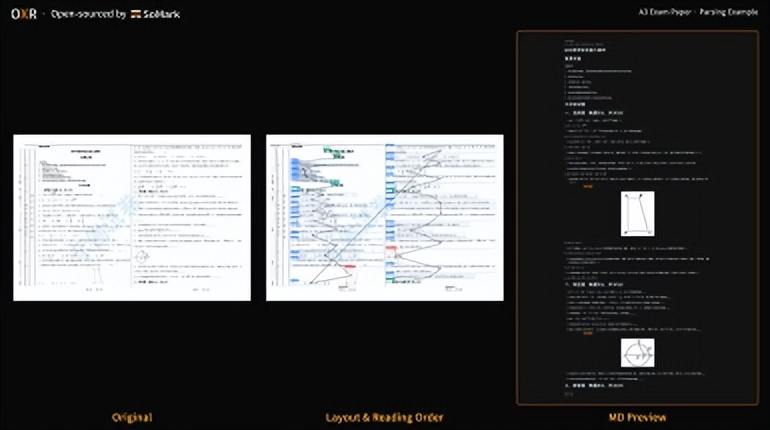
These capabilities collectively embody what OXR calls “Everything”: comprehensive coverage of 13 document element types—including text, tables, formulas, chemical structural formulas, and code blocks—parsing PDFs and diverse document images with high fidelity into Markdown / JSON to seamlessly integrate with downstream Agent and RAG workflows.
2. Balancing Precision and Speed: Not Just Accurate, but Fast
When processing a single-page document, a difference of a few seconds might go unnoticed. However, when scaling up to massive paper ingestion, historical archive digitization, or batch processing of financial research reports, throughput efficiency directly dictates latency and compute costs.
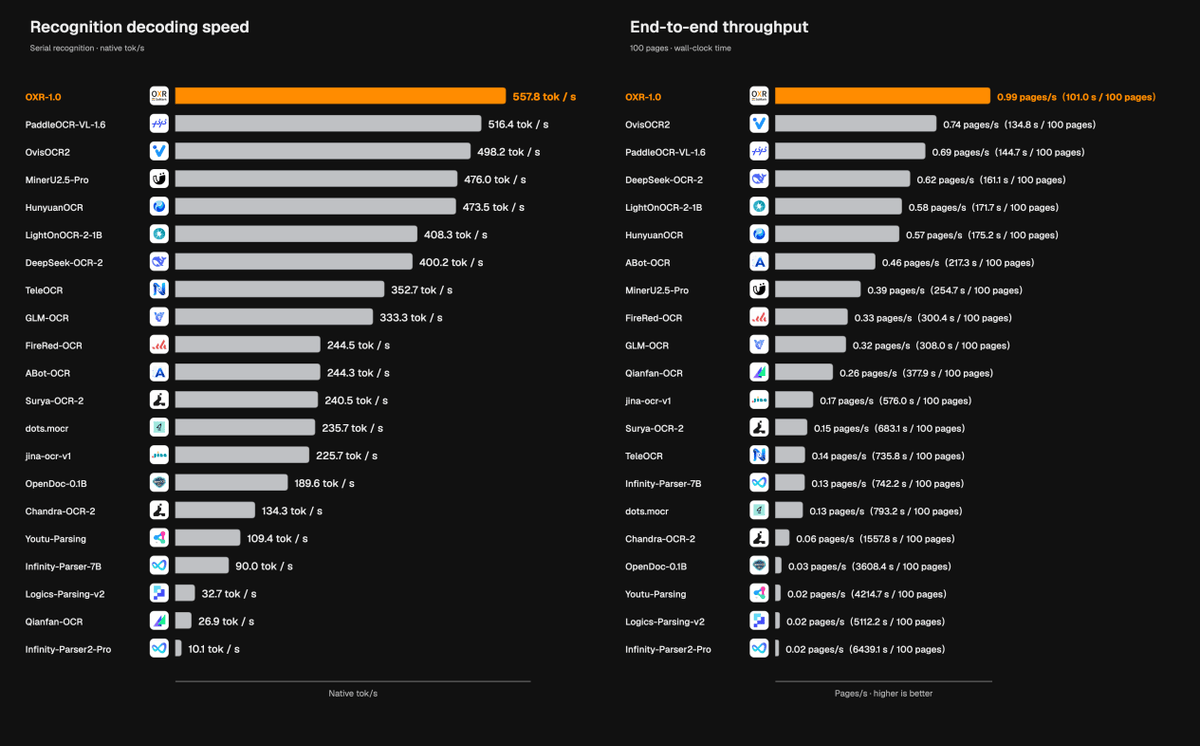
According to end-to-end parsing benchmark tests released by the team, parsing 100 randomly sampled pages from OmniDocBench on a single RTX PRO 6000 Blackwell (96GB) GPU: OXR took an average of only ~101 seconds, while PaddleOCR-VL-1.6 and MinerU2.5-Pro took ~145 seconds and ~255 seconds, respectively.
Smaller parameter scale, higher parsing precision, and faster inference speed—achieved simultaneously within a single model for the first time.
This is primarily driven by OXR’s ingenious architectural division of labor: a lightweight layout analysis model first rapidly localizes content regions, after which the primary model focuses on content recognition and reading-order inference.
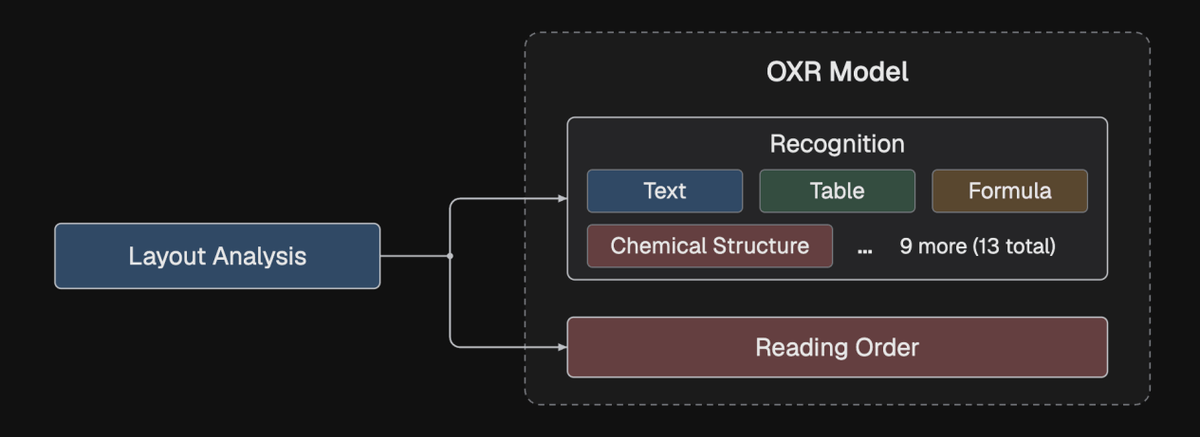
Integrating order reconstruction directly into the content recognition phase eliminates the extra compute overhead of handling layout topological ordering separately, while also empowering the model to infer sequencing based on contextual semantics. This architectural synergy is key to how OXR achieves both superior quality and high efficiency.
3. The RSI Training Paradigm: Recursive Self-Improvement on Long-Tail and Weak Samples
Behind its stellar performance lies an equally illuminating training mechanism. Traditional document parsing rarely covers all edge cases using fixed-size datasets. In the face of constantly evolving layouts, writing styles, and application scenarios, how can a model remain robust when encountering unseen documents?
During post-training, OXR pioneers a Recursive Self-Improvement (RSI) paradigm tailored for document parsing, efficiently converting erroneous and weak samples generated during inference into fuel for subsequent iterations.
The entire workflow can be viewed as a multi-model collaborative feedback loop designed to identify gaps and reinforce weaknesses:
- OXR first parses unlabeled documents to produce initial predictions.
- An external model evaluates recognition accuracy and performs sample-by-sample error attribution, while an independent clustering model automatically categorizes issues by error type.
- A discriminator model generates targeted, high-quality augmented training data addressing these weak spots, feeding back into OXR for the next round of fine-tuning.
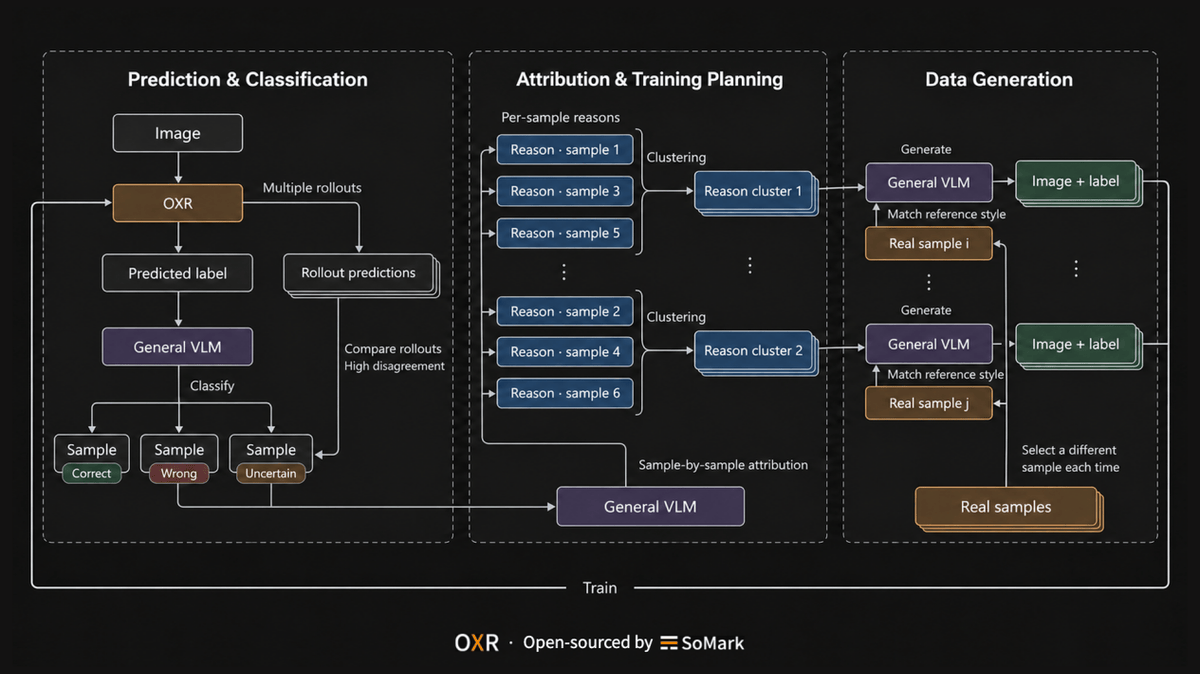
This mechanism makes the training data exceptionally problem-driven: by targeting weak links with laser focus, it drastically accelerates model convergence and iteration cycles. Meanwhile, new training samples generated within this closed loop are completely free from human annotation dependencies, fundamentally eliminating the efficiency bottlenecks and high costs of manual labeling.
4. Modular & Pluggable Layout Analysis: Flexible Adaptation to Diverse Business Needs
While recognition accuracy demands continuous model optimization, real-world deployments also face differing definitions of what constitutes “document structure.”
For instance, with a group of illustrations, archiving scenarios often require merging them as a single block for preservation, whereas image retrieval scenarios require slicing them into individual images. Similarly, for mixed text-and-image regions containing headings, body text, and borders, some systems prefer dissecting them as rich text, while others require extraction structured as a unified table. Each of these requirements makes sense within its respective business context.
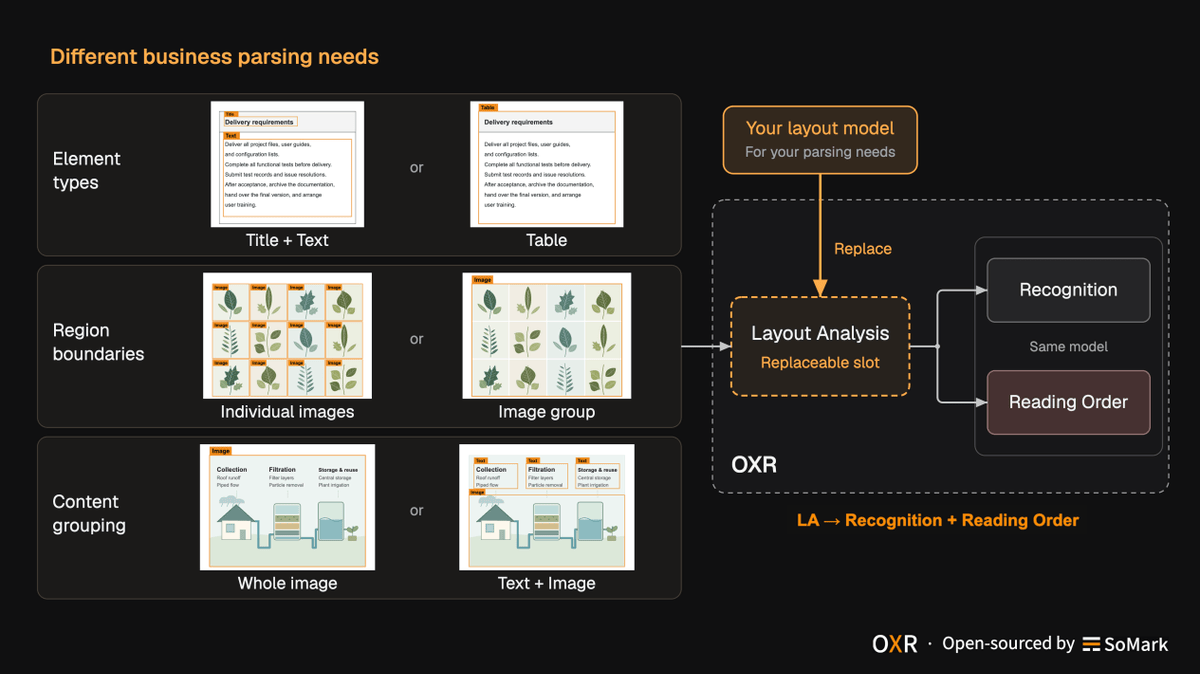
To address this, OXR designs layout analysis as an independent, decoupled, and pluggable module.
Developers can either directly leverage the high-performance built-in layout analysis model or seamlessly integrate external layout analysis algorithms tailored to their proprietary business standards. They can freely define element categories, bounding boxes, and content grouping, and then effortlessly reuse OXR’s content recognition and reading-order reasoning capabilities.
For developers building RAG knowledge bases, automated Agents, and document workflows, OXR offers a premier open-source choice that combines exceptional parsing precision, rapid inference throughput, and unmatched layout adaptability.
Currently, OXR has fully open-sourced its code and model weights, alongside an online demo and a free API to help developers test and validate on real-world documents:
- GitHub Repository: https://github.com/SoMarkAI/OXR
- Hugging Face Model Weights: https://huggingface.co/SoMarkAI/OXR-1.0
- Online Demo: https://free-oxr.somark.cn/
- Free API: https://free-oxr.somark.cn/api/v1
For more complex enterprise production-grade document parsing requirements, the team also provides SoMark, a commercial-grade document parsing engine powered by an independent proprietary model:
- SoMark Official Website: https://somark.cn/
From SoMark to the open-source OXR, the team is sharing its long-term technical accumulation to deliver core benefits to developers. As their vision reflects: transforming the knowledge embedded in documents into high-quality data directly accessible to AI, empowering real-world business scenarios across industries.