
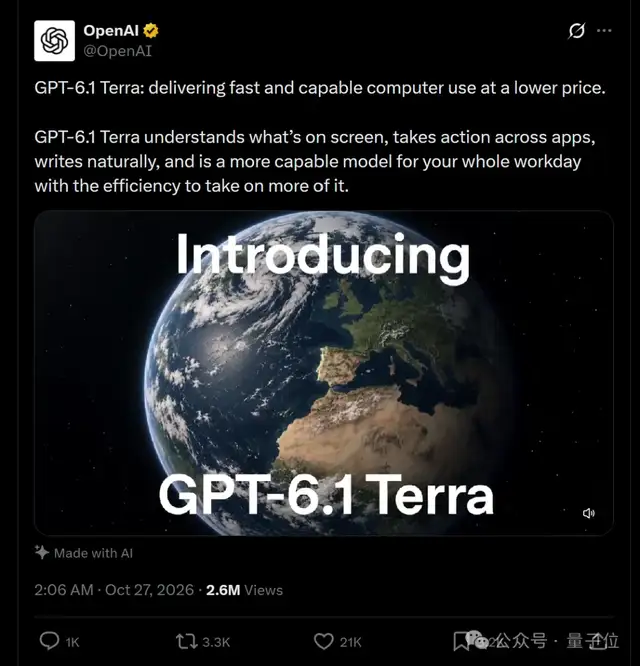
Just as rival Anthropic stole the spotlight with its prospectus, OpenAI fired back with GPT-6.1 Terra—
Think you can hog the headlines alone? Not if this new model has anything to say about it.
GPT-6.1 Terra’s core pitch is “half the price, more capable.”
Compared to GPT-5.6 Terra, standard API pricing has been cut straight in half:
$1.00 / 1M input tokens, $0.05 / 1M cached input tokens, and $5.00 / 1M output tokens.
Even with the dramatic price cuts, performance has noticeably improved.
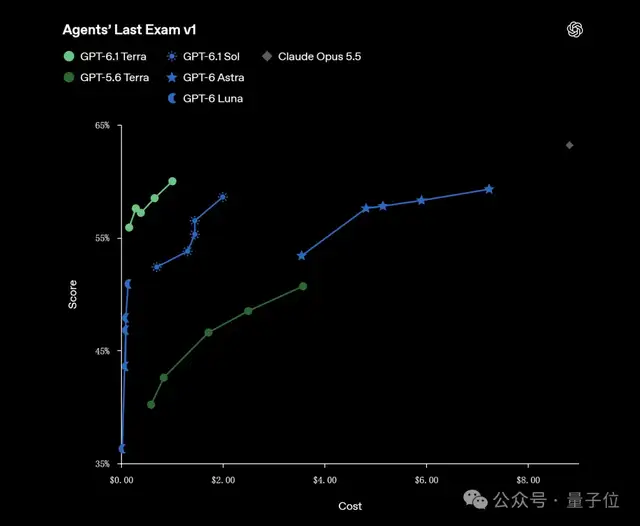
On the workplace software benchmark Agents’ Last Exam, Terra not only clearly outpaced GPT-5.6 Terra, but also matched GPT-6 Astra’s performance at just one-tenth the token cost.
Compared to Claude Opus 5.5, Terra comes in at a quarter of the token price, over 3x the token efficiency, and approximately one-ninth the per-task cost.
Has the race to cut AI costs and boost efficiency really gotten this intense?
In terms of use cases, GPT-6.1 Terra’s value proposition is just as clear: faster, more capable, and drastically cheaper for computer use.
With native support for screen comprehension, cross-application workflows, and natural language writing, it zeroes directly in on end-to-end knowledge-worker workflows.
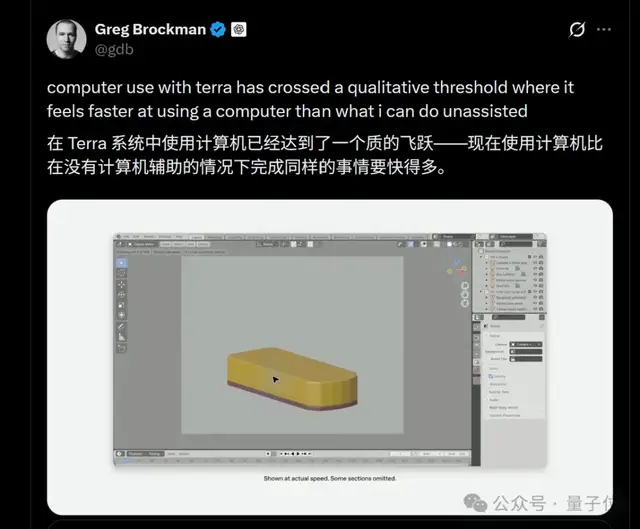
OpenAI co-founder Greg Brockman even noted that Terra’s computer-use capabilities have crossed a “qualitative threshold,” operating faster in practice than he can manually.
Plus, Pro, Enterprise, and Edu users can now access it directly within ChatGPT Work and Codex, while developers can start building with it via the standard API (gpt-6.1-terra).
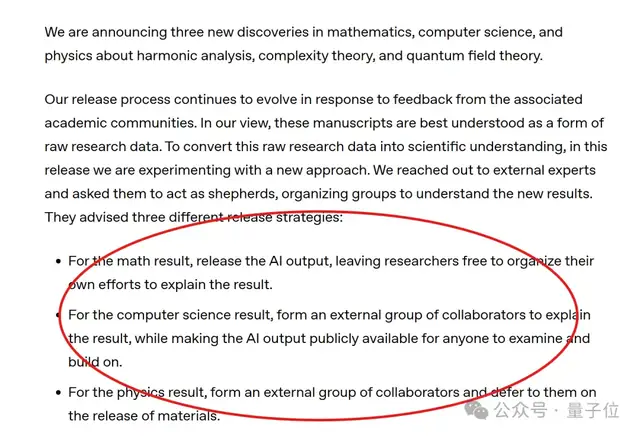
Even more striking, OpenAI announced on the very same day three frontier scientific breakthroughs achieved by internal AI systems spanning mathematics, computer science, and physics.
Slashing the cost of AI computer control on one hand, while expanding the possibilities of AI in frontier scientific research on the other.
GPT-6.1 Terra Officially Launches: Cutting Costs in Half
So how does it actually perform? Let’s look at OpenAI’s official benchmarks first.
Bottom line upfront:
While GPT-6.1 Terra is not OpenAI’s highest-ceiling model, it reliably enters flagship-tier performance territory at a fraction of the cost.
On Agents’ Last Exam, GPT-6.1 Terra Medium scored 15 percentage points higher than GPT-5.6 Terra, while slashing per-task costs to roughly one-third.
This benchmark specifically evaluates whether an AI can operate professional software to complete complex tasks, such as turning architectural blueprints into 3D models or reviewing animations frame-by-frame to generate timecoded correction logs.
Official numbers show Terra matching the performance of GPT-6 Astra at one-tenth the per-token price, while completing tasks over 3x faster than both GPT-6 Astra and GPT-6.1 Sol.
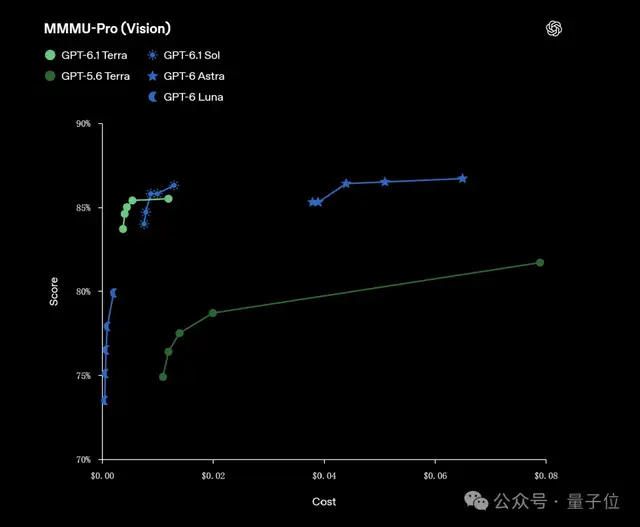
Looking at vision capabilities:
On the MMMU-Pro benchmark, GPT-6.1 Terra outperformed GPT-5.6 Terra across all reasoning effort levels, closing the gap with GPT-6 Astra and GPT-6.1 Sol at significantly lower cost.
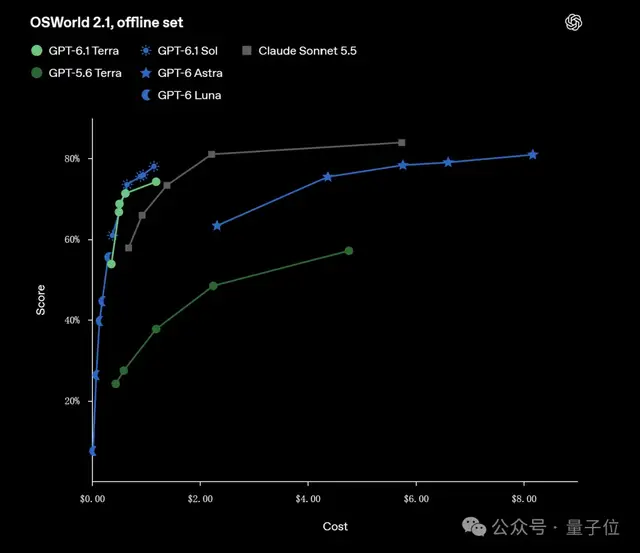
On the computer-use benchmark OSWorld 2.1, its Medium tier surpassed GPT-5.6 Terra’s previous top mark.
This means the new Terra is not just better at “seeing”—it is far more precise at turning visual screen context into completed work.
Coding capabilities also saw a major leap forward.
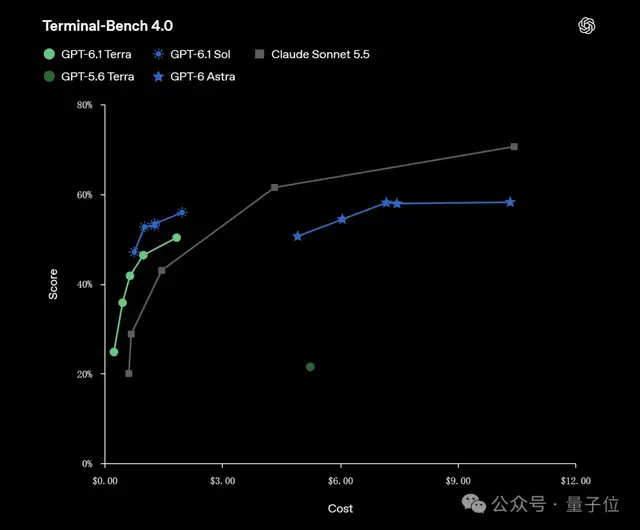
On Terminal-Bench 4.0, GPT-6.1 Terra Max resolved 50.3% of tasks—more than double GPT-5.6 Terra’s previously reported 21.5%.
However, OpenAI also outlined clear boundaries:
For the most demanding edge cases—such as complex coding architectures, frontier scientific research, and deep reasoning—GPT-6.1 Sol and GPT-6 Astra remain the better choices.
Another notable upgrade is a dramatic reduction in hallucinations.
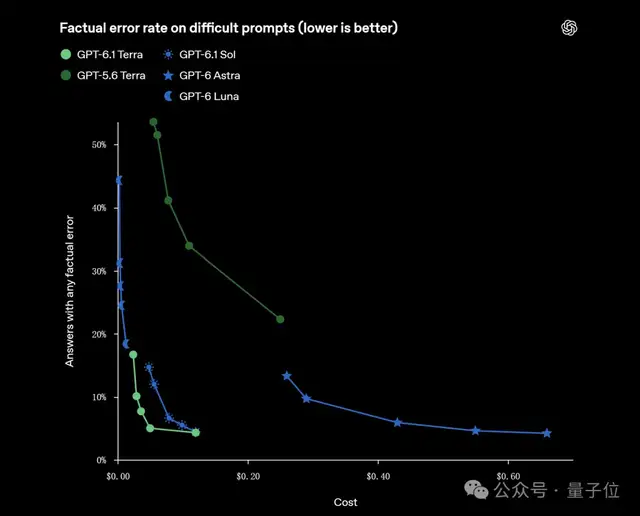
In OpenAI’s internal high-difficulty factuality stress tests, the error rate at low reasoning effort plummeted from 53.6% in GPT-5.6 Terra to 16.7%. At the Max tier, it dropped further to 4.3%, approaching the levels of GPT-6 Astra and GPT-6.1 Sol.
Based on this round of official evaluations, Terra’s positioning is unmistakably clear:
Deliver near-flagship capabilities while drastically driving down the execution cost of everyday computing tasks.
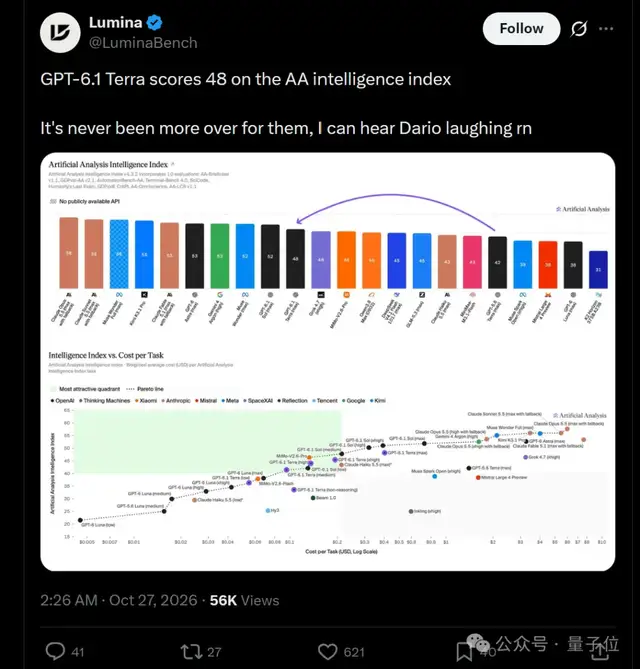
On Artificial Analysis’s Intelligence Index, GPT-6.1 Terra Max scored 48 points, trailing Claude Opus 5.5, Kimi K3.1 Pro, Google Gemini 4 Argon, Meta Muse Wonder, and GPT-6.1 Sol, while outperforming Grok 4.7 and Xiaomi MiMo-V2.6-Pro—placing it comfortably in the mid-tier of the world’s leading models.
Community Testing: Finer Detail, 38% Cheaper
How does the model hold up in real-world use? Early hands-on testing from the community provides a clearer picture.
DesignArena gave both GPT-6.1 Terra and GPT-5.6 Terra the same prompt:
Recreate the Belém Tower in Lisbon during the golden hour.
The prompt required accurately rendering the 16th-century limestone fortification—complete with carved stone ropes, open balconies, battlements, and domed bartizans—along with seagulls, sailboats, and the Ponte 25 de Abril shrouded in mist.
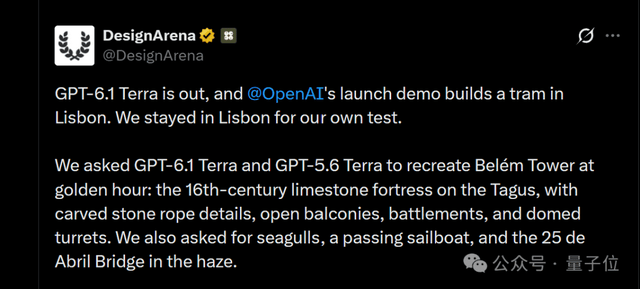
The results were quite telling:
GPT-6.1 Terra took nearly 4x longer than its predecessor, consuming 48% more tokens;
yet because its per-token pricing is less than half, the total cost actually decreased by 38% ($0.047 for the new Terra vs. $0.077 for the previous version).
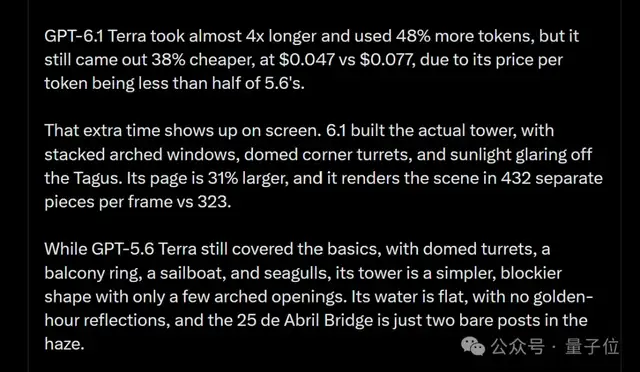
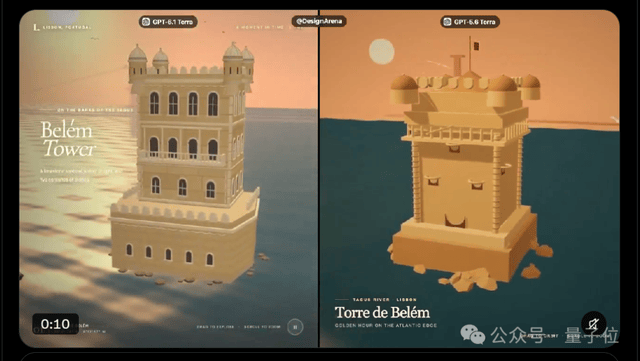
The extra compute time translated directly into image detail, showing marked improvements in texture and overall fidelity.
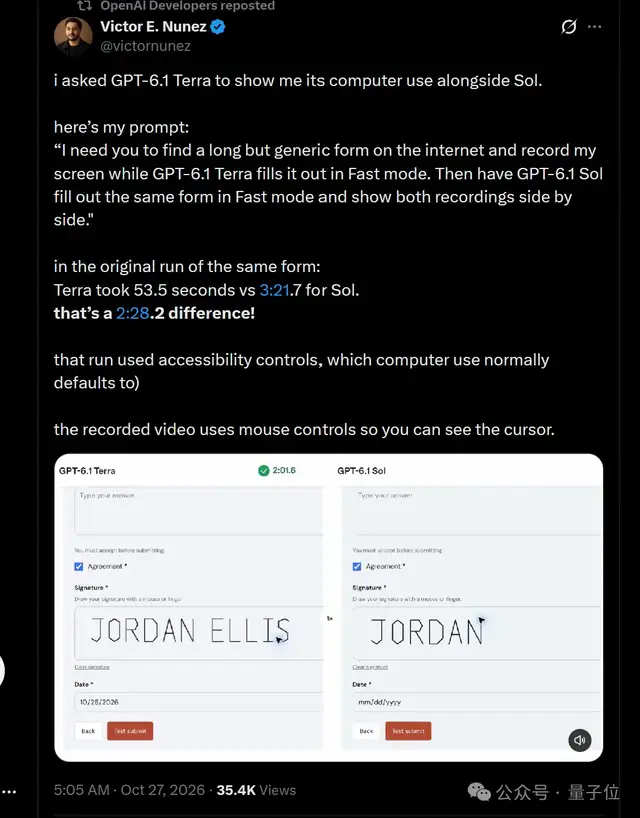
Developer Victor Nunez tested the model on automated long-form data entry.
He tasked both GPT-6.1 Terra and GPT-6.1 Sol in Fast mode with retrieving data and filling out a complex, general-purpose long form, comparing their computer-use workflows side by side.
Nunez reported that in the initial run, Terra finished the end-to-end form 53.5 seconds faster than Sol.
The demonstration was subsequently retweeted by the official OpenAI Developers account.
This hits the sweet spot of Terra’s intended role:
It doesn’t target extreme reasoning limits, but excels at extracting GUI information accurately, handling multi-step clicks and data entry, and executing lengthy workflows with high throughput.
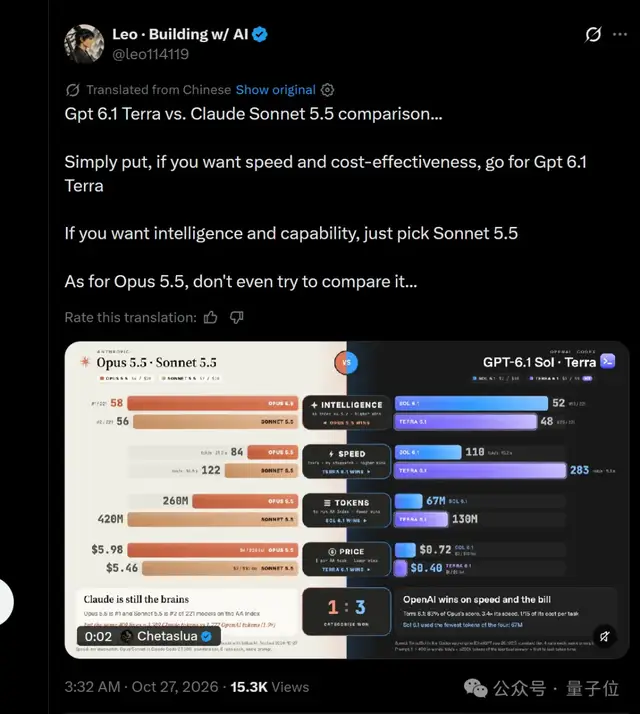
Another user, Leo, compared Terra against Anthropic’s Claude lineup:
In overall intelligence scores, Terra reached 48 points, behind Sonnet 5.5 (56 points) and Opus 5.5 (58 points).
However, the tables quickly turned on speed and cost:
Terra clocked an output speed of 283 tokens/sec—roughly 3.4x faster than Opus 5.5—while costing just $0.40 per task, about one-fifteenth the cost of Opus 5.5.
Leo concluded:
“If raw intelligence and comprehensive quality matter most, go with Sonnet 5.5; if you need high throughput and exceptional cost-efficiency, pick Terra. As for the flagship Opus 5.5, Terra isn’t in the same tier yet.”
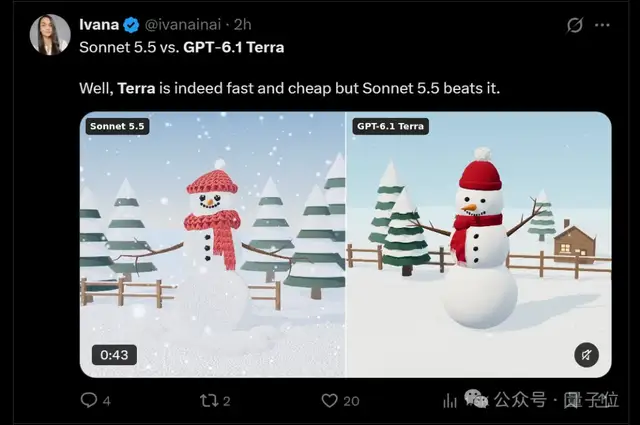
Another community evaluation corroborated this verdict. Comparing Sonnet 5.5 and 6.1 Terra under identical prompts showed a noticeable difference in output quality.
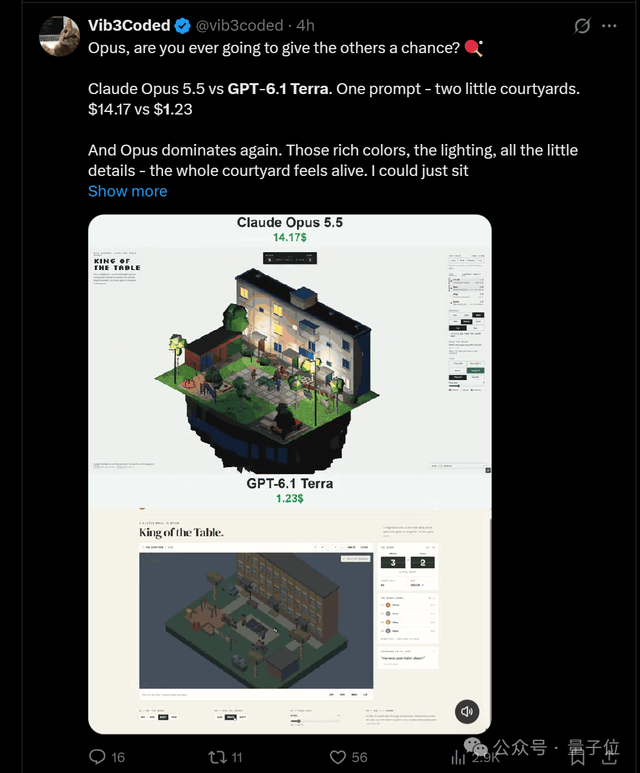
While Terra enjoys an enormous price advantage over Opus 5.5, looking at the final outputs confirms that premium models still retain their justification for higher pricing.
On the Same Day, OpenAI Drops Three Scientific Breakthroughs
Alongside the Terra launch, OpenAI also dropped a major academic bombshell.
The company announced that its internal AI systems achieved three breakthrough results across mathematics, computer science, and physics—specifically targeting harmonic analysis, complexity theory, and quantum field theory.
These discoveries are not just informal natural-language derivations:
Natural language preprints and formal Lean proofs for the mathematics and computer science results have both been released publicly.
For the physics milestone, the Lean formalization of the existence of pure Yang-Mills theory is complete and currently under review by an external panel of experts.
Here is a breakdown of OpenAI’s three scientific achievements:
1. Resolving a 30-year-old mathematical conjecture
OpenAI stated that its AI system proved the Local Smoothing Conjecture in all dimensions, consequently resolving the Kakeya conjecture and the Stein restriction conjecture.
This area of harmonic analysis focuses on understanding how wave propagation focuses energy. First proposed by mathematician Christopher Sogge in 1991, proofs had previously only been established in limited dimensions.
Now, the AI has produced both a detailed natural-language paper and a complete formal verification in Lean. If fully validated by peer review, this will mark the first time AI has comprehensively solved a deep, decades-old open problem in pure mathematics.
2. Challenging a decades-old cornerstone of computer science
The second breakthrough targets the Exponential Time Hypothesis (ETH).
ETH posits that for complex computational problems like 3-SAT, algorithms substantially faster than brute-force search do not exist. Decades of computational complexity theory have been built upon this assumption.
OpenAI announced that its AI system constructed a disproof of ETH, complete with rigorous formal verification in Lean.
This does not imply that P = NP, nor does it mean practical breakthrough algorithms are suddenly available. However, it suggests that the complexity bounds of classical hard problems may not be as rigid as long assumed.
3. Providing rigorous mathematical proof for 4D quantum field theory
The third breakthrough centers on the foundation of quantum field theory.
OpenAI reported that its system formulated an existence proof for specific 4D quantum field theories, including quantum chromodynamics (QCD).
In essence, this attempts to show via rigorous mathematics that the core framework describing quarks, gluons, and the strong force is mathematically consistent.
This work includes an existence proof for pure Yang-Mills theory, a central component of the Millennium Prize Problem: “Yang-Mills Existence and Mass Gap.”
Importantly, the mass gap itself remains open, so the million-dollar Millennium Prize cannot yet be considered fully solved. The findings are currently under review by an external panel led by Nobel laureate David Gross.
By simultaneously releasing cost-effective models to reshape practical deployment economics and achieving substantive breakthroughs on the frontiers of foundational science, OpenAI has once again asserted its technical leadership.
References:
[1] https://openai.com/index/introducing-gpt-6-1-terra/
[2] https://developers.openai.com/api/docs/models/gpt-6.1-terra
[3] https://developers.openai.com/api/docs/pricing
[4] https://x.com/OpenAI/status/2114780711664398349
[5] https://x.com/DesignArena/status/2114800086391878104