
Katelyn Lesse and Angela Jiang discuss Opus 5.5, the Claude platform, and the engineering behind AI agents.
Oct 27 · ~104 min read
As we learned yesterday from Anthropic’s S-1 filing, the lab boasts some of the highest revenue and research efficiency in human history, notably swinging from a -126% loss to a 19% GAAP profit over the past year. The company attributes this turnaround to its two core flywheels: Improvement and Investment:
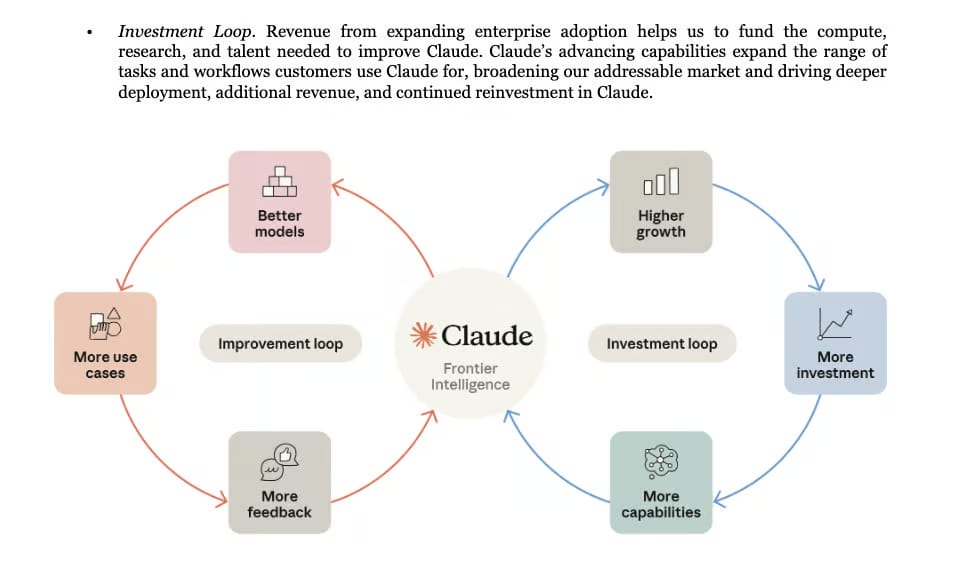
Today, we take a deep dive into how Anthropic works. With the dust settling on the Opus 5.5 launch and its undisputed hold on the #1 LLM spot for a full month, we sit down with Anthropic’s Engineering Lead Katelyn Lesse and Product Lead Angela Jiang to break down its launch journey and how Anthropic “builds and ships Claude with Claude.”
The team is navigating two competing pressures. On one hand, models are growing increasingly capable, making safe deployment and access control decisions far more complex. At the same time, usage is surging at an extraordinary rate, giving seemingly mundane infrastructure decisions—like how much CPU an API consumes—strategic weight. All of these challenges converge in product decisions made for developers.
A Model Launch Is Also an API Launch
Anthropic’s Opus 5.5 launch placed equal emphasis on model quality and cost. We discussed feedback around the previous generation of Opus being overly verbose, as well as the pressing demand for higher “intelligence per dollar.” Anthropic states that the new model costs less to run than its predecessor, with actual savings depending on the specific workload and how effectively it leverages cached context.
Much of the unseen work behind the launch involved shifts in how developers interface with the API. One example we touched on was preventing model reasoning traces from being extracted and used for distillation. Preserving thinking blocks across multi-turn conversations helps mitigate this, but introducing new requirements also risks breaking customers’ existing test harnesses.
Katelyn also described what running early access programs actually looks like in practice: customers running evaluations within their own test harnesses, reporting unexpected behaviors, and occasionally offering informal subjective impressions. What’s truly valuable isn’t just a benchmark score—it’s the ability to see how the model behaves in environments and on tasks that Anthropic’s own products don’t yet cover. As we’ve stressed on the podcast for four years running: good evals are worth their weight in gold.
The “Brain” and the “Hands”
One of our favorite mental models from the episode was separating an agent’s “brain” from its “hands.” In Managed Agents, Anthropic decouples conversation logs and the runtime harness from the execution sandbox. The harness can remain persistent while execution environments are spun up on demand only when needed; a sandbox failure doesn’t necessitate tearing down the entire agent session with it.
We previously explored this in our episode with Thariq:
This separation provides a crucial architectural advantage for security. If generated code runs inside a sandbox that never received service credentials in the first place, there are simply no credentials inside the environment for malicious code to exfiltrate. The episode details how credentials are stored separately and mounted via proxy, along with how network controls govern where outbound sandbox traffic can go. Anthropic’s containment write-up dives deeper into the broader isolation and network policies deployed across its products.
This distinction is equally critical for performance. The guests noted that an earlier approach was packing the entire coding agent inside a sandbox behind the API. Bootstrapping both the environment and the agent added overhead before returning the first response; and if the sandbox was termi…