
Specialized Tasks Call for Specialized Models
When it comes to 3D generation, the visual results make one thing clear: specialized tasks truly call for specialized models.
Provide the model with a reference image of a Marvel character (original image below):

Here is the result generated by GPT-6 Astra:
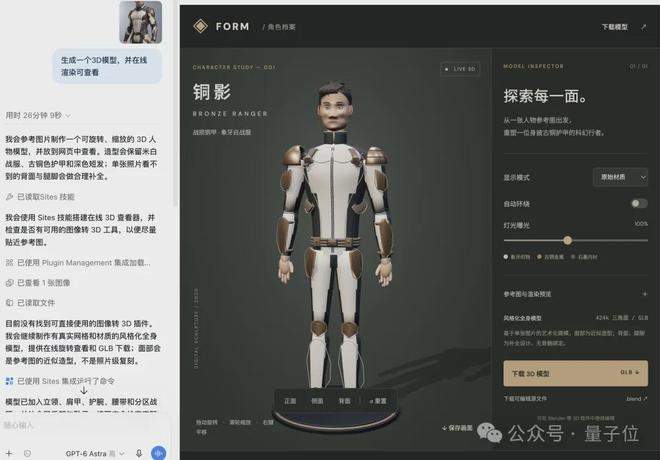
The overall form appears relatively crude, and the facial structure strays noticeably from the texture and feel of the original image.
And this is the result generated by Hi3D V3.0:
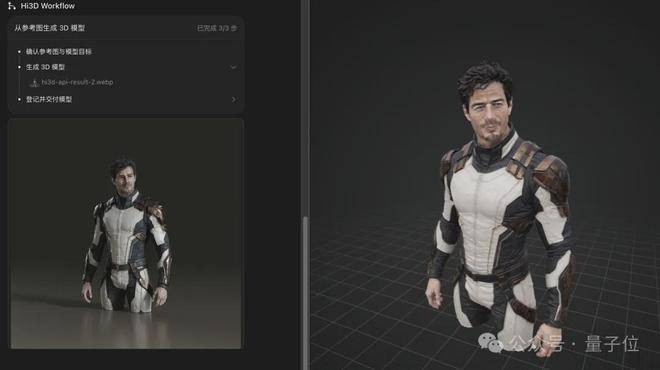
Both level of detail and fidelity are noticeably superior.
Take a look at several other comparison tests:


From left to right: input reference image, GPT-6 Astra generation result, and Hi3D Agent generation result.
As the comparison shows, Astra merely produces a recognizable basic silhouette, whereas Hi3D Agent and its underlying V3.0 model remain far truer to the reference image in terms of proportions, volume, and intricate local details.
Hi3D Agent is an AI creative assistant tailored for 3D creators by Hi3D. Its underlying engine, the newly released Hi3D V3.0, is the industry’s first domestically developed AI 3D foundation model to reach a commercial-grade ultra-high resolution of 2048³.
This performance highlights the division of labor between the two model paradigms: Large language models excel at understanding creative intent, deconstructing tasks, and orchestrating workflows, while specialized 3D models focus on generating high-fidelity 3D assets. Only by combining the two can an agent accurately translate a user’s vision into tangible 3D assets.
Today, Hi3D also officially open-sourced the V1.0 model code. Built upon Sparc3D, this release focuses on high-resolution geometric refinement and represents an earlier milestone in the Hi3D series that has been thoroughly validated across production pipelines.
According to the team, V1.0 was trained on approximately 2 million curated, high-quality 3D assets and underwent rigorous testing across internal production workflows prior to its public release.
The team aims to offer this mature, battle-tested version as a solid foundation for developers and enterprises to explore, deploy, and build upon.
- GitHub Repository: https://github.com/hi3d-official/Hi3Dv1.0
- Hugging Face Space Demo: https://huggingface.co/spaces/ilcve21/Sparc3D (Free demo for Hi3D V1.0)
- Hugging Face Model Weights: https://huggingface.co/hi3d-official/Hi3Dv1.0
- Official Open-Source Project Page: https://www.hi3d.ai/hi3d-1-0-open-source (Source code download and free trial available)
Generate, Refine, Deploy: Hi3D Takes on the Full Creative Pipeline
The newly open-sourced Hi3D V1.0 traces its technical roots back to Sparc3D, unveiled in 2025.
Published at NeurIPS 2025, that research introduced a high-resolution 3D modeling framework designed specifically to tackle the representation and high-fidelity reconstruction of intricate geometric structures, preserving minute components and fine surface details.
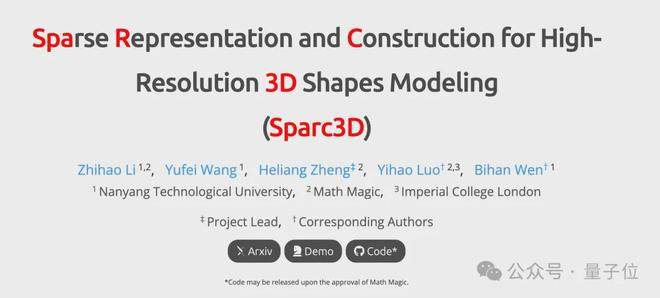
In practice, Sparc3D demonstrated exceptional prowess in capturing and reconstructing complex geometric details.
Hi3D V1.0 builds on this core architecture, scaling the training assets to roughly 2 million and further boosting its high-resolution geometric generation capabilities.
Here is a closer look at its actual performance:
In the armored vehicle case study showcased in the V1.0 technical report, the model demonstrates impressive complete 3D reconstruction capabilities:
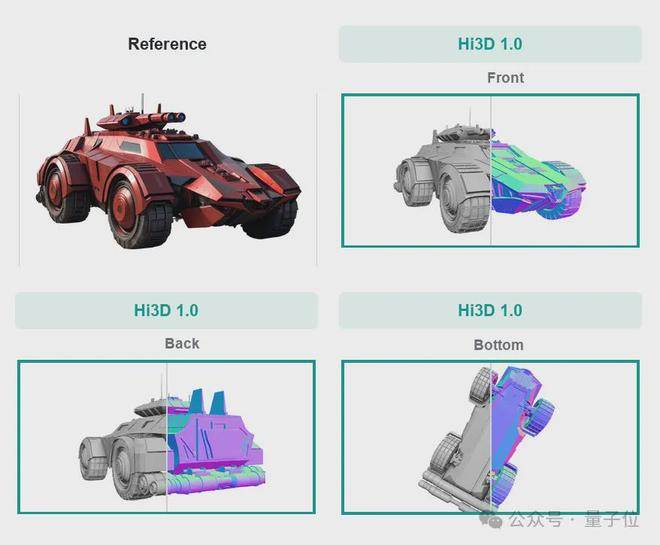
From the front view, the sloped armor plating and tire treads are sharply rendered. Switching to the rear and undercarriage perspectives, the vehicle’s structural integrity remains coherent and natural—the segmented panels at the rear and the spatial alignment between chassis and wheels are accurately maintained.
For occluded angles unseen in the reference image, the model synthesized completions that logically adhere to mechanical and engineering principles.
When faced with more intricate structures—such as a sculpted warrior in armor, wielding a greatsword, with wings unfurled:
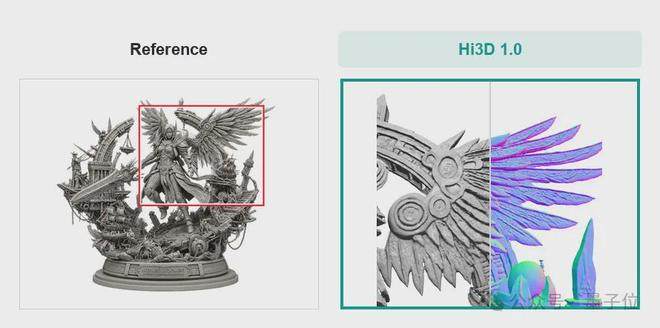
After refinement and upscaling with V1.0, individual feathers on the wings become distinctly articulated, and the layered, overlapping contours are faithfully preserved.
From the macro-level mechanical topology of an armored vehicle to the micro-level crevices between plumage, these examples underscore V1.0’s superior geometric fidelity across different scales.
After initial generation, creators can leverage Hi3D Agent for iterative refinement.
Powered by professional-grade AI 3D models, Hi3D Agent covers the end-to-end pipeline: intent comprehension, task planning, model generation, iterative editing, engineering optimization, and final deployment.
For instance, when a user points out floating components or flawed joints, requests steering wheel adjustments, and specifies that the asset will be 3D printed:

The Agent deconstructs the request into subsequent processing steps, dynamically tuning the shape, local topology, geometric structures, texture maps, and mesh distribution to converge on the target specifications.
In gaming and interactive scenarios, the Agent can generate characters, props, and environment assets on demand, importing them directly into interactive environments to accelerate prototype demos.
For animation and real-time applications, Hi3D Agent supports mesh optimization, skeletal rigging, motion capture retargeting, and facial blendshape driving, enabling static models to plug seamlessly into production pipelines.
In physical manufacturing, Hi3D Agent integrates capabilities such as part disassembly, snap-fit joint design, color separation, and slicing preparation, quickly transforming digital assets into ready-to-produce figurines and collectible toys.
Furthermore, generated assets can be exported in industry-standard formats, making it easy for creators to import them into Blender, game engines, or other specialized tools for deeper downstream editing.
From initial generation to meticulous polish and downstream integration, Hi3D supports every stage of production, helping users turn ideas into production-ready assets with maximum efficiency.
Details on how the team achieved breakthroughs in both structural integrity and fine detail are outlined in their technical report, which provides in-depth training mechanics and benchmark data.
Scaling Data and Refining Geometry: Technical Upgrades in Hi3D V1.0
Building upon the Sparc3D architecture, Hi3D V1.0 focuses on deep optimizations in dataset scale and high-resolution generative capacity.
While retaining the core framework, engineering efforts were concentrated across three dimensions: training data expansion, high-resolution generative training, and validation within real-world production pipelines.
First is expanding the training data. Compared to the 500,000-asset dataset in the original Sparc3D paper, Hi3D V1.0 scaled its training set to roughly 2 million curated 3D assets—a fourfold increase.
This directly addresses the fundamental challenge of single-image-to-3D generation: a single image provides only a limited view, leaving back surfaces and occluded areas heavily reliant on geometric priors learned by the model. A massive and diverse dataset equips the model with richer shape priors, offering robust support for inferring unseen perspectives.
With massive data in place, how does the model progressively capture fine details?
As illustrated in the architecture diagram, the pipeline can be summarized as: first establishing macro-level topology, then progressively refining geometry against the input reference.
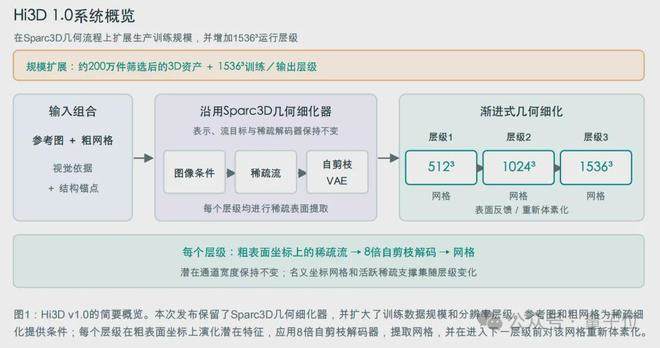
The upstream model first generates a low-poly coarse mesh from the input image, defining the object’s overarching silhouette and key structural components. Next, V1.0 fuses features from both the reference image and the coarse mesh to perform sparse geometric refinement across the surface.
After each refinement stage, the system extracts a 3D mesh at the current resolution. This mesh can either be exported directly as the final output or serve as the baseline for the next stage, progressively scaling up to 1024³ and 1536³ resolution spaces.
Here, 1536³ refers to the grid resolution for geometric extraction. Think of it as a resolution scale in 3D space: the denser the grid, the more realistic the surface relief and minute crevices. By employing a sparsification strategy, the algorithm concentrates compute power strictly on active regions near the surface. The distinct feather-by-feather articulation seen in earlier examples is directly enabled by this ultra-high-resolution capacity.
Currently, the flagship Hi3D V3.0 pushes geometric resolution even further, reaching 2048³.
Beyond resolution, the model demonstrates marked advantages across general benchmarks and downstream usability metrics.
According to the technical report, Hi3D V1.0 achieved scores of 0.75 in multi-view fidelity and 0.841 in detail richness, ranking first across all mainstream baselines evaluated.
Meanwhile, its slicing success rate reached 90%, proving high geometric readiness for 3D printing workflows.
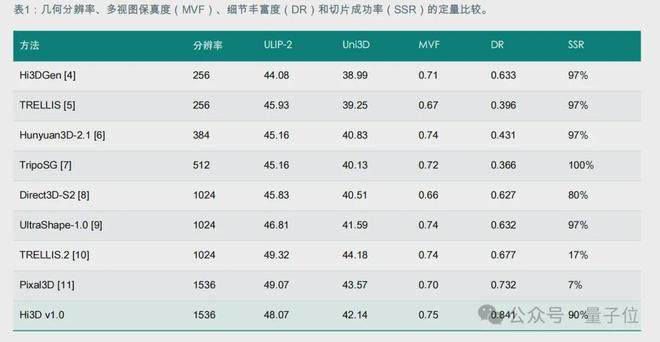
△ Source: Hi3D V1.0 Technical Report
Slicing is the critical pre-processing step that converts a 3D digital model into layer-by-layer toolpaths for a 3D printer. A 90% slicing success rate verifies that the generated mesh quality is clean enough to feed directly into 3D printing pipelines (though physical print quality remains subject to manufacturing parameters like wall thickness, support structures, and filament properties).
According to the team, V1.0 underwent extensive validation in real-world production environments prior to being open-sourced. Beyond visual rendering quality, the team focused heavily on evaluating the usability and editability of generated assets across downstream workflows.
Open-Sourcing Models and Tool Interfaces: Empowering Developers and Enterprises to Build 3D Applications
Hi3D V1.0 is now officially live on GitHub and Hugging Face.
In addition to open-sourcing the full codebase and detailing system architecture and benchmarks, the team also provides an interactive online demo on the project homepage for hands-on testing.
The open-source model targets three primary audiences:
- Researchers: Can use it as a technical baseline and benchmark platform to explore complex topology generation and high-frequency detail preservation.
- Developers: Can integrate its high-resolution geometric refinement capabilities into specialized pipelines to build domain-specific applications and custom workflows.
- Enterprise Users: Can leverage flexible licensing and deployment solutions for on-premises hosting, internal system integration, and tailored industry applications.
Beyond the open-source model, Hi3D fully supports external tool integration via the Model Context Protocol (MCP).
Developers can seamlessly invoke Hi3D from any MCP-compatible agent or tool—submitting tasks, polling statuses, and retrieving models directly—to smoothly embed it into existing workflows.
For end creators, Hi3D Agent provides end-to-end creative support: users simply describe their needs in natural language to collaborate with the Agent on multi-turn iterative model refinement.
Open-source models lay the foundational bedrock, MCP lowers integration barriers for applications, and the Agent eliminates barriers for everyday creators. Together, these three pillars form Hi3D’s comprehensive ecosystem as AI 3D infrastructure.
This aligns with the Hi3D team’s “Creator First” philosophy: lowering the barrier to 3D creation so newcomers can onboard quickly, while freeing professional artists from tedious, repetitive labor to focus on core design and conceptualization.
As AI 3D technology continues to mature, the gap between concept and finished product is shrinking. Whether starting from a rough sketch or an abstract idea, anyone can now bring their own 3D creations to life.