
📄 Paper

Reading a new paper can alter the trajectory of a research idea. Researchers might discover that someone has already implemented their proposed contribution, or spot an unresolved problem within a paper that sparks a fresh direction to explore.
We call this process a literature-initiated pivot: a shift in research direction triggered by reading prior work. It ties together two activities researchers typically handle separately: formulating research ideas and determining which literature to benchmark them against.
Together with collaborators at the University of Pennsylvania, we developed LitPivot, a system designed to help researchers navigate these pivots. LitPivot leverages papers retrieved via Asta Paper Finder to organize relevant literature around the specific section of a proposal being edited. It offers critiques grounded in curated research excerpts and suggests revisions that researchers can adopt, edit, or reject. While designed for early-stage research ideation, this approach can also be extended to longer-form writing tasks (such as drafting paper introductions).
In an evaluation study with 17 researchers, domain experts judged research ideas developed using LitPivot to be more solidly grounded in the literature than those conceived using a text editor paired with conversational AI tools. Participants also found their revised ideas to be more novel and practical, and reported a deeper understanding of the relevant literature.
LitPivot will be presented at UIST 2026 in Detroit. You can read the paper here.
Why Pivoting is Hard
Research ideas evolve through continuous interaction with the literature. By analyzing meeting logs from four completed computer science research projects, we identified 21 literature-initiated pivots across all four projects. These pivots fell primarily into two categories: establishing novelty by distinguishing an idea from existing work, and aligning an idea with existing work to build upon it. This project itself underwent two pivots before finalizing its contributions.
Navigating these shifts can be challenging. In a formative study, five researchers drafted proposals using text editors and standard search tools. They struggled to critically evaluate their ideas against the literature while simultaneously pushing them forward. When a paper challenged the novelty of an idea, they wanted concrete revision suggestions backed by prior work. These insights shaped LitPivot’s evaluation mechanism—pairing literature-supported critiques with actionable recommendations for revising specific facets of an idea.
How LitPivot Works
In LitPivot, researchers begin by drafting a brief proposal in the editor and enabling what we call facet highlighting, which partitions the expressed idea into distinct facets (namely: problem, contribution, and evaluation methodology). To examine a proposed facet, researchers simply click on the corresponding segment of the draft. An adjacent panel groups relevant papers based on the selected facet (e.g., grouping papers by their evaluation methods when the evaluation facet is selected) and highlights the most relevant clusters. Researchers select papers, request an evaluation, and review revision suggestions alongside supporting excerpts for each critique. The literature is then reranked based on its relevance to the revised facet.
Specifically, LitPivot breaks down a research idea into its problem, proposed contribution, and evaluation plan. Each facet maintains its own independent set of relevant literature and relevance ranking. LitPivot clusters retrieved papers around the facet currently being edited, allowing researchers to choose which papers the system should use to evaluate the draft.
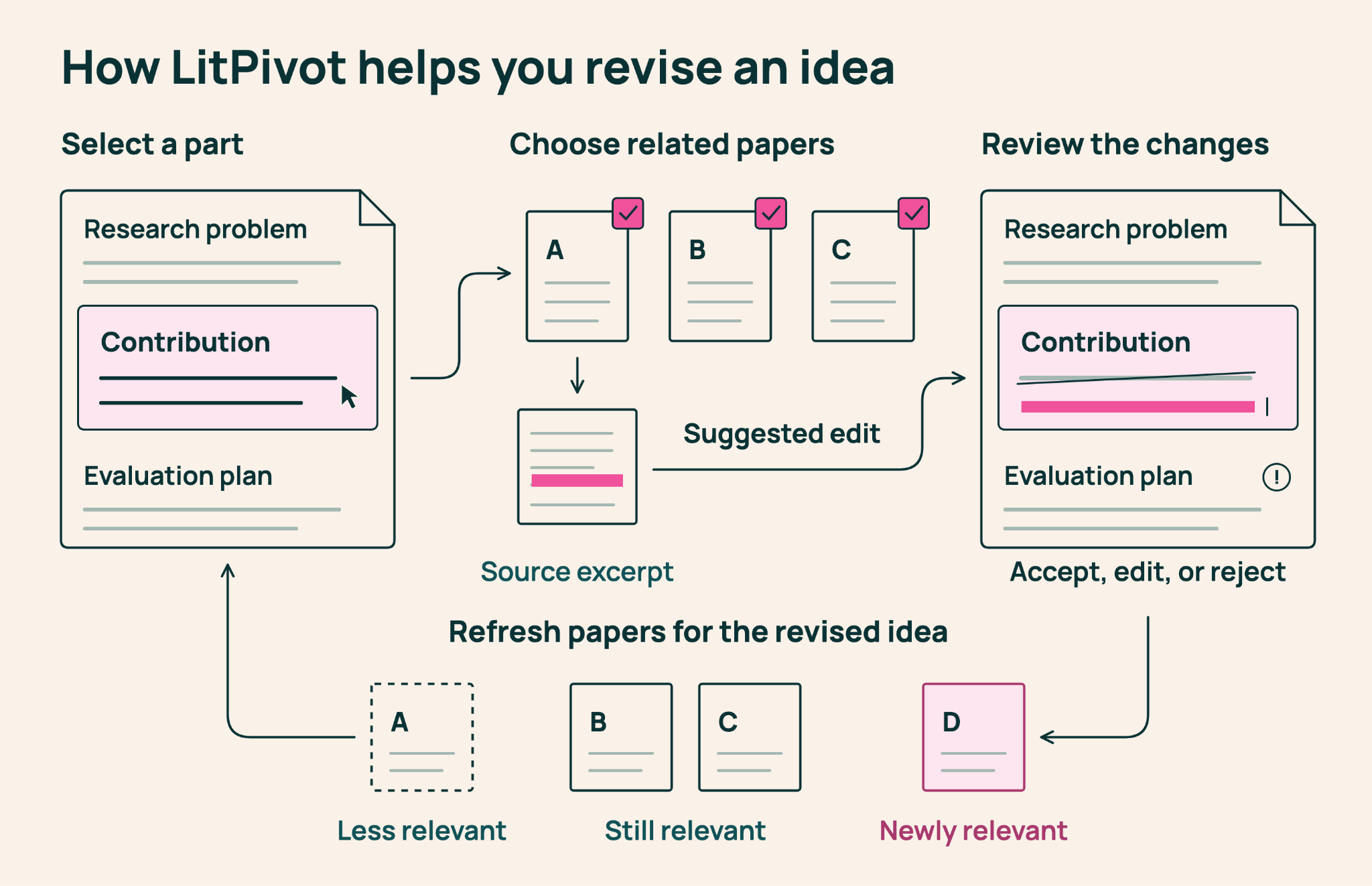
Similar to scientific writing environments like Prism and agentic assistants like Claude Code, LitPivot explores a new workflow for developing early research ideas: selecting literature for evaluation, revising based on that evidence, and reconsidering which papers are relevant as the idea evolves. Its paper clustering and associated critiques make these steps more explicit across different parts of the proposal, all while keeping researchers firmly in control of both the draft and the evidence used to critique it.
For the problem statement, LitPivot looks for evidence demonstrating that the problem is real and significant. To evaluate the proposed contribution, it examines what selected papers have already…