
AI models are solving an increasing number of hard math problems. Behind their string of successes, a pattern is beginning to emerge that can help us predict which problems they might solve next.
Oct 23 · 16 min read
In May of this year, an internal OpenAI model found a counterexample to Erdős’s unit distance conjecture. The conjecture had stood open since 1946; where many experts had attempted to prove it, OpenAI found a counterexample instead. A month later, OpenAI published a proof of the Cycle Double Cover (CDC) conjecture, followed by solutions to ten more open problems before July. In September, they published proofs related to the Navier-Stokes equations. Anthropic also announced the formalization of Fermat’s Last Theorem and advancements on the bounds of the Riemann Hypothesis. AI models are suddenly getting exceptionally good at math.
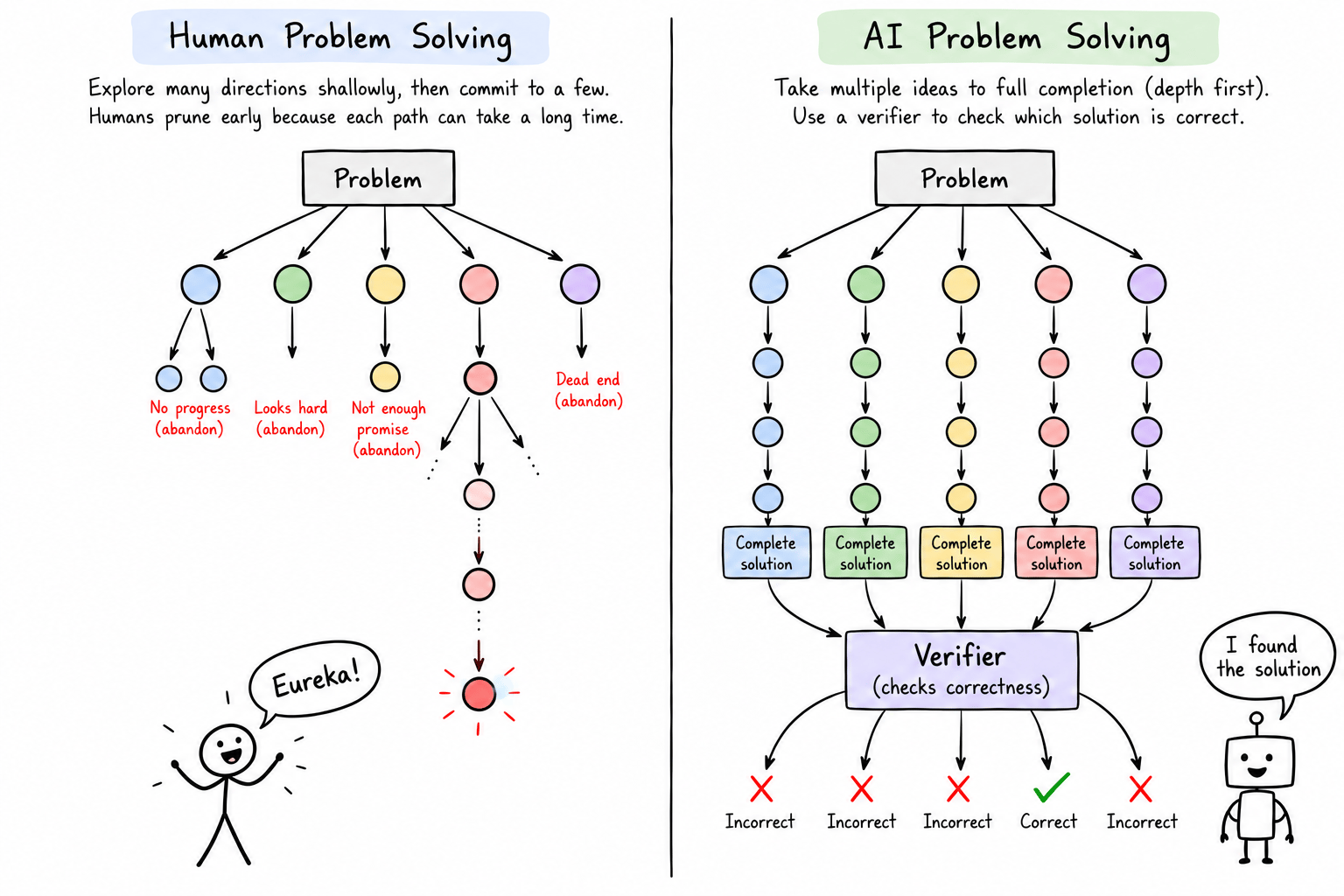
The question that really interests me is: can we predict what kinds of problems these models will actually be able to solve? What makes a problem solvable by an LLM, and what do these solutions have in common? If AI solves problems differently than humans do, understanding that difference will help us decide where to direct its compute. The unit distance counterexample has sparked the richest discussions, so let’s start there.
Problem Complexity
Here is a simple mental model: solving any given problem requires a sequence of hints or insights, separated by a lot of work. This pattern fits everything from trivial everyday questions surprisingly well to complex theories like general relativity 1 (see the easter egg at the end). The sequence looks roughly like this:
Insight -> Time / Effort -> Insight -> Time / Effort -> Solution.
Experts have more background knowledge than beginners, so they need fewer hints. W. T. Gowers took a similar approach in his commentary on the unit distance proof: the difficulty of a proof equals the length of the shortest sequence of hints required for an expert to reconstruct it. He called this “Kolmogorov complexity modulo experts” 2. For the unit distance problem, his sequence of hints breaks down into three parts:
-
Look for a counterexample.
-
Take the best-known construction and generalize it.
-
Try a sequence of number fields of increasing degree, but work modulo prime ideals with bounded norm.
Gowers’ proposed complexity formula is 2^k + t, where k is the length of the shortest hint sequence, and t is the amount of work required to flesh out the derivation. While this formula appears rigorous, its abstract nature becomes obvious as soon as you try plugging in real numbers—which hits right at the core: problem complexity grows exponentially with the number of insights required to solve it.
Most of problem-solving is actually the heavy lifting done between these insights. You have a “eureka” moment, and then you spend months following up on that hint before the next conceptual leap becomes possible. For an expert, the time spent is an effective proxy for this work—represented by t. Even if someone were handed the first hint about unit distances directly, they would still have to put in substantial legwork to arrive at the generalized construction.
While this model is useful, it is inherently post hoc. You cannot look at a problem at first glance and reliably predict that it will take x hints to solve. Consequently, how long a problem has stood open, how many attempts have been made to solve it, and the bounty offered for its solution are often used as real-world proxies to gauge its difficulty.