
Alibaba Group’s Amap Officially Releases λ0: The First Whole-Body Foundation Model Based on Open-World Behaviors
Recently, Amap, a subsidiary of Alibaba Group, officially released λ0, the first whole-body foundation model based on open-world behaviors. Relying solely on human action data, this model enables robots to autonomously learn whole-body coordination across locomotion, posture, and bimanual manipulation, breaking completely free from the constraints of localized action learning. In the SIMPLE simulation benchmark and multiple real-robot evaluations, λ0 achieved state-of-the-art (SOTA) performance: its data collection efficiency is approximately 3.4 times that of mainstream approaches, and its real-robot task success rate surpasses the strongest baseline by 22.5%.

As embodied AI increasingly transitions into open environments such as homes, retail stores, and warehouses, robots no longer face isolated manipulation tasks performed from static poses. Instead, they must continuously coordinate whole-body movements to accomplish complex, long-horizon tasks.
However, existing technical approaches struggle to balance the collection and learning requirements of whole-body coordinated robotic data. On one hand, traditional real-robot teleoperation heavily relies on specialized hardware and manual resets, incurring prohibitive scaling costs. On the other hand, existing first-person VLA (Vision-Language-Action) foundation models generally lack coordinated whole-body motion information; their data is often confined to localized interactions of the hands or arms, lacking whole-body dynamics such as joints, torso movement, and poses. In open scenarios and complex tasks, this “fragmented” motion-learning paradigm has become a core bottleneck constraining general robot capabilities and task success rates.
To address this, λ0 pioneered a technical framework combining “embodiment-free whole-body data collection + software-hardware co-designed human-robot alignment” to systematically tackle the multifaceted challenges of collection efficiency, whole-body coordination, and cross-embodiment transfer in open environments.
In terms of cost and efficiency, embodiment-free whole-body data collection frees λ0 from heavy reliance on expensive robotic hardware. Operators only need to wear consumer-grade devices to capture data on the go in everyday environments. Compared to conventional robot-embodiment collection, this approach slashes the single-demonstration collection time for representative tasks from approximately 100 seconds to 29 seconds, boosting collection efficiency to roughly 3.4 times the baseline.
Regarding whole-body motion learning and alignment, λ0 leverages a software-hardware co-designed data collection architecture to comprehensively record and align visual, body displacement, and hand manipulation data across the entire body. Combined with a three-stage training pipeline—“hand interaction, whole-body coordination, and humanoid embodiment”—it progressively converts human experience into whole-body robot control commands. Based on this scalable data pipeline, Amap constructed the HumanVerse-500 dataset, comprising 500 hours of open-world, embodiment-free whole-body data.
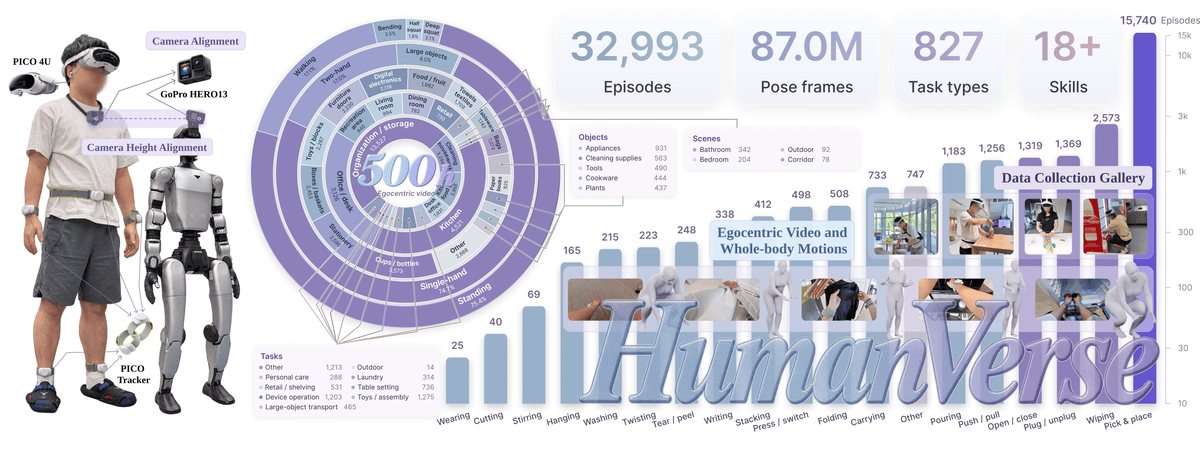
(Construction and panoramic overview of the HumanVerse-500 dataset)
To resolve the transfer challenges stemming from human-robot morphological discrepancies and end-effector execution deviations, λ0 incorporates a dedicated viewpoint matching mechanism and a coarse-to-fine motion alignment algorithm across collection, processing, and action execution. This design significantly enhances physical contact precision while fully preserving whole-body motion coordination.
In cross-morphology transfer and data scaling, λ0 achieves zero-shot transfer on physical robots across seven tasks requiring whole-body coordination and long-horizon mobile manipulation, relying solely on human action data. Experiments demonstrate that given the same volume of robot demonstration data, scaling up human whole-body data leads to substantial improvements in real-robot task performance. This confirms that systematically amassing human whole-body data at scale is an effective pathway to elevating real-world humanoid robot performance.
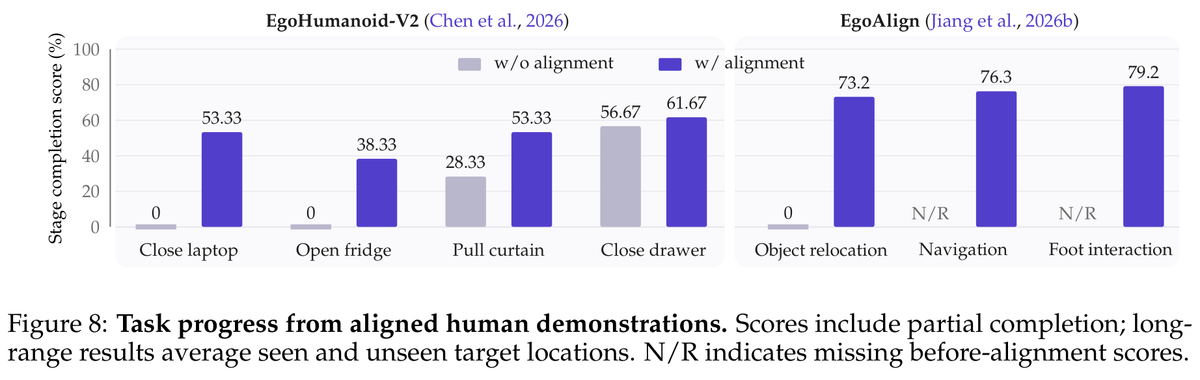
(Task progress aligned with human demonstrations across seven tasks)
This research was conducted jointly by Amap and Alibaba’s ATH Business Unit. From lightweight, hardware-free data collection to precise human-robot observation and motion alignment, and ultimately to generalization validation on real robotic platforms, λ0 successfully closes the complete technical loop for transferring whole-body human motion expertise to humanoid robots. This lays a solid foundation for robots to learn and execute whole-body coordinated tasks across broader open-world scenarios such as facility inspection and logistics.
Currently, the hardware configuration code for λ0 has been open-sourced on GitHub, and sample data from HumanVerse is available on HuggingFace for developers and researchers to explore directly.
Related Links:
- Project Homepage: https://lambdahumanoid.github.io/
- Technical Report: https://arxiv.org/abs/2610.18950
- GitHub: https://github.com/LambdaHumanoid/openlambda
- HumanVerse Data Sample: https://huggingface.co/datasets/lambda-humanoid/HumanVerse-500-sample