
Turn a Room into a Grassland in Seconds, Make It Snow with a Wave of a Hand
A real-time world model born out of a domestic virtual production studio has won an award on NVIDIA’s stage.
On October 15, the semi-finals of the 2026 NVIDIA Inception Showcase took place at Jinji Lake in Suzhou. Dawa Technology from Chongqing took home the “Showcase Excellence Award” for its real-time world model product, Scenes AI.
This year’s competition hosted 11 regional events across China, attracting over 580 tech startups. In the end, only 30 NVIDIA Inception member companies qualified for the semi-finals.

Unlike most video models that compete over “how realistic the next frame looks,” Scenes AI takes a fundamentally different path:
Instead of directly predicting the next frame, it maintains a continuously running world state—where the scene, characters, camera, lighting, objects, and physical laws each serve as an independently readable and writable set of variables.
When a subtle change occurs in the world, the model does not need to scrap and redraw the entire scene. It only needs to update the specific local state that changed and write the result back into the world, allowing the next moment to evolve on top of it.
Consequently, the core question it answers shifts from “What does the next frame look like?” to “If a certain variable in the world changes, how will the world evolve next?”
More importantly, its input is neither a game engine feed nor a virtual agent, but a physical space captured by an ordinary camera.
In Dawa’s own words: “A video is an output. A world is a process.”
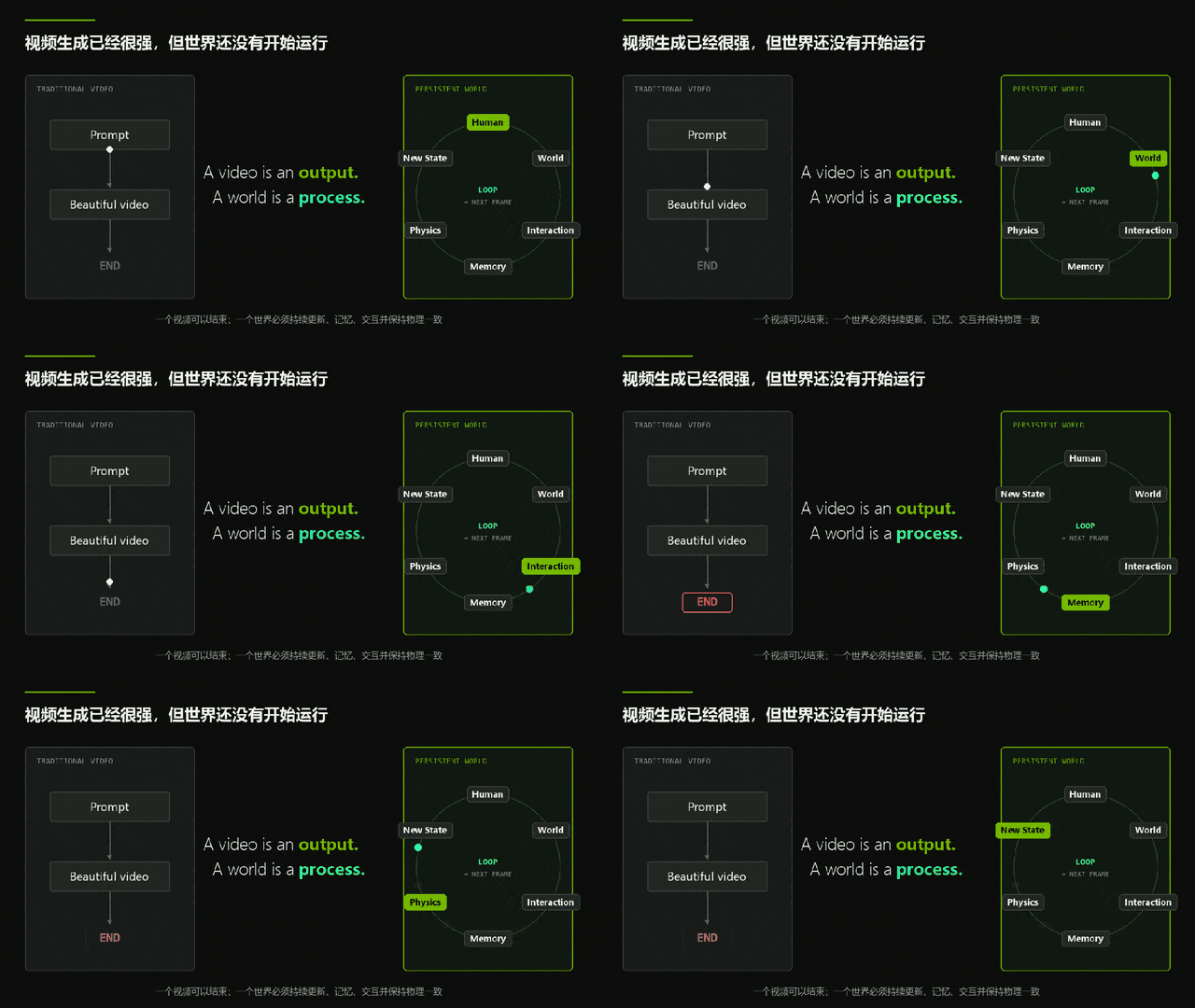
First, the Results: Reshaping an Entire World or Repainting a Single Wall
Take a look at the newly released demo.
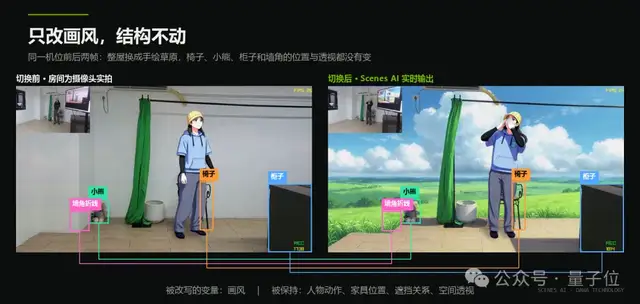
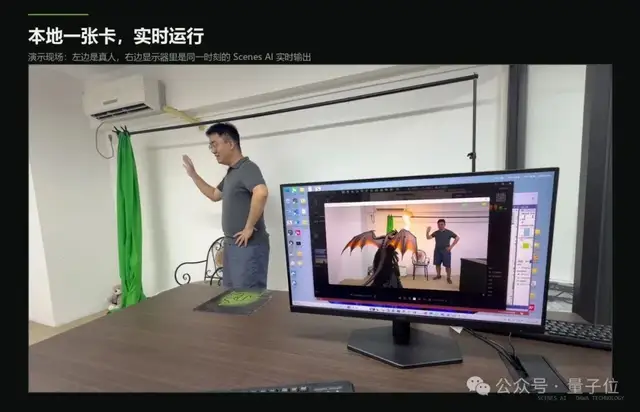
In the top-left corner is the real room captured by the camera in real time: white walls, a green screen, a wrought-iron chair, a stuffed teddy bear in the corner, and a real person standing in the middle adjusting their hat brim.
The main screen shows the model’s output at the very same moment: the room is rendered into a hand-drawn summer grassland, and the person seamlessly transforms into an anime girl wearing a yellow baseball cap, mirroring every motion in real time.
A closer look reveals that only the visual style has changed. The chair remains behind the girl, the teddy bear still sits in its original “corner,” and the spatial position and perspective of the dark cabinet on the right remain completely intact. You can even faintly see the seam where the two walls meet projected onto the grass.
Challenge 1: Full-Scene Rerendering Without Breaking Structure
In this frame, the only modified variable is the “art style.”
Character movement, furniture placement, occlusion relationships, and spatial perspective are all locked as preservation conditions. The model must first accurately identify key subjects—the person, chair, doll, and cabinet—hold them firmly in their physical locations while transforming the overall visual style of the space, and guarantee logical consistency across every single frame.
Challenge 2: Local Editing with Persistent Memory
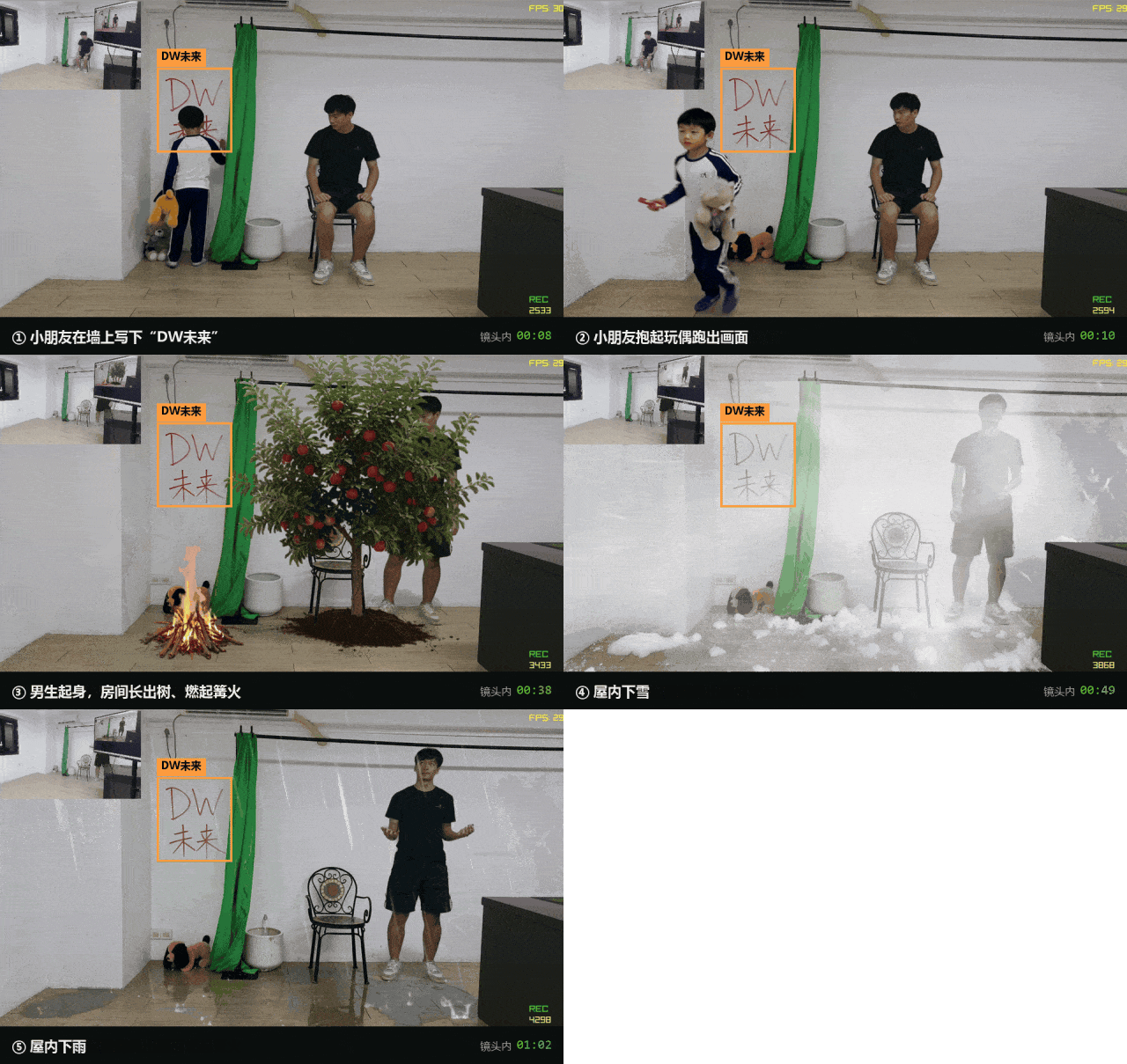
In the same scene, a child writes “DW Future” on the wall, picks up the teddy bear, and runs off-screen. A young man then stands up; trees sprout from the floor, and a campfire ignites on the ground. Next, he raises his hand to control the weather—snowflakes begin fluttering through the room, quickly shifting into a heavy downpour.
Throughout this sequence of events—people entering and leaving, new objects generating, and weather shifting repeatedly—the four words on the wall remain clearly intact, down to the exact stroke and position.
This tests whether the model can write the world state back accurately and sustain it over time.
For models relying on frame-by-frame generation, the more dynamic changes there are in a scene, the easier it is for prior details to wash away; every redraw risks detail drift. In Scenes AI, however, the moment the words are written on the wall, they are committed as a persistent part of the world state. From then on, no matter how the environment changes, that state persists unless an event explicitly modifies it.
This same underlying logic was demonstrated in its initial September debut: after a snow monster burst out of the ground and left, the crater in the floor remained permanently; the wrought-iron chair was twice transformed into a wolf-headed Iron Throne, yet the host could still sit down in the exact spot; the bottom of the curtain caught fire, yet adjacent plush toys and potted plants remained completely unaffected.
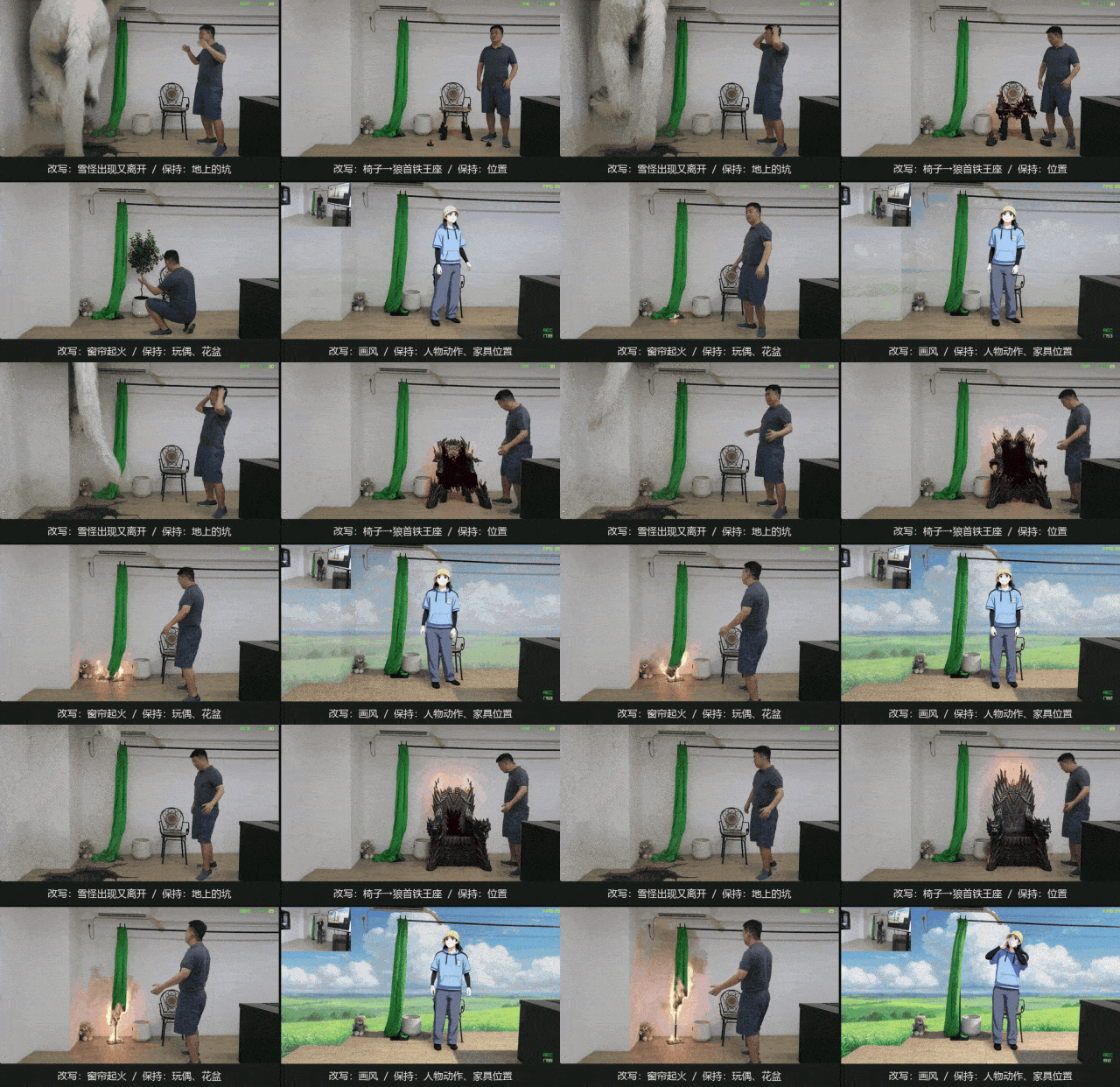
The entire real-time generation pipeline runs on a single consumer-grade local RTX GPU, with the rendering frame rate displayed live in the top-right corner.
A Differentiated Path: From “Redrawing the Next Frame” to “Updating World States”
Behind the demo lies Dawa’s fundamental assessment of where world models stand today:
Video generation tech is already powerful enough, but the world itself has not yet truly started running.
The end deliverable of mainstream video generation is often a “static output”: feed in a prompt, generate an exquisite video clip, and inference concludes.
Even when applied to continuous frame-by-frame rollouts, the core focus remains on “what the next frame looks like.” As a result, errors in identity, geometry, lighting, and physical laws compound over time.
Dawa defines a world model differently: When a state variable changes, why does the world change, and how will it evolve?
Take “changing the lighting to a sunset” as an example:
- Traditional video models: Regenerate the entire video, risking drift in scene layout, character appearance, camera angles, and object shapes.
- Scenes AI: Freezes the scene, characters, camera positions, and objects as preservation conditions, adjusts only the “lighting” variable, and generates new frames based on the updated world state.
Dawa summarizes this technical paradigm as: “Modify one variable, preserve the entire world.”
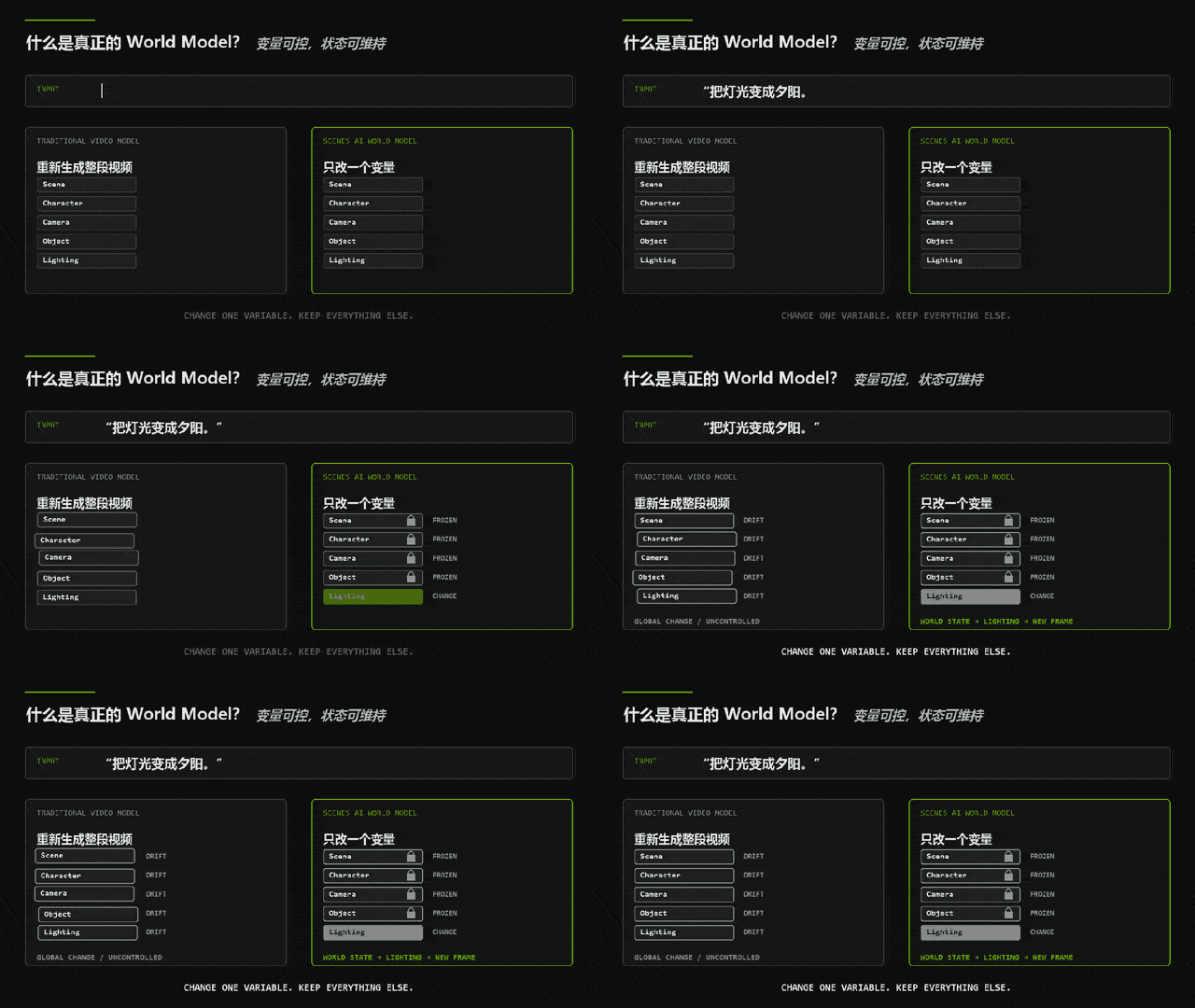
At the computational level, this translates from “redrawing the next frame” to “updating the state delta ΔS”—computing only the local areas that have changed, while keeping the rest of the world state stable, queryable, and predictable.
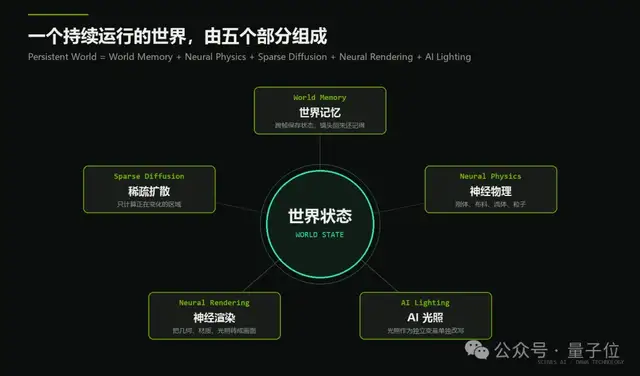
Under this definition, an ongoing, persistent world is deconstructed into five key modules:
Persistent World = World Memory + Neural Physics + Sparse Diffusion + Neural Rendering + AI Lighting
That is: World Memory, Neural Physics, Sparse Diffusion, Neural Rendering, and AI Lighting.
The Dawa team believes that making the leap from “generating static videos” to “running interactive worlds” requires breaking through five core barriers simultaneously:
Cross-frame long-term memory, precise localized controllability, physical laws and causal relationships, real-time computational efficiency, and data assets capable of explaining “why the world changes this way.”
They point out that the technical hurdle is not simply stacking up larger model parameters, but ensuring that state, control, physics, and compute efficiency hold true all at once.
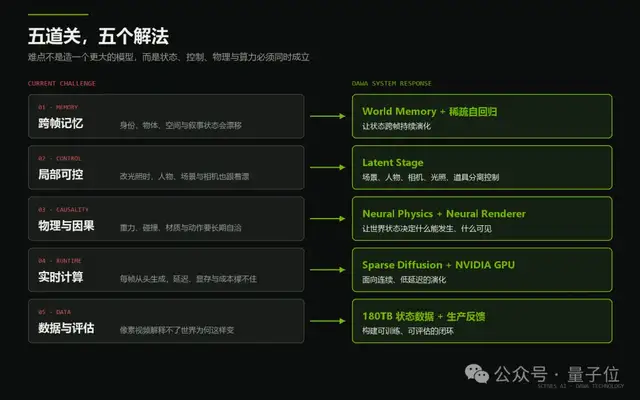
The fine-grained control and real-time rendering capabilities detailed below represent this architecture’s answer to the twin challenges of “control” and “compute.”
Technical Architecture: Heavy Control Layer, Light Generation Layer
To turn this logic into an engineering system, Dawa adopted a core strategy: make the control layer heavy, and the generation layer light.
Instead of offloading all inference pressure onto a single model to redraw frame by frame, Scenes AI builds a state-centric control system between “creative intent” and “image generation”—which it calls the Video Generation Control Layer.
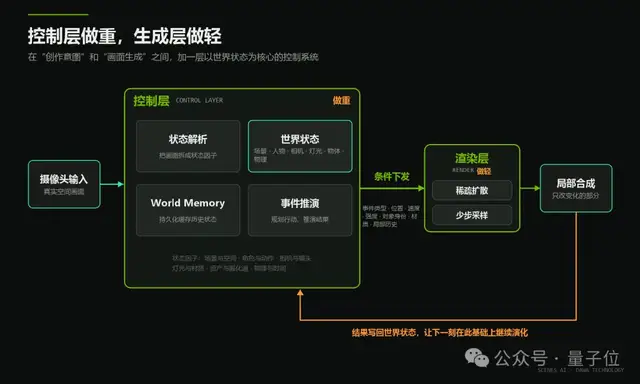
- Control Layer: Disassembles continuous video streams into queryable, updatable, and constrainable state factors—including spatial scenes, character actions, camera setups, lighting materials, assets/props, physical laws, and temporal flow; handles motion planning, state maintenance, and causal deduction.
- Rendering Layer: Takes state instructions dispatched by the control layer, generates only the parts that need to change, and composites them back into the global frame.
Its typical operational pipeline is:
World State → Action/Contact Event → State Update → Local Generation & Composition → Result Write-Back.
Taking the “DW Future” demo as an example:
- When the child writes on the wall, the event layer identifies the writing motion and its point of contact (the wall).
- The control layer updates the world state accordingly, binding the property “wall contains writing” to the wall entity.
- When trees subsequently sprout, campfires burn, and rain or snow falls, the control layer only updates the corresponding environmental and weather variables. The rendering layer only needs to generate the trees, fire, rain/snow, and their associated lighting changes, while directly reusing the established representations for the wall and writing.
- Rain and snow are transient dynamic changes that cease once the event ends; the writing on the wall, by contrast, is committed as a persistent state in the world, available for subsequent viewpoints and interactions to call upon continuously.
The crux of this mechanism lies in defining the boundary between “transient changes” and “persistent states”:
The former can be handled on the fly by the rendering layer, while the latter must be written into the world state. In the demo, the “persistent crater” and “unfading handwriting” both stem from this tiered state maintenance mechanism.
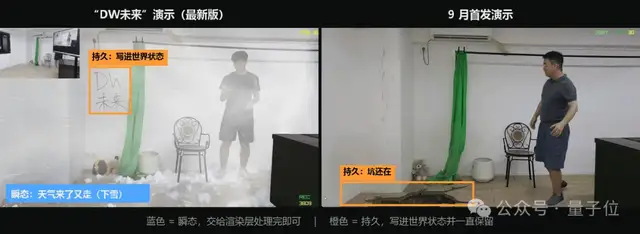
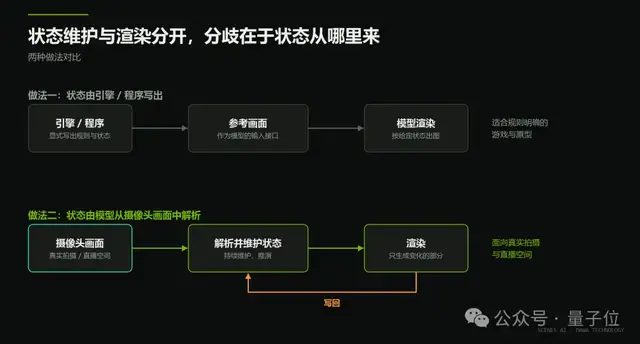
From an industry perspective, decoupling state maintenance from visual rendering is becoming a shared consensus for real-time world models. The core divergence lies in how states originate:
One approach relies on upstream game engines or procedural rules to explicitly define states, where the model only renders based on reference frames—a better fit for games and prototyping where rules are rigid and explicit.
Scenes AI directly targets real-world live shooting and broadcasting scenarios. Its world state must be parsed and extracted in real time from a live camera video stream, followed by continuous maintenance, deduction, and write-backs.
Precise Control: Altering a Single Variable While Preserving Everything Else
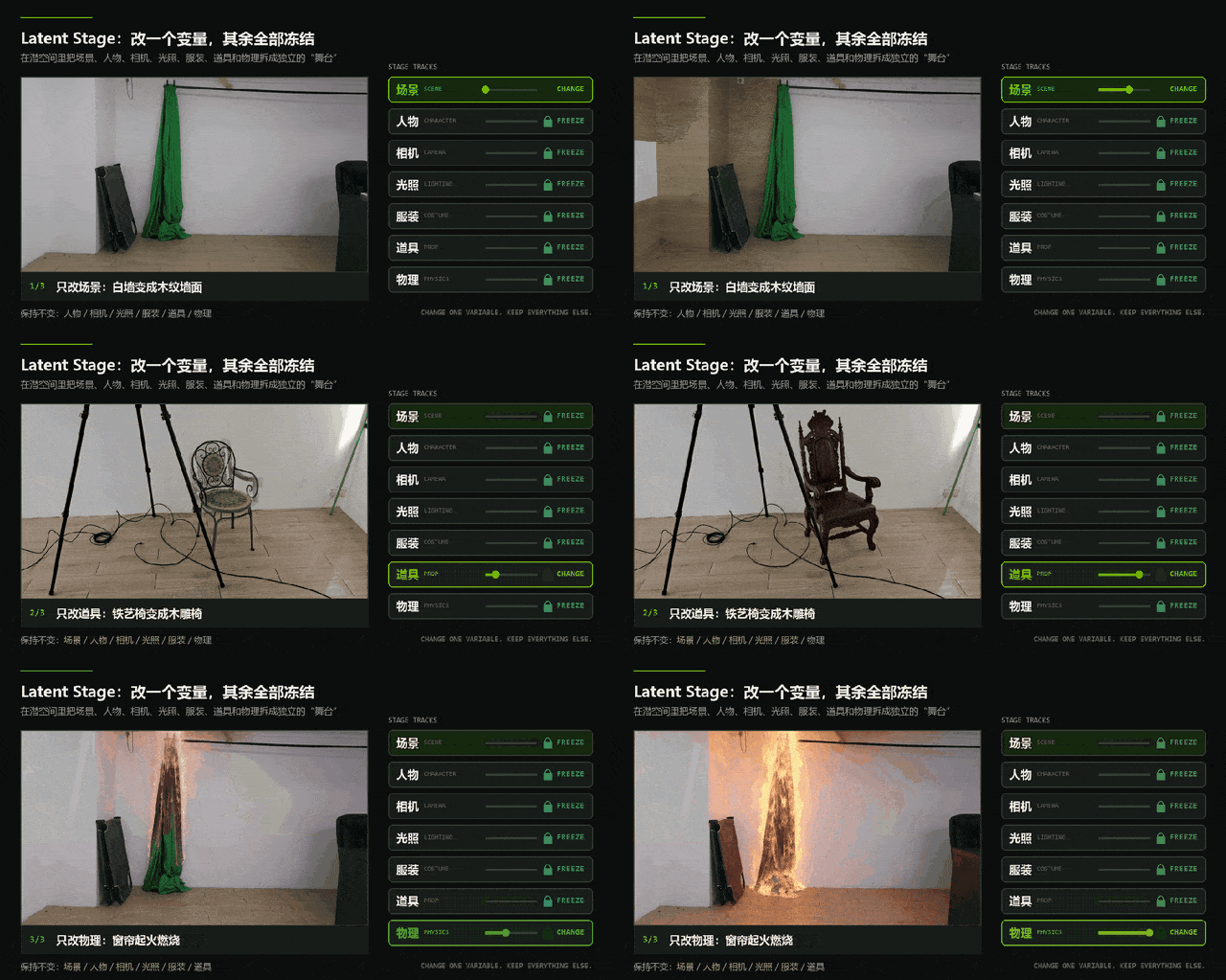
Achieving precise control hinges on the control layer’s Latent Stage module.
First, variable decoupling.
Latent Stage decomposes the scene, characters, camera, lighting, wardrobe, props, and physical laws within latent space into multiple independent “virtual stages.” Each factor can evolve independently or constrain others collaboratively.
Every editing operation clearly delineates between a “mutation set” and a “preservation set”: when adjusting lighting, the scene geometry, character pose, and camera parameters are fully locked; when swapping costumes, the character’s identity features and body movements continue to constrain image generation.
In the demo, the room’s art style changes dramatically while furniture remains down-to-the-pixel identical—a direct result of completely decoupling the mutation set from the preservation set.
Second, the non-linear view matrix.
Dawa introduced a non-linear view matrix fusion method that transforms video from a “linear temporal stream” into a “multi-dimensional editable matrix”: characters, environments, cameras, lighting, objects, and motions are deconstructed into recomposable visual elements, allowing the control layer to accurately interpret camera movements and achieve seamless real-virtual fusion.
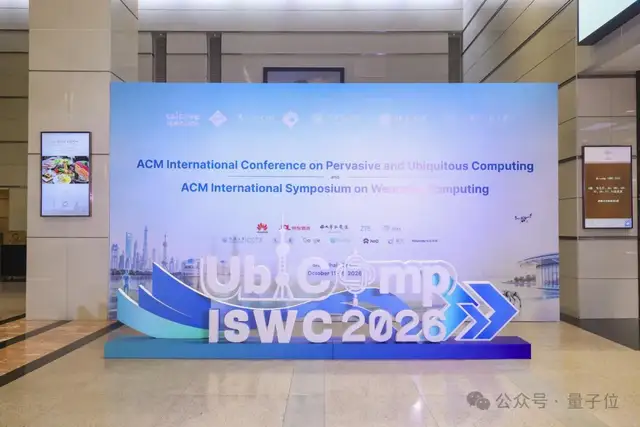
The related paper, NVD: Non-Linear View Matrix Fusion for 2D Video Using Multimodal Foundation Models, was accepted by ACM UbiComp / ISWC 2026 and presented on-site at the Shanghai International Convention Center on October 13. The work was co-authored by the Dawa AIGC Research Institute alongside the Hong Kong Polytechnic University, the University of Illinois Urbana-Champaign, and Newcastle University.
Third, long-term world memory.
The World Memory module persistently caches historical state fragments, providing an instantly retrievable and updatable context for downstream generation.
When the camera pans away and returns to the same area, the model prioritizes fetching historical state records of that area rather than generating a wall out of thin air.
Dawa regards long-horizon temporal memory as the single most critical challenge today—character identities, spatial geometry, physical causality, and narrative states must remain strictly consistent across time.
The team believes that without a causal memory mechanism, merely stacking compute clusters will not solve the fundamental problem.
Fourth, hard physical constraints.
Neural Physics covers rigid bodies, cloth, fluids, and particle systems, establishing generative constraints centered around collisions and gravity. It tightly bounds fire propagation margins and cloth stress deformation paths; the Neural Renderer then translates geometric shapes, material properties, and ambient lighting into the final image.
Physical states thus become the unified ground truth for generation, training, and evaluation pipelines, overcoming the limitations of relying purely on video pixel fitting.
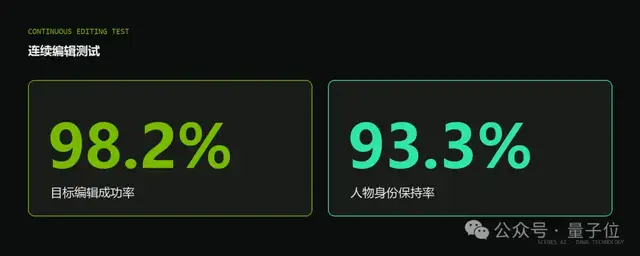
In continuous editing benchmarks, Scenes AI achieved a 98.2% target editing success rate and a 93.3% character identity preservation rate.
Real-Time Rendering: Focusing Compute Exclusively on Changing Regions
The rendering layer is driven by its real-time generative model, LiveStage, designed with a crystal-clear objective:
Under the compute and VRAM constraints of a single consumer-grade graphics card, deliver continuous, low-latency, and stable real-time outputs tracking real-person movements.
1. Sparse Diffusion Autoregression
The autoregressive mechanism ensures continuous temporal rollout across frames, while sparse computation strictly limits the update scope of each iteration step. This means the model’s predictive core targets “state deltas” rather than synthesizing entire new frames from scratch.
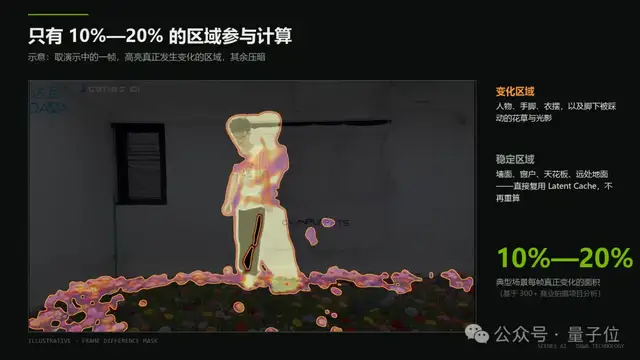
Based on in-depth analyses of over 300 real commercial production projects, Dawa discovered that the regions undergoing substantial frame-to-frame change in typical scenarios account for only 10% to 20% of the total canvas.
Consequently, static backgrounds like walls and floors are directly reused via Latent Cache, enabling system compute to focus intensely on core interaction regions such as character subjects, facial expressions, hand gestures, clothing drapery, smoke flow, and lighting gradients.
2. Causal Sparse Micro-Diffusion
The rendering layer receives a set of conditioning parameters from the control layer (covering event types, spatial coordinates, velocity, interaction intensity, target identity, material properties, and localized history), performs low-step sampling inference strictly on the changed regions, and accurately composites the local results back into the global world canvas.
- Causal: Guarantees that every computation step strictly relies only on established historical information, naturally matching the demands of streaming video output;
- Micro-Diffusion: Focuses each iteration solely on tiny localized areas, bypassing the heavy overhead of full-frame diffusion.
3. Dynamic Sparse Activation
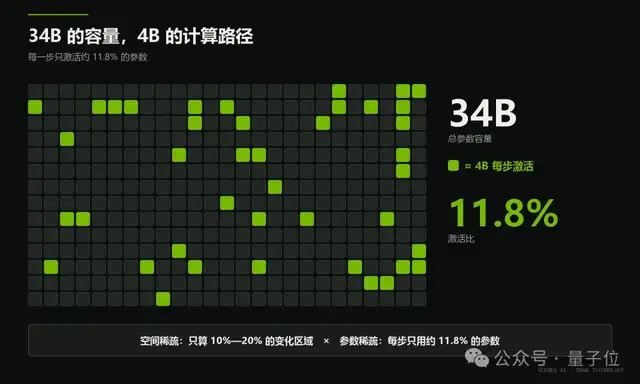
The model contains 34B total parameters, but dynamically activates only about 4B parameters during each step of actual inference—an activation rate of roughly 11.8%.
Spatially localized updates lower the “compute ceiling,” while internal sparse activation tightly caps the “per-inference compute load.” Together, they deliver the technical advantage of “retaining large-model representational capacity while operating on a real-time compute path.”
Through the synergy of these three techniques, Scenes AI reduces GPU resource overhead by 40% to 60% and accelerates inference speed by 3x to 5x compared to conventional video diffusion methods.
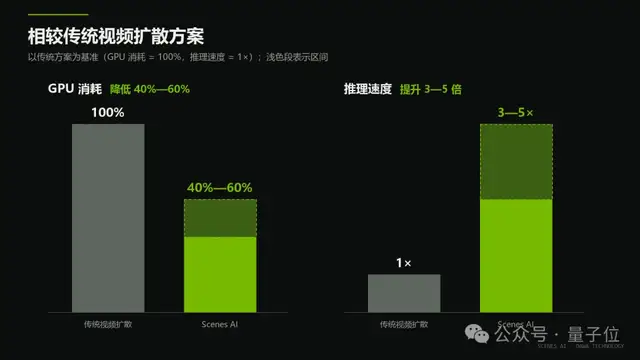
For extreme scenarios requiring full-scene transitions (such as an entire room turning into a summer grassland, where changed areas far exceed 20%), the system dynamically allocates compute according to the scale of changes, seamlessly unifying local touch-ups and panoramic transformations within a single computing pipeline.
Ultimately, on a single consumer-grade NVIDIA GeForce RTX card, Scenes AI reliably achieves low-latency real-time rendering at 720P and 25 FPS.
Natively Built on NVIDIA’s Low-Level Tech Stack
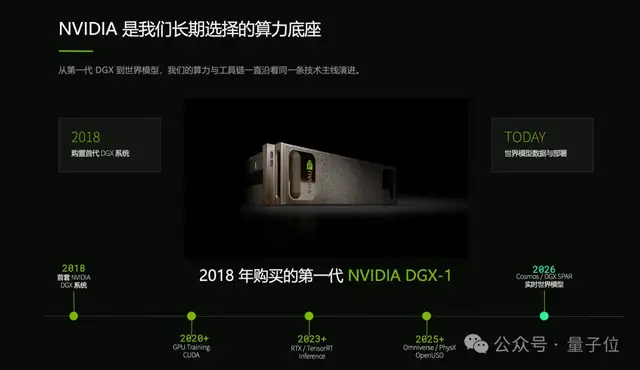
Dawa’s technical collaboration with NVIDIA dates back to 2018, when Dawa acquired its first NVIDIA DGX-1 system.
Today, Scenes AI relies heavily on CUDA for model training and inference acceleration, leverages TensorRT for operator-level inference optimization, and integrates NVENC hardware modules to achieve ultra-low-latency real-time video encoding and streaming.
Sparse updates minimize redundant compute consumption, Latent Cache significantly improves VRAM reuse, and the layered architecture naturally suits heterogeneous distributed deployment. From the ground up, the entire technology stack is tailored for GPU parallel architectures and compute reuse logic.
The Core Moat: Not a Video Dataset, but a State Dataset
Once the algorithmic framework is established, the real hurdle for engineering deployment lies in constructing training data. Dawa’s accumulated expertise in this domain spans three tiers.
Layer 1: Full-Dimensional State Dataset
To genuinely teach a model “how the world changes,” relying solely on raw video pixels is far from enough.
The vast majority of videos circulating on the internet are post-edited finished products. Underlying physical causality data—such as camera trajectories, lighting setups, and prop interaction nuances—has long been stripped away. Raw pixels alone cannot explain the evolution mechanics of the physical world.
To address this, Dawa’s core philosophy is: Training a world model requires not just a Video Dataset, but a State Dataset rich in causal attributes.
Currently, Dawa operates an 84,000-square-meter end-to-end digital production studio in Yongchuan, Chongqing.
Over the past five years, the team has continuously collected, annotated, and categorized data from more than 300 commercial live-action projects, amassing roughly 180TB of high-quality structured world state datasets. These encompass six core dimensions: camera trajectories, motion paths, object states, lighting states, physical states, and narrative states.
In a single studio shoot, the system performs structured annotations across more than 300 fine-grained dimensions, precisely aligning lens optics, spatial geometry, actor performances, and motion capture onto a unified timeline.
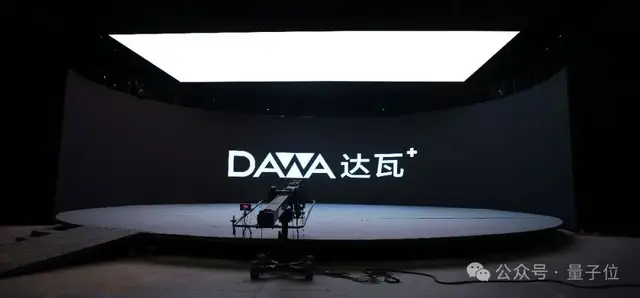
At the same time, professional studio environments naturally accumulate the most challenging long-tail edge cases in real-time generation, such as the dynamic physical drag and motion of wide sleeves and intricate dresses.