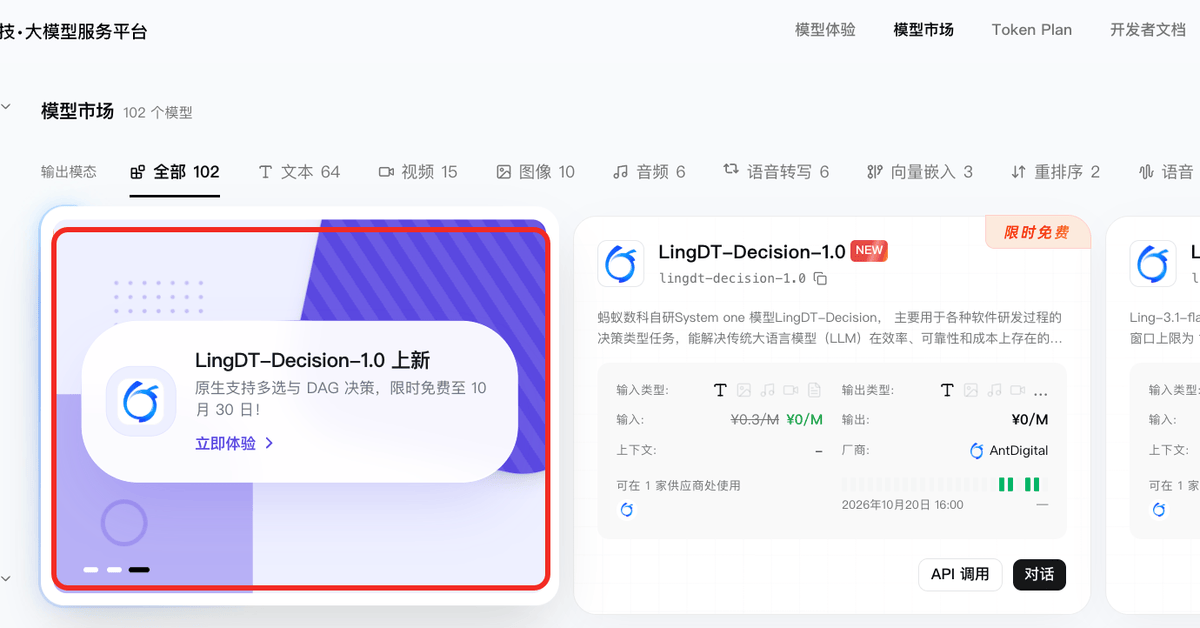
On October 22, Ant Digital Technologies officially released its decision-making model, LingDT-Decision-1.0. Purpose-built for fast decision-making tasks, the model delivers higher accuracy, faster response times, and lower token costs in structured decision scenarios, making it particularly well-suited for industrial AI deployments. LingDT-Decision-1.0 is available in two sizes: 4B and 27B. The model is now live on Ant Digital Technologies’ DTMaaS platform, where developers can access a limited-time free trial.
Tests conducted by the Ant Digital Technologies team across real-world business scenarios—such as intelligent customer service, risk control, and finance—show that compared to general-purpose large language models handling similar tasks, LingDT-Decision-1.0 slashes token consumption by over 90%, boosts response speeds by 10x, and delivers superior overall performance.
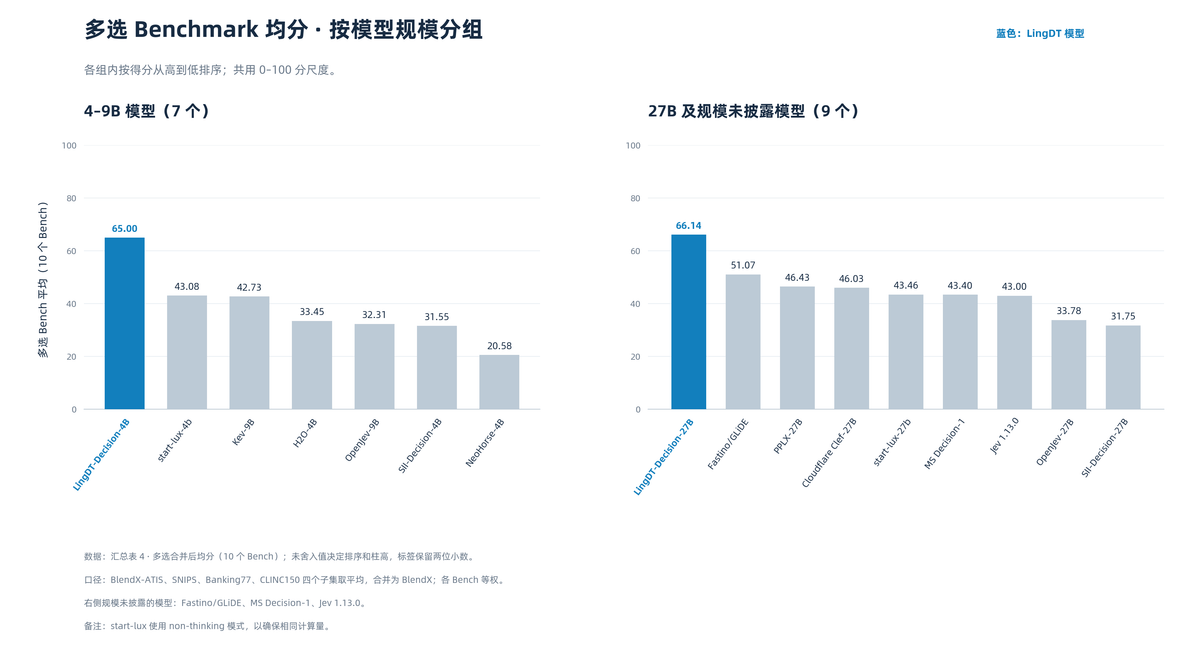
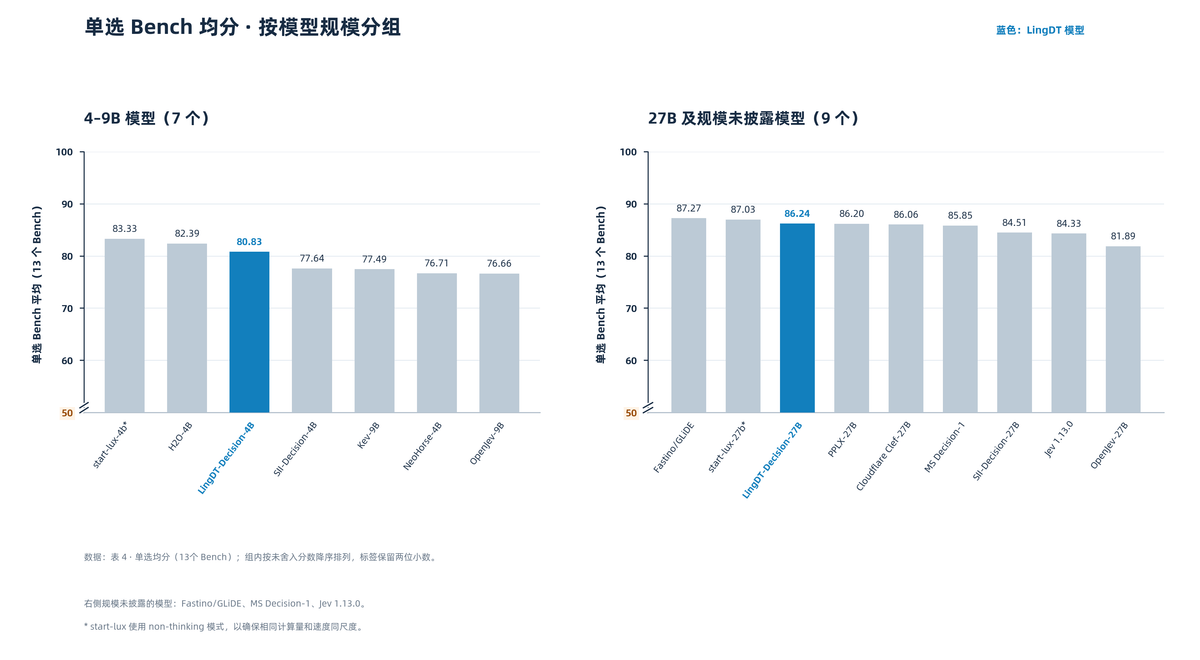
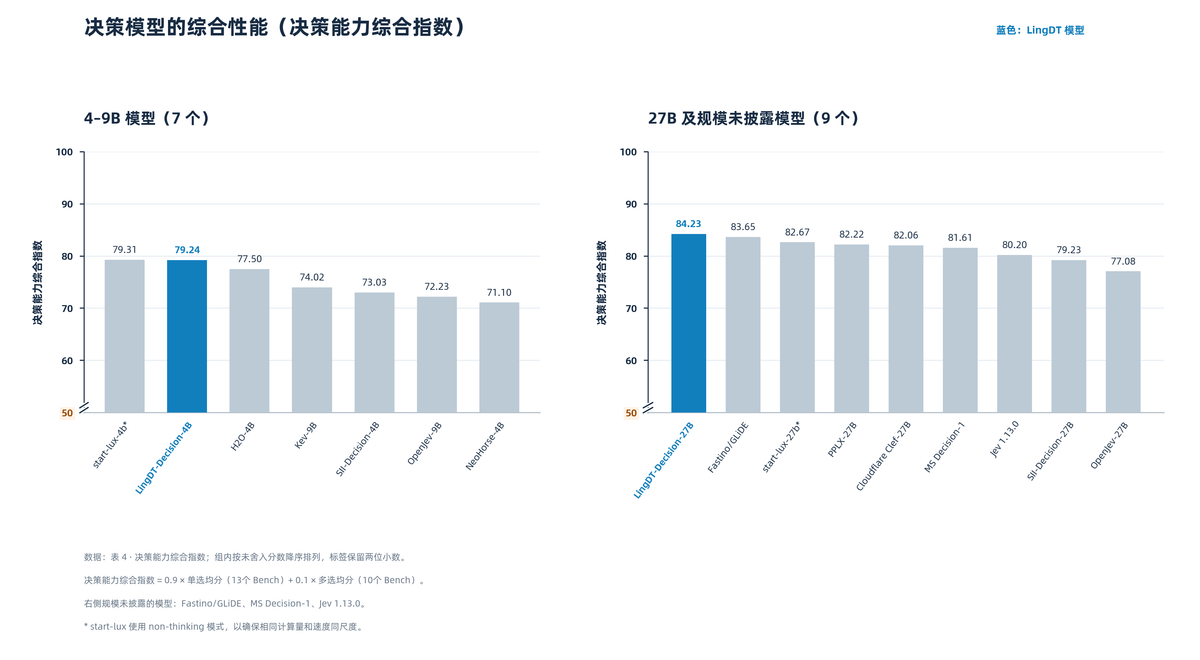
Compared to other decision-making models, LingDT-Decision-1.0 is an industry first to support native multi-selection and sequential decision-making, aligning seamlessly with real-world enterprise business processes. Across 23 open-source evaluation benchmarks, LingDT-Decision-1.0 outperformed mainstream decision models like Microsoft-Decision-1 and Jev 1.13 in overall score; notably, the 27B version achieved the highest accuracy among models in its parameter class.
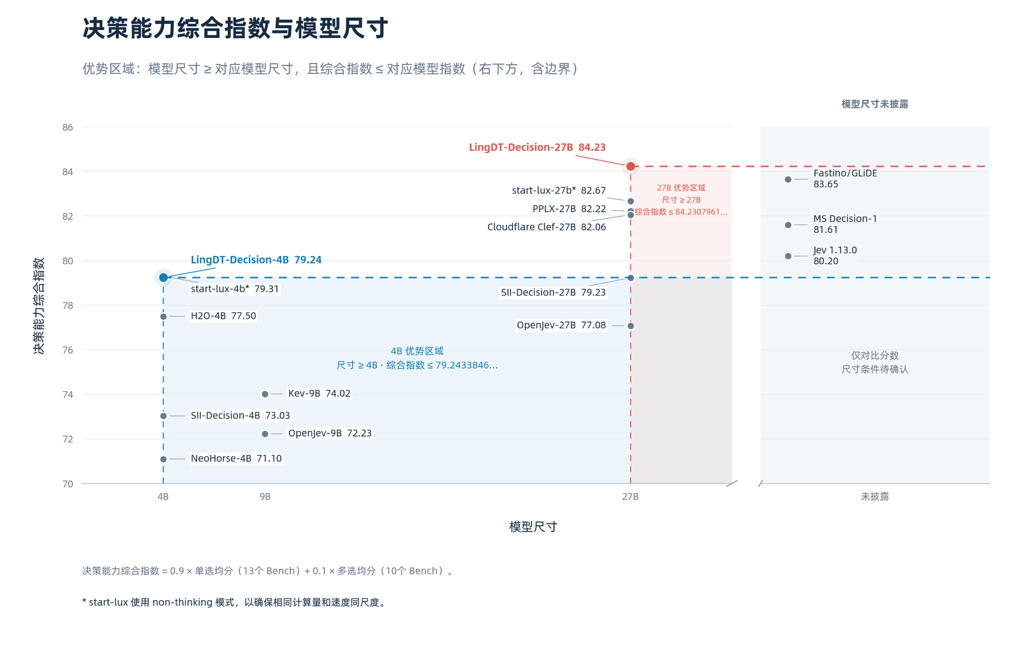
(Caption: The core advantage zone of LingDT-Decision 4B/27B covers decision models of similar scale, including Jev, MS Decision, and GLiDE, demonstrating exceptionally high overall cost performance.)
Engineered for Decision Tasks: Slashes Token Costs by Over 90% with Faster, More Accurate Output
Enterprises handle a massive volume of high-frequency decision tasks in their daily operations.
Take customer service as an example: when a user asks, “It’s been three days and my order hasn’t shipped yet. Please handle this ASAP,” the AI system must rapidly execute a coherent chain of judgments and decisions: identify the issue type (refund, expediting, or complaint?), evaluate ticket urgency (does it require expedited handling?), route to the right department (which business line should take it?), and review risk level (should it be immediately escalated to a human agent?).
General-purpose large language models face significant bottlenecks in these scenarios: they rely on token-by-token autoregressive inference to generate text, leading to long inference pipelines, high compute costs, fragile output formatting, and inconsistent overall reliability.
Decision models are specifically designed to address these pain points. Rather than generating lengthy text, their primary goal is to make fast, accurate business judgments. Consequently, they are a natural fit for high-frequency decision points such as intent recognition, tool selection, rule-based classification, and result scoring.
Currently, LingDT-Decision-1.0 is undergoing production testing across customer service, risk control, and finance workflows at Ant Digital Technologies. Its core technical approach shifts from the conventional LLM workflow of “generate structured text first, parse it downstream” to “directly output decision probabilities and classification outcomes within a bounded option space.” This eliminates parsing errors caused by formatting discrepancies and significantly simplifies downstream data validation and engineering pipelines.
In real-world business evaluations, LingDT-Decision-1.0 demonstrated remarkable results:
- Data Annotation: Compared to DS-V4-flash, token consumption dropped by ~97%, and processing throughput surged by ~10x;
- Intelligent Customer Service: Compared to Qwen-3.7-flash, token consumption decreased by 90%, response speed doubled (~1x faster), and risk detection accuracy improved from 76% to 89%;
- Financial Services: In composite tasks involving intent recognition, multi-tool orchestration, and hallucination detection, processing throughput increased by ~5x, the exact-match rate for tool combinations rose ~2.6x, and hallucination recall jumped from 44% to 70%, significantly sharpening sensitivity to potential operational risks.
Comprehensive testing confirms that LingDT-Decision-1.0 reliably delivers low-cost, low-latency, and high-accuracy decision support across complex enterprise environments. Furthermore, the model uses a single unified architecture to adapt to diverse business decision logics, substantially lowering system integration and maintenance overhead while enabling rapid reuse across business units.
Building Next-Gen Decision Models: Two Industry-First Features
Compared to peer decision models, Ant Digital Technologies’ LingDT-Decision-1.0 places greater emphasis on the real-world demands of complex enterprise workflows. On top of standard capabilities like single-selection, binary classification, multi-class categorization, and scoring, LingDT-Decision-1.0 introduces two world-first features: native multi-selection and sequential decision-making (DAG).
In enterprise workflows, user requests are rarely simple “single-choice” problems; instead, they often require “identifying a bundle of intents and executing them in order.” For example, a user might say: “I want a refund, turn off auto-renewal, and issue an invoice, but don’t delete my account.” Traditional single-choice models typically capture only the most prominent intent—“refund”—missing the rest. In contrast, a multi-choice model resolves the entire set of intents in a single pass. Paired with sequential decision-making, the system can dynamically map execution dependencies: verify refund eligibility first, disable auto-renewal in parallel, and process the invoice once the refund is finalized. This approach aligns closely with practical enterprise workflows and dramatically improves end-to-end resolution rates.
Specifically:
- Native Multi-Selection: Captures multiple valid candidate labels in a single inference pass, effectively serving multi-label classification, composite intent recognition, and parallel multi-tool execution;
- Sequential Decision-Making: Autonomously executes multi-step chained decisions based on underlying business logic, perfectly suited for high-security, logic-critical scenarios like finance and risk control.
In comprehensive benchmarks covering 23 mainstream open-source evaluations, LingDT-Decision-1.0 27B ranked first in overall score (weighted 90% single-selection + 10% multi-selection), outperforming models such as Microsoft-Decision-1, Jev 1.13.0, and Fastino/GLiDE.
In dedicated multi-selection task benchmarks, both the 4B and 27B variants outperformed 16 competing decision models, including Microsoft-Decision-1, Jev 1.13.0, and Star-lux, showcasing the power of a native multi-selection architecture in handling complex decision tasks. For foundational single-selection tasks, the series also firmly holds its position in the top industry tier.
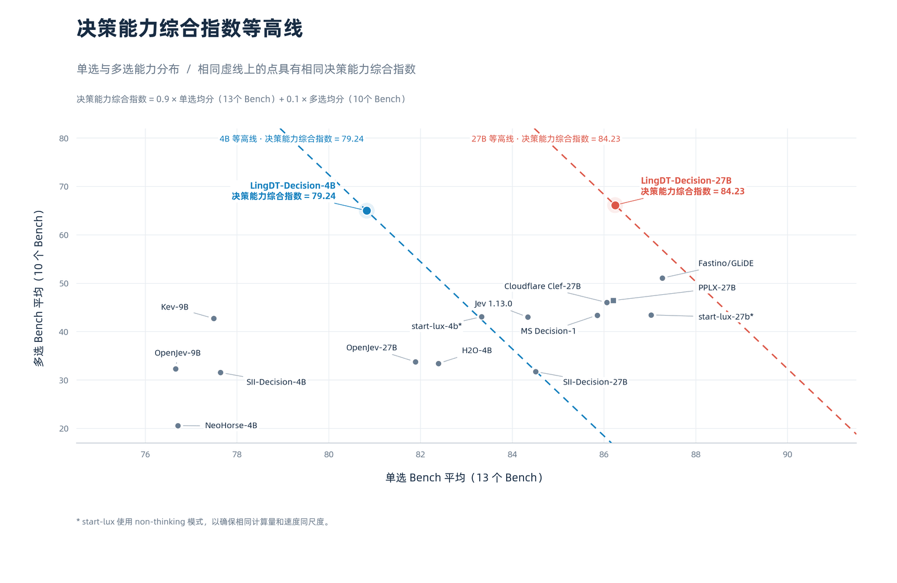
(Caption: The 2D evaluation mapping for single- vs. multi-selection capabilities shows that LingDT-Decision 4B/27B ranks firmly in the top tier for single-selection judgments, outperforming the vast majority of same-size models, while establishing an unmatched lead in native multi-selection capabilities.)