
Roughly two months ago, OpenAI launched Daybreak for Frontline Defenders, offering $1 billion in grants for access to Daybreak cybersecurity models and products. That funding paid dividends almost immediately: two teams independently uncovered critical security vulnerabilities in PHP. Ryan Austin, a researcher at the security firm Calif, discovered the flaws in August 2026 using GPT-5.6 Sol as part of OpenAI’s “Patch the Planet” initiative:
…as did Wiz, recently acquired by Google Cloud (leveraging Gemini 4 Argon, GPT-5.6 Sol, and their proprietary tool, Wiz Atlas).
Every high-profile cybersecurity disclosure comes with a touch of marketing theater, and there is some debate over whether this reaches the jaw-dropping severity of vulnerabilities like Log4Shell and Heartbleed. Still, there is no question that the coordinated response across the entire PHP ecosystem demonstrated the developer community operating at its best.
We anticipate that critical vulnerabilities like these will continue to surface over at least the coming year. Blaming the messenger who uncovers them, however, misses the mark; instead, it is reassuring to know that our critical software is currently undergoing the largest security audit in human history.
AI Twitter Roundup
Spotlight: PHP2Shell — Timeline, Core Claims, and the Complicated Reality Behind the Response
What Happened
Researchers disclosed two memory corruption vulnerabilities in the PHP engine, demonstrated unauthenticated exploitation against major CMS platforms, and triggered an unusually broad coordinated response.
-
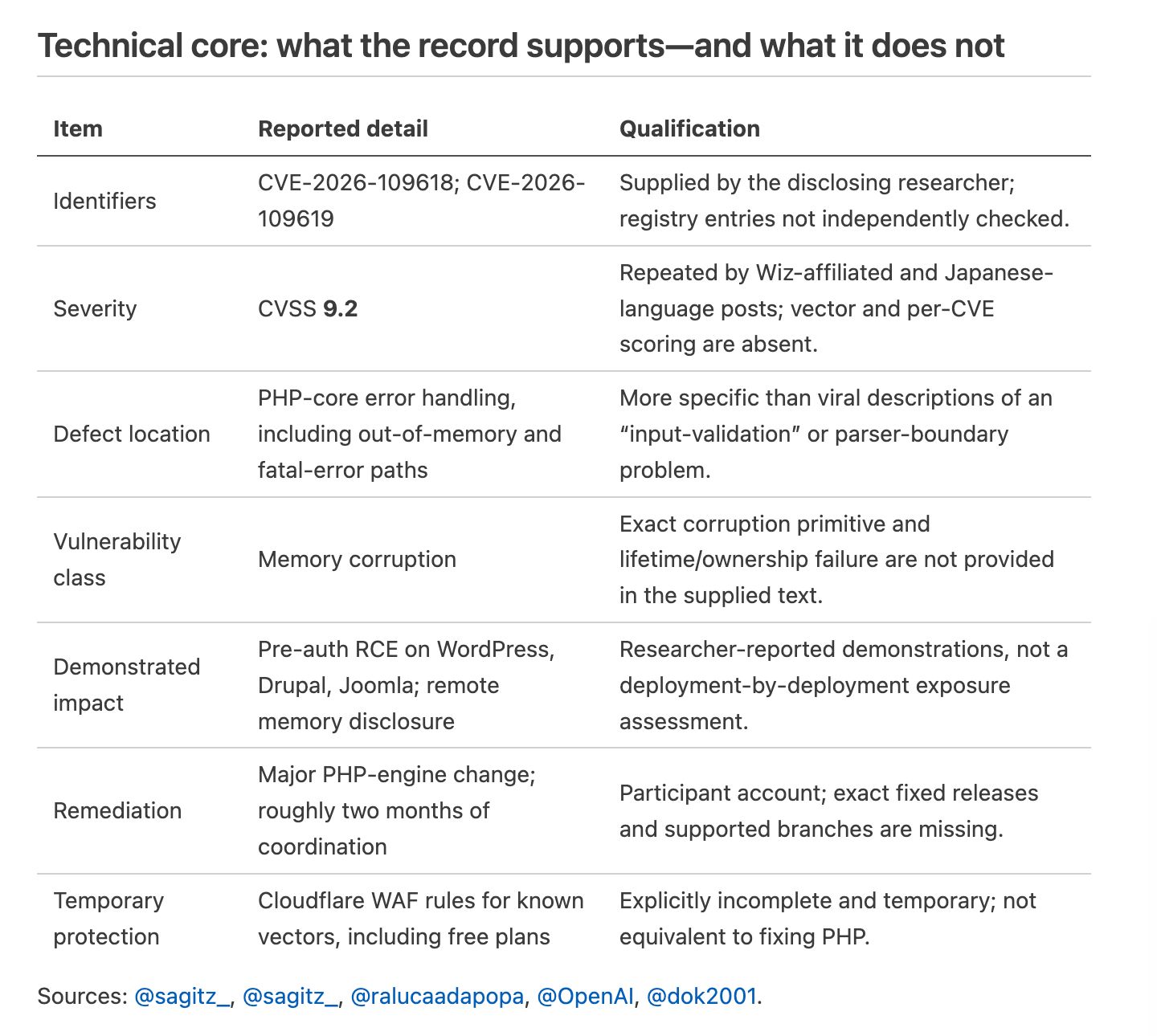
Researchers dubbed the vulnerabilities PHP2Shell, tracking them as CVE-2026-109618 and CVE-2026-109619. Their technical write-up places the flaws in PHP’s internal handling of out-of-memory conditions and fatal errors—not within WordPress plugins or application authentication logic. They reported demonstrating full remote code execution (RCE) alongside a “Heartbleed-style” memory leak. @sagitz_
-
The disclosed exploit demonstrations include pre-authentication RCE against WordPress, Drupal, and Joomla. The advisory additionally claims remote memory leaks are possible against arbitrary PHP applications. These represent the exploit demonstrations reported by researchers; they should not be assumed to translate into identical, turnkey RCE paths across every production deployment. @sagitz_
-
OpenAI credited Calif researchers with discovering the flaws using its models, while separate reports confirmed Wiz independently found the same vulnerabilities. Posts indicate Calif/OpenAI utilized GPT-5.6 Sol, whereas accounts tied to Wiz credited Gemini 4 Argon with vulnerability discovery, exploit-chain development, detection tooling, and patch validation. This stands as a coordinated, multi-party discovery rather than a single vendor finding and remediating the issue in isolation. @TheRundownAI, @steipete, @ralucaadapopa
-
OpenAI reported an approximately two-month coordinated remediation process prior to public disclosure. According to OpenAI, the patch required non-trivial changes to the PHP engine and cross-coordination among maintainers, researchers, security vendors, and government entities. A participating researcher confirmed collaborating directly with The PHP Foundation to support and harden the patch. @OpenAI, @itszn13
-
Cloudflare deployed initial WAF (Web Application Firewall) mitigation rules ahead of the scheduled patch release. Its CTO stated that the rules covered known exploit vectors, were made available to all customers including those on the free tier, and were updated as in-the-wild exploitation attempts emerged. He emphasized that these rules were merely a temporary stopgap, urging operators to apply upstream patches promptly.