
Published on October 21, 2026
By John Kosnik, Frank DeLise, and Pomi Lee (NVIDIA)
- What Makes an Asset SimReady?
- Why Publish OEM Assets to SimReady Central?
- Build Simulation Environments with SimReady Assets
- Help Shape the Next Wave of Assets
- Start Building on Hugging Face 🤗
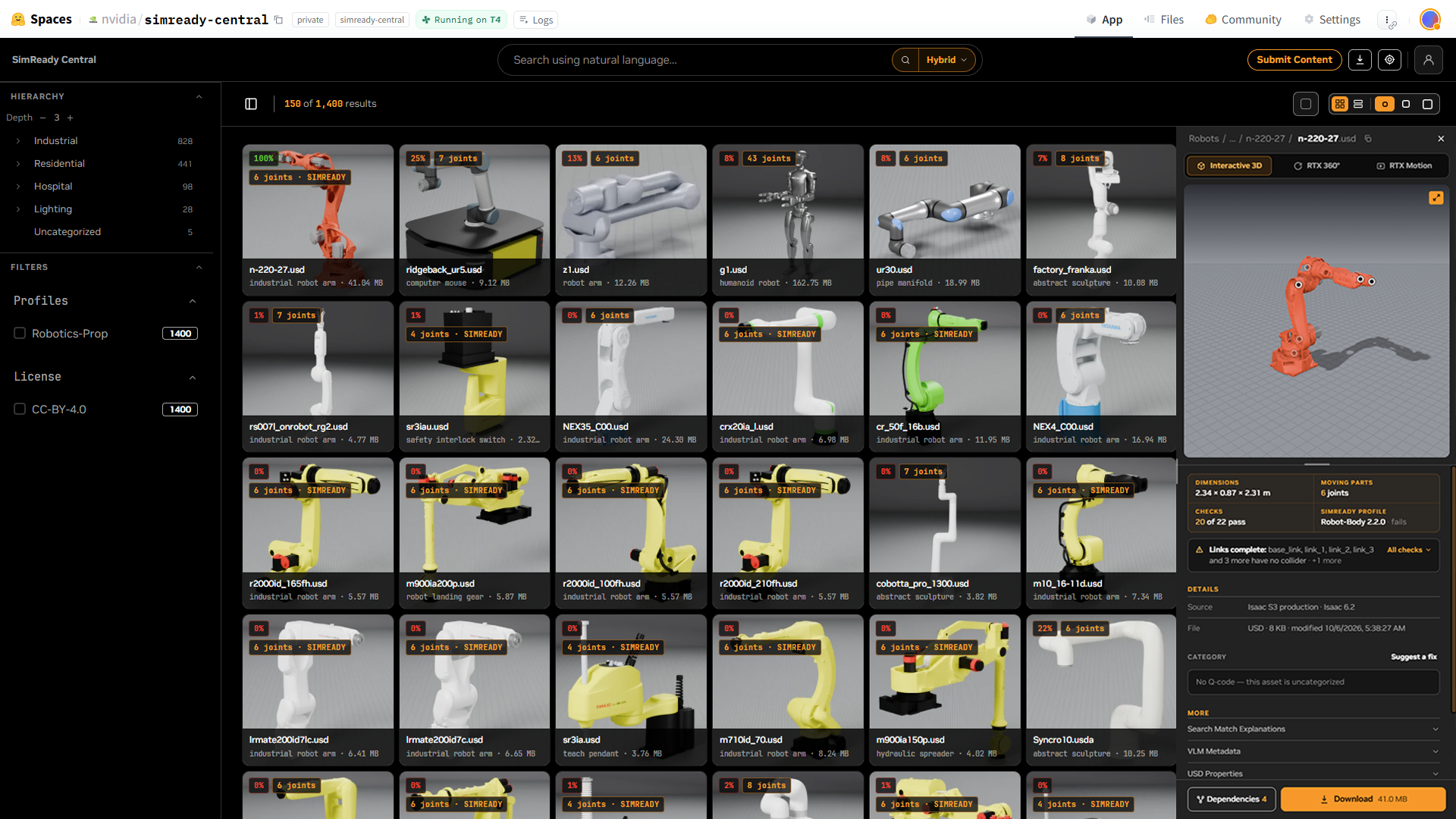
Building robotics simulations and high-fidelity AI factory digital twins requires far more than just 3D models. Developers often have to manually configure properties like collision geometry, mass, and friction. SimReady assets are 3D models pre-configured with the properties needed for simulation workflows, cutting down on this tedious manual effort.
The SimReady Central Library brings together over 2,000 simulation-ready OpenUSD assets on Hugging Face, offering developers a free and accessible starting point to build Physical AI training environments and AI factory digital twins. The library spans a broad range of infrastructure and equipment assets—from robotic arms and grippers to warehouse equipment, server racks, and cooling infrastructure. Developers can inspect the supported capabilities of each asset and seamlessly combine components from different vendors into a single scene.
Original Equipment Manufacturers (OEMs) can now prepare and validate their assets against SimReady specifications and reach developers through the SimReady Central Library. This allows end customers to test and simulate scenarios much faster, accelerating decision-making. As a result, industries can build comprehensive simulation ecosystems around their products while managing their own Hugging Face datasets.
This post explores what makes an asset SimReady, how OEMs can contribute to the SimReady Central Library, and how developers can leverage these assets to build robotic pick-and-place scenarios and compare AI factory layouts.
What Makes an Asset SimReady?
SimReady assets are OpenUSD assets pre-configured with the properties required for simulation workflows. Detailed 3D models (such as CAD files) are a solid starting point, but simulations require additional context on how the object should be interpreted and utilized.
For robotic manipulation tasks, this information might include the object’s mass, collision geometry, and friction characteristics. For AI factory workflows, it may encompass equipment geometry alongside application-specific electrical or thermal metadata.
[OpenUSD](https://ope