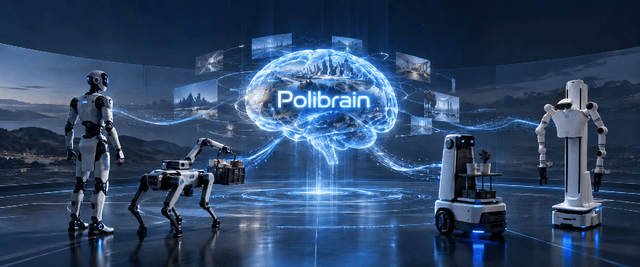
A New Highlight in the World Model Race: Qianjue’s Research on Latent Variable Identifiability Preceded LeCun’s Similar Work by a Year; Rather Than Brute-Force Pixel Prediction, It Focuses on Physical Laws and Cross-Embodiment Reuse.
The world model arena is increasingly taking on the feel of a clash among the world’s elite AI minds.
Yann LeCun continues to double down on predictive world models, Fei-Fei Li leads World Labs in exploring interactive 3D worlds, and leading AI teams across the globe are accelerating along distinct technical trajectories.
Enabling AI to truly comprehend the physical world and forecast physical changes is rapidly emerging as the focal point of a new wave of technological competition.
Recently, this momentum in world models reached Nanjing.
On October 20, the Inaugural 2026 Physical AI and World Models Conference opened in Nanjing, featuring remote keynote insights from Turing Award laureates Yann LeCun and Andrew Yao.
At this academic and industrial summit in the world model domain, Qianjue Technology, an embodied AI company rooted in Tsinghua University, officially unveiled its predictive world model, Polibrain.

In his opening keynote, Haichuan Gao, Founder of Qianjue Technology, captured the unique value of world models in a single sentence:
With a map, one can deduce the shortest path; but with a path, one cannot reverse-engineer a map.
Here, the “map” represents an abstract understanding of the physical world and its governing dynamics.
And the mission behind Qianjue’s launch of Polibrain is precisely to endow robots with such a “map” for prediction and planning.
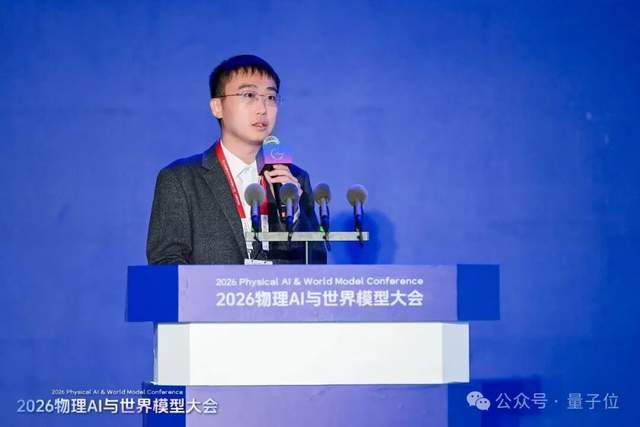
As early as 2025, Qianjue, in collaboration with a Tsinghua University team, published theoretical research on world models at ICML. Their published explorations into directions like latent variable identifiability and low-degree preferences preceded similar work by LeCun’s team by roughly a year.
Just one year later, Qianjue has translated this technical foundation into real-world robotic applications.
From environmental perception and action prediction to autonomous planning and execution feedback, Qianjue is working to teach robots how to make autonomous next-step decisions based on the dynamic evolution of the physical world.
Currently, this intelligent system has been adapted across multiple robotic morphologies, including quadruped, humanoid, wheeled, and dual-arm platforms.
What makes Qianjue’s predictive world model Polibrain so distinctive? And how do they enable robots with diverse physical forms to share a single unified “brain”?
A New Paradigm for Robotic Brains
“World models are discussed everywhere, but do people truly understand them?”
In his keynote at the opening ceremony, Haichuan Gao posed this question right from the start.
He then shared an analogy: “How did ancient merchants find the fastest route when transporting fresh lychees from Guangzhou to Chang’an?”
Those familiar with the film The Lychees of Chang’an will recognize this dilemma.
Gao presented two approaches:
One method is brute-force trial and error: traverse every conceivable route and pick the optimal one.
The other is to first survey the terrain—identifying which cities lie between Guangzhou and Chang’an and how they connect—to draw a comprehensive map, and then plan the optimal route based on that map.
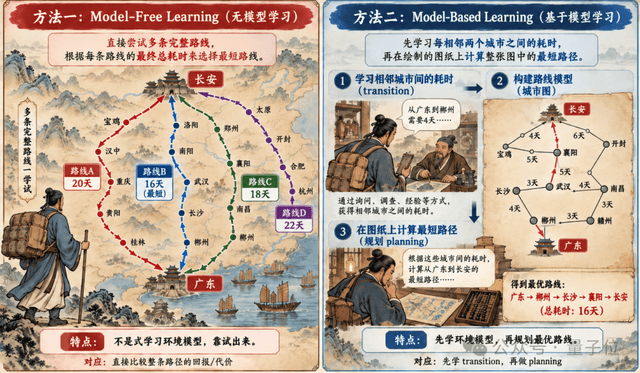
He used the former to characterize the current Vision-Language-Action (VLA) approach, while the latter represents the predictive planning paradigm of world models.
The fundamental distinction lies in whether a robot can simulate the potential outcomes of its actions in advance, thereby drastically slashing real-world trial-and-error costs.
This is precisely the core challenge that Qianjue’s Polibrain predictive world model seeks to resolve.
So, what does this approach look like when deployed on physical robots?
A live demonstration video showcased on-site by Qianjue illustrated a vivid scenario:
Outdoors, a quadruped robot dog equipped with a robotic arm and a rear-mounted collection bin was carrying out a litter collection mission.
It had to autonomously search for debris on the ground, lock onto target locations, navigate into position, plan the robotic arm’s trajectory to grasp the trash, and steadily deposit it into the onboard bin.
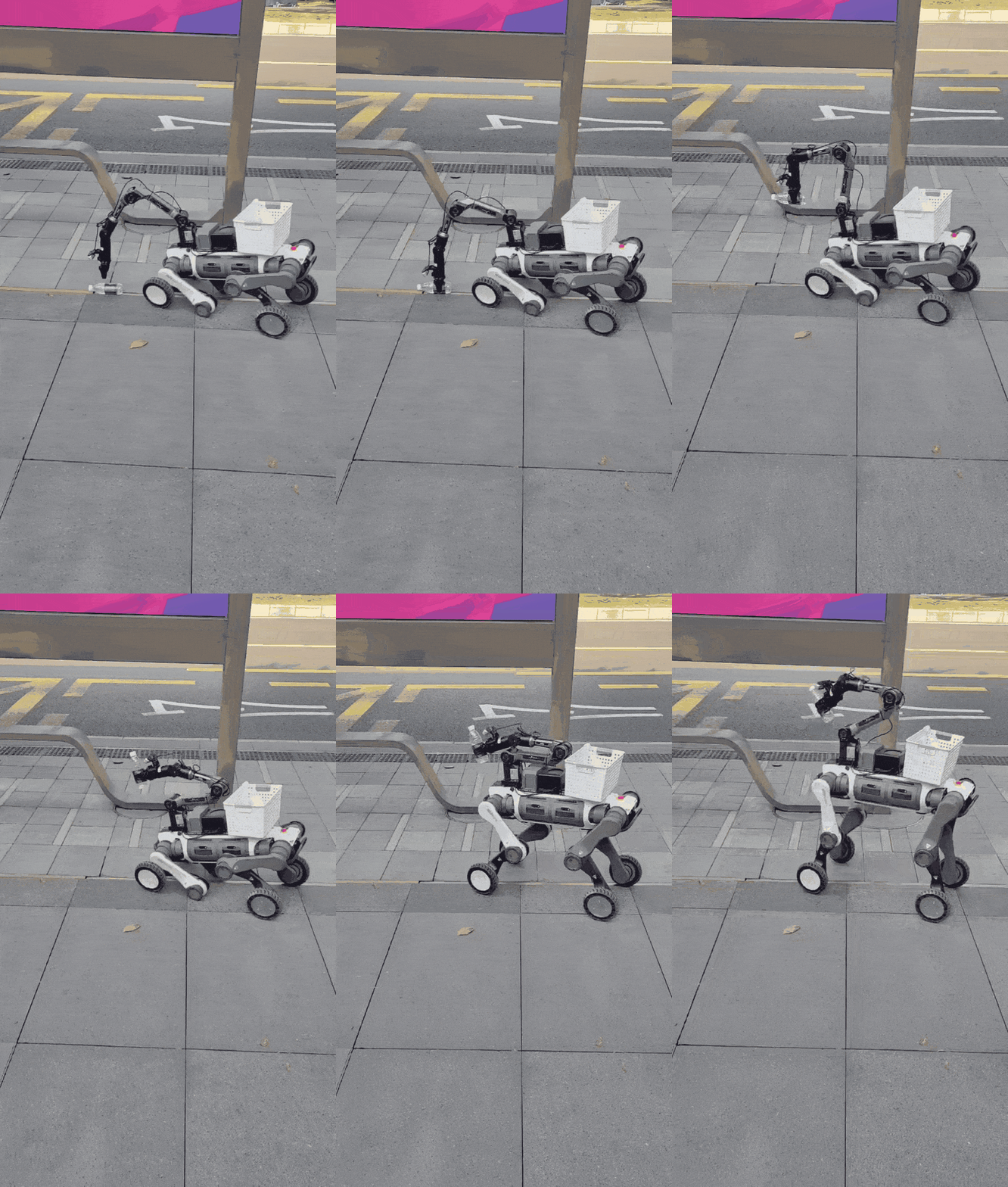
What appears to be a straightforward cleanup routine actually encapsulates a complex chain of decisions: Where is the litter? From which angle should the robot dog approach? Once the arm reaches out, can it securely grasp the target?
In real, dynamic environments, object positions and spatial relationships can shift at any moment. The robot must not only recognize what to do right now, but also forecast the physical consequences of each completed action.
This is where a predictive world model shines.
By learning the mapping between environmental states, historical context, and action feedback, Polibrain accurately predicts state transitions within a task-relevant latent representation space.
During this process, Qianjue made a crucial architectural choice:
Polibrain does not attempt to generate complete future scenes frame by frame.
For a robot tasked with picking up litter, the granular texture of the pavement or the complex background scenery is irrelevant. What truly dictates success or failure are the 3D coordinates of the target, the relative pose between the manipulator and the object, and how the grasping action alters the object’s physical state.
Rather than burning massive compute to photorealistically reconstruct the entire physical world, it is far more effective to concentrate resources on predicting the critical variables that govern action.
Gao emphasized in his speech: “The true cornerstone of building a sound world model lies in state representation.”
Yet accurate prediction is only the first step.
Real-world operations rarely unfold according to a pre-written script. If an object slips or moves unexpectedly, the robot must possess self-correction and retry capabilities.

Polibrain seamlessly links environmental perception, state comprehension, action prediction, task decision-making, motion execution, and feedback regulation into a continuous closed-loop decision system.
When execution deviates from expectations, the model re-evaluates the task based on the latest environmental state and dynamically adjusts subsequent strategies. Furthermore, the system supports decoding key features to track discrepancies between expectation and reality, providing quantitative diagnostics for fault isolation and task recovery.
Naturally, the robustness of this mechanism under extreme real-world corner cases still calls for further empirical validation at scale.
More importantly, this “cognitive map” is not theoretically confined to any single robotic configuration.
A humanoid robot can grasp a cup with a dexterous hand, just as a wheeled single-arm robot can accomplish the same task. While their hardware kinematics and low-level motion control differ drastically, their understanding of spatial relationships, target physical states, and evolutionary dynamics remains universally consistent.
This implies that high-level physical cognition and decision-making capabilities have the potential for cross-embodiment reuse.

Qianjue has already deployed adaptations across multiple robotic platforms—humanoid, wheeled, single-arm, and dual-arm configurations—spanning applications in companion services, catering delivery, item organization, and precision manipulation.
However, enabling heterogeneous robots to genuinely share a unified cognitive core requires more than just environmental forecasting; the model must distill universal physical principles that transcend individual scenes and tasks.
This brings us to Qianjue’s foundational theoretical pillar: polynomial representation.
A Year Ahead of LeCun’s Parallel Work: How Qianjue Tackles the Generalization Dilemma
Put simply, “polynomial representation” refers to leveraging a rigorous mathematical framework to guide AI in distilling the core, task-determining variables from high-dimensional, noisy environments, thereby stripping away reliance on irrelevant background details to the greatest extent possible.
Why is this technology indispensable?
The primary bottleneck preventing widespread robotic deployment is generalization.
For instance, a robot may master item retrieval in a specific warehouse, but when transferred to a new facility, subtle variations in lighting, background clutter, or minor shelf spacing discrepancies can cause task success rates to plummet.
The root cause is that under conventional training regimes, models are notoriously prone to overfitting superficial visual artifacts. Background wallpapers, ambient lighting temperatures, or incidental furniture arrangements can easily be misinterpreted as decision features, causing severe “feature contamination.”
Another hazard is even more insidious: models tend to mistake coincidental temporal co-occurrences for genuine causal links.
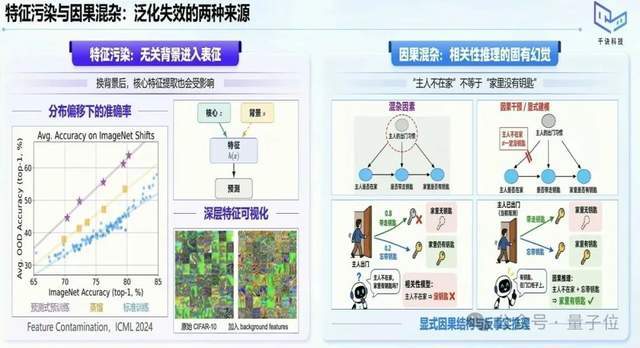
Gao cited an illustrative example during the presentation:
Before leaving home, a homeowner takes their keys out of a drawer. This involves three distinct events: the owner leaves, the owner grabs the keys, and the keys disappear from the drawer.
If a model merely mines superficial correlations, it might deduce the absurd conclusion: “Whenever the owner steps out, the keys in the drawer vanish.” Consequently, if the owner truly forgets the keys inside and asks the robot to look for them, the robot might conclude that the keys cannot possibly be in the drawer simply because the owner has already departed.
This blatant violation of physical causality highlights the fundamental question: Is the model merely memorizing patterns by rote, or has it genuinely grasped the causal laws governing physical reality?
Through polynomial representations, Qianjue aims to steer models away from rote environmental memorization toward distilling fundamental invariants that transfer seamlessly across domains.
This strategy builds directly upon years of theoretical groundwork at Qianjue.
Back in 2025, Qianjue and a Tsinghua research team published a paper at ICML titled When Do Neural Networks Learn World Models?, which systematically investigated the conditions under which neural networks can recover hidden world structures from high-dimensional observations.
Focusing on “multi-task learning” and “low-degree preferences,” the study employed the Fourier-Walsh transform to analyze functional topologies over discrete Boolean worlds, deriving sufficient mathematical conditions for identifying true underlying latent variables.
Remarkably, LeCun’s team subsequently approached the problem from a strikingly parallel theoretical angle.

In May 2026, LeCun and collaborators published When Does LeJEPA Learn a World Model?, likewise investigating the identifiability of latent variables in world models and the interplay between functional degrees and low-degree inductive biases.
Gao dissected the nuanced differences between the two works:
Qianjue’s framework primarily formulates learning criteria based on causal inference and Boolean spaces, whereas LeCun’s team tackles the problem along the time-series dimension.
Despite differing entry points and mathematical apparatus, the learning criteria established by both teams exhibit profound underlying equivalence, with their derived representations converging at the information-theoretic level.
Fundamentally, both efforts address the very same core question:
How can AI learn generalizable world model representations directly from complex physical observations?
In terms of publication timelines, Qianjue and Tsinghua’s explorations in this direction emerged roughly one year ahead of the aforementioned work by LeCun’s group.
In 2026, Qianjue and the Tsinghua team further introduced the concept of “Effective Degree” (ED), engineered as a computable, quantitative yardstick for assessing neural network complexity.
Traditional benchmarks can only judge whether an inference output is correct or incorrect, yet remain blind to how convoluted the model’s underlying learned function actually is.
The introduction of ED bridges this critical gap:
By monitoring neural network behavior along interpolation trajectories between real data manifolds and fitting model outputs using orthogonal polynomials, ED computes overall function complexity weighted across spectral degrees.
When low-degree components dominate, the ED score remains low; as high-degree oscillatory components multiply and amplify, the ED score escalates accordingly.
With this metric, researchers can not only intuitively benchmark topological complexity across different architectures, but also integrate ED into loss functions as a regularizer, compelling models to autonomously suppress redundant high-degree oscillations.
While a simpler function does not automatically guarantee mastery of objective physical truth, this work provides a brand-new engineering instrument for diagnosing and mitigating generalization bottlenecks.

Beyond abstracting physical dynamics, robots must also possess the capacity for “long-horizon critical memory.”
For instance, after a robot places a cup inside a cupboard and closes the door, the cup vanishes from direct view. When subsequent instructions call for retrieving the cup, the model must still know its precise location.
In multi-stage continuous manipulation, local occlusions and transient invisibilities are commonplace; a single snapshot rarely provides sufficient context for decision-making.
To address this, Qianjue developed a counterfactual inference-based historical filtering mechanism.
The core logic involves evaluating in real time whether observations from a given past interval exert a counterfactual influence on downstream reasoning and decisions, determining which information to retain and which to prune.
Instead of blindly recording entire visual streams, the robot maintains sharp focus exclusively on pivotal nodes that close future causal loops.
The specific color of a background wall is inconsequential, but the specific shelf tier on which the cup rests directly dictates the next path-planning sequence.
“Polynomial representations” empower the model to isolate core state variables, while “causal memory” enables it to discard irrelevant sensory noise.

Working in tandem, these two capabilities provide robust technical backing for robots navigating visual occlusions, latent feedback delays, and complex, multi-step horizons.
Of course, translating rigorous theoretical deductions into resilient real-world performance still demands extensive validation across long-tail tasks.
A robot cannot be expected to relearn fundamental common sense every time it crosses into a new room.
Polynomial representations and causal memory dismantle the underlying barriers to cross-scene generalization. Yet to extend this shared intelligence across disparate robotic forms, another hurdle remains: how to cleanly decouple high-level physical understanding from low-level mechanical execution?
No Proprietary Hardware: Qianjue Aims to Build the Universal Brain for Robots
Let us revisit that courier journey delivering lychees to Chang’an.
Even with an immaculate map in hand, safely transporting fresh fruit across thousands of miles still demands coordinated execution—swift steeds, river barges, imperial post roads, and waystations working in unison.
Similarly, possessing an intuitive grasp of physical laws does not imply that every execution step must be handled exclusively by a single robotic body.
Gao illustrated this with another scenario: when loading clothes into a washing machine, a humanoid robot might coordinate two hands—one pulling the door open while the other loads the garments.
A single-arm wheeled robot, by contrast, can simply issue an IoT command to trigger an automated door opener before placing the items inside.
Hardware forms vary and execution tactics differ, but the target state transition within physical reality remains identical.
This observation forms the core rationale behind Qianjue’s “loosely coupled world model architecture.”
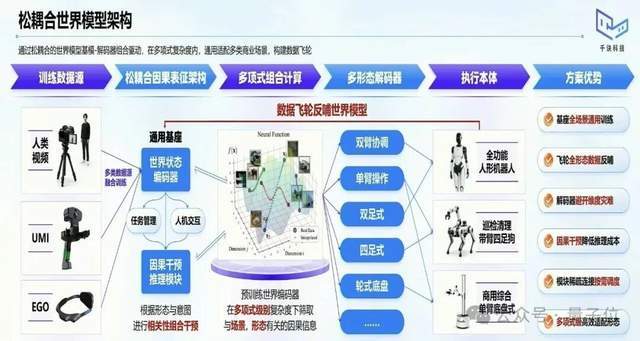
In its architectural design, Polibrain strictly decouples shared representations of physical space and task goals from the low-level execution control layer of specific robot embodiments.
Understanding of the physical world is universally shared; how low-level motor primitives are executed is left to individual robotic hardware or external automated systems to resolve contextually.
This decoupling directly defines Qianjue’s commercial positioning: rather than building proprietary robotic hardware, the company focuses exclusively on delivering universal cognitive and decision-making capabilities across all robotic morphologies.
Furthermore, Qianjue’s strategic scope is not restricted to general-purpose bipedal humanoids; it is equally open to specialized equipment engineered for dedicated industrial and service environments.
Gao noted that the commercial monetization of embodied AI is an evolutionary journey—one that need not adhere rigidly to the dogma that “full humanoid morphology is the only viable path.”
For instance, a simplified robotic arm configuration suits hotel room delivery; equipping a chassis with agile dual arms serves restaurant preparation stations; while tuning chassis suspension and structural stiffness enables seamless transitions into outdoor inspection, security patrol, or municipal sanitation.
Outer form factors adapt to operational demands, yet the foundational “intelligence substrate”—responsible for parsing physical reality and projecting state evolutions—carries immense reuse value.
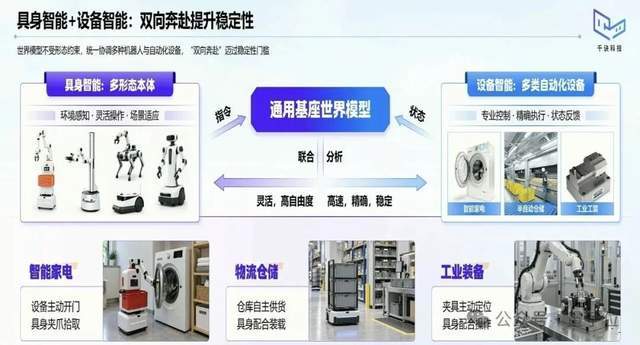
Crucially, cross-embodiment reuse revitalizes the data assets of embodied AI.
For years, the extreme scarcity of real-world physical interaction data has been the defining bottleneck hindering embodied AI—physical collection cycles are painstakingly slow, marginal costs run steep, and data harvested across disparate hardware platforms rarely interoperates.
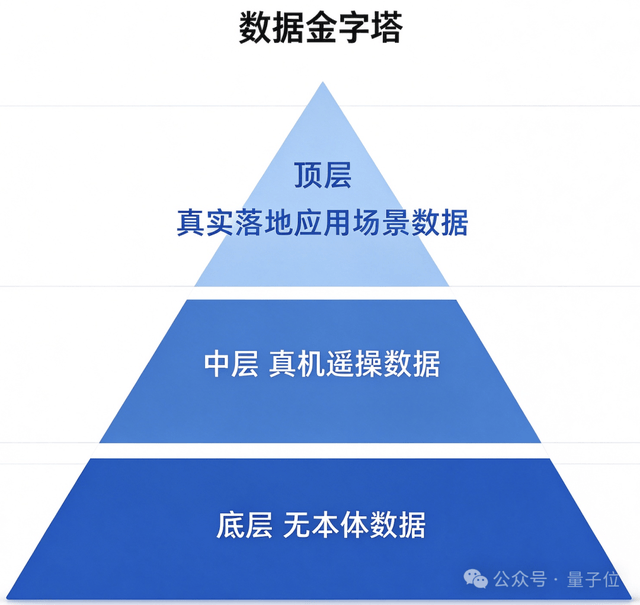
Deconstructing the data streams used in robot training yields three primary tiers:
- The foundational tier consists of embodiment-agnostic data, such as egocentric human-machine videos and everyday manipulation recordings, aimed at helping models learn 3D spatial geometry, physical contact, and object interactions;
- The intermediate tier comprises strongly embodiment-dependent data, including physical teleoperation logs and dynamic trajectories, used to ground precise motor executions against real-time environmental feedback;
- The top tier encompasses massive streams of dynamic feedback logs from actual deployment scenarios, utilized to expose and remediate rare edge cases, driving swift algorithmic convergence and iteration.
All three data categories serve distinct functions within the pipeline, and only by dismantling cross-embodiment barriers can their collective flywheel effect be truly unlocked.
Gao maintains that while humanoids, wheeled rovers, quadrupeds, and robotic vacuums feature vastly different mechanical dynamics, their high-level reasoning regarding object causality, long-horizon goal decomposition, and environmental state evolution is intrinsically homogeneous.
Polibrain is designed to channel disparate data streams collected by heterogeneous robots into a single foundational model backbone via abstract, unified high-level latent space representations.
As more diverse robot forms hook into the system, the model gains exposure to a broader expanse of long-tail edge cases; incoming operational data continuously feeds training, expanding the world model’s cognitive precision and generalization bounds; and a superior model, in turn, attracts more hardware OEMs and ecosystem partners to integrate.
Only then does the cross-embodiment data flywheel for embodied AI genuinely begin to turn.
Nevertheless, architecturally shared representations do not automatically dissolve data silos across competing commercial entities. Gao openly acknowledged the pragmatic data barriers between robotics enterprises.
For specialized hardware manufacturers, raw operational data represents highly sensitive, proprietary technical capital; open data sharing across corporate lines remains a formidable challenge.
As an independent, neutral model provider, Qianjue is currently partnering with diverse industry clients to explore win-win mechanisms that balance proprietary data security with cross-embodiment cooperative reuse.
From rigorous frontier theory to real-world validation across physical quadrupeds and dual-arm robots, the debut of Polibrain provides a compelling case study—both academically and industrially—of how predictive world models can transition from ivory-tower research into scalable real-world deployment.
Whether a cross-embodiment data flywheel can fully materialize, and whether model cognitive capabilities can achieve a qualitative leap through scale, will ultimately depend on broader validation across commercial deployments.
For now, the “cognitive map” has been drawn.
Yet journeying from a cartographic blueprint to reliably delivering those metaphorical lychees all the way to Chang’an remains an extensive, unexplored path.