Last year, Alex Lieberman and his co-founder joined us on the show to break down an unusual bet Tenex was making: paying AI engineers for the outcomes they deliver rather than the hours they spend at the keyboard. If AI makes engineers exponentially more productive, hourly billing perversely penalizes them by reducing what they earn for the same scope of work. Tenex wanted to align incentives in the opposite direction.
At the AI Engineer Summit in New York, Alex took the stage again alongside CJ Hess to explore what happens when you scale this philosophy across an entire engineering team. We also brought in an experiment of our own: Kill My SaaS—after a vendor quoted us $43,000 a year for a conference speaker management tool, we invited developers to build a replacement and kill it off.
Both stories lead to the same question: when the cost of building software plummets toward zero, how do you value great work?
Paying for Outcomes When the Nature of Work Keeps Shifting
Tenex still relies heavily on story points as a core pillar of engineer compensation. Alex noted that the commonly feared failure modes—such as inflated estimates or churning out shoddy code just to rack up points—haven’t materialized as the biggest issues. Tenex’s AI Strategists are held accountable for client retention and growth, giving them a strong incentive to push back on work that doesn’t genuinely benefit the client.
The harder challenge lies in rewarding the work that can’t be easily captured in a ticket: wrapping your head around a client’s problem, designing system architecture, or deciding what should actually be built in the first place. CJ described how, as models grow more capable, he spends less time directly writing code and far more time structuring client business context into a format models can work with. Any compensation model designed around task delivery must leave room for this kind of work.
Alex shared that Tenex has grown to 75 people, serving a client base that spans Fortune 2000 companies and mid-market enterprises. The company started out as an AI-powered dev shop; today, more and more clients turn to them to help drive organization-wide AI transformations. Jump to the compensation discussion →
MetaHarness: Keeping the Entire Project in the Repo
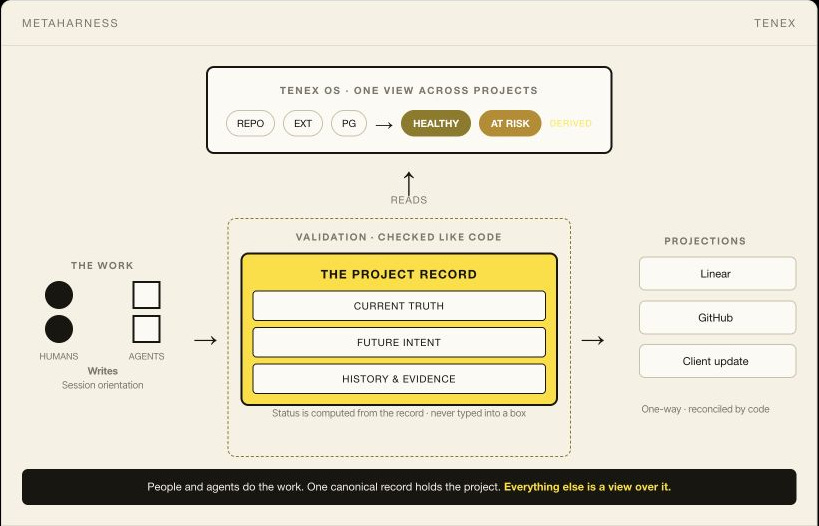
CJ walked through Tenex’s MetaHarness: a shared set of skills, project documentation, and CLIs tailored to the task at hand. Plans and architectural decisions are committed to Git right alongside the code. When an agent picks up a task again, it doesn’t just see what was built—it understands why the team chose to build it that way.
Tenex’s own post on the AI-native SDLC illustrates this concept as a shared project log where humans and agents collaborate, synthesizing views across Linear, GitHub, and client updates: