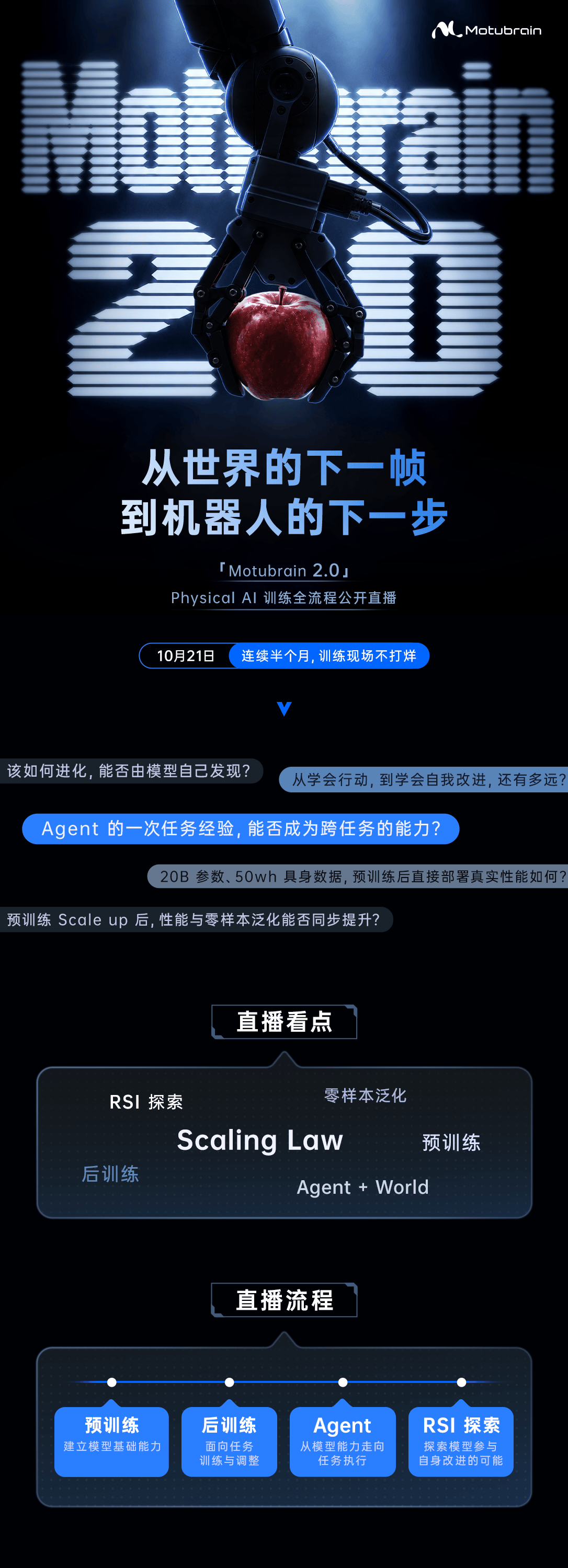
Shengshu Technology World Model Team Officially Launches Full Training Process Livestream for Motubrain 2.0
The large model training process is increasingly stepping into the public eye.
Previously, Fuli Luo, head of Xiaomi MiMo, publicly shared the training progress of the reinforcement learning phase for MiMo-V2.6, offering the outside world a look into the granular details of large model training.
Now, a similar initiative has arrived in the field of Physical AI.
On October 21, Shengshu Technology’s World Model team officially kicked off a livestream covering the entire training process of Motubrain 2.0. Scheduled to run for half a month, this livestream aims to give the public a comprehensive look at the embodied model’s training pipeline and the latest research progress.
The livestream centers around a core question: How is Physical AI actually realized?
Physical AI aims to enable artificial intelligence to understand physical environments and execute practical tasks through robots. Compared to large language models (LLMs), Physical AI must also tackle challenges such as action decision-making, task execution, and cross-scenario generalization.
The Motubrain series is an embodied model family developed by Shengshu Technology, dedicated to building a general-purpose “brain” for robots and continuously exploring capability generalization across diverse tasks, environments, and robotic embodiments.
Motubrain 2.0 will soon be officially open-sourced. Ahead of this milestone, the team chose to open up the entire training process first, providing the outside world with a complete view of the model’s evolutionary journey from training and testing to capability iteration.
This open training initiative encompasses four major stages:
- Pre-training: Observing the impact of training scale on model performance and zero-shot generalization capabilities.
- Post-training: Further training tailored to specific tasks to enhance execution capabilities.
- Agent Task Execution: Exploring whether the model can effectively transfer existing experience to other tasks.
- RSI (Recursive Self-Improvement) Exploration: Investigating whether the model can evaluate and refine its own actions based on execution feedback.
What makes this livestream unique is its attempt to open the “black box” of embodied model training.
In the past, the industry understood progress in embodied AI primarily through robot demos, benchmark evaluations, and academic papers. It was rarely possible to directly observe how a model was trained or how its capabilities evolved across different stages.
By choosing to make the entire journey—from training and testing to capability iteration—fully transparent, Motubrain 2.0 aims not only to give observers a firsthand view of how model capabilities take shape, but also to candidly present the failures, trial-and-error, and adjustments along the way.
For the embodied AI industry, this approach brings much-needed transparency to model development. Researchers and developers can see not just the final results, but also gain insights into the specific engineering and algorithmic challenges encountered during training, as well as how the team continually refines the model through experimentation and feedback.
At the same time, the team hopes to leverage this livestream to exchange experiences, challenges, and insights with fellow technical peers. By collectively exploring crucial topics such as scaled training, cross-task generalization, and autonomous self-improvement, they hope to provide valuable references for the realization paradigms of Physical AI.
Naturally, this research remains in an exploratory stage, and specific results will require further validation through subsequent experiments and evaluations. Compared to simply showcasing what robots can ultimately accomplish, opening up how models are trained and how their capabilities are progressively built holds profound value for both industry and research.
- Livestream link: www.motubrain.com/motubrain2.0-live
- Official website: www.motubrain.com