
Beneath the Bunny Mask, It’s Actually MiniMax!
The mystery model Space Bunny, which burst onto OpenRouter over the National Day holiday and anonymously dominated the leaderboards, has finally unmasked itself.
And beneath the bunny suit… it was MiniMax all along!

Its official release name is M3.1 Flash.
The official release pushes benchmark performance even further than during the Space Bunny preview—especially in agentic capabilities:
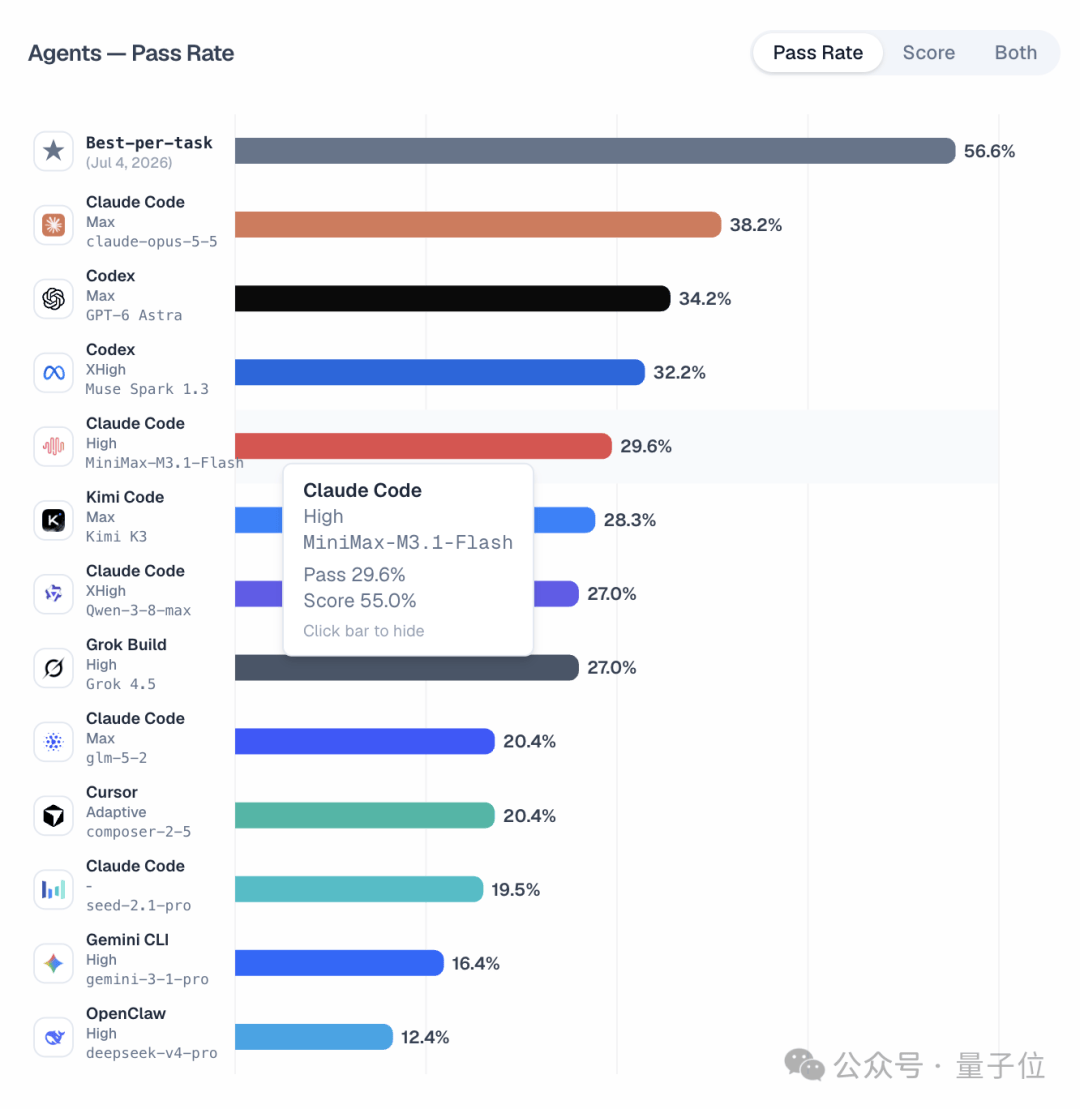
Scoring 29.6% on Agents’ Last Exam (ALE), it captured the #1 spot among Chinese models.
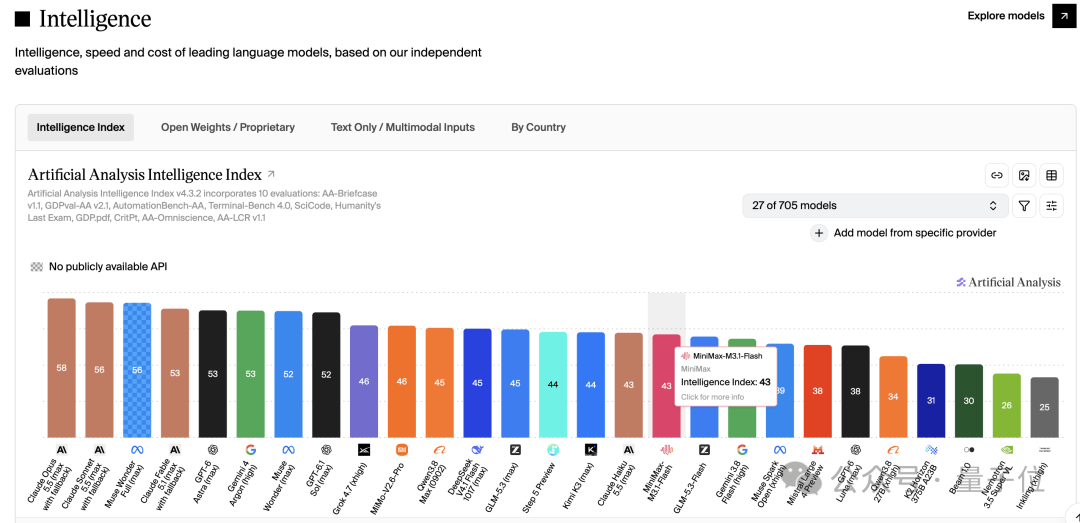
It also posted a score of 43 on the AA benchmark—an exceptionally impressive result for a lightweight Flash-tier model.
Its general task execution capabilities have taken a massive leap forward, effectively graduating it to a “senior digital worker.”
Beyond agents, it has firmly established itself in the global top tier across coding, cybersecurity, and computer use.
On top of that, it retains the blistering inference speeds seen during the Space Bunny preview, reaching peak outputs of over 200 TPS.
Even more importantly—
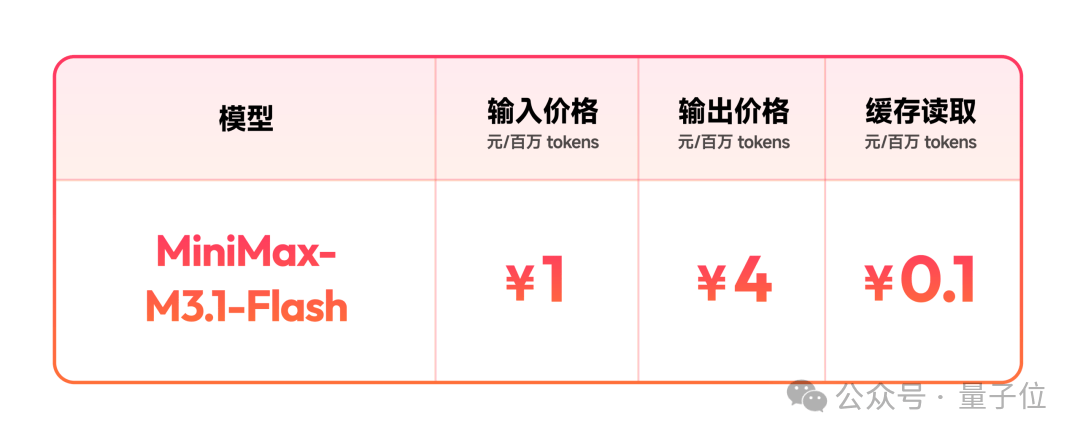
Living up to the Flash name, its pricing is extraordinarily aggressive:
- Input: Just ¥1 per million tokens;
- Output: Just ¥4 per million tokens;
- Cache read: A mere ¥0.1 per million tokens.
Overall operational costs have been slashed to just 30% of the previous-generation M3.
To put that pricing into perspective:
It is essentially on par with V4.1 Flash during off-peak hours.
An absolute steal—practically a case of “DeepSeek for off-peak valleys, MiniMax for rush-hour peaks” (jk).

△ Source: @BigTechMicroscope
Meanwhile, Silicon Valley’s closed-source camp is likely feeling the heat once again.
Following in the wake of DeepSeek, Silicon Valley’s massive flagship models are being forced by Chinese Flash models into an entirely new price-performance execution zone.
The Text Model Comeback
Frankly speaking, MiniMax had its share of skeptics in the past.
While their multimodal and video generation breakthroughs turned heads, their pure-text LLM efforts had appeared quiet for quite some time.
The launch of M3.1 Flash marks an undeniable comeback.
Here is a closer look at the benchmark results:
Software Engineering and Real-World Bug Fixing
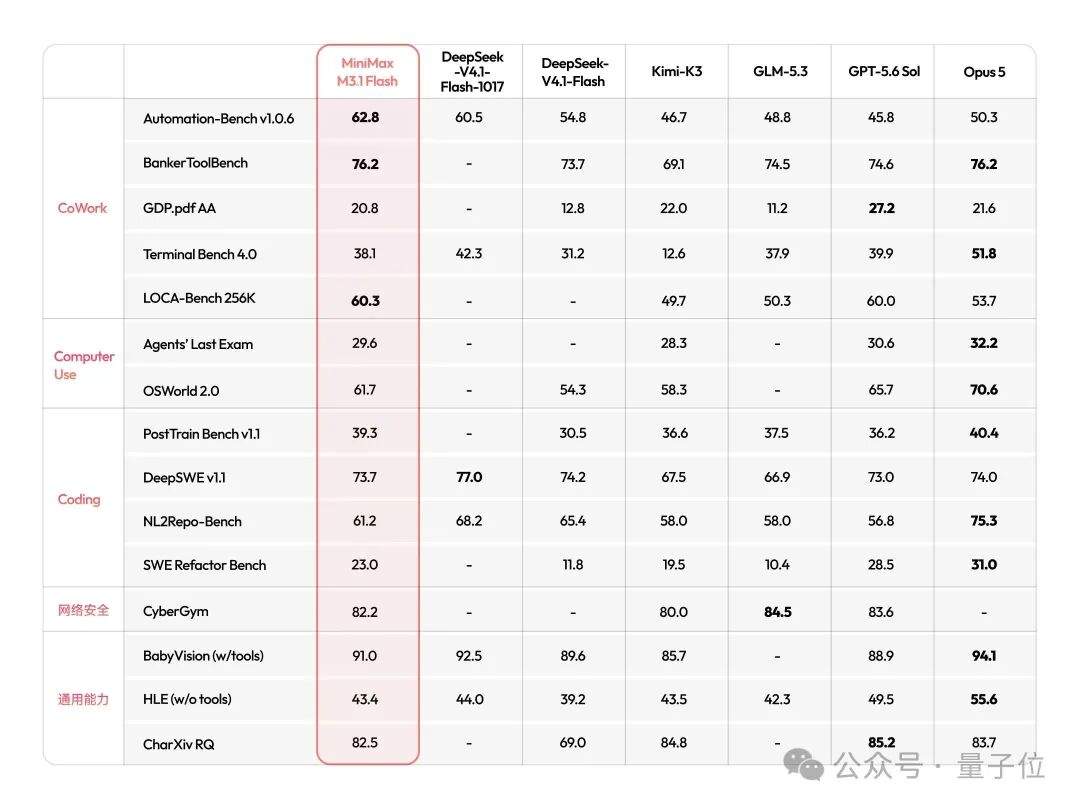
On the DeepSWE v1.1 benchmark, M3.1 Flash scored an impressive 73.7%.
Heavyweight flagships like GPT-6.1 Sol, Claude Opus 5, and Claude Fable 5 were all surpassed by this Flash model.
The only model ahead of it was DeepSeek V4.1 Flash 1017 with a score of 77.
This aligns with community feedback during Space Bunny’s anonymous testing phase: when tackling Three.js 3D rendering and complex frontend tasks, its attention to detail was exceptionally precise.

Real-World Cybersecurity
In the UC Berkeley-led CyberGym benchmark, M3.1 Flash posted a score of 82.2, trailing closely behind GLM-5.3 (84.5) and GPT-5.6 Sol (83.6), firmly securing its place in the global top tier.
Complex Agents & Enterprise Cross-SaaS Workflows
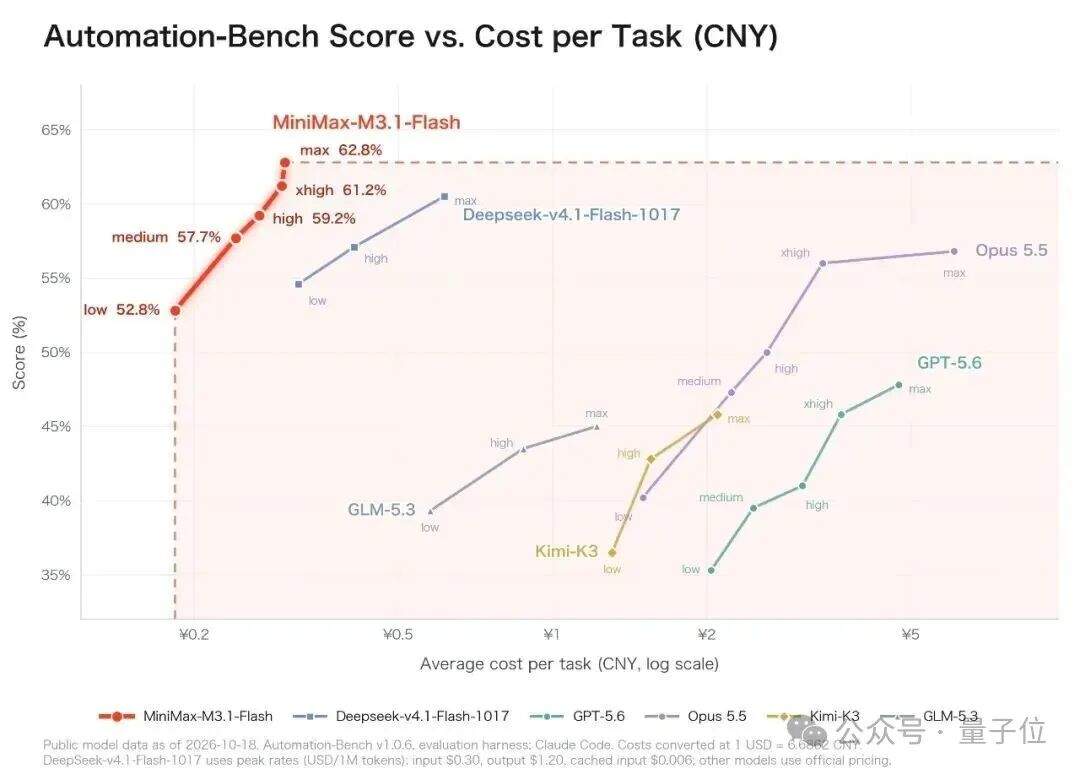
On AutomationBench-AA, open-sourced by automation platform Zapier, M3.1 Flash ranked near the very top.
At a per-task cost under $0.05, it autonomously orchestrated complex workflows spanning sales, marketing, customer service, finance, and HR.
On BankerToolBench—a finance-specific benchmark with virtually zero tolerance for error—M3.1 Flash scored 76.2, tying the industry gold standard Claude Opus 5 for the #1 spot globally.
Computer Use: Real-World Desktop Operation
It scored 61.7 on OSWorld V2, which simulates real-world computer operations;
Meanwhile, on the ALE benchmark—which measures real-world commercial value scenarios—M3.1 Flash delivered flagship-tier performance at rock-bottom task costs.
Both scores ranked #1 among Chinese models, once again proving its extraordinary price-to-performance ratio.
While observers widely anticipated that MiniMax’s pure-text models would eventually return to center stage, few expected that a lightweight model bearing the “Flash” moniker would be the one leading the charge.
Blazing Speed and Low Cost Are King
Looking beyond benchmark scores, what truly stands out is the model’s impact on real-world industrial deployment.
When building multi-agent systems or long-chain workflows, developers constantly run into two major pain points: agonizing latency and terrifying end-of-month API bills.
A mature enterprise-grade agent often makes dozens of tool calls in the background and communicates frequently across multiple sub-agents.
If output generation is sluggish, users churn due to prolonged loading screens; if token costs are astronomical, projects can be forced to a halt by runaway budgets.
This is precisely where M3.1 Flash shines.
Under the hood, it employs an aggressive sparse attention architecture.
Online inference speeds have increased nearly threefold, with peak throughput hitting 200+ TPS and a median (P50) consistently holding above 170+ TPS.
What does 170 TPS actually mean in practice?
When dispatching refactoring tasks in MiniMax Code Desktop, Claude Code, or various local coding tools, the generated code streams onto the screen almost instantaneously.
The stutter and friction of chaining four sub-agents together has vanished, replaced by a virtually seamless, responsive experience.
Alongside this speed boost, pricing has been slashed dramatically:
- Input price: Just ¥1 per million tokens;
- Output price: Just ¥4 per million tokens;
- Cache read price: Just ¥0.1 per million tokens.
Input and output costs have been cut in half, while cache read pricing has plummeted by 75%.
In total, blended operational costs have dropped by 70% compared to the previous-generation M3.
For developers and enterprises alike, the barrier to large-scale deployment has fallen significantly.
China’s Twin Stars Lead the Counteroffensive
Historically, the prevailing consensus in the industry was that “Flash” models were merely stripped-down, budget compromises of flagship architectures.
Choosing a Flash model usually came down to budget constraints or lightweight workloads; when tackling mission-critical, complex tasks, you inevitably had to revert to large-parameter Pro flagships.
That dynamic is now shifting.
Fresh off DeepSeek V4.1 Flash 1017 establishing a new price-performance benchmark, MiniMax M3.1 Flash followed in rapid succession, both delivering astonishing compute-efficiency ratios.
Compact models are no longer experimental toys—they are now going toe-to-toe with flagships boasting multiples of their parameter count at ten times the price.
Even more fascinating is how these two Chinese Flash models complement each other through distinct specializations:
- DeepSeek pushes cost efficiency to new extremes in pure software engineering;
- MiniMax M3.1 Flash establishes a distinct edge in comprehensive agentic workflows across SaaS ecosystems and financial toolchains.
One specializes in code engineering; the other dives deep into complex business logic.
This opens up flexible model routing strategies tailored to specific operational needs:
By intelligently orchestrating model resources across different workloads and hours—routing to MiniMax during peak demands and leveraging DeepSeek during off-peak hours—teams can achieve optimal token economics without compromising system throughput.

This model also makes API access a vastly more cost-effective option for individual users.
LLM capabilities evolve at a breakneck pace; even standard monthly consumer subscriptions risk falling behind in value as models rapidly leapfrog one another.
At the same time, consumer apps are plagued by frustrating UX constraints: 5-hour rate limits, arbitrary midnight quota resets, and dynamic model degradation (silent dumbing-down).
Switching to direct API access allows users to pay strictly for what they use and seamlessly switch providers based on performance, offering far greater autonomy and flexibility.

In recent months, a flurry of next-gen flagship launches from leading overseas giants fueled a growing narrative: that the LLM race was settled, and Silicon Valley’s compute scaling had locked in a winner-take-all outcome.
Yet the tide appears to be turning.
The sequential debut of these two Chinese Flash models is democratizing flagship-grade intelligence at blistering speeds and accessible price points.
Chasing top-of-the-line SOTA remains a grueling battle, but as “cost efficiency” and “engineering viability” are conquered, the true war over enterprise-scale AI deployment has only just begun.
And engineering pragmatism alongside deep vertical deployment happens to be precisely where Chinese tech companies excel.