
October 20, 2026
Startups
Terminal X’s Eval Agent scores outputs against a 54-metric rubric, catching 25% more off-mandate recommendations with GPT‑6.1 Sol.

Company size: Startup
Region: North America
Industry: Finance
Product: API
25%
Increase in catching off-mandate agent responses with GPT‑6.1 Sol compared to the next-best model
$2.4M
Annualized cost savings achieved by a single client across due diligence and investment workflows
+220 bps
Higher alignment with human reviewers for GPT‑6.1 Sol–powered agents compared to the next-best model
30%
Lower cost per query with GPT‑6.1 Sol compared to the next-best model
An investment firm’s competitive edge is built deal by deal, but the judgment behind each decision often resides solely in the heads of a few senior investors. When they leave, the firm accrues what Terminal X calls “memory debt”—retaining the documents, but losing the underlying reasoning.
Terminal X developed its Capital Memory operating system to pay down this debt. The company’s forward-deployed engineers—finance and investment professionals formerly with JPMorgan and Blackstone—embed directly within clients’ investment teams. They design firm-specific agentic architectures and codify the firm’s investment thesis into client-owned agents deployed on-premises or in a private cloud.
OpenAI models, including GPT‑6.1 Sol and GPT‑6 Luna, power reasoning across these agents, while Terminal X’s Eval Agent evaluates and scores outputs against firm standards. Powered by GPT‑6.1 Sol, the Eval Agent catches roughly 25% more off-mandate recommendations, while reducing the cost per query by about 30% on the same workflows compared to the next-best model.
“GPT-6.1 Sol’s long-context reasoning capabilities and token efficiency allow us to build deeper evaluation pipelines. This helps our Eval Agent make investment judgment measurable and auditable.”
— Hyun Hong, Co-founder and CEO, Terminal X
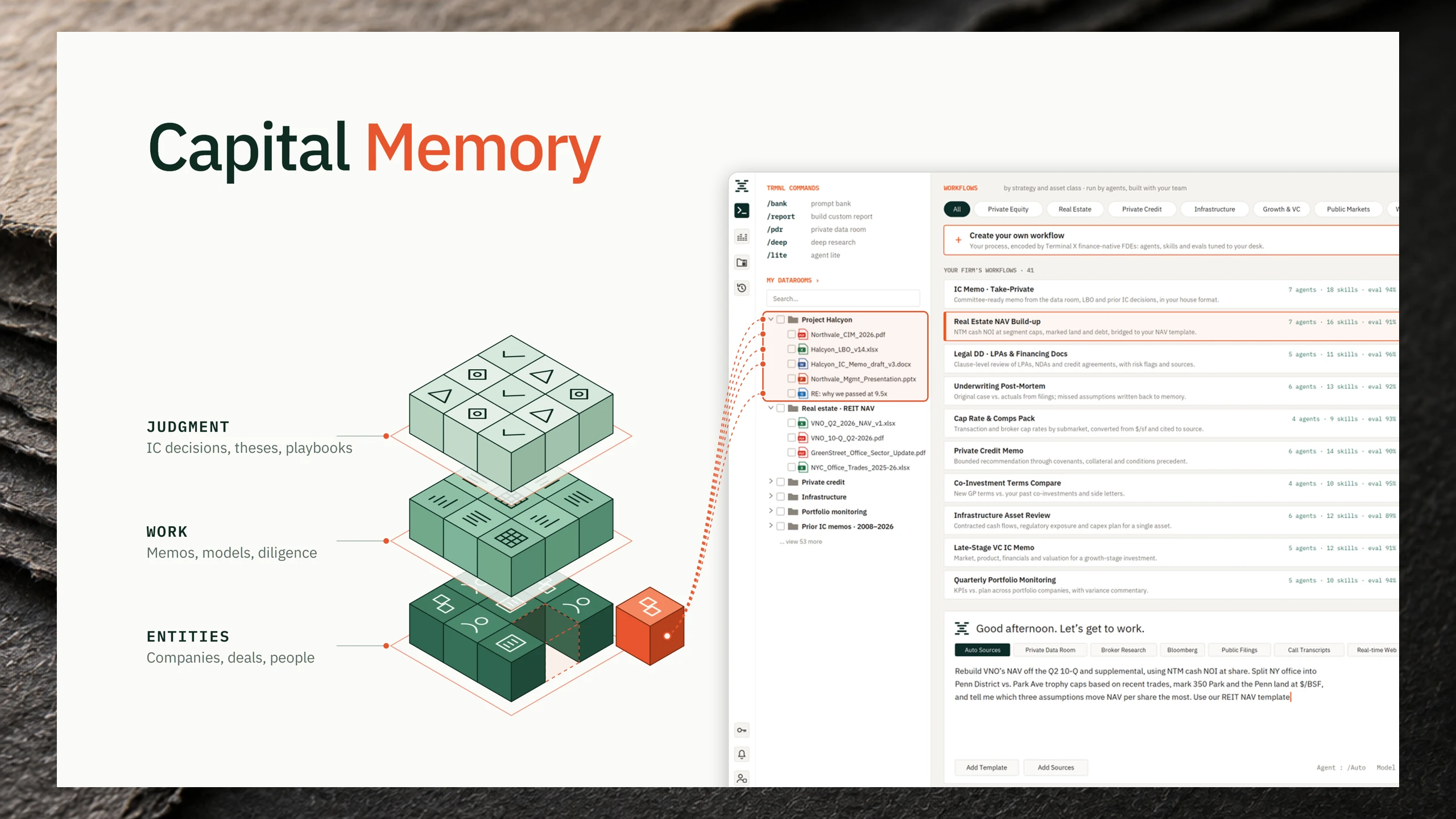
Distilling and codifying the reasoning of each firm’s top investors
For each client, Terminal X builds agents tailored to emulate the investment styles of the firm’s top performers. Terminal X engineers spend weeks on-site reverse-engineering the firm’s gold-standard investment memos, extracting the tacit, unwritten processes—such as how a credit team screens borrowers or which sources a co-investment team consults before drafting a memo.
These processes are then codified into hundreds of agents, customized by asset class and strategy, with dedicated sub-agents assigned to each stage of the investment lifecycle. GPT‑6.1 Sol handles steps requiring deep judgment and massive context windows: distilling the core investment thesis, identifying key considerations, and evaluating mandate fit. GPT‑6 Luna powers high-throughput stages where token cost efficiency outweighs the need for reasoning depth.
The agents operate inside each firm’s private data room—an isolated environment dedicated to sharing and managing sensitive investment data. The agents process documents in English, Korean, Japanese, and Chinese, storing what they learn as “firm Memory”—version-controlled archives of how a specific desk makes decisions, complete with historical analyses, investment committee decisions, workflow runbooks, and the firm’s house views.
Engineers translate these memories into reusable workflows on the Terminal X platform. In production, every query produces a fully auditable trail: steps executed, sources retrieved, models invoked, and the underlying reasoning.
According to Terminal X, this approach delivers substantial cost savings for clients. One private equity firm reported $2.4 million in annualized savings by automating due diligence and investment memo workflows.
Scoring outputs and continuously improving systems with the Eval Agent
To evaluate agent responses against each firm’s proprietary standards, Terminal X built the Eval Agent—an orchestrated workflow powered by GPT‑6.1 Sol and other OpenAI models designed to review every agent output much like a vice president reviewing an analyst’s work.
The Eval Agent checks each output against a 54-metric rubric: Are numbers, comps, consensus figures, and quotes pulled from authoritative sources? Does the narrative hold up logically? Do recommendations align with the firm’s house views?
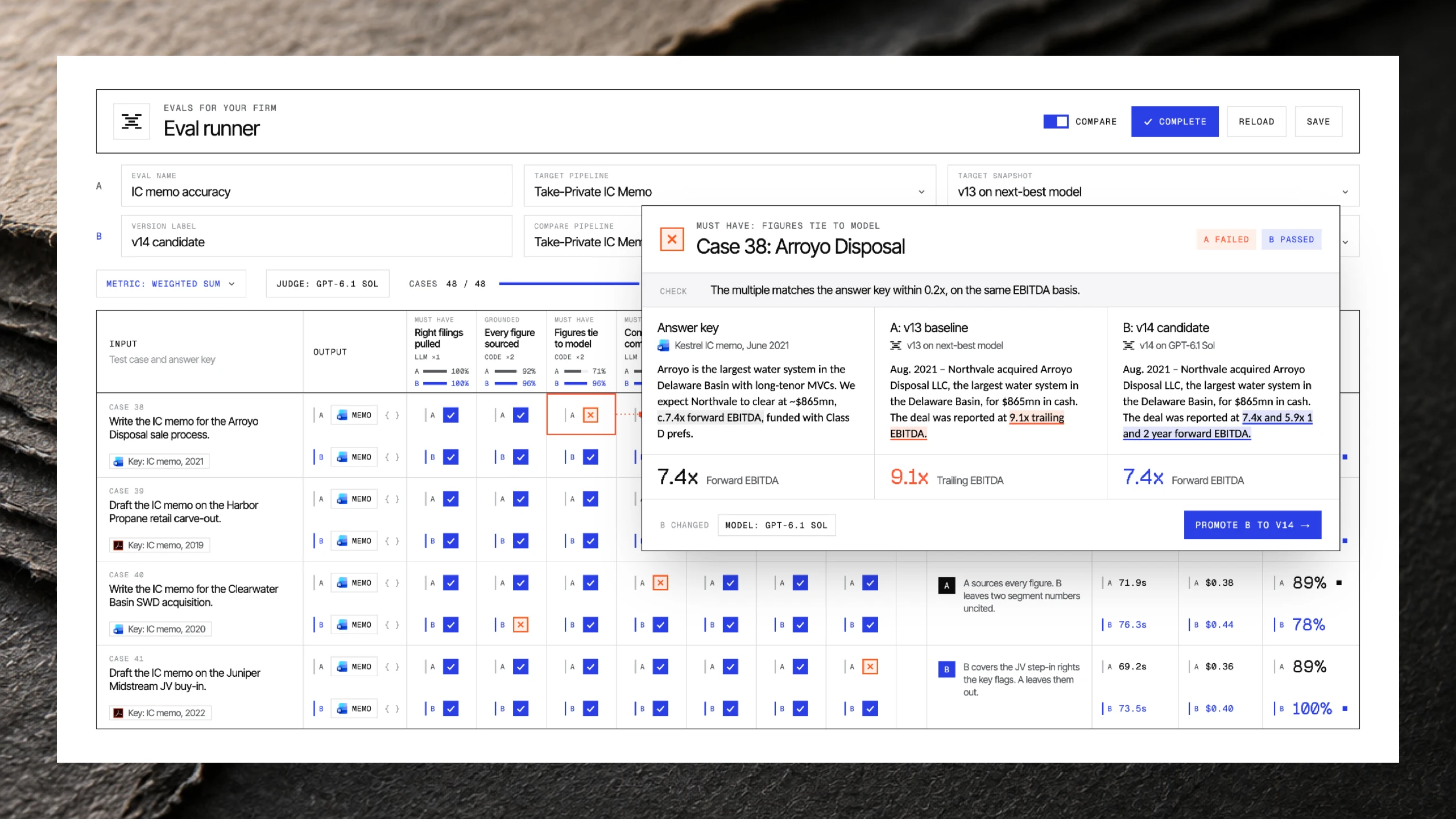
Each check yields a pass or fail. Every failure comes with a one-line explanation, a preferred source, or corrected copy, and becomes a Memory. Missed data sources, incorrect comps, or off-house-view arguments are codified into new runbooks or test cases for that desk.
“Every answer is evaluated, and every correction an analyst makes teaches the system more about how that firm operates,” says Ken Lee, Co-founder and CTO of Terminal X. “The longer a firm uses it, the more the agents think like their own team.”
Testing models to match the right tool to the task
Terminal X selects models based on its own evaluation benchmarks. Across 500 evaluations, the GPT‑6.1 Sol–powered Eval Agent achieved 88.6% alignment with experienced human reviewers, compared to 86.4% for the next-best model—a 220-basis-point improvement.
One failure category where GPT‑6.1 Sol particularly excelled was “style drift.” For example, a buyout fund may have a mandate to identify take-private targets trading below NAV, underwrite the asset, and structure financing. When scenario models projected a market inflection, some proposals drifted toward recommending distressed debt or rescue financing instead. Powered by GPT‑6.1 Sol, the Eval Agent achieved an approximately 25% higher detection rate for such off-strategy recommendations.