
Enabling Everyone to Freely Create and Experience Interactive Worlds
Tingyu reporting from the Office
VAST has achieved a new breakthrough in world models.
Its real-time world model, EdenLive, was officially released and open-sourced today.
According to VAST, EdenLive is the first model to achieve real-time generation while simultaneously supporting arbitrary reference inputs, arbitrary artistic styles, and long-horizon continuous operation.
Specifically, by simply providing a simplified scene or reference video alongside a target first frame and a text prompt, the model can continuously generate high-fidelity visuals across diverse styles—such as photorealistic or anime—strictly adhering to the layout and motion trajectory of the reference content.
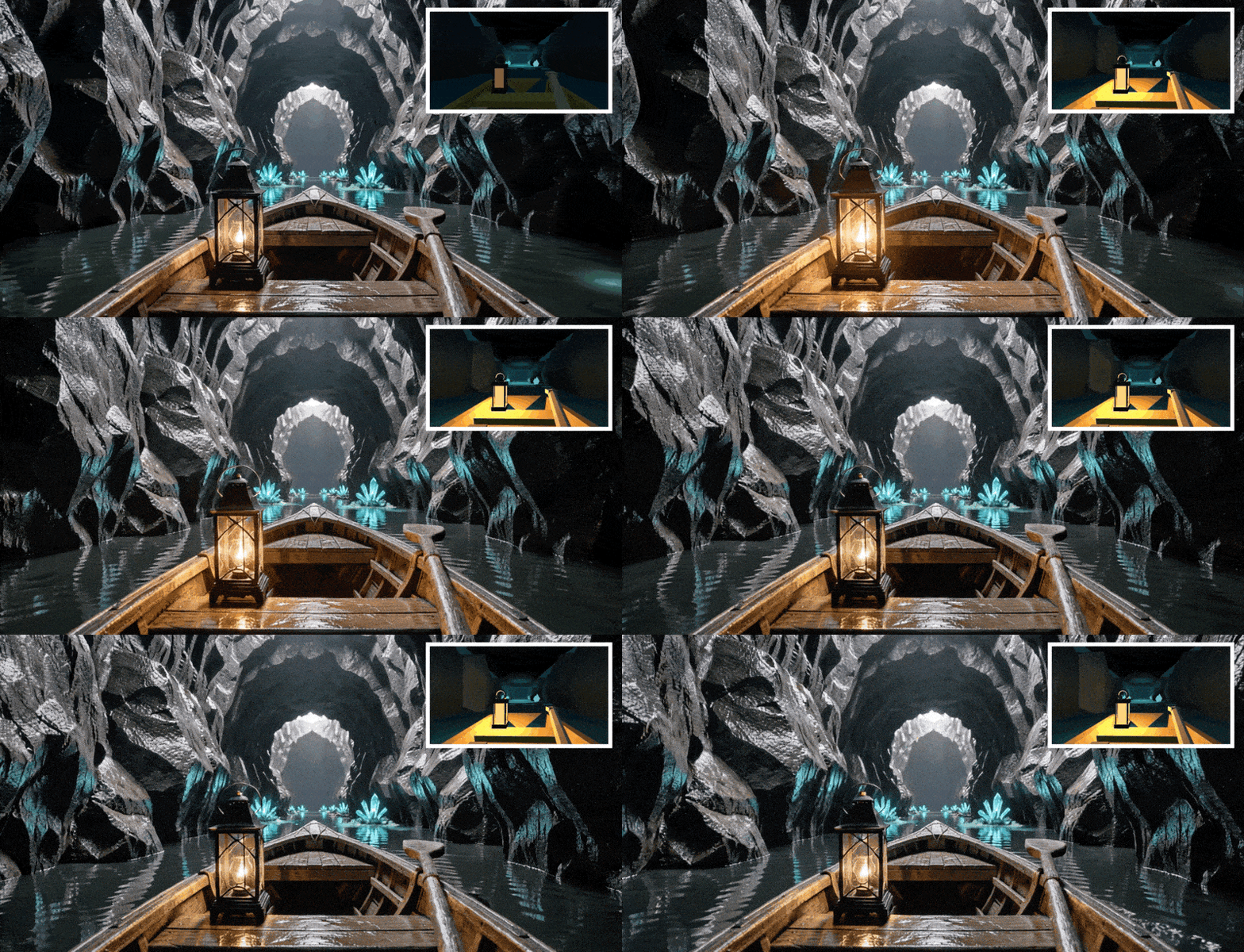
With support for diverse reference sources and customizable visual styles, all visual transitions and progressions are rendered seamlessly in real time.

Running on a single consumer-grade NVIDIA RTX 5090 GPU at 720p resolution, its 5B model achieves a generation speed of over 24 FPS, supporting stable, continuous generation over minute-long durations.
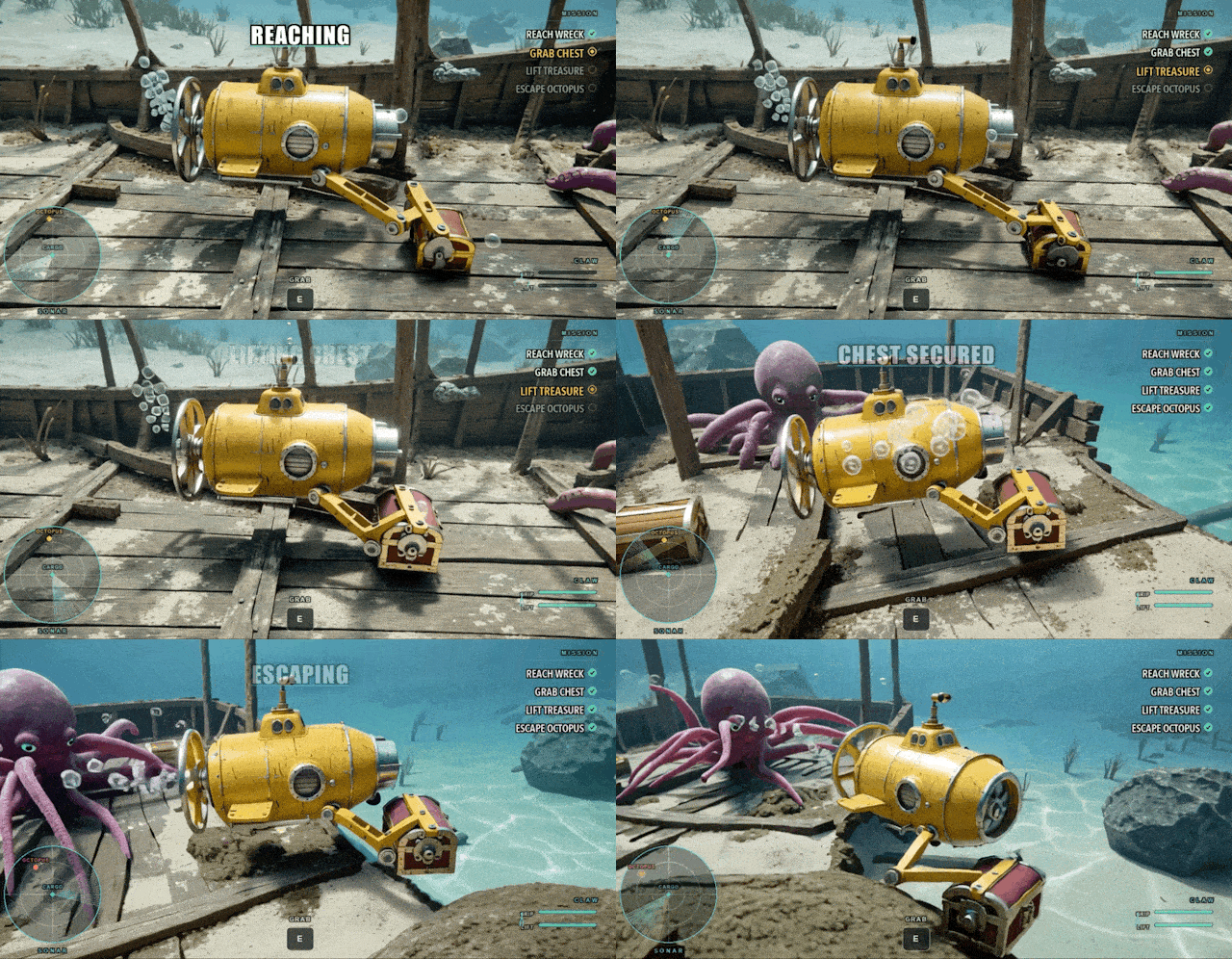
VAST states that the end-to-end latency—from user input to rendered visual feedback—is on the order of mere hundreds of milliseconds.
Throughout this continuous visual progression, interaction rules and underlying world states are maintained centrally by an upstream interaction system: the system receives player inputs and updates the state in real time, while EdenLive translates these state changes into rich, nuanced visuals based on the corresponding reference feed.
Recently, AI capabilities in 3D scene construction and interactive creation have become increasingly tangible.
GPT-6 Astra serves as a prime example: it can already model houses in Blender and seamlessly import them into Unreal Engine 5 to construct interactive environments that users can freely explore and navigate.
Now that AI possesses scene-building and interaction-design capabilities, delivering sophisticated, real-time visual rendering for this content has emerged as the next critical frontier for the industry to conquer.
Against this backdrop, a technical roadmap has steadily gained industry consensus: letting the interaction system manage underlying states and operational rules, while delegating visual rendering to generative models.
VAST explicitly proposed this division of labor and showcased corresponding results as early as June of this year.
In the Project Eden research preview released back then, the team had already established “decoupling state maintenance from visual rendering” as a foundational architectural design. Judging by the pace of industry developments, this architectural vision predated the broader industry consensus by roughly 3 to 4 months.
Today, as a milestone deliverable of this roadmap, EdenLive officially open-sources its model weights and inference code, alongside the technical report and an end-to-end demo.
- Code Repository: https://github.com/VAST-AI-Research/EdenLive
- Project Page: https://vast-eden.ai/?p=edenlive
- Technical Report: https://assets.vast-eden.ai/assets/edenlive/EdenLive-tech-report.pdf
- Model Weights: https://huggingface.co/VAST-AI/EdenLive
Multiple Reference Inputs, Real-Time Generation Across Styles
The core value of EdenLive lies in providing high-quality real-time rendering services for simplified scenes and interactive content, while the underlying logic and world states remain hosted by the upstream interaction system.
What capabilities does it offer in practical scenarios? The following application demos provide a direct look:
Interactive Game Prototyping and Preview
EdenLive supports flexible integration with both 2D and 3D scenes. Currently, it is particularly well-suited for gameplay prototypes with moderate interaction frequencies, such as scene exploration and Sokoban-style puzzle games. This allows creators to playtest prototypes in real time while immediately evaluating high-fidelity visual rendering.
For example, in a lava platformer game, a character uses a freeze gun to create footholds and advances through consecutive jumps. Smoothly updating such dynamic gameplay visuals in response to user inputs hinges on high generation frame rates. According to data released by VAST, on a single RTX 5090 GPU at 720p resolution, the EdenLive 5B model achieves a generation speed of over 24 FPS.
Another two-player fighting game demo demonstrates precise synchronization between character combat moves and game UI elements, such as health bars and round timers.
Beyond a smooth frame rate, input latency is equally crucial to the interactive experience. EdenLive currently maintains an end-to-end latency from input to visual response within several hundred milliseconds. Furthermore, the system supports continuous generation lasting multiple minutes, providing ample runway for complex scene exploration and seamless sequential actions.
Scene and Animation Previsualization
Beyond interactive games, EdenLive can also be applied to previsualization for film and animation—enabling creators to rapidly explore diverse art styles once scene layouts and camera movements are established.
Take, for instance, a whimsical scene of a “pelican riding a bicycle”: the generated output not only accurately captures feather textures and seaside environmental details, but also simulates physically plausible lighting and shadows. Similarly, a snow-driving scene built with basic whitebox geometry is transformed by EdenLive to showcase realistic car paint, tactile snow accumulation, and dynamic lighting.
The generation of such visuals is governed by three coordinated inputs: the reference video/stream provides spatial layout, camera trajectories, and dynamic motion; the target first frame sets the overall aesthetic tone and artistic style; and the text prompt enriches material details and stylistic nuances. Consequently, a single underlying camera path and composition can yield multiple art-style variations with a single click, empowering directors and concept artists to evaluate options side by side.
Video Re-rendering and Reskinning
Existing video footage can also be fed into EdenLive for real-time re-rendering, enabling seamless replacement of character appearances, visual elements, or overall artistic styles.
For instance, live-action footage of an actor in front of a blue screen can be converted into a cartoon character in real time, while faithfully preserving the original body posture, motions, and clothing palette. This capability is directly applicable to virtual streaming avatars. Additionally, real-world footage of architectural structures can be quickly restyled into hand-drawn animation—retaining the overarching spatial architecture while using soft lines and colors to reimagine silhouettes and lighting.
Embodied Data Augmentation
In the field of embodied AI, EdenLive can be used for data augmentation on manipulation videos. It can convert first-person human manipulation footage into a robotic perspective while enabling controlled modifications of objects, materials, and surface appearances within the environment.
In a tabletop-wiping video, human hands are replaced in real time with robotic grippers, and the cleaning cloth changes from orange to yellow—yet the core trajectory of the wiping action and its underlying physics remain strictly consistent with the original clip. Similarly, the operating agent can be swapped for a metallic robotic arm, or a cart handle can be given a brushed-metal finish.
This allows a single base demonstration video to generate vast volumes of diverse samples with varied appearances and materials at low cost, significantly scaling up training datasets for embodied AI algorithms.
From lightweight 2D animations and 3D whitebox models to live-action footage and first-person interaction recordings, a wide array of content can serve as inputs for EdenLive. The ability of a single model to ingest diverse references, recast visual styles while honoring existing spatial layouts and motions, and output this in real time with long-horizon stability is precisely the model’s core strength.
Currently, EdenLive still has room for refinement: motion fidelity and latency management in high-frequency, fast-paced adversarial scenarios; identity consistency when multiple characters share the screen; fine-grained manipulation of minute objects; and visual stability over extended rollouts all require continuous iteration.
To this end, VAST has open-sourced model weights across various scales, inference code, and technical documentation, while simultaneously open-sourcing Game Prototype Turbo (a Prompt-to-Proxy Game skill module). Using this toolkit, creators can rapidly construct playable game prototypes: the interaction system handles state simulation and outputs lightweight proxy frames, while EdenLive instantly renders them into polished visual feedback for the user—completing the entire end-to-end loop from gameplay mechanics to real-time rendering.
Dissecting EdenLive’s Technical Architecture and Core Moats
The core of EdenLive’s architecture is “decoupling world state maintenance from visual rendering”—clearly separating the underlying physical rules of the world from its final visual representation.
Taking the street-fighting demo as an example:
Character locomotion, combat moves, and hit detection are driven entirely by player inputs; the upstream interaction system handles button inputs, computes collision detection, and updates health values; and EdenLive takes the skeleton rigs and reference states emitted by the logic layer, rendering simplistic proxy characters into high-fidelity, photorealistic fighters in real time. Players then execute their next actions based on visual feedback, creating a closed interactive loop.
The complete pipeline architecture is shown below:
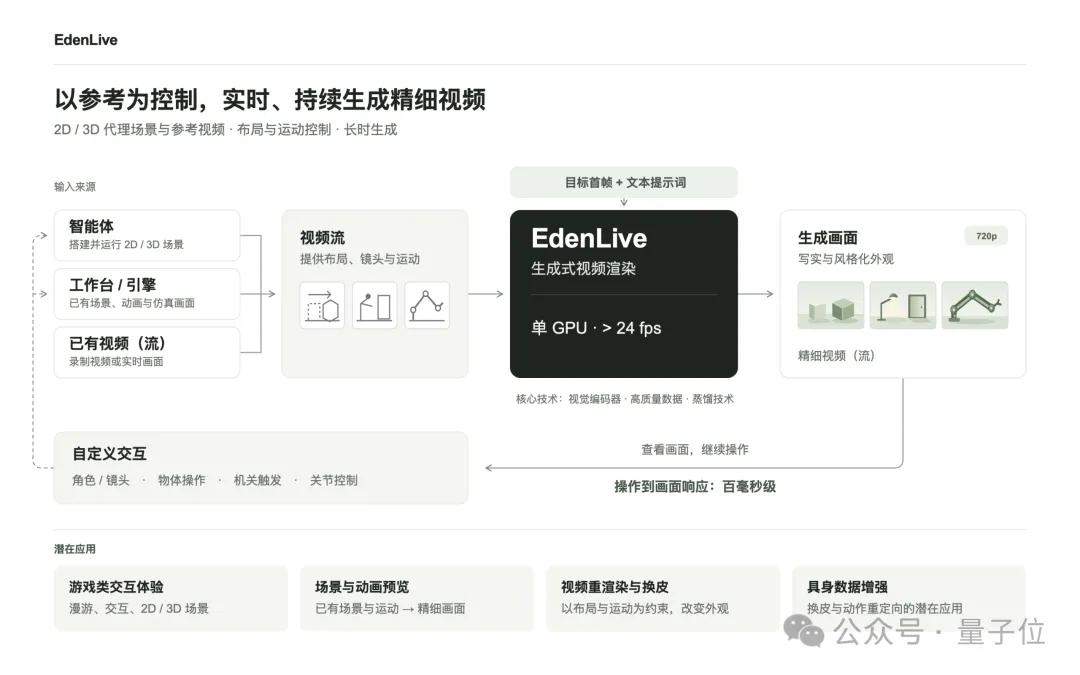
In this pipeline, low-fidelity scenes or reference streams provide spatial layouts and physical motion baselines; the target first frame and text prompt condition appearance details; EdenLive delivers high-quality visual outputs; and logical state simulation is handled by the upstream interaction engine.
This clarifies EdenLive’s role within VAST’s broader initiative: Project Eden is VAST’s long-term endeavor to develop general-purpose world models, while EdenLive represents a pivotal milestone specifically focused on the “real-time generative rendering” dimension.
While the conceptual logic of this pipeline is clean, practical engineering demands overcoming multidimensional challenges: preserving high visual detail and tight motion alignment while ensuring high real-time inference frame rates and long-duration stability. Its core technical moats lie in three main areas:
First, the accumulation of high-quality paired data. Mapping simple primitives to realistic objects while maintaining precise kinematic consistency relies on accurate mapping between reference data and generated frames. Scene topologies, camera parameters, and object motion vectors must all be tightly aligned. VAST’s data pipeline synthesizes diverse data streams—including simplified 2D/3D scenes, engine-rendered synthetics, and real-world physical videos—providing a solid foundation for cross-domain reference understanding.
Second, cross-disciplinary engineering and architectural synergy. EdenLive unifies 3D spatial computing, video generation models, and system-level engineering optimizations. The model must interpret 3D spatial and kinematic constraints, deliver cutting-edge visual synthesis quality, and meet stringent low-latency inference requirements—demanding deep co-design between algorithmic architecture and underlying hardware acceleration.
Finally, forward-looking architectural foresight and continuous R&D. From the inception of Project Eden, VAST introduced a three-tier architecture comprising “continuously evolving structured states,” “state-to-observation interactive interfaces,” and “generative neural rendering”—allowing state simulation to exist independently of any single viewpoint.
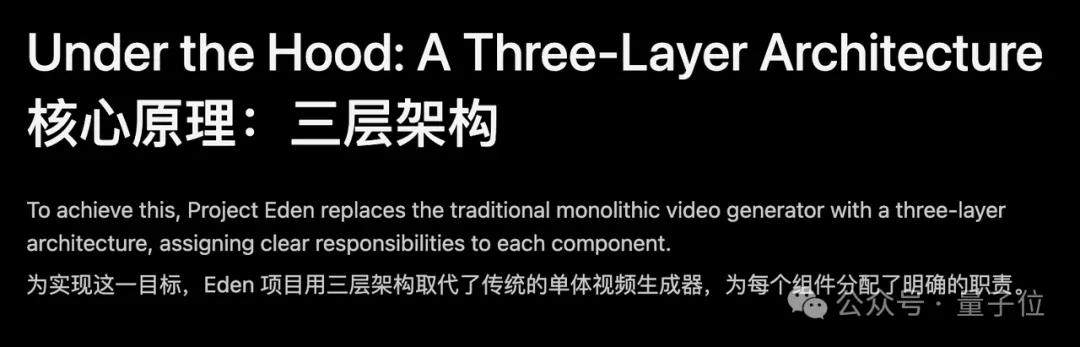
Anticipating this technical trajectory months ahead of the industry consensus granted the team a crucial development window to build robust data flywheels and optimize system performance.
The 3D Path Toward Interactive Worlds
From a systemic perspective, EdenLive remains deeply anchored in the 3D technical foundation that VAST has steadily constructed.
Building truly interactive virtual worlds requires concrete characters, props, and environmental assets, as well as explicit spatial scales and geometric topologies. 3D representations provide an interactive, editable structural scaffold for the world; generative video technology then elevates this scaffold into rich, refined visuals complete with realistic lighting, tactile materials, and physical dynamics.
The synergy of both allows creators to tweak underlying rules and scene layouts at low cost while receiving instant, cinematic visual feedback.
This is also the underlying technical logic behind VAST’s world model strategy: existing 3D generation and understanding capabilities not only produce static assets, but also help curate the multimodal data required for world models. Leveraging established 3D pipelines, depth, camera trajectories, and geometric topologies can be unsupervisedly extracted from video, while simulation engines can batch-generate synthetic data where physical states strictly correspond to rendered outputs.
This technological evolution continues to lower the barrier to entry for creators: progressing from generating individual models to assembling complex scenes, and onward to defining interactive logic with fully dynamic, high-fidelity visual expression—ultimately serving the goal of “enabling everyone to freely create and experience interactive worlds.”
While Project Eden undertakes the long-term exploration of foundational world models, EdenLive breaks through the critical bottleneck of real-time rendering, providing creators with a powerful tool to rapidly elevate playable prototypes into high-quality visual experiences.