
New Version V4.1-Flash-1017 Released, Alongside In-House Search API
It all makes sense now.
A couple of days ago, when DeepSeek suffered an outage followed by user compensation, speculation was already brewing that big moves were underway.
And sure enough, the wait paid off—the new model, DeepSeek-V4.1-Flash-1017, has officially rolled out.
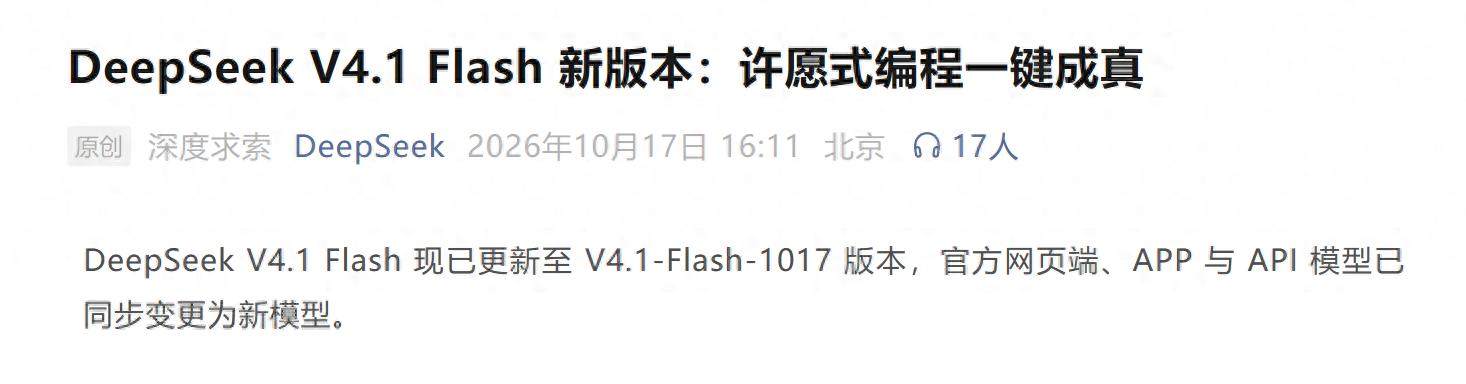
Powered by this new model, the all-new DeepSeek Harness v0.2.1 has also received significant capability upgrades. According to the official announcement:
The new model was specifically optimized for DeepSeek Harness during training—boosting task performance while cutting down runtime, output length, and token costs.
Faster, cheaper, and noticeably more capable across the board!

To sweeten the deal over the weekend, DeepSeek also rolled out a perk:
Eligible users logging into DeepSeek Harness for the first time can claim a ¥6 bonus credit directly—no top-up required—valid for 7 days upon receipt.
Note that supplies are limited and distributed on a first-come, first-served basis.
Higher Performance at a Lower Cost
Perks aside, let’s dive into the model’s highlights (if you’ve logged into Harness before, remember to log out and back in first).
The official web interface, mobile app, and API endpoints have all been switched over to the new model.
Compared to the previous V4.1 Flash, the 1017 version sees across-the-board gains on benchmark evaluations, showing remarkable improvements in coding, agentic workflows, and more.
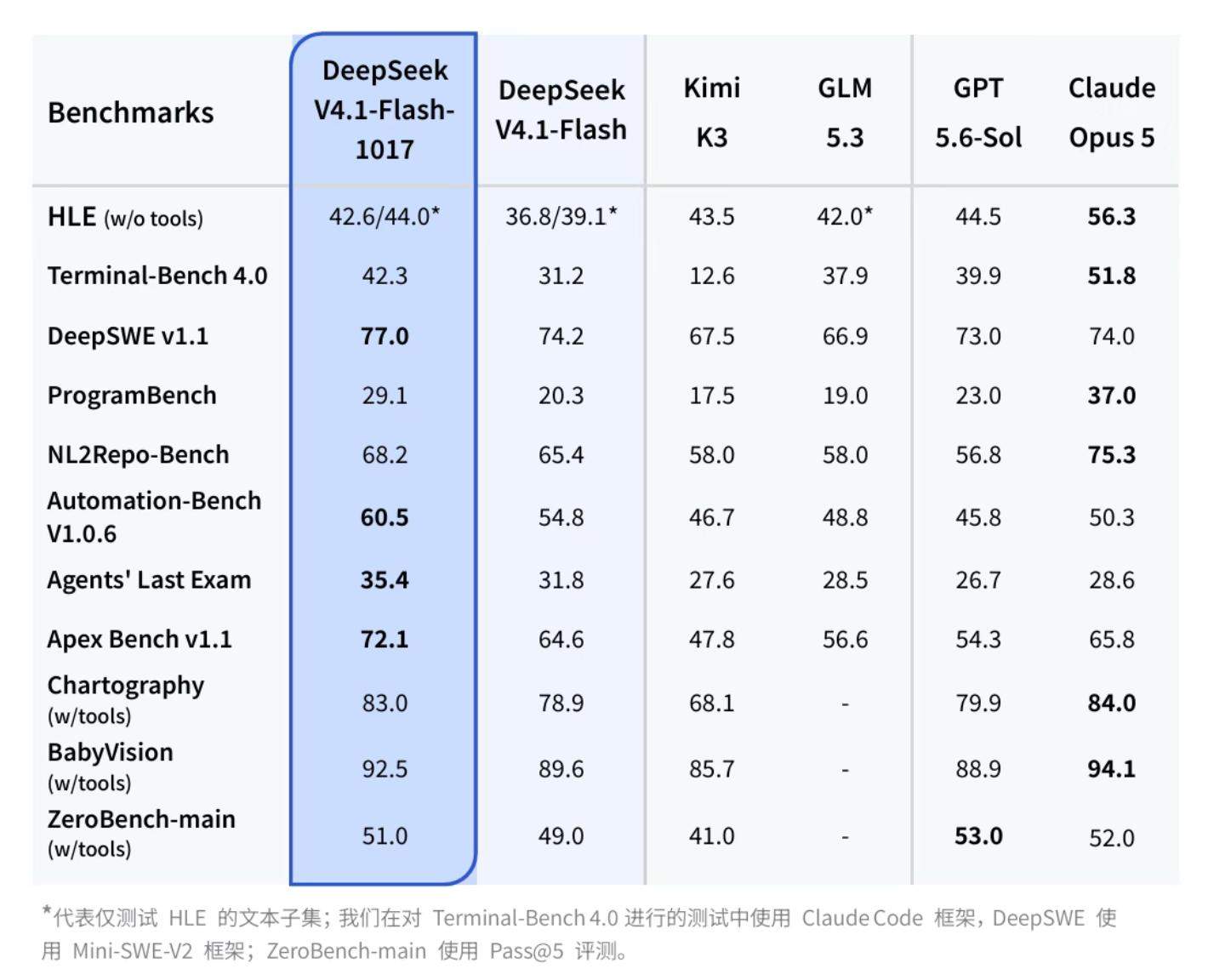
However, higher benchmark scores aren’t even the most impressive part of this update.
Because while performance shot up, task runtimes and output lengths were actually reduced.
The team calls this a “performance-cost Pareto improvement.” Previously, getting an agent to deliver better results meant accepting longer reasoning times, extra steps, and higher token consumption.
With V4.1-Flash-1017, the model cuts out detours and fluff, heading straight toward the objective.
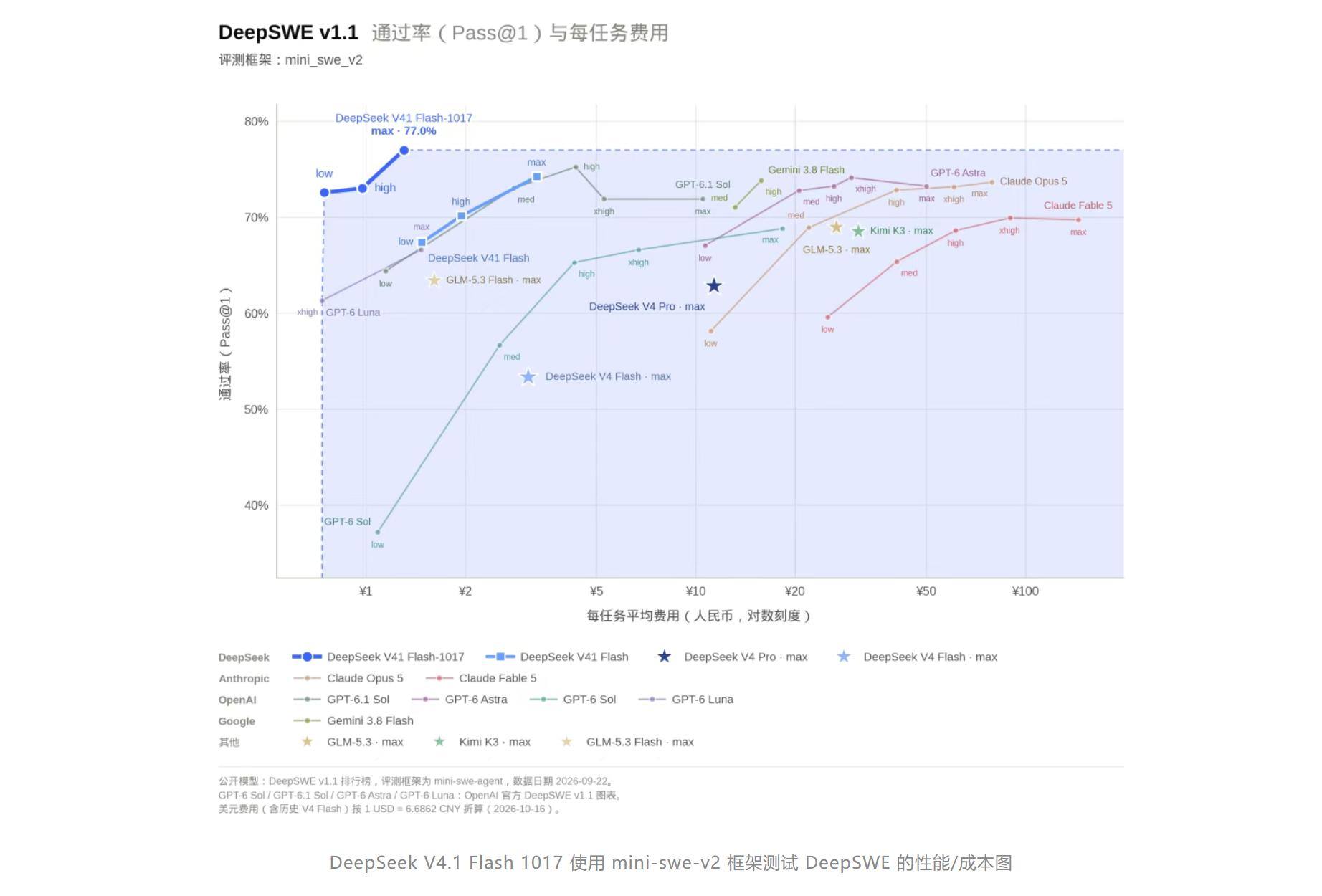
Judging by the official DeepSWE evaluations, V4.1-Flash-1017 has once again pushed the frontier of performance versus cost across multiple agent frameworks.
DeepSeek Harness, Tencent CodeBuddy, and WorkBuddy, in particular, received dedicated optimizations in this release.
To fully experience these new capabilities, DeepSeek Harness must be updated to version 0.2.1-rc.1 or above.
“Wish-Driven Programming” Becomes Reality
Of course, no matter how dazzling the benchmarks are, nothing beats seeing what it can actually do in practice.
DeepSeek’s new trick for V4.1-Flash-1017 has an intuitive name—
“Wish-Driven Programming.”
How does this “wishing” actually work?
Previously, building a complete project required breaking down features, architecture, UI interactions, and tech stacks step by step before explaining them to the model.
Now, users simply state their requirements, and the model handles everything autonomously from there—architectural design, code implementation, running, debugging, testing, and iterative refinement.
The core foundation behind this is a self-feedback reinforcement learning training pipeline.
Rather than simply handing over the first draft of code, the model actively inspects its own output and rectifies any issues it discovers on the fly.
So, how well does this approach work in practice?
DeepSeek kicked things off with an ambitious showcase: building the Forbidden City entirely with code.

Using pure code, DeepSeek rendered an interactive 3D scene supporting real-time exploration and camera switching.
While others are still using Vibe Coding to whip up Todo lists, DeepSeek is out here “Vibe-building” the Forbidden City.
The subsequent demos were equally eye-catching:
These included a fully playable web-based racing game, an interactive Godot remake of Portal 2, and a dynamic 3D world simulation spanning from prehistoric times to the modern era.



From a simple prompt to a fully visual, animated, and interactive project, “wish-driven programming” has genuinely become a reality with this generation of models.
Pre-Launch Leaks: “Smarter and More Concise”
In fact, word of DeepSeek-V4.1-Flash-1017 had already been circulating prior to the official launch.
Hours before the release, sharp-eyed users spotted “DeepSeek V4.1 Flash-1017” briefly appearing in DeepSeek’s model selector.
Although the option was quickly hidden, watchful users managed to capture screenshots.
The “1017” in the name corresponds directly to October 17, aligning with DeepSeek’s standard convention of tagging model snapshots with release dates.
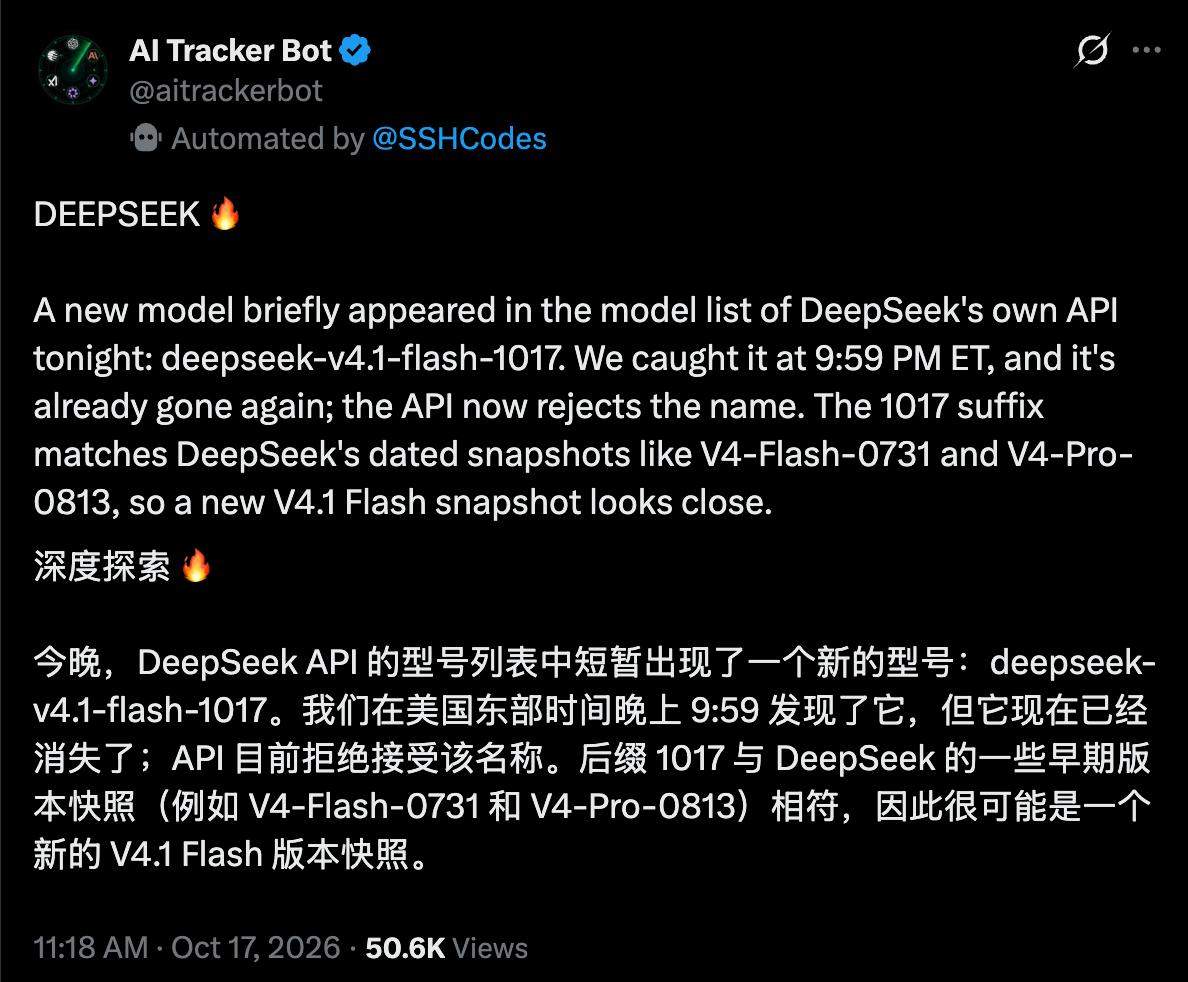
Shortly after, another piece of evidence surfaced.
Developers noticed that the system fingerprint returned by the deepseek-flash endpoint had changed from aeb56401ca74e127821c4f9126dcb669 to e72d3c7f663d3e1383b00b3884cb4501.
A change in system fingerprint typically signals that the backend model version or underlying deployment configuration has been updated.
Early hands-on impressions across the community share a consistent verdict:
The new model feels smarter, responds faster, and delivers more concise outputs.
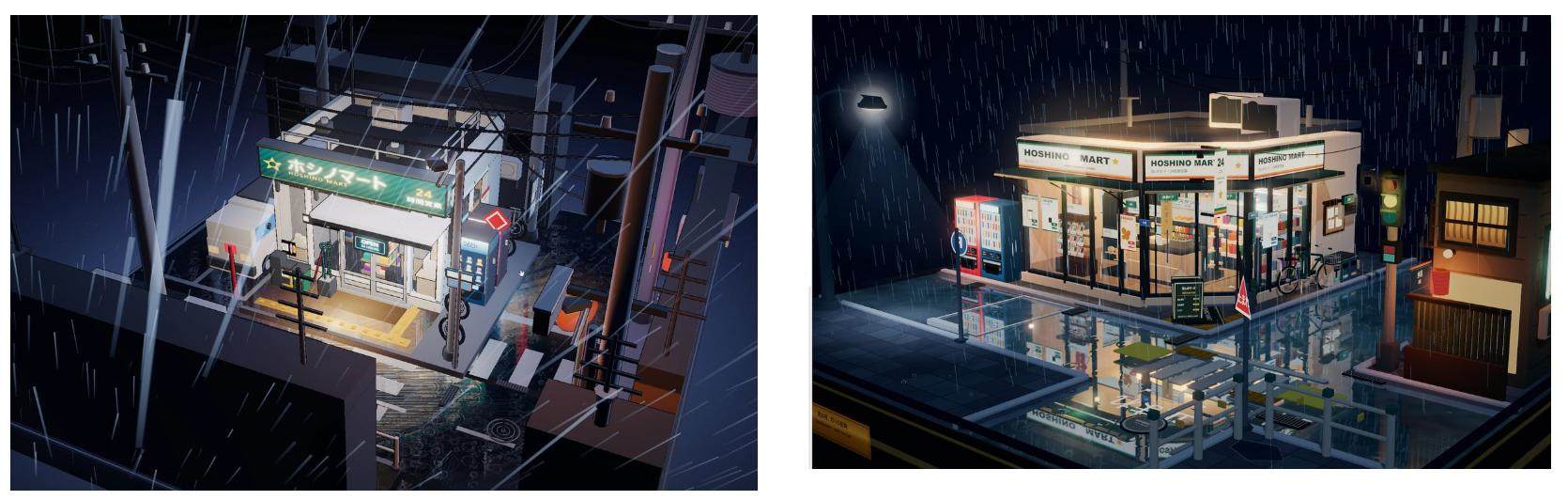
Tech blogger Chetaslua noted that visuals generated by the new version (on the right) feature richer details and noticeably more realistic lighting and shadows.
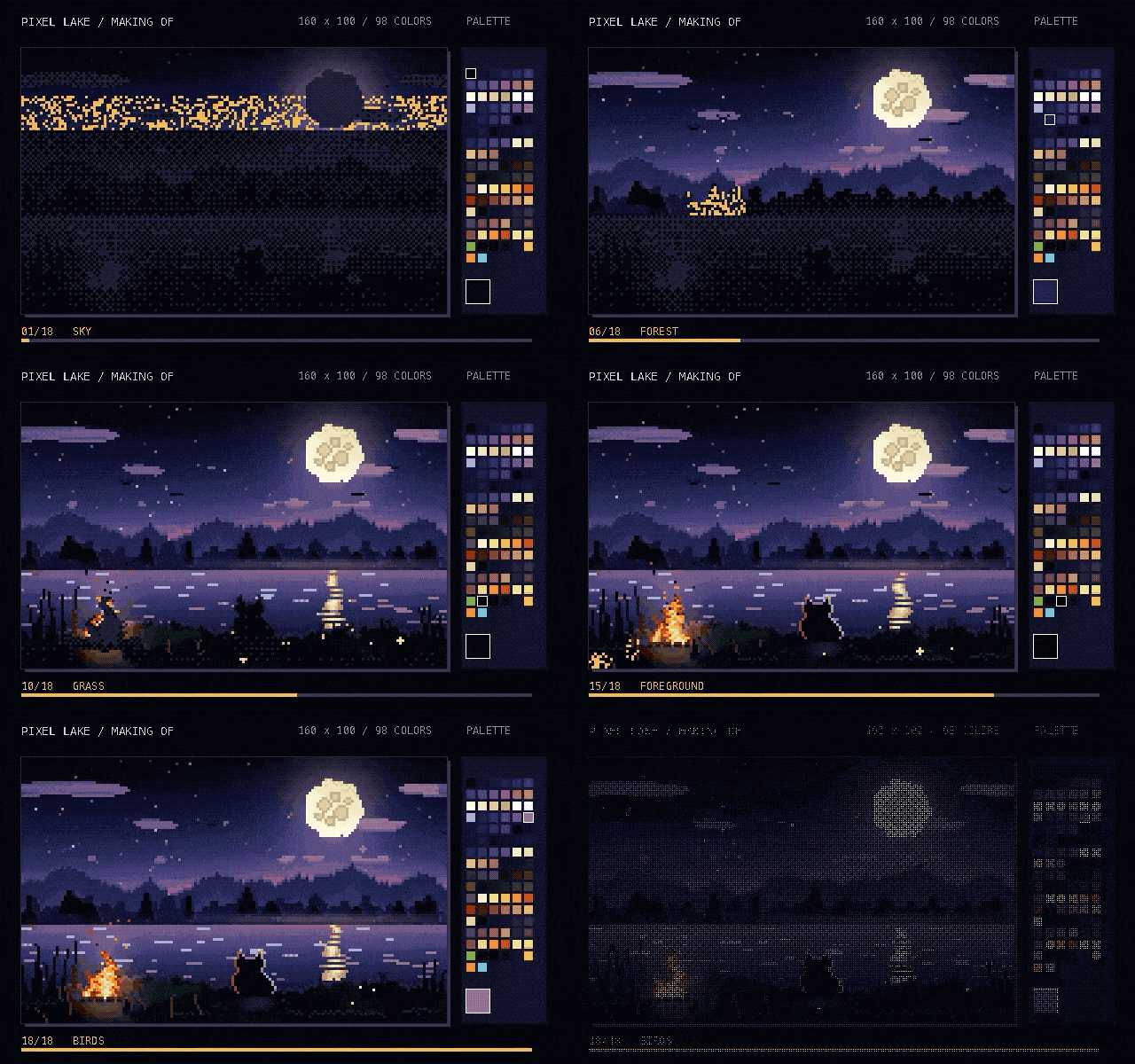
Single-prompt generations were equally impressive, accompanied by a complete breakdown of the creation process. The creator noted that the overall experience felt smoother than Gemini 4 Argon.
Broader multimodal evaluations also reveal a substantial upgrade in 3D content generation capabilities.
A series of generation showcases published by blogger Hakm stood out, delivering visual fidelity reminiscent of the GPT-6 Astra unveiling.

He also used the model to spin up a classic first-person shooter game with an impressively high degree of completion.
In-House Search API Now Available
Alongside the model upgrade, DeepSeek has also released its core tool for agentic web retrieval to the public.
DeepSeek’s proprietary search engine officially opens two API endpoints: Search and Fetch—the former for retrieving relevant web pages, and the latter for extracting page body text.
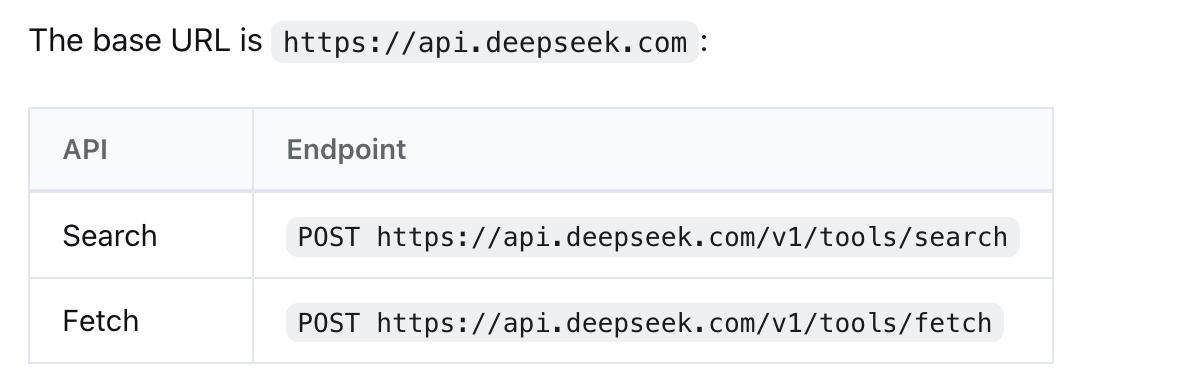
Developers can have an agent search for information using keywords, crawl the selected target pages, convert them into clean Markdown text, and feed them into the LLM for further analysis.
The Search API also supports filtering by specific domains, languages, and publication date ranges, significantly improving precision when retrieving time-sensitive content.
Billing for the API is calculated per successful request:
Pricing is remarkably competitive at just ¥5 per 1,000 successful requests—amounting to half a fen (¥0.005) per call. Failed requests, zero-result queries, or timeouts are not charged.
Users can now invoke the DeepSeek API within DeepSeek Harness, Claude Code, or Codex to try it out, and it is free to use for a limited time until November 1.

With its signature cost-performance advantage firmly intact, DeepSeek once again demonstrates its relentless pace of product iteration.
HuggingFace: https://huggingface.co/deepseek-ai/DeepSeek-V4.1-Flash-1017
ModelScope: https://modelscope.cn/models/deepseek-ai/DeepSeek-V4.1-Flash-1017
References: [1] https://mp.weixin.qq.com/s/X-5kbBkedQ5Oct9byUunag [2] https://x.com/aitrackerbot/status/2111295736411300047 [3] https://x.com/yugen_matuni/status/2111336985554227345 [4] https://x.com/hakmgpt/status/2111314470433947988 [5] https://x.com/hakmgpt/status/2111314427416895798 [6] https://api-docs.deepseek.com/guides/search/