
Even a former Boston Dynamics executive has been completely captivated by a Chinese robot.
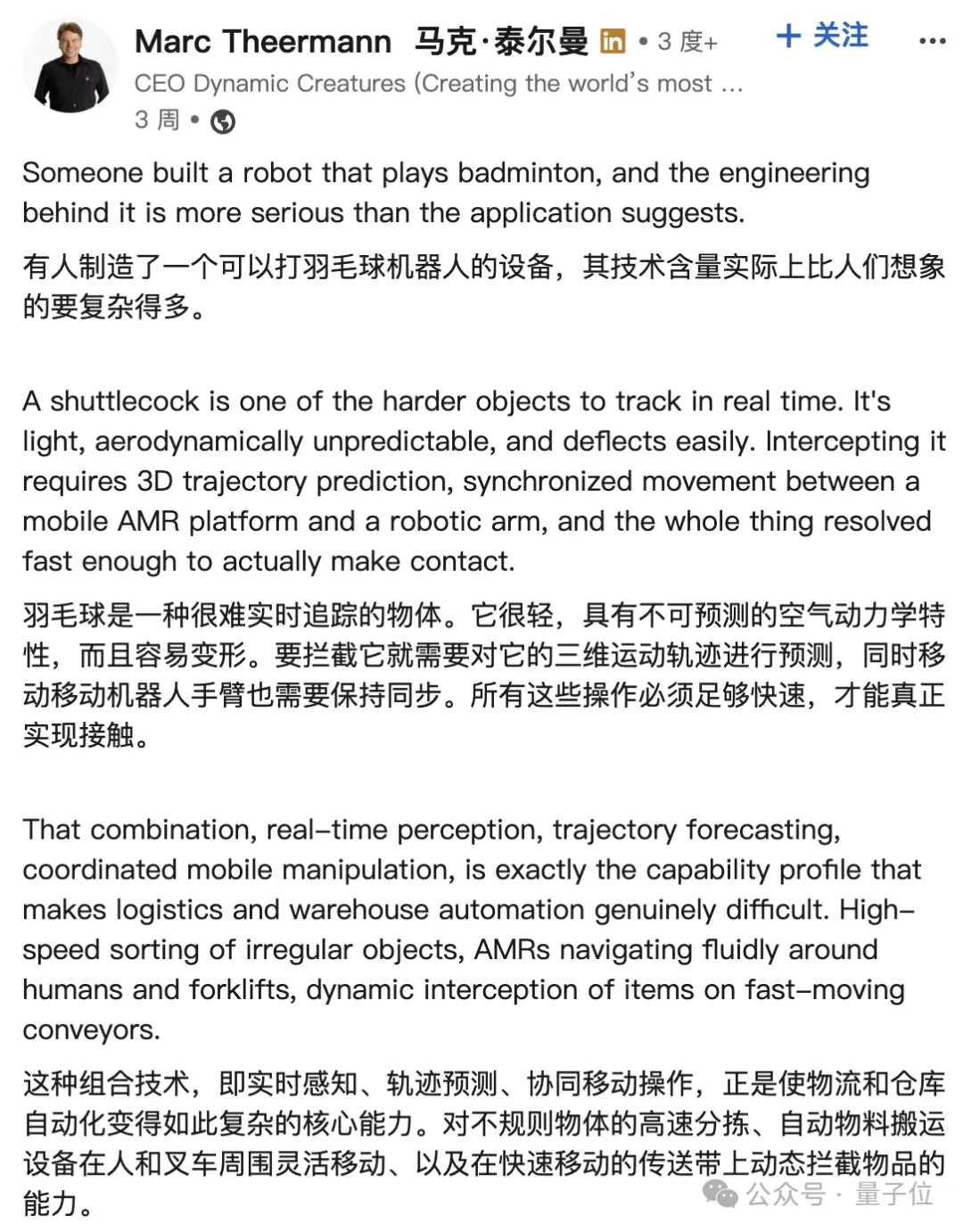
Recently, a post has been making waves across the robotics community.
The author, Marc Theermann, boasts serious credentials. He spent nearly six years at Boston Dynamics, rising to Chief Strategy Officer. During his tenure, he helped drive the large-scale commercial deployment of the Spot quadruped robot and oversaw the entire journey of the Stretch logistics robot from launch to commercial sales—making him a seasoned veteran in robotics commercialization.
The robot that caught his eye—and earned his praise—was built by Zhejiang Shenchen Kaidong Technology Co., Ltd.
Founded in March 2025 in Shaoxing, Zhejiang, the company was co-launched by A-share listed company Daqian Ecology and a research team led by Dr. Dong Xuan, a former tenured professor at The Ohio State University.
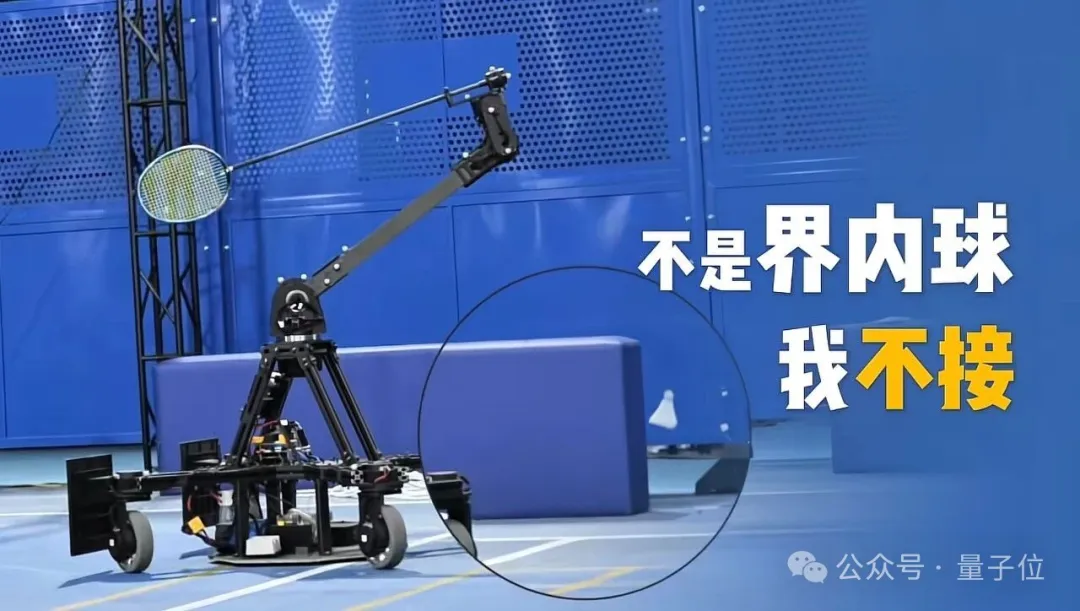
So, how did a badminton-playing robot earn public praise from a former Boston Dynamics executive? What technological breakthrough lies behind this viral post?
What Did the Post Actually Say?
Theermann’s commentary was less of a simple compliment and more of a technical deep dive.
In his post, he wrote:
Shuttlecocks are notoriously difficult to track in real time. They are extremely light, follow unpredictable aerodynamic trajectories, and are highly prone to deflection from disturbances.
Intercepting one requires not only precise 3D trajectory prediction and high-speed coordination between a mobile AMR platform and a robotic arm, but also completing the entire computation and control loop in mere fractions of a second to deliver an accurate hit.
In his view, this combination of capabilities—real-time perception, trajectory prediction, and high-speed coordinated manipulation between a mobile base and a robotic arm—hits the exact pain points of modern logistics and warehouse automation.
Examples include high-speed dynamic sorting of irregular items, AMRs navigating autonomously among pedestrians and forklifts, and dynamically intercepting packages on high-speed conveyor belts.
In other words, playing badminton is simply a concrete, tangible showcase of hardcore underlying engineering capabilities.
From Badminton to a General-Purpose Physical Motion Platform
Shenchen Kaidong’s original intent in developing a motion robotics “brain” was never limited to building sports equipment. Instead, it was to build a general-purpose physical motion platform for the real physical world.
The core team members have spent years focusing on robot motion control, computer vision, and reinforcement learning. Their underlying thesis is straightforward:
A badminton robot serves as a technical testbed for high-difficulty embodied AI. By tackling such a highly dynamic scenario, the team aims to hone and mature the most critical hardware-software coordination capabilities needed for general-purpose robotics.
Ultimately, by leveraging their self-developed robotic brain and general-purpose physical motion platform, they aim to close the loop across perception, prediction, decision-making, and coordinated execution in physical environments filled with disturbances and uncertainty—thereby powering the rapid development and iteration of diverse robotic form factors.
Crucially, this badminton robot is not a single-purpose, custom-built sports machine; it is a concrete application built on top of a general-purpose physical motion platform.
The platform consists primarily of two layers:
- Hardware Layer: Features a highly reusable mobile chassis, joint motor drive systems, and a multi-degree-of-freedom racket arm;
- Software Layer: Shenchen Kaidong’s proprietary robotic brain, which handles end-to-end real-time perception, trajectory prediction, motion planning, and whole-body coordinated control.
Badminton is merely one of the most recognizable real-world showcases for this general-purpose platform to date.
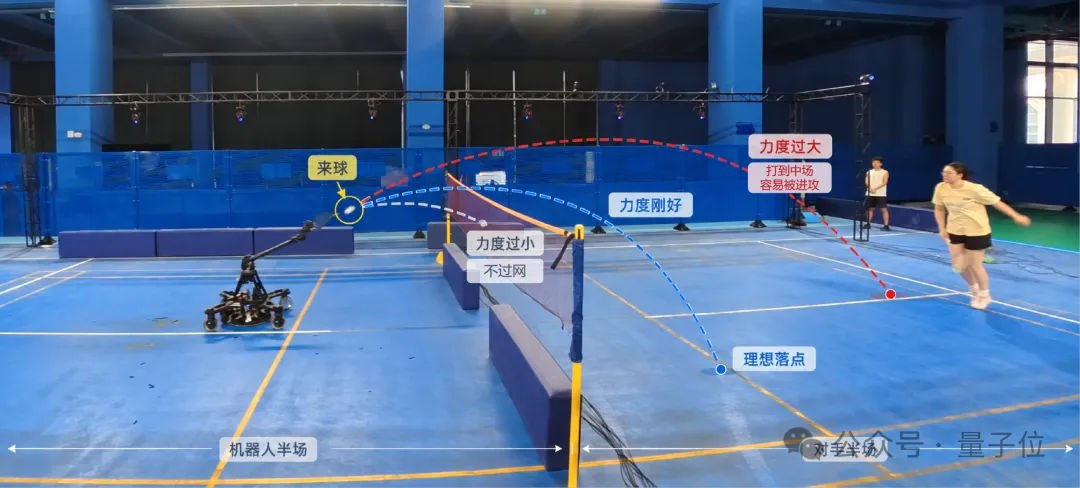 △ Experimental setup of Shenchen Kaidong’s badminton robot rallying against a human opponent
According to public reports, the robot can identify an incoming shuttlecock in roughly 0.5 milliseconds, swing at speeds up to 30 m/s, and smash at over 250 km/h. From the mechanical structure and motion control to visual perception and AI algorithms, the team has achieved full-stack in-house development, amassing over 100 domestic and international patents.
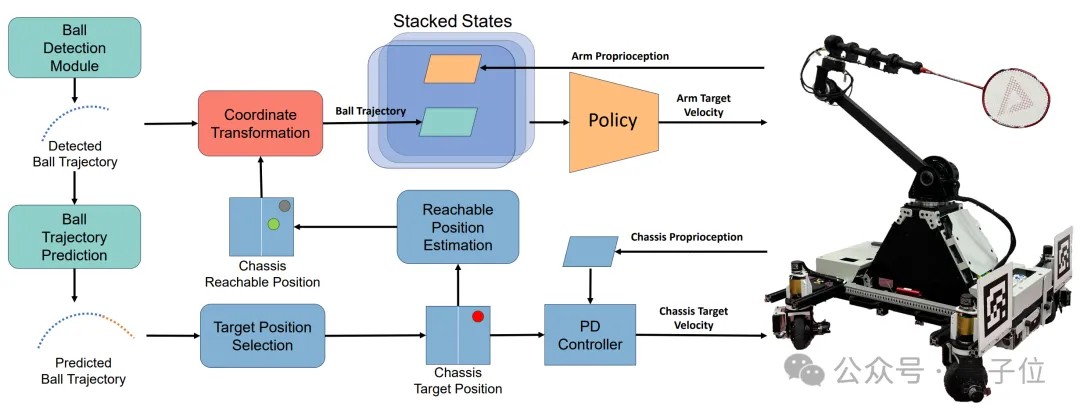 △ System architecture and control flow of the badminton robot
Back in 2022, the team presented the VaRSM system at ICCPS, a flagship conference in cyber-physical systems. It was reportedly the world’s first autonomous robot capable of adapting across three racket sports: table tennis, tennis, and badminton.
In 2025, the team’s whole-body control research was once again accepted by the premier robotics conference ICRA. During automated feeding machine tests, the robot achieved a 94.5% return rate, and maintained a 90.7% success rate during sustained rallies with human players.
A Guinness World Record: 1,452 Rallies
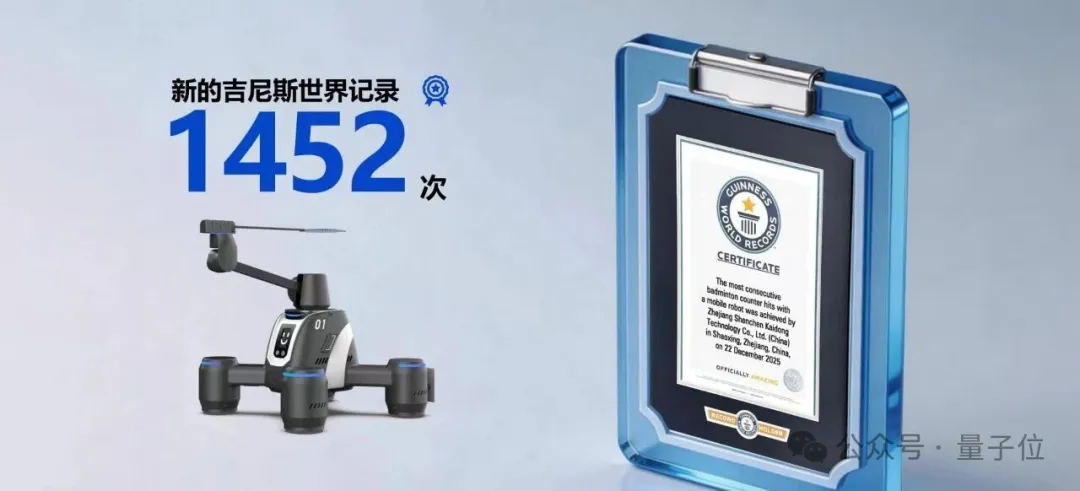
On December 22, 2025, at the Shaoxing Hangzhou Bay Joint Innovation Center, Shenchen Kaidong’s badminton robot completed an uninterrupted 1,452-shot rally with a human player.
This milestone has been officially certified by Guinness World Records under the title “Most consecutive badminton counter hits with a mobile robot,” setting a new world record at 1,452 hits.
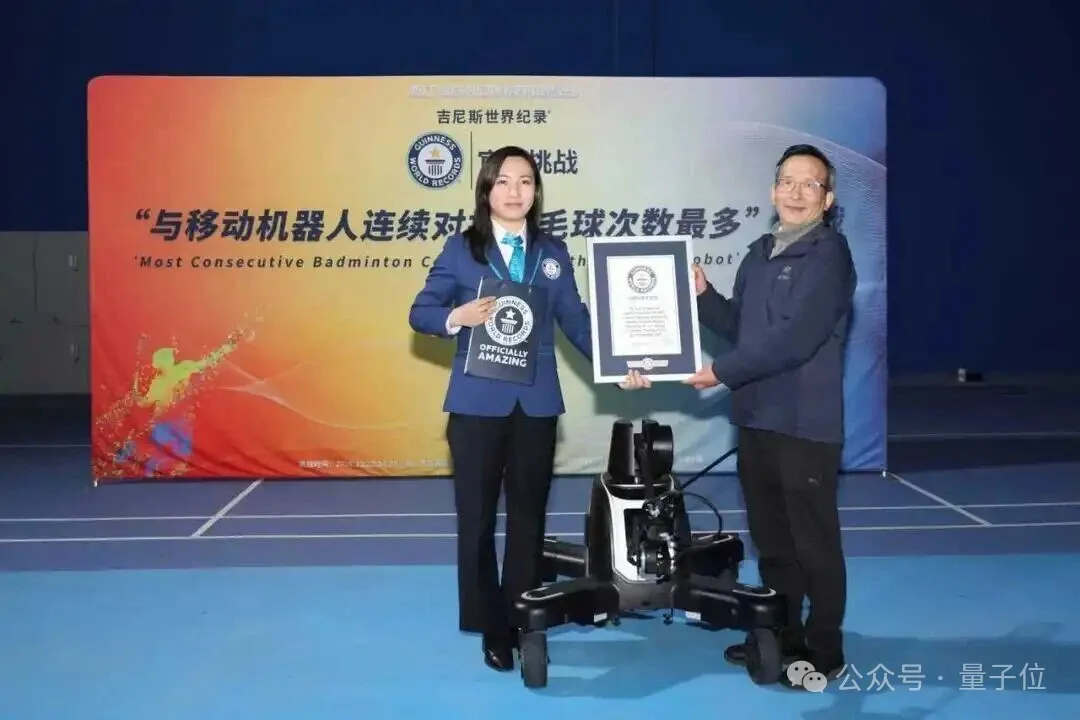
This record represents far more than just a number; it serves as an open test of the system’s reliability and stability under sustained, high-intensity human-robot interaction. It signals that the robot is transitioning from a laboratory prototype into a viable commercial product.
Real-World Deployment and Application Scenarios
In sports scenarios, the robot’s most immediate use case is serving as an indefatigable professional sparring partner.
In traditional competitive badminton training, multiball drills are essential for sharpening reaction times and shot consistency. However, relying on a coach alongside traditional feeding machines often incurs high costs while offering rigid, predictable rhythms.
A robot capable of sustained continuous rallies with adjustable pacing and intensity allows professional athletes to access highly realistic sparring anytime. For general fitness and youth training, it offers an engaging, interactive training experience.
Yet Shenchen Kaidong’s ambitions go well beyond sports gear.
The core value of a general-purpose physical motion platform lies in modular portability: its chassis hardware, joint actuators, and control brain can be seamlessly transferred to other dynamic operational environments. Badminton was simply the first validation scenario for this architecture.
The Industrial Ripple Effects Beyond the Racket
As Theermann highlighted, many casual observers might initially see this badminton robot as just an eye-catching tech demo.
However, its core value transcends sports and entertainment. It validates an engineerable, reusable, and scalable technical path forward for the entire embodied dynamic robotics industry.
For a long time, many cutting-edge robotic systems could only operate reliably in static, structured, tightly controlled lab environments. When confronted with real-world dynamic disturbances and random variables, they frequently suffered from decision latency, degraded precision, and poor generalization.
By building on its in-house robotic brain and general-purpose motion platform, Shenchen Kaidong has mapped out an engineering roadmap for deploying high-dynamic motion control in the real world:
It enables robots to consistently execute high-precision, rapid-response commands within real, uncertain, and unstructured physical environments—bridging the gap between lab theory and industrial implementation.
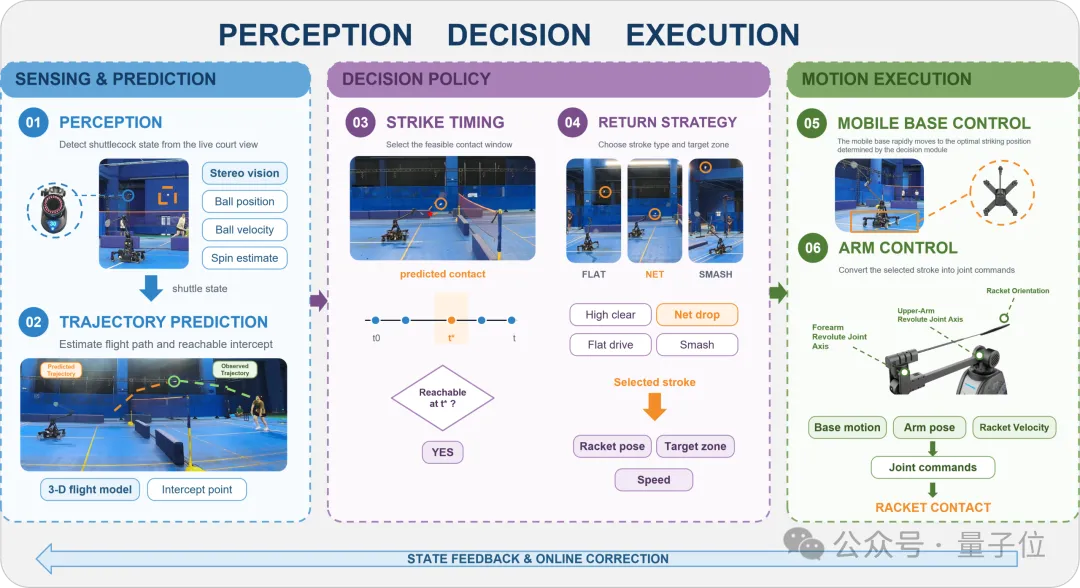
At a foundational level, returning a badminton shot with pinpoint accuracy shares the exact same core embodied AI pipeline as performing household chores, autonomous driving obstacle avoidance, flexible factory assembly, and outdoor intelligent inspections: precise perception of complex environments, millisecond-level dynamic decision-making, and high-precision multi-actuator coordination. High-speed badminton rallies serve as the ultimate stress test for this closed loop.
The team chose badminton as their proving ground specifically because the scenario imposes unforgiving demands on environmental perception, trajectory forecasting, control latency, and disturbance rejection.
Shuttlecocks are featherlight and easily swayed by air currents. Combined with the unpredictable trajectory, landing zone, and spin introduced by human players, the system must complete the full pipeline from perception to execution within a millisecond-level window.
Passing such an extreme stress test means the underlying architecture has what it takes to scale into broader industrial domains, including:
- Intelligent Logistics: High-speed dynamic grasping of unorganized parcels, rapid sorting, and agile material handling in shared human-robot spaces;
- Mobile Robotics: Autonomous navigation across unstructured terrain, millisecond-level dynamic obstacle avoidance, and compliant manipulation;
- Form Factor Expansion: Powering diverse form factors such as home service robots, flexible industrial arms, and specialized field robotics.
What looks like a fun human-robot badminton match actually marks a pivotal step toward freeing robots from pre-scripted static routines and sending them out into the open physical world.
Founding Team and Shareholder Background
Shenchen Kaidong’s technical capabilities are backed by a leadership team that combines deep academic rigor with industry execution.
Chairman Prof. Dong Xuan earned his bachelor’s and master’s degrees from the Department of Electronic Engineering at Shanghai Jiao Tong University, followed by a Ph.D. in Computer Engineering from Texas A&M University. He is an IEEE Fellow, a Changjiang Scholar Chair Professor recognized by China’s Ministry of Education, and designated as Zhejiang Top Talent. Prof. Xuan taught in the Department of Computer Science and Engineering at The Ohio State University for over two decades, where he became a tenured Full Professor in 2013.
His long-standing research focuses on networking and systems as well as robot intelligence. He has authored more than 160 high-impact academic papers across networking, sensing, robotics, and computer vision, frequently featured at top-tier venues such as ICCPS, NeurIPS, and ICCV. Prof. Xuan serves as the primary architect guiding the team’s research direction and system design.
CEO Xiaole Bai holds a bachelor’s degree in Electronic Engineering from Southeast University and a Ph.D. in Computer Engineering from The Ohio State University. With extensive experience across AI, big data, machine learning, and digital transformation, he has published over 40 high-impact papers and previously served as a senior executive at a Top 500 private enterprise in China.
CTO Fan Yang earned his bachelor’s and master’s degrees in Electronic Engineering from Shanghai Jiao Tong University and a Ph.D. in Computer Engineering from The Ohio State University. He co-authored key papers including VaRSM (ICCPS 2022) and Hamlet (ICRA 2025), and has served as the technical lead driving the development and real-world deployment of two generations of racket-sport robots.
On the capital side, Shenchen Kaidong is jointly owned by A-share listed company Daqian Ecology and the founding technical team. The actual controller of Daqian Ecology is Zhang Yuan, an early core member of the BBK group (who currently serves as an OPPO Director and Non-Executive Director of J&T Express), alongside Daqian Ecology Chairman Duan Liping. The company was incorporated in Zhejiang in March 2025 with a registered capital of roughly 24.75 million RMB.
From introducing a concept system supporting three racket sports in 2022, to documenting a 90%+ rally success rate against human players at ICRA 2025, to breaking a Guinness World Record later that year, the team has spent years turning cutting-edge academic research into a robust, demonstrable system with commercial scale potential.
Final Thoughts
The robotics industry has never lacked slick conceptual videos. What it often lacks is the patience to face the messy physical world and painstakingly grind out hardcore engineering capabilities.
A shuttlecock takes only a few hundred milliseconds to travel across the net, but mastering those few hundred milliseconds took years of dedicated effort.
When Boston Dynamics’ former Chief Strategy Officer voiced his admiration for this Chinese robot, he wasn’t just applauding an entertaining match. He was acknowledging an emerging industry shift: Chinese embodied robotics teams are delivering globally competitive, battle-tested engineering in the most demanding dynamic scenarios.
The badminton court is merely the training ground; the complex, unpredictable physical world is the true arena this general-purpose motion platform was built to conquer.