
Paradigm Technology Group Co., Ltd., in partnership with Beijing Ruisi Zhilian Technology Co., Ltd., announced the official launch of ModelSphere, a one-stop production-grade AI deployment platform.

October 16, Beijing — Paradigm Technology Group Co., Ltd. (“Paradigm” or the “Group”, Stock Code: 6682.HK), in partnership with Beijing Ruisi Zhilian Technology Co., Ltd. (“Ruisi Zhilian”), announced the official release of ModelSphere, a one-stop production-grade AI deployment platform. Made free and open-source for enterprise users, ModelSphere consolidates compute management, model deployment, and runtime optimization into a single unified platform. It helps enterprises lower deployment and operational barriers, efficiently turning compute resources into secure, stable, and production-ready AI services. The platform is now officially open-sourced on GitHub.
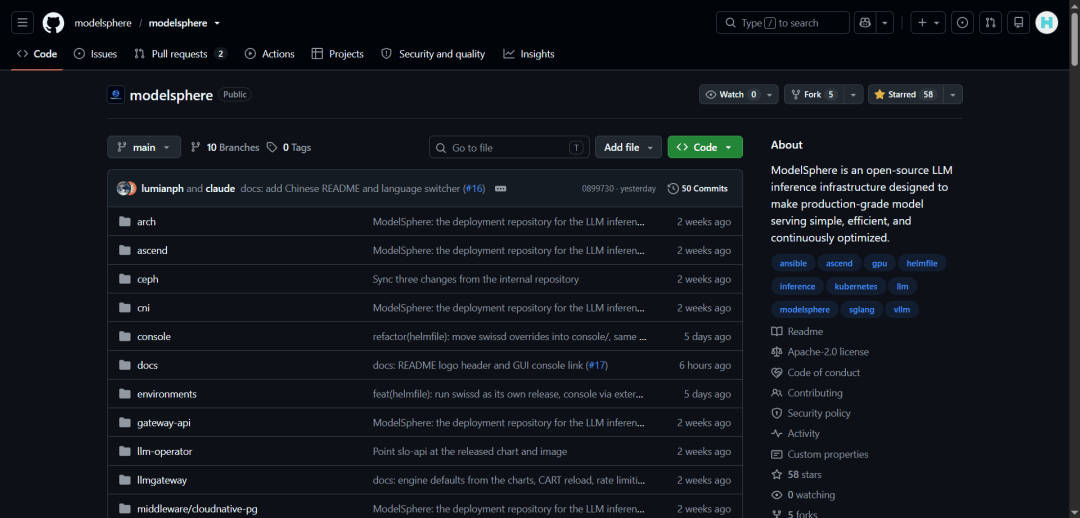
GitHub Repository: https://github.com/modelsphere/modelsphere
As large models enter the phase of large-scale commercial adoption, enterprises widely face challenges across compute allocation, model deployment, and performance optimization—such as low resource utilization, fragmented chip ecosystems, steep deployment barriers, and difficult production tuning. ModelSphere aims to integrate these workflows into a unified deployment and management pipeline, minimizing redundant efforts in low-level system adaptation, resource scheduling, and daily maintenance. By eliminating the need to master complex driver compilation and hardware adaptation, ModelSphere enables enterprises to seamlessly integrate various open-source large models into core business processes, freeing technical teams to focus on application development and business logic.
ModelSphere Features Four Core Advantages:
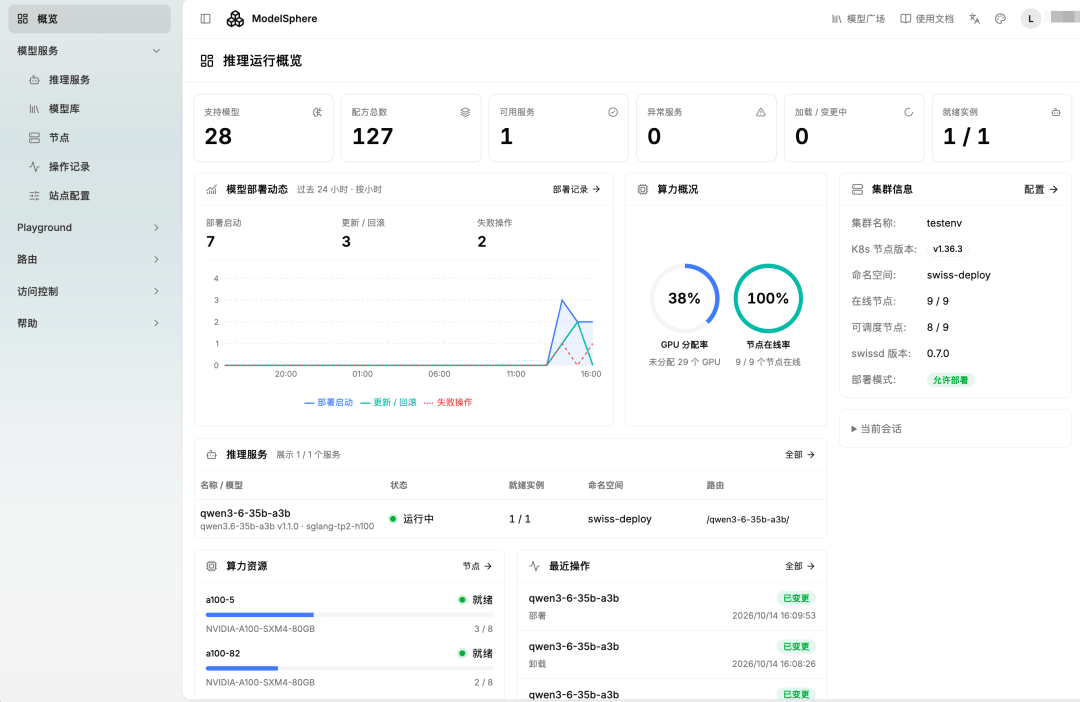
1. Simplified Deployment & Stable Model Serving: ModelSphere provides a graphical dashboard and pre-configured deployment templates, dramatically reducing the need for environment configuration code. This enables developers to quickly launch LLM inference services while streamlining deployment and operations across heterogeneous chip clusters. Built-in enterprise-grade features—including automated elastic scaling, prefill-decode (PD) disaggregated deployment, a three-tier KV cache, high-availability load balancing, and automatic stream recovery—ensure reliable and stable model serving in production environments.
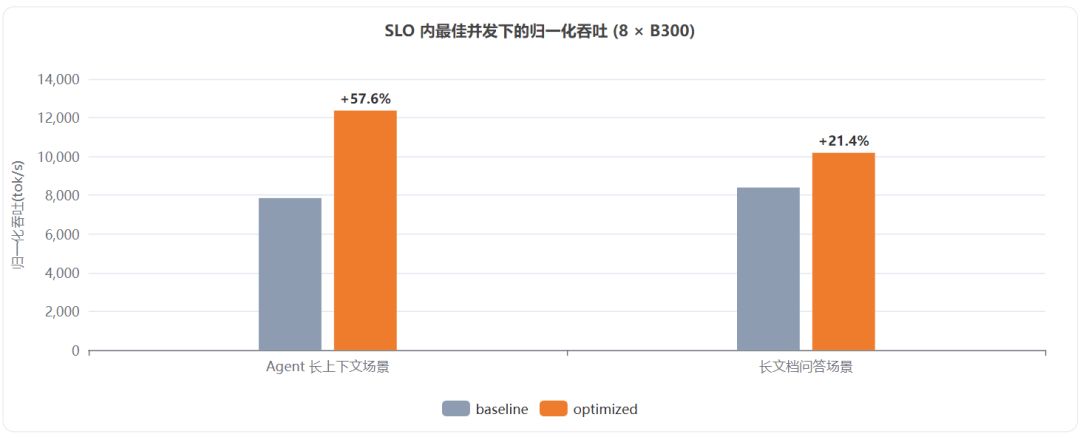
2. Continuous Automated Tuning & Higher Efficiency: Built with the AutoTune intelligent model scheduling strategy and hardware-accelerated adaptive load balancing, the platform comprehensively optimizes request throughput and time-to-first-token (TTFT). The system’s peak throughput increases by approximately 285% over the baseline—a 4x performance leap—fully unlocking the true potential of the underlying compute.
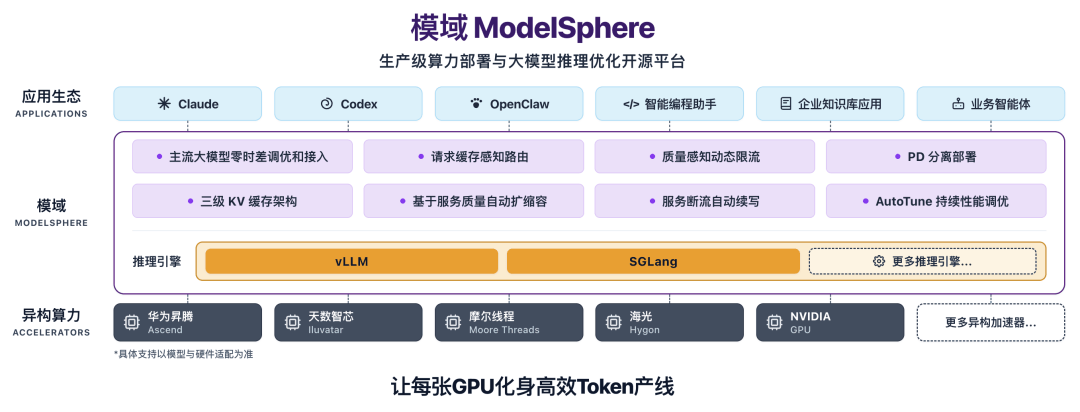
3. Unified Multi-Chip Management & Reduced Redundant Adaptation: Deeply integrated with the EngineX inference engine, ModelSphere supports and optimizes across a variety of compute architectures. It provides unified, hybrid scheduling across domestic compute resources such as Huawei Ascend, Iluvatar CoreX, Moore Threads, and Hygon DCU, eliminating the need for developers to rewrite low-level code for different chips.
4. Continuous Optimization for Mainstream Models & Accelerated Time-to-Market: Keeping pace with open-source community releases, the ModelSphere team has adapted and optimized mainstream models including DeepSeek-V4/V4-Flash, Qwen, Kimi, MiniMax, and GLM. It allows organizations to swiftly deploy and tune newly released models for production, accelerating the real-world adoption of cutting-edge architectures.
Architecturally, ModelSphere works hand-in-hand with mainstream inference engines like vLLM and SGLang: while inference engines maximize compute efficiency on individual nodes, ModelSphere focuses on cluster-level orchestration and global optimization. This includes load- and cache-aware request routing, unified KV cache pools, QoS-based auto-scaling, automatic stream recovery, automated online performance tuning, runtime monitoring, and service governance—ensuring that production systems achieve both high performance and high availability.
Open-sourced under the permissive and developer-friendly Apache 2.0 license, ModelSphere shares enterprise-grade LLM deployment and optimization capabilities with the global community. By bringing industry partners together, it continuously expands support for diverse chips and models, breaks down hardware adaptation barriers, lowers the barrier to LLM deployment, and helps enterprises revitalize existing compute resources to efficiently unlock the commercial potential of heterogeneous computing.