
UBTECH Thinker-WM Sweeps First Place Across Three Major Embodied World Model Benchmarks
01 Sweeping the Top Spots: Thinker-WM Takes First Place Across Three Major Benchmarks
Recently, UBTECH’s Thinker-WM took first place across three widely recognized embodied world model benchmarks, setting new industry records:
WorldOlympiad:
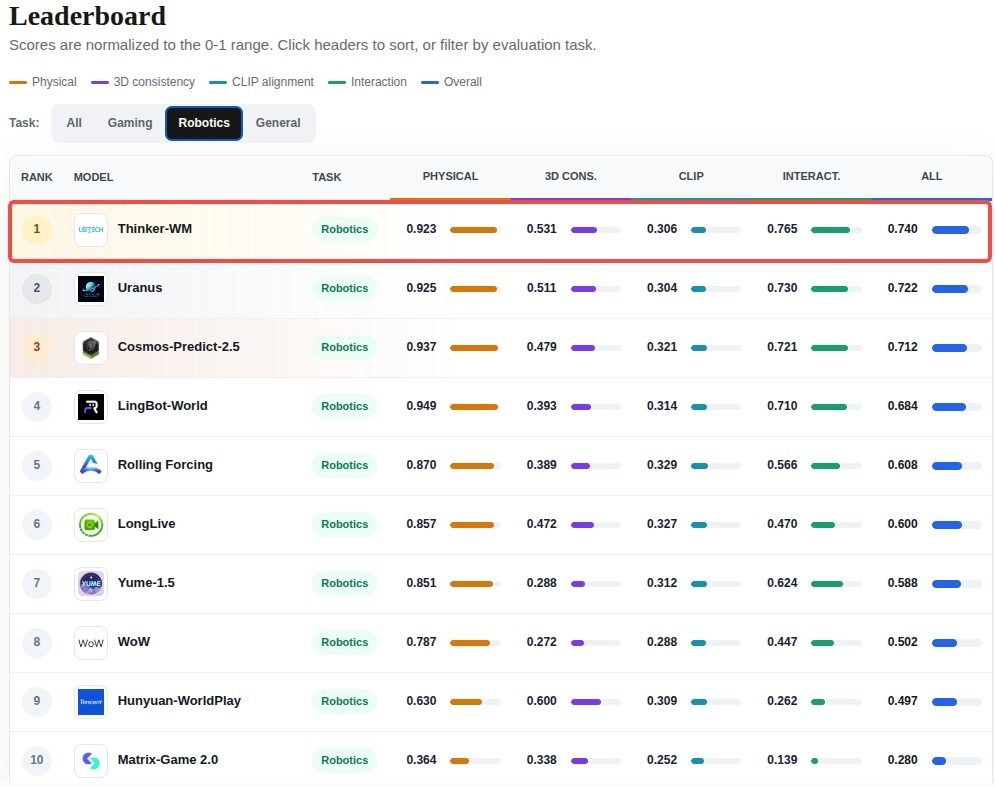
Thinker-WM ranked first with an overall score of 0.740. Built on massive amounts of real-world robot interaction data, this benchmark covers over a dozen distinct robot embodiments and various camera configurations, with an emphasis on evaluating cross-embodiment and cross-viewpoint generalization. In detailed evaluations, the model achieved a 3D consistency score of 0.531 and an interaction fidelity score of 0.765—both topping the leaderboard among all evaluated models—demonstrating its ability to accurately model 3D geometric structures and robot interaction dynamics.
EWMBench:
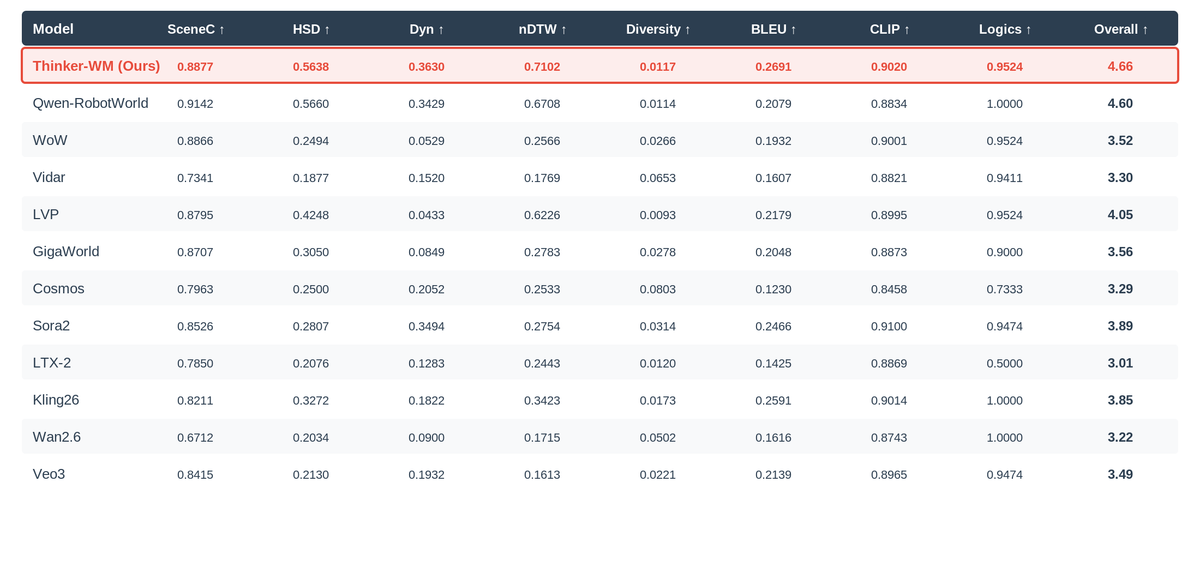
Thinker-WM achieved an overall score of 4.66, outperforming mainstream models such as Qwen-RobotWorld and Sora2. EWMBench comprehensively evaluates three capability dimensions: scene consistency, robot end-effector motion correctness, and instruction semantic alignment. Thanks to joint multimodal modeling at the representation level, Thinker-WM leads across core robot motion metrics, including nDTW (Normalized Dynamic Time Warping)—which measures spatiotemporal trajectory alignment—and Dyn (dynamic consistency), which reflects the physical plausibility of velocity and acceleration.
WorldArena1.0 Track-1:
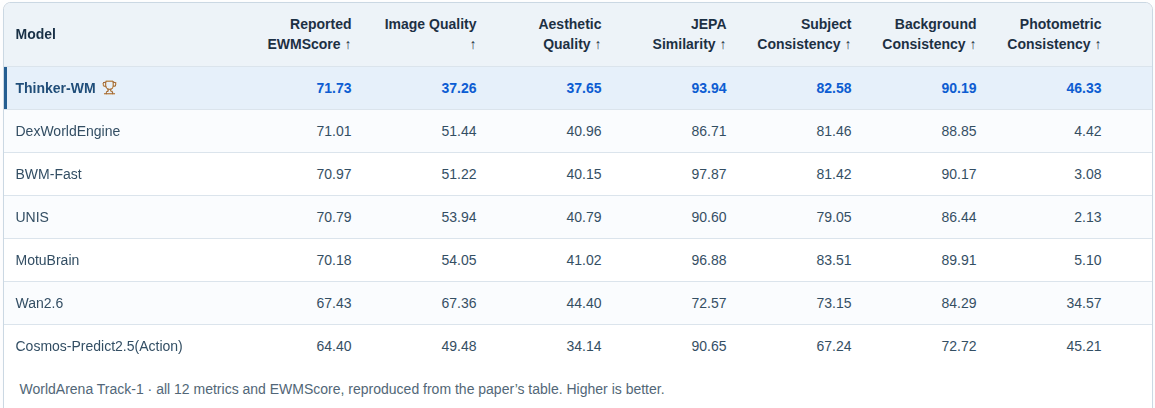
On the simulation benchmark WorldArena Track-1, Thinker-WM led across 12 key evaluation metrics—including visual quality, content consistency, physical plausibility, 3D geometric accuracy, and instruction following—striking a balance between visual generation fidelity and physical interaction realism in simulated environments. Centered around a Unified Dynamics Transformer (UDT) that unifies representations, Thinker-WM jointly evolves RGB images, metric depth, and robot actions within a shared dynamic representation space. This enables the integration of multiple capabilities—such as joint video-action generation, world prediction, policy reasoning, video-to-action translation, and inverse dynamics—providing a next-generation foundational world model for embodied AI.
02 Technical Breakthrough in Thinker-WM: Multimodal Unification of Vision, Geometry, and Action at the Representation Level
When deploying robots to perform tasks in the physical world, the hardest challenge is rarely identifying visible objects; rather, it is accurately predicting how the environment will evolve next. This is precisely the core value of a world model. Prior world models generally relied on a “piecemeal” approach: video generation handled the visuals, policy networks computed actions, and geometry prediction handled spatial information—each module calculating independently before their outputs were stitched together through interfaces.
However, this architecture suffers from inherent limitations: actions alter the environment, the environment constrains actions, and geometry influences both. When tightly coupled signals in the physical world are artificially decoupled into isolated modules, their intrinsic causal dependencies are often lost.
For instance, the physical event of “a cup being pushed off a table” is a single descriptive sentence in language, a sequence of joint commands in action, a visual trajectory across frames in video, and a continuously evolving distance field in depth data. All four representations describe the exact same event rather than four separate phenomena. Thus, tasking a model with generating any one of these modalities is fundamentally an exercise in simulating that single, shared underlying process.
Yet this informational overlap between modalities is incomplete: action carries no appearance or context—the exact same joint command carries entirely different meanings on an empty desk versus a cluttered one; language lacks spatiotemporal detail—“a cup being pushed off a table” specifies neither the force vector, magnitude, or speed, nor the hand’s exact trajectory or the cup’s tumbling rotations and landing spot; video lacks explicit metric geometry—a series of pixels knows neither the cup’s true dimensions nor its absolute distance; and depth information lacks appearance, semantics, and intent—it exposes surface occlusions and contact geometry, but cannot distinguish a cup from a tablecloth, let alone interpret the intent behind knocking it over.
To tackle these challenges, the UBTECH Thinker team introduced a novel solution: moving beyond shallow interface-level concatenation to achieve deep multimodal unification at the representation level. As UBTECH’s proprietary unified multimodal world model, Thinker-WM (Thinker World Model) encodes RGB video, depth information, and robot actions into a single intermediate representation space, where they evolve jointly via shared parameters. Visual appearance, spatial geometry, and robot actions are no longer isolated pipelines, but three expressive facets of the same physical world dynamics. The foundational design philosophy of Thinker-WM is that different modalities are simply distinct projections of one physical process; the model achieves alignment and performs reasoning within a shared representation space, rather than relying on mechanical conditional concatenation at interface boundaries.
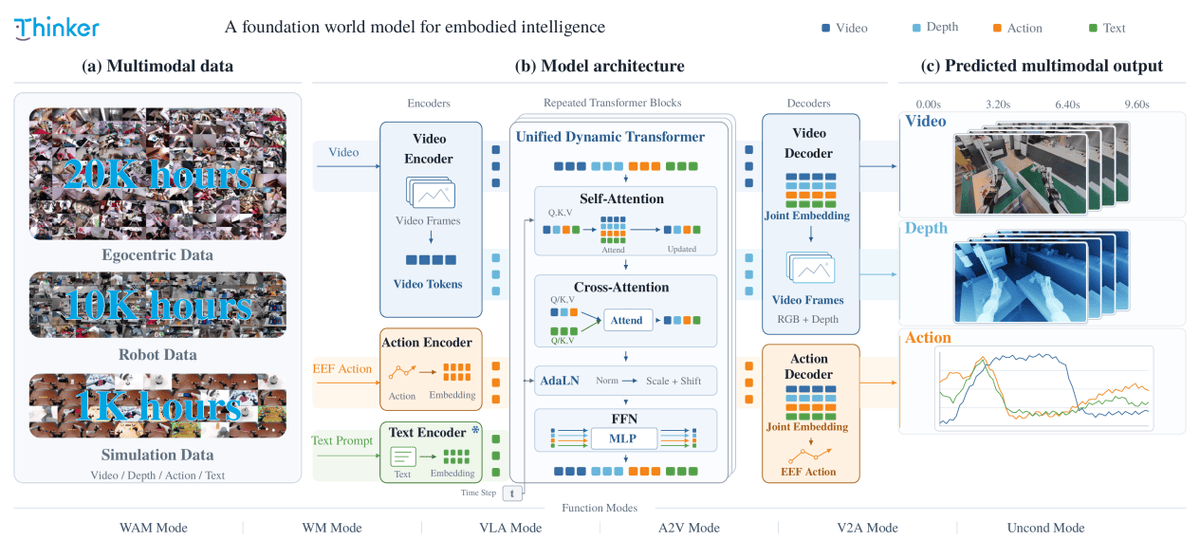
Thinker-WM: Unified Modeling Framework for Vision, Geometry, and Action
Specifically, RGB images, depth information, and robot actions are mapped into a unified latent space via their respective encoders, then fed into a shared Unified Dynamics Transformer (UDT) for joint temporal modeling, and finally reconstructed into output video, depth maps, and executable robot actions by dedicated decoders. This means multimodal interactions take place natively inside the Transformer: visual tokens, geometric tokens, and action tokens exchange information directly through a unified attention mechanism, circumventing shallow concatenation at the input or output layers.
Furthermore, geometric information no longer serves merely as an auxiliary supervisory signal. Thinker-WM treats depth as a native generative modality that shares a consistent latent topology and spatiotemporal organization with video. Depth supervision directly shapes the shared representation, making 3D spatial structure the “native language” of the world model rather than an external plug-in, thereby enabling robots to understand physical space with greater precision. The value of this unified modeling approach was validated during downstream task execution: in RoboTwin single-task ablation experiments, incorporating the depth modality improved manipulation task success rates by 15 percentage points over the depth-free baseline. This demonstrates that spatial geometry not only aids scene comprehension, but also substantially enhances the quality of action generation and task execution.
03 Six Capabilities from One Model, Powered by Unified Representations
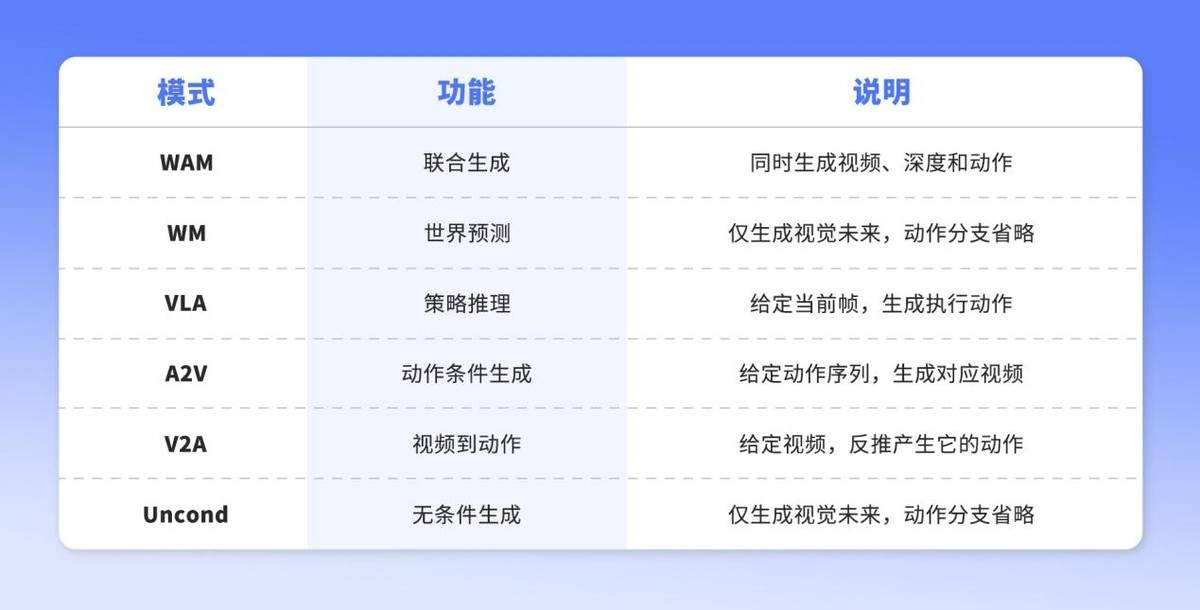
Leveraging its unified multimodal representation and shared-parameter architecture, Thinker-WM natively supports six operational modes simply by flexibly toggling conditioning and target generation modalities.
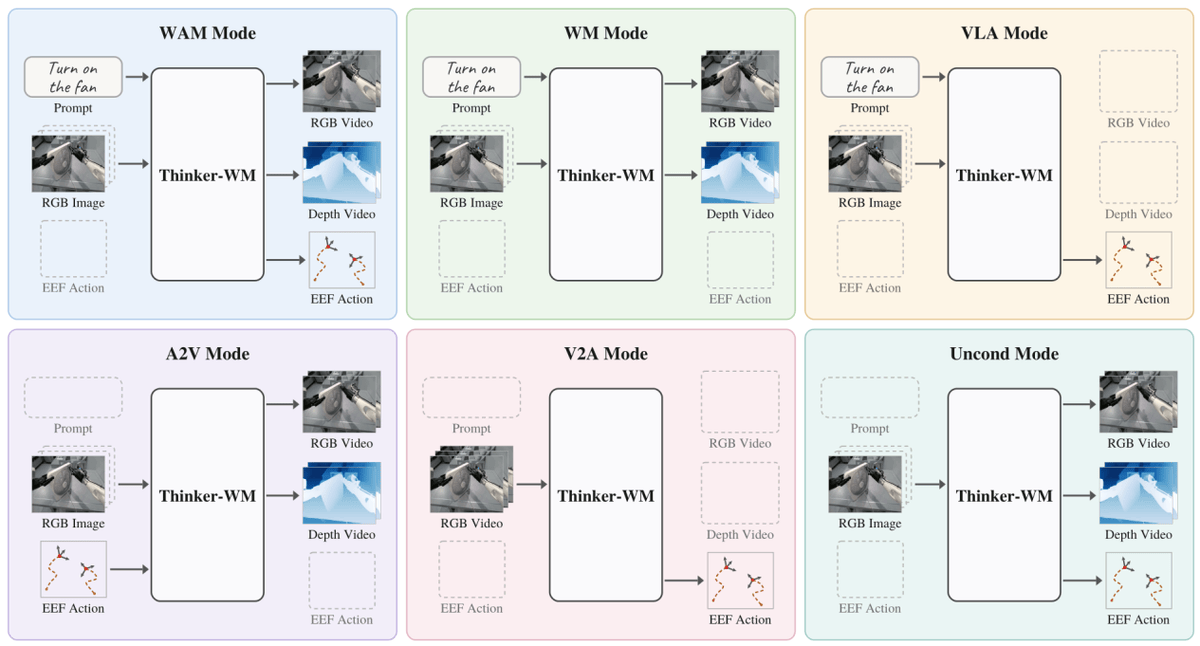
With a single set of model weights, Thinker-WM can roll forward to predict and imagine future frames, infer robot execution trajectories, or inversely extract action commands directly from video. This is the core technical dividend enabled by unified representations.
04 30,000 Hours of Heterogeneous Data Powering a General World Model Foundation
Behind these unified representation capabilities lies UBTECH’s massive and diverse training dataset. The training corpus for Thinker-WM represents a substantial volume in the field of embodied AI:
- ~20,000 hours of egocentric human video: Covering household, commercial retail, and industrial environments, this data compensates for the high cost and difficulty of gathering diverse tasks, objects, and scenes via robot teleoperation, complemented by ~1,000 hours of aligned depth data.
- ~10,000 hours of real-world robot data: Collected from multiple robot embodiments, providing paired supervisory signals across visual observations and executable actions, with ~3,000 hours accompanied by high-precision, aligned depth annotations.
- ~1,000 hours of high-fidelity simulation data: Providing precise supervisory signals for geometry and physical interactions.
Robot embodiments differ significantly in action spaces, coordinate frames, and control protocols. Thinker-WM’s unified philosophy extends beyond model architecture into data engineering: the model standardizes all robot action outputs using end-effector poses while embedding embodiment-specific tokens. As a result, robots of diverse morphologies can share a single generative space while retaining precise, embodiment-specific control capabilities.
05 Data Infrastructure: Efficiently Powering Unified Model Training with Massive Heterogeneous Data
Transforming massive heterogeneous datasets into model capabilities requires stable, high-efficiency data infrastructure. To handle discrepancies across formats, modalities, and annotation schemas across different robots, human videos, and simulation data, the UBTECH Thinker team developed the Data Factory platform. By decoupling data management from training sampling, Data Factory enables the flexible, on-demand composition of multi-source heterogeneous data.
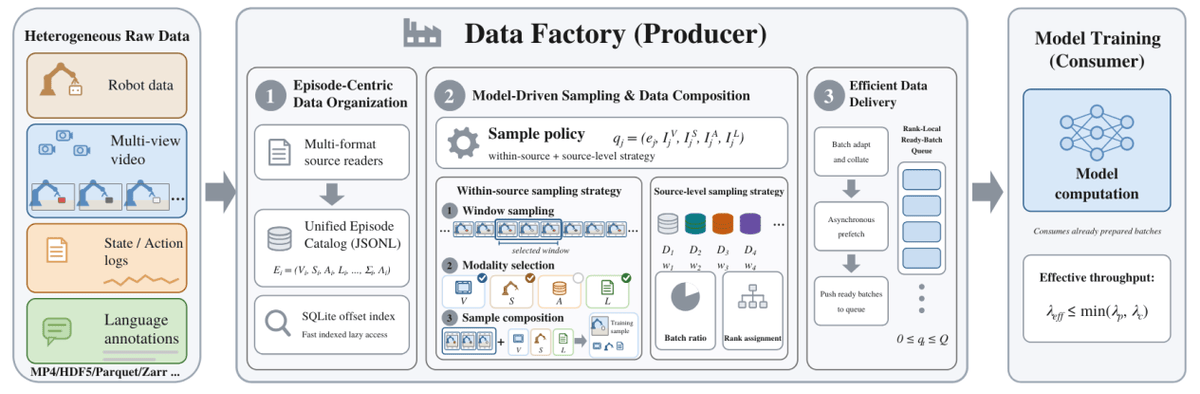
Data Factory: From Multi-Source Heterogeneous Data to Unified Model Training
Data Factory supports model training through three core mechanisms:
- Unified Organization: Standardizes and integrates video, state, action, and language modalities, dynamically generating training samples tailored to different training objectives;
- Hierarchical Quality Control: Automatically filters anomalous segments and rigorously verifies spatiotemporal alignment between depth and video streams to ensure training signal fidelity;
- Asynchronous Prefetching & Feature Caching: Prefetches and schedules training data in advance while reusing encoded features, substantially slashing I/O latency and redundant compute.
This data infrastructure delivers dependable organization, flexible scheduling, and high-throughput ingestion of multi-source heterogeneous data, providing a robust engineering foundation for the joint training and continuous iteration of Thinker-WM’s six operational modes.
06 Motion Probe Experiment Design: Verifying True Cross-Modal Representation Coupling
While multimodal unification at the representation level is the core highlight of this architecture, it raises a crucial question: did the model truly learn causal coupling among vision, geometry, and action within the shared latent space, or is it merely processing multi-channel inputs in parallel—achieving coexistence only in form?
To answer this question, the UBTECH Thinker team designed a lightweight Motion Probe verification experiment. Researchers attached a minimal motion prediction head on top of the frozen UDT visual representations and trained only this lightweight probe, testing whether it could accurately reconstruct end-effector trajectories solely from pure visual representations.
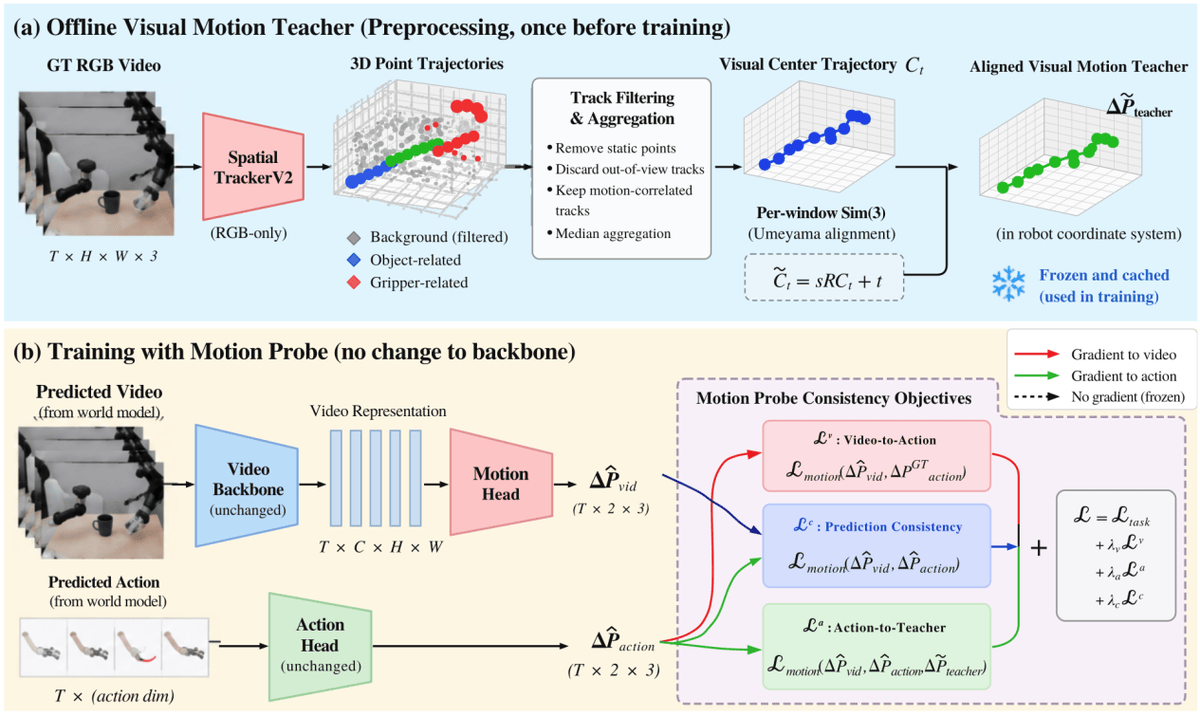
Motion Probe Architecture
The experimental results confirmed the hypothesis: the probe exhibited extremely low prediction error. Even in the absence of explicit action supervision, high-fidelity kinematic information was already inherently embedded within the visual representations. This finding directly demonstrates that Thinker-WM’s representation-level multimodal unification is genuinely effective: visual perception and action planning are not isolated pipelines, but deeply causally coupled within the shared latent space.
07 What This Means
The technical breakthrough of Thinker-WM extends far beyond topping benchmark leaderboards; more fundamentally, it establishes a new paradigm for the evolution of embodied world models:
An embodied AI world model should not be an external assembly of a “video generator + policy head,” but rather an inherently unified spatiotemporal generative system—where visual observations, spatial geometry, and action planning are fundamentally manifestations of the same underlying physical event across different modalities.
When a robot can synchronously simulate visual dynamics, spatial geometry, and action trajectories within a unified representation space, its understanding of physical world causality achieves a qualitative leap. This marks a pivotal step in moving robotics from “mechanically executing commands” toward “autonomously understanding the governing principles of the physical world.”
Thinker-WM has already been deployed and validated on UBTECH’s robot platforms, and these underlying technologies will continue to power next-generation embodied AI systems.
Technical reports and subsequent iterative releases of Thinker-WM will be continuously updated on UBTECH’s official embodied AI developer community, Thinker Cosmos. Developer enablement initiatives for secondary development and technical deep-dive livestreams will also be rolled out soon.
Project Links
- Paper: https://arxiv.org/abs/2610.18447
- Project Page: https://thinkercosmos.ubtrobot.com/thinker-wm
- GitHub: https://github.com/UBTECH-Robot/Thinker-WM
- Hugging Face: https://huggingface.co/UBTECH-Robotics/Thinker-WM