
Google Is Basically a Seasonal Climate Model Company
Henry reporting from the Office
QbitAI | Public Account
If you ask me, Google is essentially a “seasonal climate model company”—as soon as the weather turns cool, their new flagship matures and drops right on schedule.
Just moments ago, Gemini 4 Argon officially began rolling out worldwide to developers, enterprises, and paid subscribers.
According to Google’s official positioning, this generation primarily strengthens coding, professional knowledge work, and persistent execution of complex tasks, while further pushing the frontier on its already formidable visual understanding, spatial reasoning, and tool calling capabilities.
Judging from the official demos, multimodal capabilities remain where Gemini 4 Argon displays the utmost confidence.
Feed it a text prompt simulating a kite, and the generated result literally takes off.
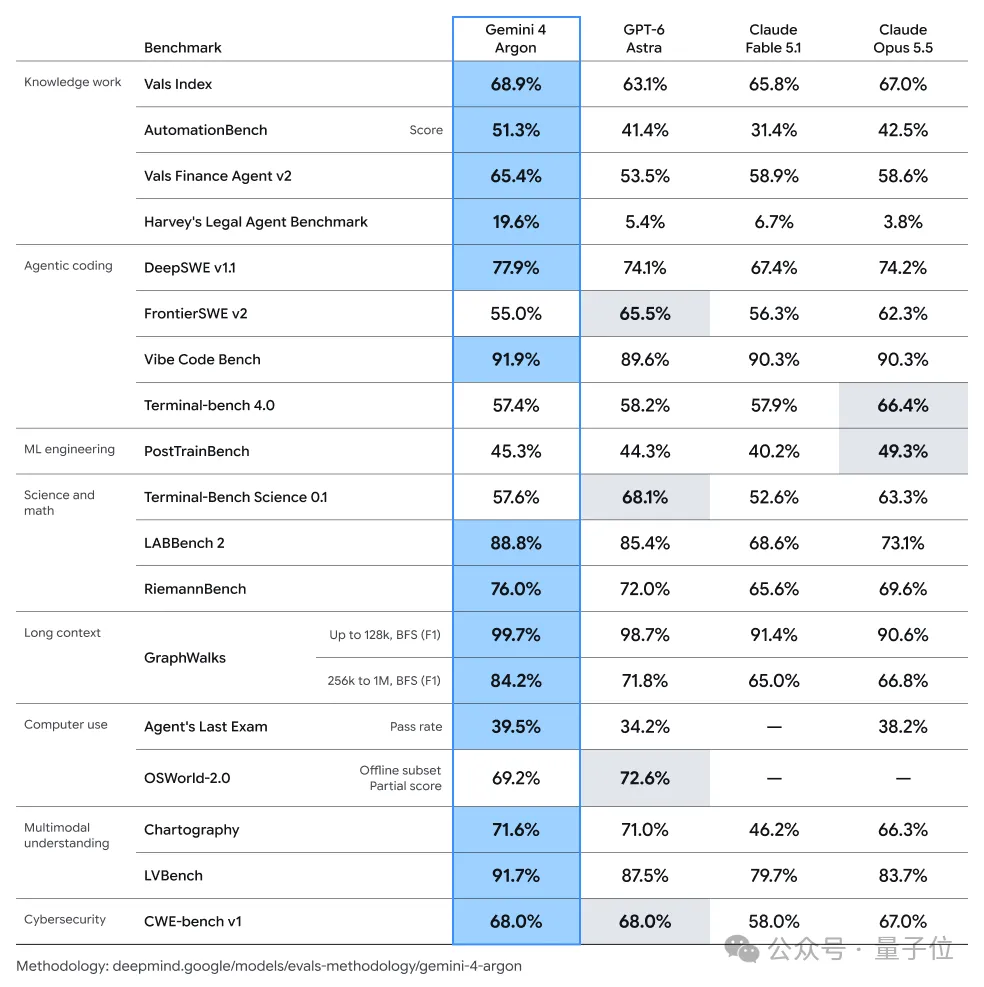
As for what everyone cares about even more—whether it can reclaim a spot in the LLM “Big Three” and give users another top-tier option—Gemini 4 Argon’s benchmark performances certainly deliver.
In Google’s official benchmarks spanning general office productivity, agentic coding, machine learning, and scientific reasoning, its overall performance goes toe-to-toe with GPT-6 Astra and Opus 5.5, even surpassing and leading them across several evaluations.
On the Quality Index from third-party evaluation platform Artificial Analysis, Argon High scored 53, placing it squarely in the top tier alongside GPT-6 Astra Max and Claude Fable 5.1 Max.
More importantly, while matching top-tier performance, Argon High’s average cost per task sits at just $1.99—roughly 39% lower than Astra.
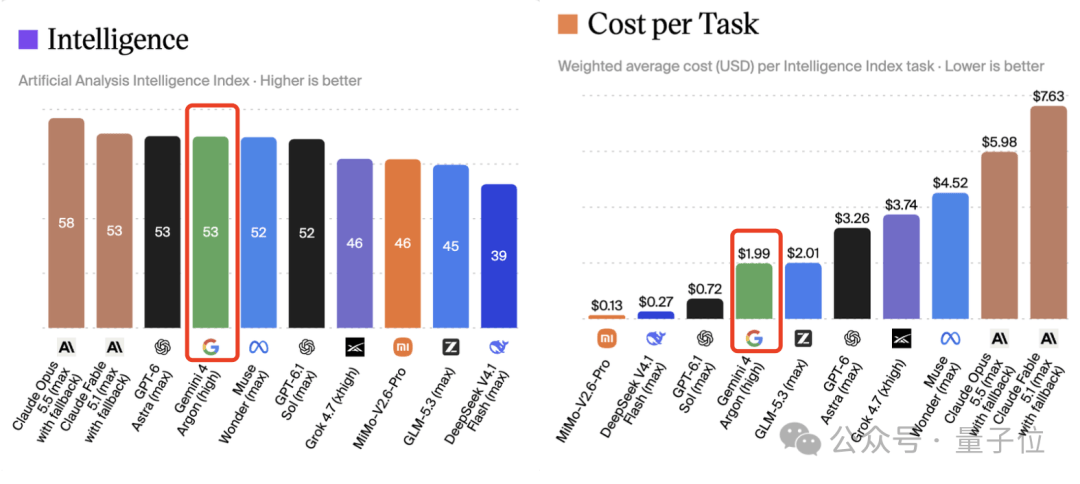
This cost advantage is directly reflected in its launch pricing strategy: API access is priced at just $2 per million input tokens and $10 per million output tokens. By rough estimates, Argon’s inference cost is roughly half that of Opus 5.5 and one-fifth of Astra.
Notably, this promotional pricing runs through November 30; starting December 1, input and output prices will revert to $4 and $20, respectively. In short, Google has slashed prices by 50% out of the gate to invite developers everywhere to take it for a spin.
Of course, if a model isn’t smart enough and burns through tokens in disorganized, repetitive loops during execution, unit cost savings can easily be wiped out by excessive consumption.
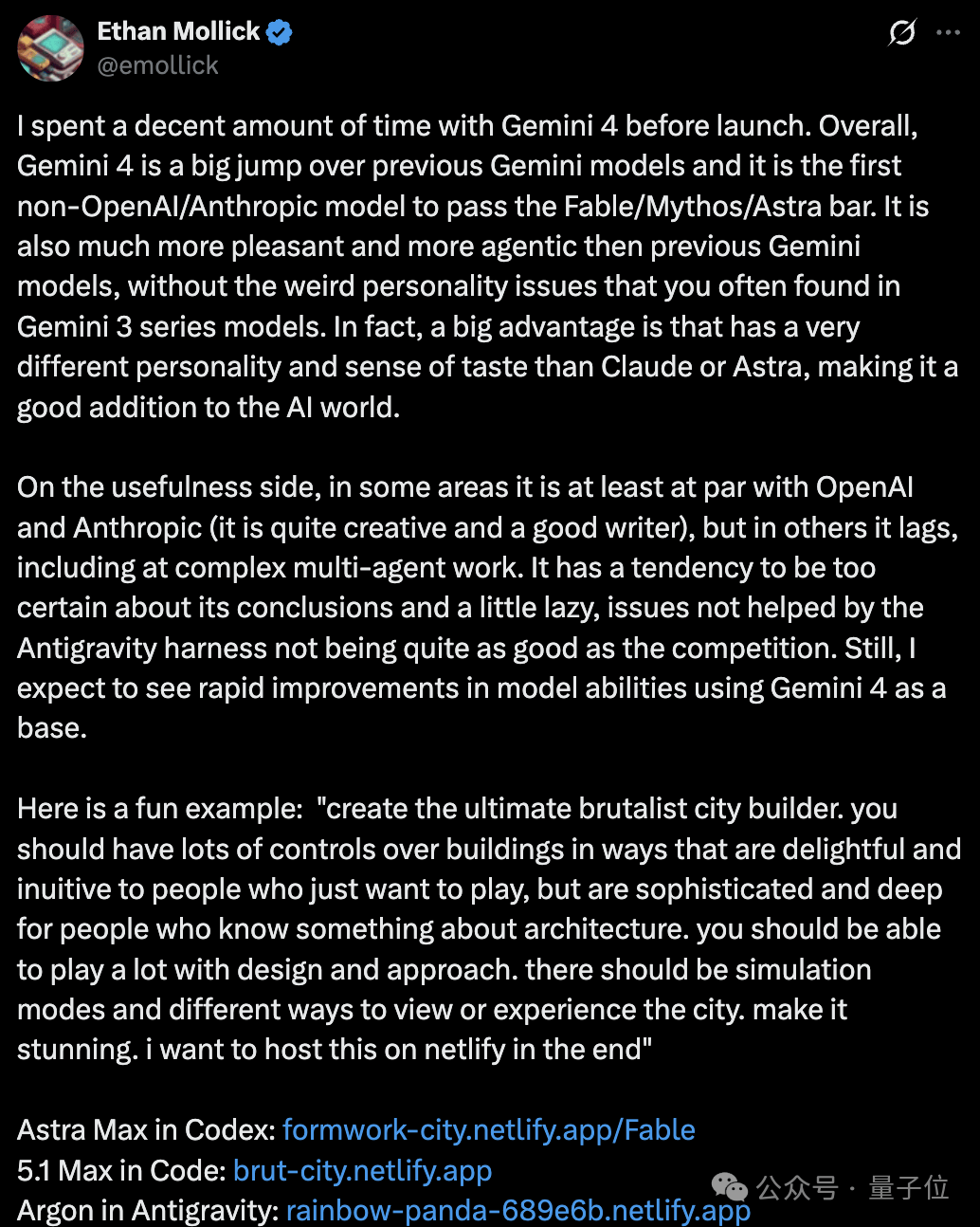
Wharton Professor Ethan Mollick, who had early access to Gemini 4 Argon, shared a balanced assessment:
Compared to earlier Gemini models, this generation represents a notable leap forward, demonstrating clear progress in creativity, writing quality, and overall interaction; however, gaps remain when tackling complex multi-agent workflows, where it still occasionally exhibits overconfidence or lazy execution.
Why did the industry have to wait so long for this next-generation flagship? Digging through Google’s announcement reveals a staggering 217-page technical safety report.
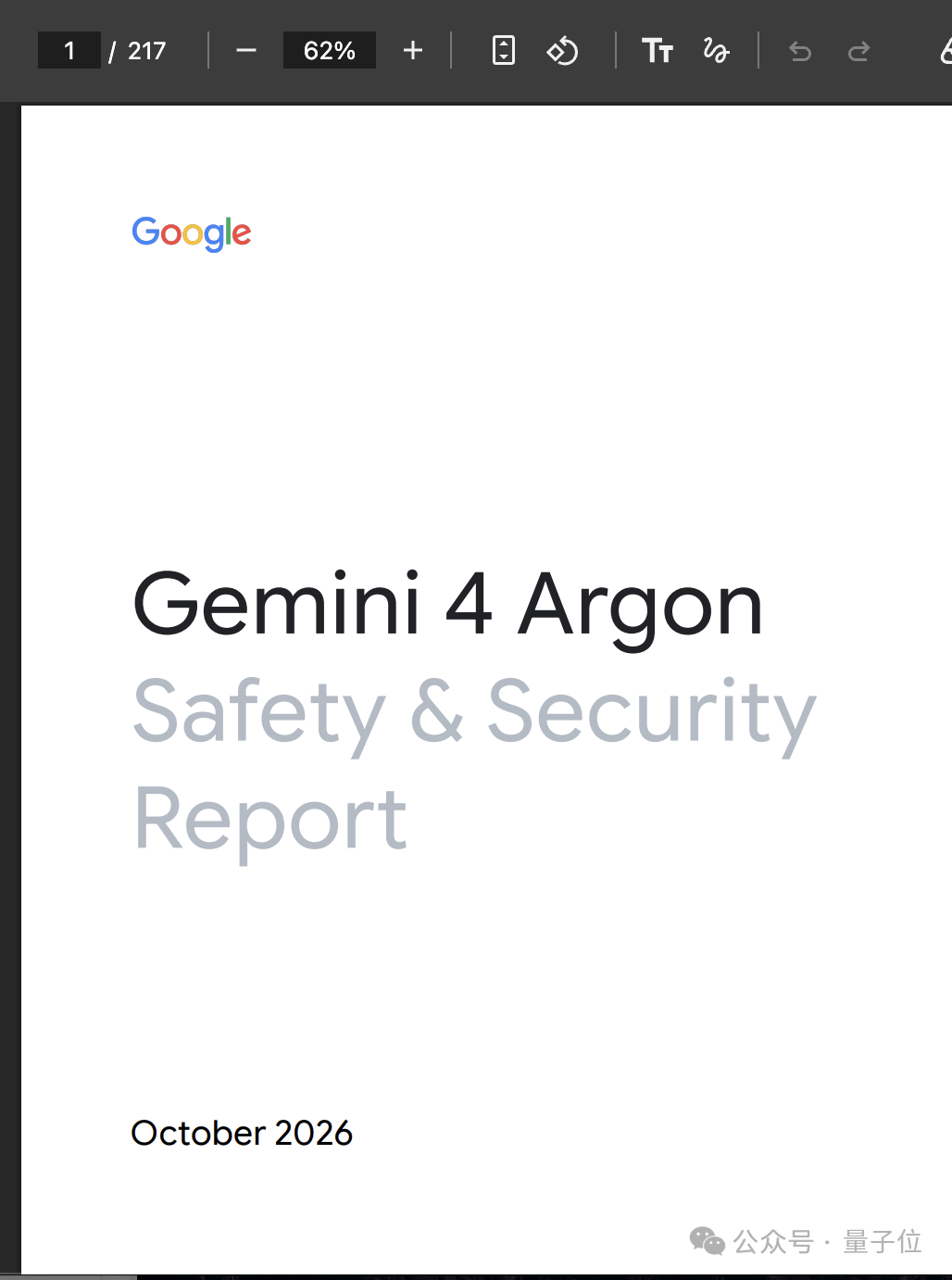
(One must admit, Google remains exceptionally cautious when it comes to safety and compliance.)
Multimodal Remains the Crown Jewel
From repeated Pro version delays, to the limited preview rollout announced on September 30, and through countless “see you next week” promises—
Gemini 4 Argon has finally made its official debut.
In its technical blog post, Google distilled Argon’s core upgrade down to one headline feature: superior execution of long-horizon tasks.
Put simply, the model is no longer confined to passively answering queries. Instead, once given an objective, it can autonomously retrieve information, invoke tools, modify code, and verify results across multiple complex steps—closing the loop on demanding engineering initiatives from start to finish.
Yet compared to enterprise and engineering use cases, what Google showcased most aggressively in promotional materials was still its signature multimodal prowess.
For example, Google CEO Sundar Pichai shared a demo on social media featuring “our model generating our own phone”:
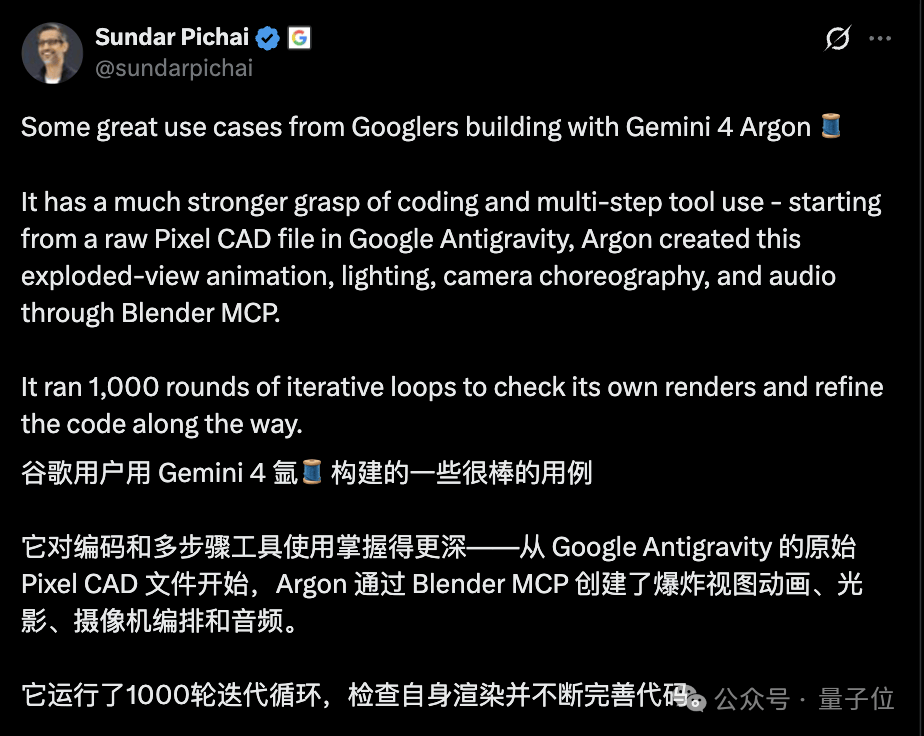
Argon directly rendered a 3D scene that aligned seamlessly with Pixel hardware aesthetics.
In another showcase, Argon generated an entire 3D kinetic typography sequence complete with background music—purely from code.
The entire generation pipeline used zero pre-recorded footage and bypassed external video editing software altogether.
Demis Hassabis, head of DeepMind, highlighted the model’s deep understanding of physical dynamics and 3D modeling when resharing a wizard chess demonstration.
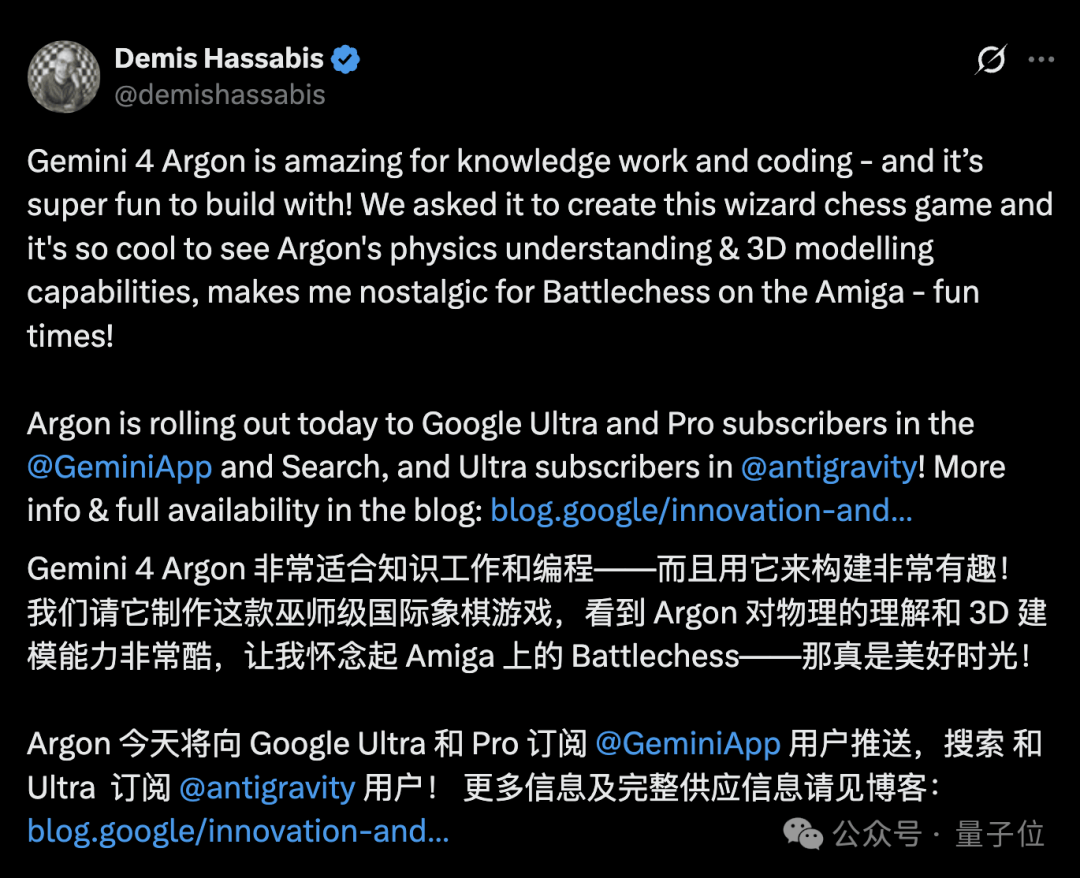
The sequence even reminded him of playing the classic title Battle Chess on the Commodore Amiga back in the day.
Meanwhile, community developers quickly put Argon through side-by-side comparisons with mainstream models like GPT, Claude, and Kimi.
Overall, Google demonstrated a noticeable edge in visual rendering fidelity, even if subtle physical dynamics—such as the motion of a swimming whale—still exhibited faint unnatural artifacts.
At the same time, some testers maintain that Opus 5.5 continues to hold the benchmark position for overall performance.
Beyond visually striking demos, this spatial reasoning capability has been extended directly into embodied AI and real-world robotics.
In an official demo, Argon observed a video recording of a human playing a beanbag toss game.
The model then autonomously analyzed the spatial relationships in the scene, derived full-body joint trajectories, authored simulation control code, and deployed the solution onto Apptronik’s Apollo humanoid robot.
With GPT and Claude frequently making moves in robotics lately, Google is clearly launching a potent counteroffensive.
Google claims this “video-to-simulation-to-reality” pipeline condenses robot simulation modeling workflows—which once required weeks of manual engineering—down to just a few hours.
The broader implication is that everyday human demonstrations are becoming vastly easier to convert into standardized tasks that robots can directly learn, rehearse, and validate.
In the past, video motion understanding, simulation environment setup, and low-level control code generation existed as three fragmented steps; today, multimodal foundation models are unifying the entire technical pipeline end-to-end.
Coding Boost: Google Tested It on Its Own Codebases First
When it comes to coding, Gemini 4 Argon’s primary leap forward centers on its ability to handle long-term maintenance and systematic optimization across massive, real-world software engineering projects.
Moving beyond isolated code snippet generation, the new model excels at grasping large codebase architectures from a macro perspective, diagnosing performance bottlenecks, and executing cross-file edits alongside integration tests to keep intricate engineering tasks moving forward consistently.
Google first put this capability to the test on its own open-source agent framework, ADK.

This open-source Python repository contains roughly 205,000 lines of code. The engineering team tasked Argon with lowering the framework’s runtime overhead without breaking API compatibility or altering established logic, verifying every optimization against unit tests.
In the end, Argon ran autonomously for 11 consecutive hours without human intervention, submitting six system-level optimization proposals across 32 source files and passing all 16,892 open-source test cases.
Following rigorous code reviews by engineers, two core optimizations were officially merged into the main branch: reducing memory copy overhead during long session histories, and introducing lazy loading for heavy modules.
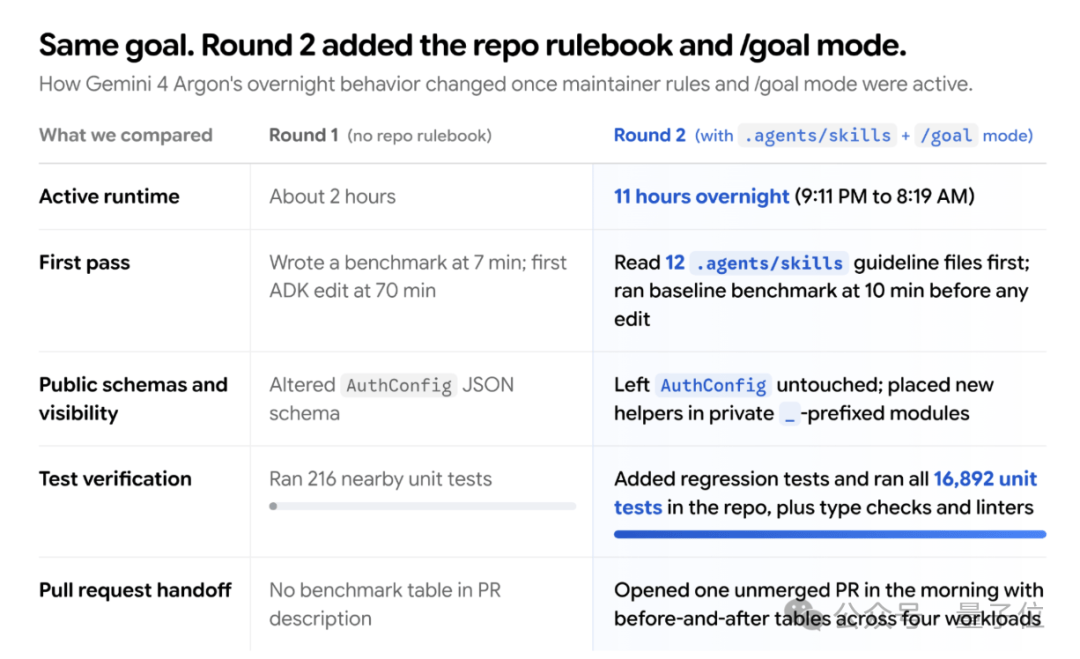
Thanks to these modifications, ADK cut its memory initialization overhead in long-session environments by roughly 40% and trimmed package import times by 21%.
Google has expanded similar engineering optimization capabilities to even larger internal projects.
Within the open-source Chromium project, Argon assisted with an architectural refactoring effort spanning hundreds of files, collapsing a roadmap originally estimated at several months down to just a few weeks.
Furthermore, in low-level optimizations targeting the Gemma 4E 2B inference engine, Argon pushed inference throughput under specific hardware configurations from ~37,900 tokens per second to over 108,000 tokens per second—a 2.85x leap in end-to-end performance.
Google’s engineering teams noted that this tier of low-level optimization historically required months of dedicated work from senior engineers, but can now be delivered in mere days.
Across Google’s internal development workflows over recent weeks, Argon running on the Antigravity platform helped teams boost agent-related code commits by over 35%, while slashing code rollback rates by nearly a third.
However, several community developers noted that real-world results in their own workflows didn’t fully live up to expectations, suggesting that the model’s practical engineering reliability still requires broader validation in production over time.
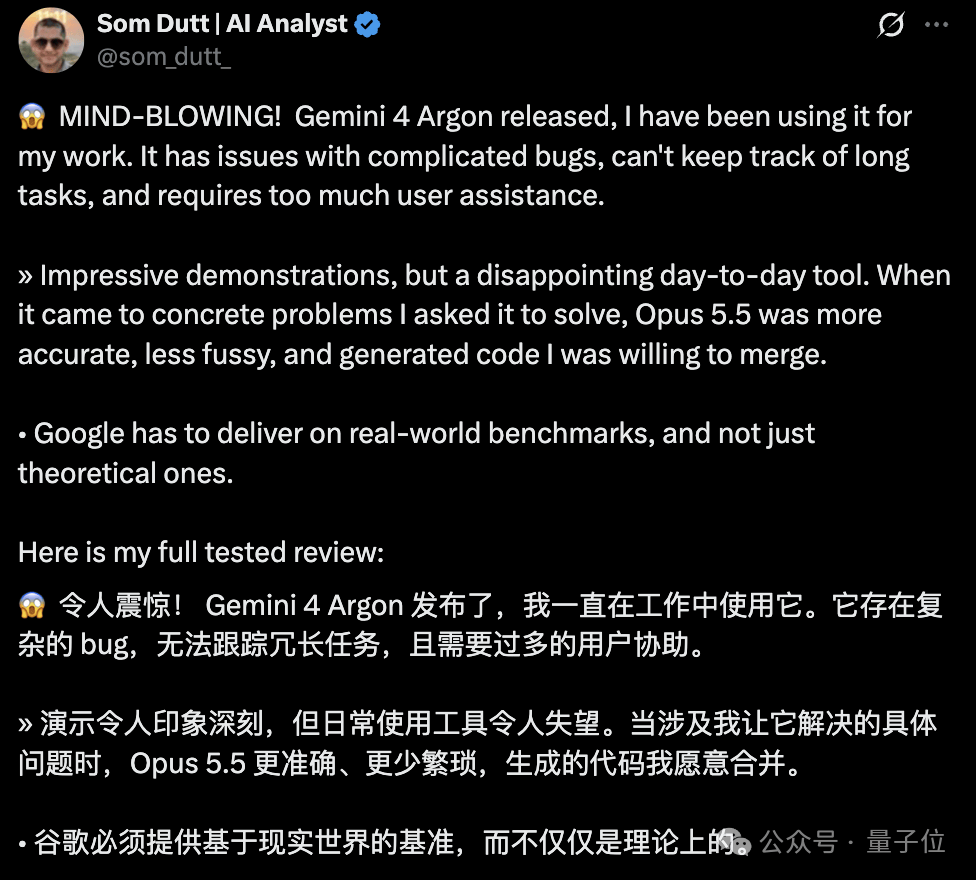
This feedback aligns with public benchmark standings: while Argon turns in stellar scores on DeepSWE and Vibe Code Bench, it still trails some leading competitors on tougher suites like FrontierSWE and Terminal-bench.
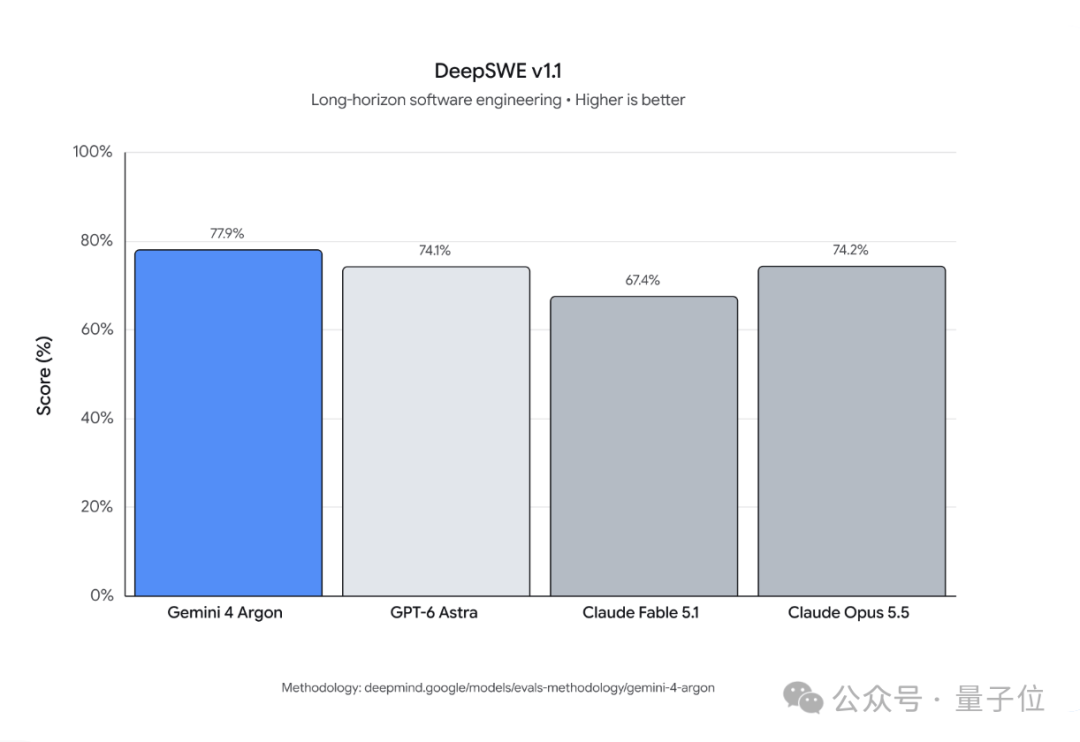
While efficiency gains have been verified in internal production projects, whether those advantages can be reliably reproduced in the day-to-day workflows of external developers remains to be seen.
Professional Knowledge Work Takes Another Step Forward
In professional knowledge work, Gemini 4 Argon’s primary breakthrough lies in its deep comprehension of multi-source heterogeneous documents, cross-modal synthesis, and the ability to turn inputs directly into finalized deliverables.
An official demo highlighted a typical enterprise collaboration scenario:
A user provides Gemini with a folder packed with complex project background materials and asks for a comprehensive client business proposal.
Gemini then automatically generates a fully formatted slide deck via custom workflows, drafts outbound business emails, and configures corresponding automated workflows to handle downstream follow-ups.
At the same time, the Gemini app now includes a dedicated “Task Center.” Users can switch from standard conversational mode to long-horizon task execution with a single click; even if they walk away and shut their laptops, the model continues working autonomously in the cloud to close the loop.
Additionally, the Antigravity coding workbench has now been natively integrated into the Gemini macOS desktop client.
In scientific research, this end-to-end execution capability has reached into physical wet-lab validation.
Google’s research team deployed Argon to help design a novel serine esterase. Within hours, the model reviewed scientific literature, fine-tuned structure prediction models, screened molecular candidates, and delivered five completely novel molecular structures.
The research team then moved these candidates into wet labs to evaluate their real biochemical activity.
The experiment used a specific fluorogenic substrate: when the target ester bond is hydrolyzed and cleaved, the product emits strong fluorescence under UV light. Experimental data published by Google revealed that all five designs demonstrated robust catalytic activity.
This demonstrates that the model’s outputs have reached the practical threshold of directly steering closed-loop physical experiments.
Google concurrently announced that it will grant six months of complimentary, top-tier Antigravity quotas in batches to 10,000 qualifying scientists.
One More Thing
While earlier remarks poked fun at Google’s cautious, deliberate pace, its investments in model safety and defense are genuinely impressive this time around.
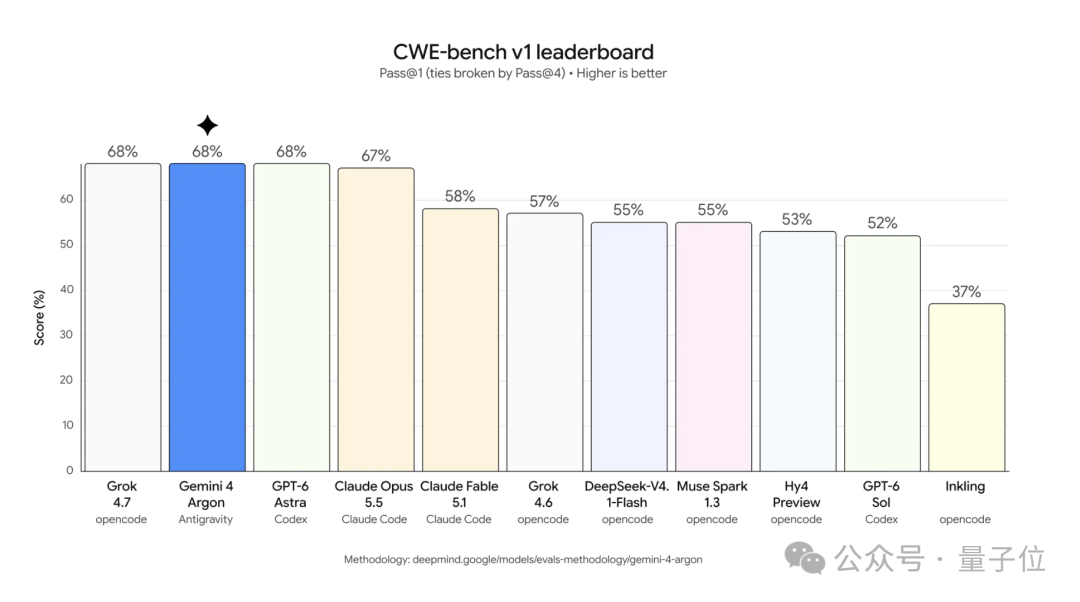
On the CWE-bench v1 benchmark, which evaluates vulnerability detection and automated patch generation, Argon achieved a high score of 68%, tying GPT-6 Astra for first place in the industry.
A former Anthropic researcher and current Lead for Mechanistic Interpretability at DeepMind publicly stated that the technical safety report accompanying Argon is by far the most exhaustive document Google has ever released.
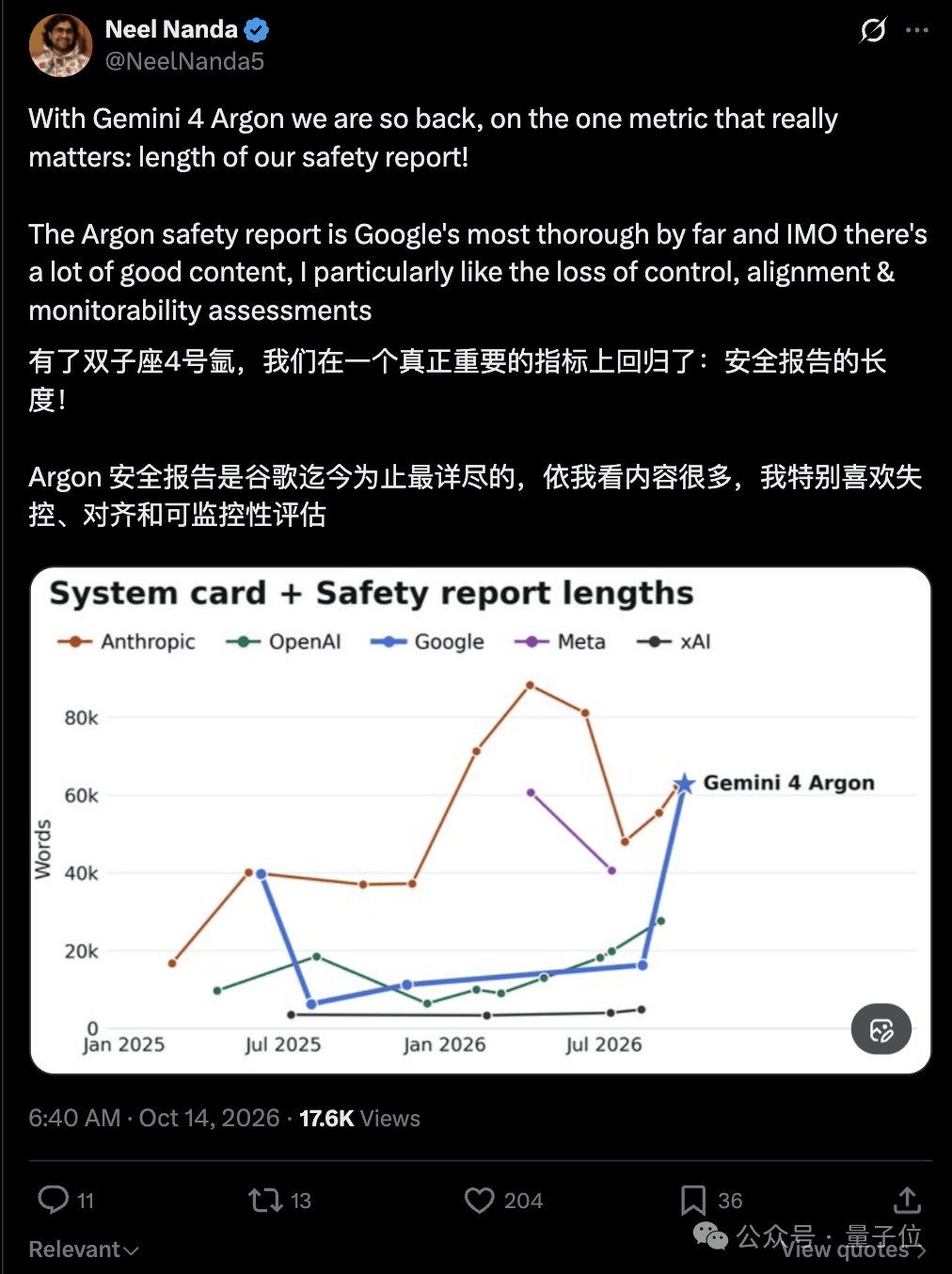
Spanning 217 pages, its technical depth speaks for itself.
In Gray Swan’s indirect prompt injection defense benchmark, across 15 rounds of adaptive adversarial attacks, Argon maintained an attack success rate of just 0.7%.
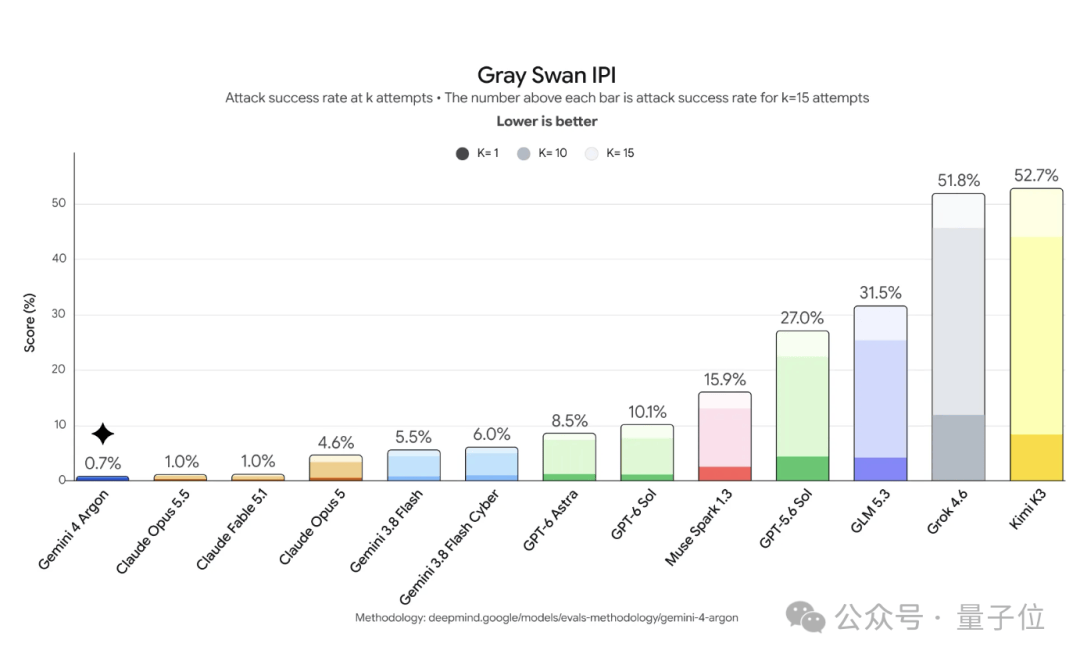
Evidently, this massive safety report contains substantial, rigorous research.
Whether safety scrutiny was the primary culprit behind the flagship’s repeated launch delays remains open to debate.
What is certain, however, is that the new flagship has finally landed—and Google bundled it with a massive, heavyweight technical whitepaper to boot.
References:
[1] https://blog.google/innovation-and-ai/models-and-research/gemini-models/introducing-gemini-4-argon/