
Our latest release, Apertus 1.5, builds upon the 8B and 70B Apertus 1.0 models by adding image and audio understanding capabilities, an optional thinking mode, a 4x longer context window, stronger instruction following, and improved tool use. The updated 8B and 70B model weights were released on Hugging Face on July 24, 2026, under the Apache 2.0 license. Further details are now available in the project’s technical report and summarized here. Apertus 1.5 represents a continued pretraining of the first-generation models: adding 4 trillion tokens of text and multimodal training data to the 8B model and 2 trillion tokens to the 70B model, bringing total training data to 19T and 17T tokens, respectively. As with every previous Apertus release, these models are completely open: open weights, open data, open values, and full training details.
Key Enhancements
- Native Multimodal Understanding: Apertus 1.5 supports image and audio inputs alongside text, bringing documents, diagrams, and photos into the conversation. The model can also process spoken voice, although this capability remains experimental.
- Thinking Mode: The model can switch into a thinking mode to reason through inputs before responding, thereby improving performance on reasoning tasks.
- Long Context: The context window has been extended to 262,144 tokens—a 4x increase over Apertus 1.0.
- Stronger Instruction Following: Offers improved instruction following compared to Apertus 1.0, delivering more predictable and accurate responses.
- Improved Tool Use: The models have been trained for tighter tool integration, enabling them to call external tools and APIs more effectively.
- Open Values: Stricter adherence to the Apertus Charter brings greater transparency to the model’s values and principles.
Training Process
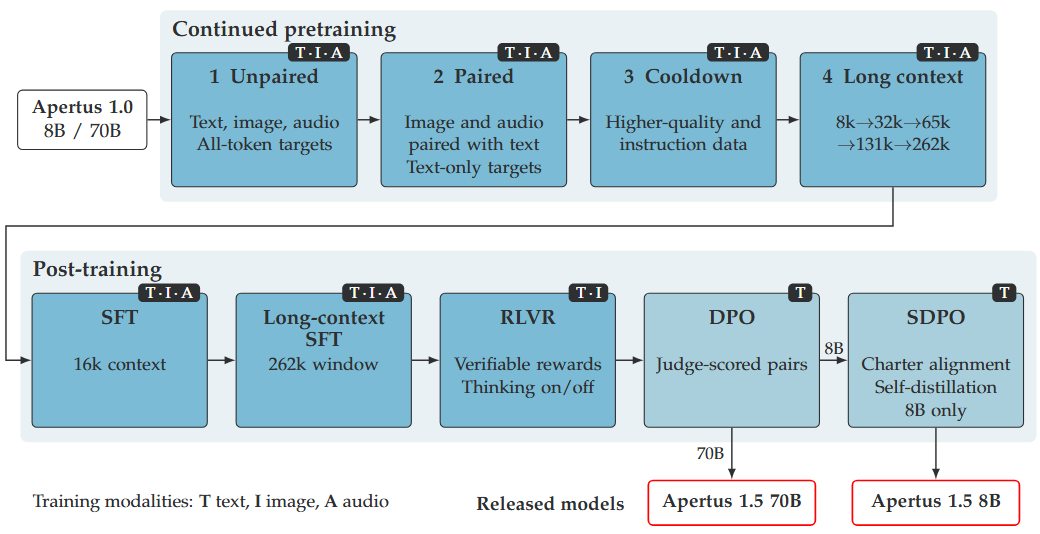 Full Apertus 1.5 training pipeline
Multimodality Through the Tokenizer
We introduce multimodal capabilities into the v1.5 models via early fusion: rather than relying on a separate vision encoder, image and audio inputs are fed into Apertus as discrete tokens within the same sequence as text tokens. Images are tokenized using the Emu3.5 tokenizer (a 512×512 image