
How Can AI Agents Truly Penetrate the Capillaries of Business Operations?
Over the past year, virtually every enterprise has rallied behind the slogan “fully embrace AI.”
Chatbots have launched, agents are in use, and internal reports boast eye-catching metrics like “efficiency increased by XX%.”
But ask business leaders a simple, straightforward question—Have stockouts decreased? Has delivery sped up? Has customer satisfaction improved?—and the answer is often far less certain.
In reality, the intelligent transformation of most enterprises is experiencing a collective “false prosperity.” We have grown accustomed to viewing AI merely as a personal productivity booster, overlooking a harsh truth:
Efficiency in personal tasks does not equal the realization of enterprise business value.
If AI cannot establish an end-to-end closed loop across data, judgment, action, and system control, enterprise intelligence will remain perpetually stuck in the “last mile” of scaled adoption.
How can enterprises break through in the second half of the enterprise AI race? And how can agents truly penetrate operational capillaries to achieve a future-proof, systemic overhaul?
Recently, QbitAI Research officially released the report “Agent-Driven Enterprise Intelligence: From Point-Solution Efficiency to Scaled Transformation”. In this report, we attempt to cut through the fog surrounding LLM adoption and explore brand-new approaches to enterprise intelligence planning.

AI Is in Use, but Where Is It Getting Stuck?
The sticking points impeding enterprise AI adoption can be clearly illustrated through a typical scenario: handling store stockout risks.
Take the same operational analysis assistant: the technical team considers the job done once the report is generated; business staff feel their duty is fulfilled once the root cause is identified; yet management solely cares about whether stockout rates have actually dropped—three distinct parties with entirely mismatched delivery standards.
Similar misalignments exist at the data layer: book inventory might show available stock, but after deducting allocated and reserved items, the actual dispatchable quantity diverges wildly from the reported figure. If an AI makes judgments based on raw book numbers, its decision-making foundation is flawed from the start.
Even if the data is accurate and the analysis spot-on, a lengthy manual chain—filling out forms, submitting approvals, and tracking deliveries—still stands between generating a recommendation and executing it. Logging a recommendation into the system does not mean the task is completed; whether the execution status feeds back to the AI in real time dictates whether the operational loop can truly close.
Furthermore, every operational step entails complex boundaries of authority and accountability: who has the right to initiate, who approves, and who takes over when anomalies occur.
The report systematically categorizes these breakpoints across six dimensions: task definition, data trustworthiness, verifiability of judgment, action execution, allocation of authority and responsibility, and value measurement and replication.
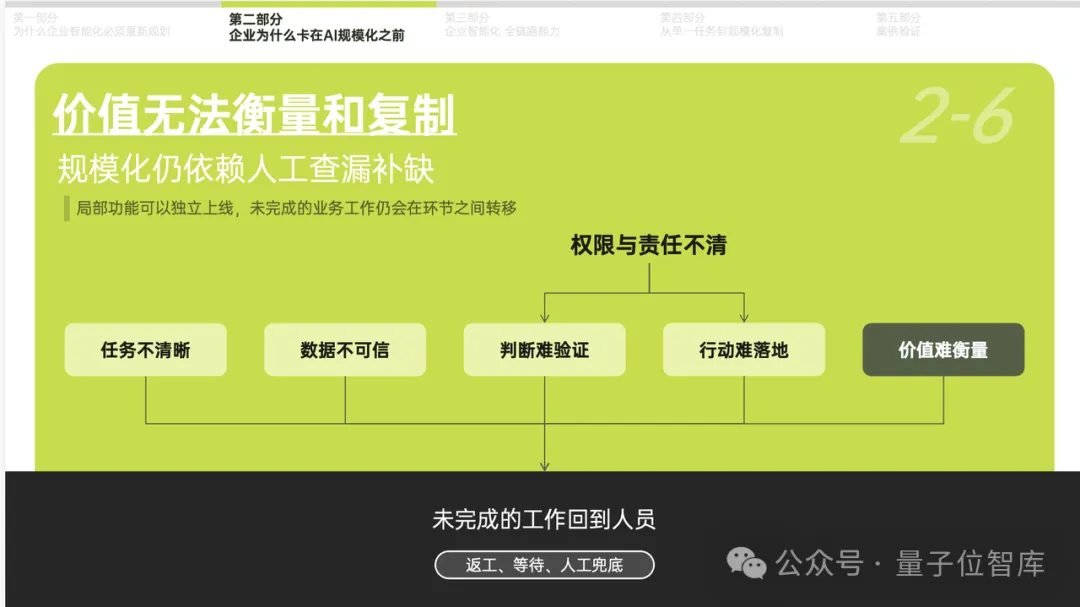
Viewed in isolation, each breakpoint might seem trivial, but combined, they explain why so many enterprise AI projects remain trapped in the awkward state of being “usable in isolated pockets, but impossible to scale across the board.”
Unresolved tasks that fall outside the loop inevitably spill back into manual workflows, resulting in prolonged rework, delays, and human safety nets.
How, then, can enterprises systematically eliminate these blind spots?
An End-to-End Framework Centered on Business Outcomes
Since localized quick fixes cannot address the root cause, how can enterprises build an effective framework for intelligent implementation?
In the report, QbitAI Research points out that mature enterprise-grade agents are by no means standalone Q&A tools; they must possess end-to-end capabilities connecting tasks, context, judgment, action, control, and measurement.
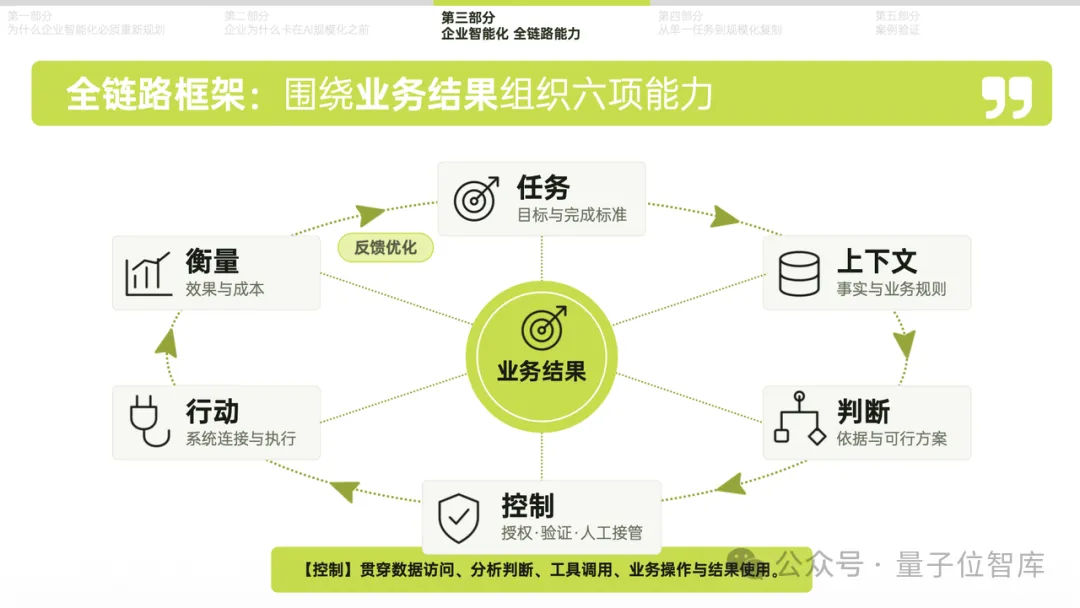
Among these, the starting point for all intelligent decision-making lies in breaking down data silos to build a genuinely trustworthy contextual environment.
In most cases, AI appears “not smart enough” in business analytics primarily due to the disconnect between underlying data and business semantics: chaotic field definitions and inconsistent reporting criteria naturally make it difficult for AI to deliver reliable assessments.
To turn agents into business-savvy advisors, underlying data must first evolve from merely “queryable” to end-to-end “trustworthy.”
In this regard, leading technological practices offer a blueprint for the industry. For instance, Shufan, the data intelligence brand under NetEase Zhiqi, relies on its integrated development and governance platform EasyData to deeply fuse data development, quality, security, and business governance—continuously feeding high-quality, traceable asset semantics into agents.
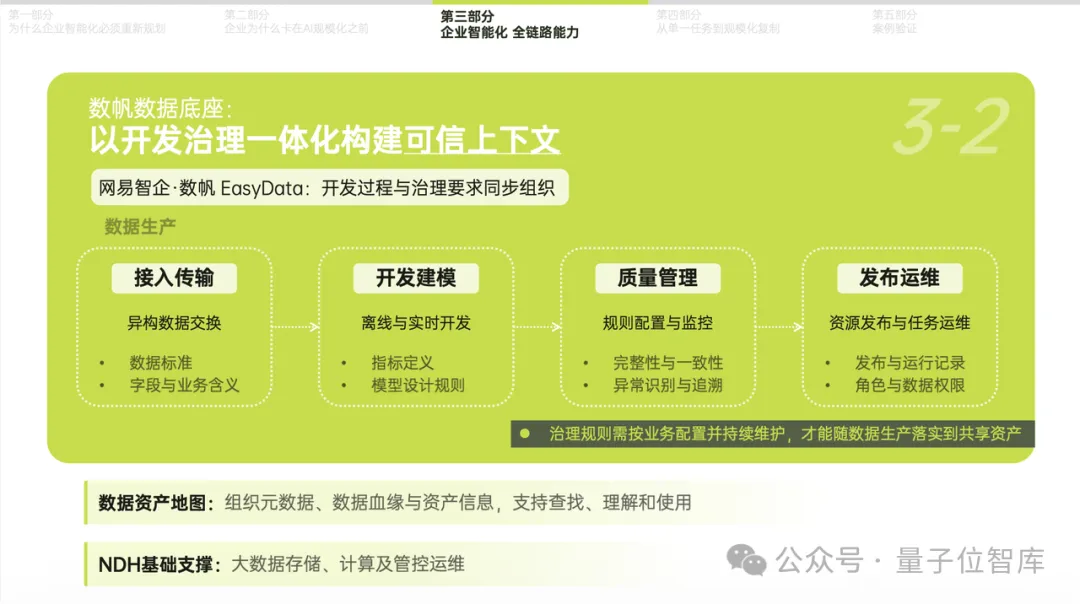
Building on this foundation, powered by NetEase Zhiqi’s Zhishu DataAgent, enterprises can seamlessly bridge dispersed metrics, knowledge bases, and natural language queries, enabling AI to genuinely understand business language.
In real-world business scenarios, this end-to-end integration translates into substantial business gains. Take Sanhua Intelligent Controls as an example: with Shufan unifying data and semantic definitions at the underlying layer, AI can automatically pull budget vs. actual figures and identify variances. This slashes budget analysis time from 2 to 3 hours down to just 10 minutes, helping the finance team pivot from tedious spreadsheet compiling to deep operational analysis.

As intelligence moves from analytical decision-making to deeper levels of software engineering and application delivery, new challenges emerge: How can we prevent coding agents from straying from requirements or causing inefficiencies during frontend-backend joint debugging?
A notable trend is that enterprises are attempting to rein in AI development from divergent “free-form generation” into more deterministic, engineered workflows.
Taking NetEase Zhiqi CodeWave’s SDD (Spec-Driven Development) as an example, its core philosophy is not to have AI write code directly, but rather to break down the delivery pipeline into multiple cascading tiers: requirements, architecture, development, testing, and release:
Business requirements are first transformed into structured specifications, from which technical design and task breakdowns are derived, and only then is code generated.
Every stage establishes clear inputs, outputs, and validation checkpoints, ensuring that the entire lifecycle—from requirements clarification and coding to testing and deployment—remains controllable and traceable throughout.
This “cascading” mechanism directly addresses three major bottlenecks of traditional SDD approaches: first, non-standard spec writing lacking explicit clarification mechanisms provides only weak constraints for LLMs; second, complex requirements easily exceed context window limits, leading to forgetfulness and hallucinations; third, capabilities are confined to the coding stage, leaving a disconnect between requirements and delivery.
CodeWave SDD explicitly clarifies ambiguities using the standardized EARS requirement syntax; isolates context and breaks down complexity through modular decomposition and granular subtasks; and unifies requirements, design, coding, testing, and release into a multi-role, end-to-end collaborative pipeline.
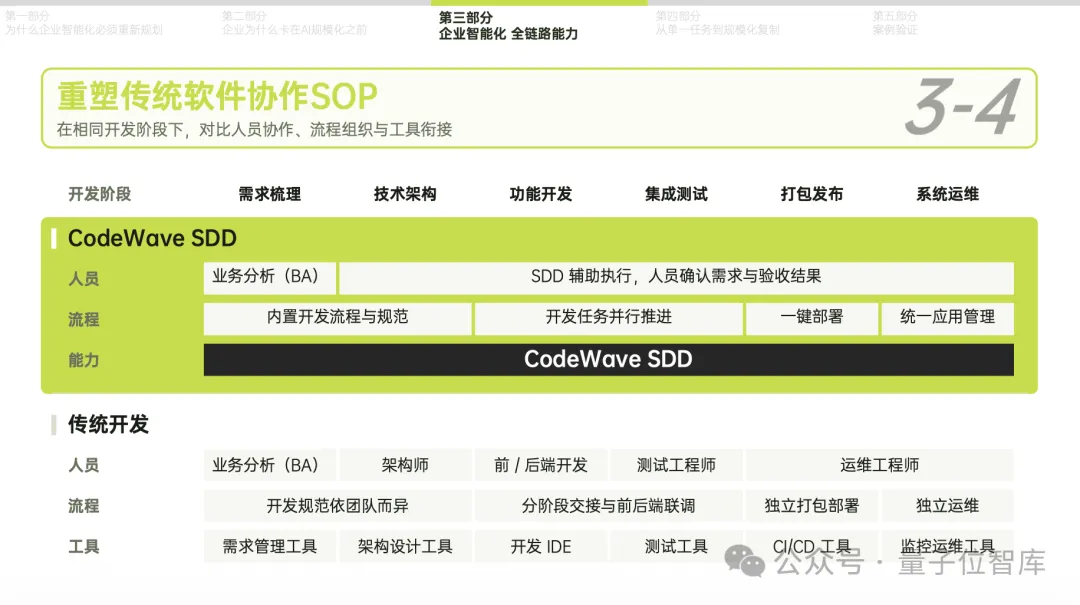
This engineering paradigm has already demonstrated remarkable efficiency gains in real-world projects. For example, Kongge Digital Intelligence Technology slashed development time from 60 person-days to 16 person-days in its new energy CRM project; Shanghai Qitong Digital Technology achieved an approximate 2.5x efficiency boost in developing its BIMS system, with a 78.63% first-time functional usability rate.
Getting a Demo Working Is Easy; Replicating It 100 Times Is the Real Test
Once the framework is built, the next question enterprises face is how to break ground.
While the conventional approach for many companies is to cast a wide net with parallel pilots on multiple fronts, QbitAI Research advises: prioritize closing the loop on a single high-value scenario first, then pursue horizontal expansion.
High-value scenarios can be evaluated across five dimensions:
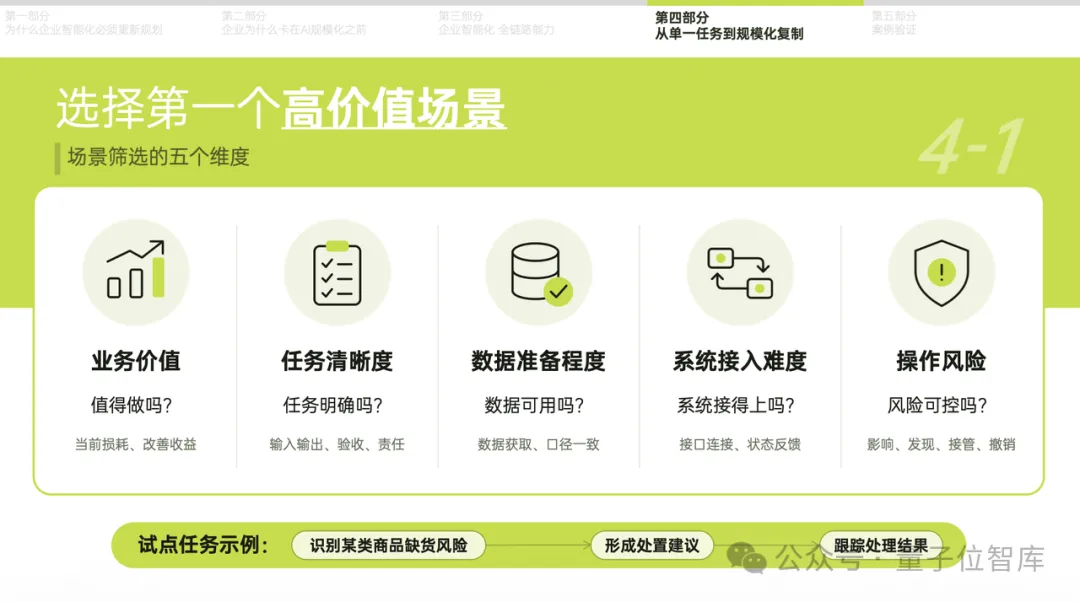
This might sound like common sense, but in practice, many teams get their priorities backwards: they rush to implement scenarios that are technically easiest to pull off, only to find negligible business value after launch, causing subsequent expansion to lose momentum.
Once a scenario is selected, process design during the pilot phase demands equal diligence.
Which steps in the existing workflow are suited for system automation, which still require manual review, and how exceptions should be routed all require meticulous re-engineering—not just technological layering.
A common pitfall is keeping the legacy workflow entirely intact while tacking on an extra layer of manual verification for AI outputs, which ultimately increases overall management costs rather than reducing them.
Once a pilot succeeds, enterprises typically face three evolutionary paths:

However, what truly determines whether an enterprise can bridge the chasm from “1” to “100” is whether it can distill lessons from individual successes into reusable, enterprise-grade intelligent assets.
Rigorously validated metric definitions, interface components, approval rules, and exception case repositories do not need to be reinvented from scratch for every new scenario. New business requirements can directly invoke existing capabilities, requiring only minor adaptations for specific differences.
Thus, the essence of scaled replication is ensuring that each AI deployment builds upon the foundation of previously consolidated assets.
Get the Full Report for Free
As enterprise intelligence progresses, the key differentiator lies in whether foundation model capabilities can be deeply woven into actual business operations, organizational structures, and processes, ultimately yielding tangible business results.
Exceptional intelligence planning never starts purely from a tooling perspective; it must adhere to “working backward from business outcomes.” Meanwhile, the essence of a future-proof agent architecture lies in practicing: “Humans define boundaries, AI drives execution.”
This report delivers a systematic blueprint covering problem diagnosis, architectural design, and operational validation.
Whether you are a business lead spearheading an AI pilot, an engineering team tasked with “AI efficiency” targets but struggling with measurement metrics, or an executive coordinating governance and accountability across departments during scaled rollout, you will find actionable references tailored to your current stage.
The report elaborates extensively on defining criteria for task completion, designing comparative evaluation frameworks, and transforming pilot outcomes into enterprise assets.
Access the full report via the link below:
https://jkhbjkhb.feishu.cn/wiki/W5D7wuDcbiPXDLkaRLQcAJpOn8f