Guiding student thinking and learning through questions | OpenAI
October 15, 2026
On Teachers’ Day, we celebrate the people who help us learn. A good question can change the course of a lesson. It can surface unspoken doubts, open up new approaches to problem-solving, or help learners realize what they already know. Teachers do this every day: understanding their students, thoughtfully introducing concepts, and guiding them from their first attempts to genuine understanding.
Set in a university classroom, this short film takes a humorous look at the evolving dynamic between students and educators, celebrating the vital role teachers play in the era of AI.
AI for Educators is now available in Portuguese
Today, we launched the Brazilian Portuguese version of the AI for Educators course on OpenAI Academy, our free learning platform. Designed for K-12 and higher education professionals, the course demonstrates how AI can assist with lesson planning, classroom activity and assessment design, and drafting communications—all while respecting and preserving educators’ pedagogical judgment.
Step-by-step learning through active engagement
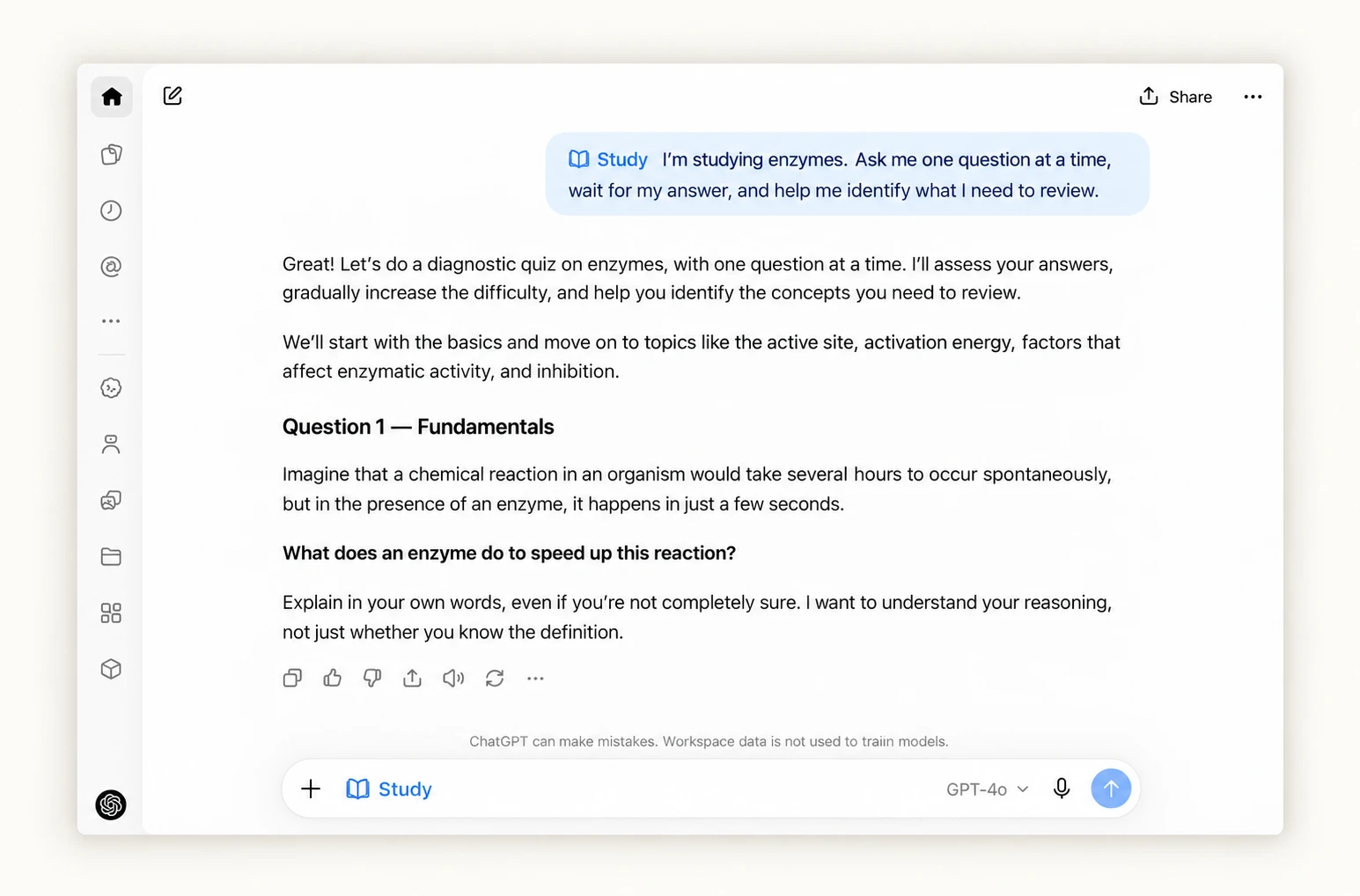
Study Mode helps you explore topics step-by-step through questions, hints, explanations, and comprehension checks. Developed in partnership with teachers, scientists, and learning experts, the feature is designed to encourage active engagement and reflection on one’s own reasoning process.
To turn on Study Mode, select “Study” from the tools menu in ChatGPT.
For example, a student reviewing biology might prompt: “I’m studying enzymes. Ask me one question at a time, wait for my response, and help me identify what I need to review.”
Teachers can also test Study Mode in their own subject areas to see whether the questions spark reasoning and whether the explanations are well-suited for their classrooms.
For instance, during a science unit on evaporation, a teacher could ask students to investigate why clothes dry on a clothesline. After exploring the topic using Study Mode, students write down their own explanation without referencing the chat transcript, along with a question for class discussion. Teachers can then review these responses to pinpoint concepts the class needs to revisit.
This Teachers’ Day, we invite you to explore with us: dive into the AI for Educators course, try Study Mode, and discover how these tools can support different educational settings. Technology can unlock entirely new avenues for learning, but it takes teachers to know their students, ask the questions that matter most, and help transform curiosity into knowledge.