
Is an LLM Truly Useful? Bailing Lets the Deliverables Speak
It’s that time of the year again—the preparation season for the annual Double 11 mega-sale.
How are e-commerce professionals holding up? Many friends in the industry are already feeling the heat, texting daily for help:
“Any recommendations for a great AI productivity tool? Urgent! Ideally something that does high-quality work and can sustain long hours.”

Actually, there really is a productivity tool worth keeping on your radar.
Ant Bailing recently open-sourced Ling-3.1-flash, capable of delivering high-quality outputs across everyday tasks like weekly reports and content ideation summaries.
To be fair, tools like Claude Code and Codex have been widely tested. However, in day-to-day domestic business workflows, models tailored to local work practices often feel much more seamless to use.
In particular, the Bailing series avoids hype around parameter sizes or benchmark-gaming, consistently demonstrating solid execution capabilities in real-world business scenarios.
According to its official positioning, the core objective is crystal clear: Get the actual work done across real workflows.
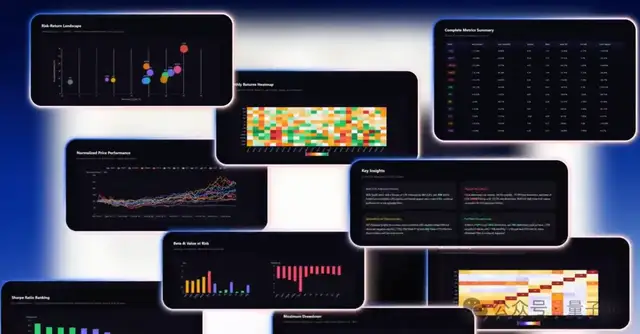
Take post-campaign e-commerce reviews as an example. When a business lead casually asks to “put together a recap of this campaign,” execution requires locating source materials, validating data, tracking progress, and eventually building structured spreadsheets and presentation decks.
Driving business forward requires deep, cross-functional collaboration—and to make matters worse, critical data is usually scattered across fragmented documents and software platforms.
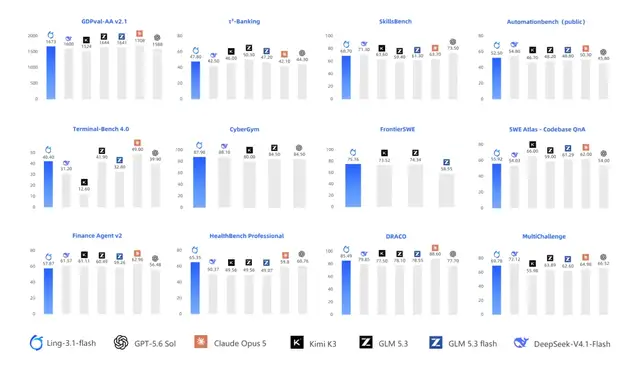
Image source: Bailing Official Account
Ling-3.1-flash was engineered specifically to solve such complex pain points with a high intelligence-to-efficiency ratio.
The core rationale: fluent conversation is merely table stakes; the ability to reliably deliver end-to-end task completion is what truly counts.
Built for Real-World Tasks
Taking on multi-step, extended-cycle operational work—like promotional campaign analyses—requires a model to steadily drive multi-phase progress. You can understand Ling-3.1-flash’s architecture through this business chain:
The first challenge the model faces is accurately decomposing delivery objectives.
Users might offer only a brief prompt, yet expect a fully structured, publication-ready presentation. The model must independently identify required materials, spot information gaps and prerequisites, and dynamically iterate based on intermediate outputs.
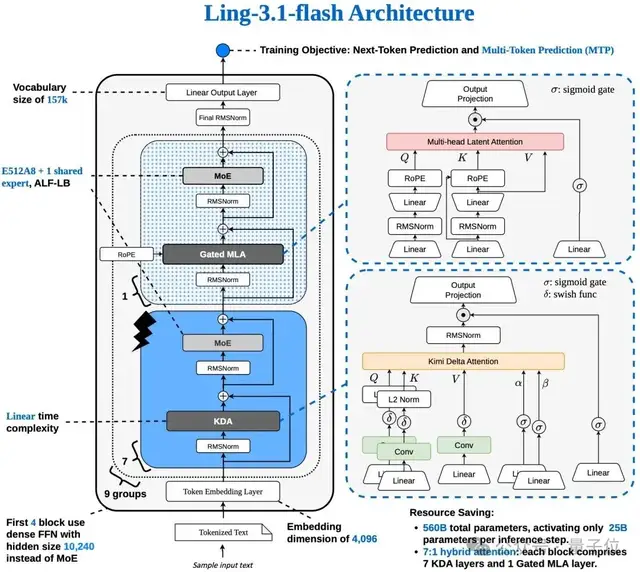
Ling-3.1-flash’s operational architecture embodies this logic.
It unifies intent parsing, task decomposition, information synthesis, tool invocation, and result verification into a cohesive loop, enabling complex multi-agent orchestration across webpages, documents, spreadsheets, and coding environments.
It doesn’t just generate Excel sheets and slide decks; it simultaneously writes code and runs automated tests.
What’s more, these capabilities have already manifested in concrete deployments.
Ling-3.1-flash has been integrated into Ant’s internal desktop collaborative agent client, “Xiaohu”: the model oversees planning and scheduling, while the execution runtime reads files, executes programs, and writes results.
This deployment paradigm offers practical lessons. Even without direct access to Xiaohu, users can combine existing workplace Agent frameworks with Ling-3.1-flash to build equally efficient workflows.

As long-horizon tasks unfold, context windows and historical reference data expand dramatically, inevitably causing inference compute costs to surge.
This is where Ling-3.1-flash’s hybrid architecture plays a critical role.
The model totals roughly 560B parameters, activating around 25B parameters per token. While preserving an enormous knowledge base, Ling-3.1-flash drastically lowers the actual compute load per inference step.
On the attention front, it inherits and refines Ling-3.0-flash’s architecture by increasing the proportion of Linear Attention.
The model employs a hybrid layout of “7 KDA layers paired with 1 Gated MLA layer”: KDA handles long-sequence inputs with linear time complexity, while 1 Gated MLA layer is preserved every 8 layers to ensure effective global attention propagation.
Thanks to this design, its context window scales up to 1M tokens, ingesting massive documents, codebases, and historical interaction logs in a single pass—substantially eliminating the overhead of chunking and manual data staging.
For expert routing, the model features 512 routed experts, dynamically activating 8 per token alongside 1 shared expert.
This architectural path combining hybrid linear attention with sparse MoE is engineered to maintain steady performance over long, complex task executions while keeping compute expenditure tightly controlled.
In terms of engineering deployment, the team utilized mixed-precision quantization to reduce model weight footprint from approximately 534GB to 292GB. Under standard Hopper-architecture test environments, required GPU hardware dropped from 8 GPUs to 4 GPUs.
For real-world production environments, the team also introduced long-context parallel inference schemes (PCP/DCP) and reinforced native support for JSON Schema, facilitating long-document ingestion and seamless integration with existing enterprise APIs.
Beyond underlying architecture, real delivery power must be validated through objective benchmarks.
On GDPVal-AA V2.1, a benchmark dedicated to complex workplace task evaluations, Ling-3.1-flash achieved an ELO score of 1673, demonstrating a pronounced edge in navigating multi-step composite workflows.
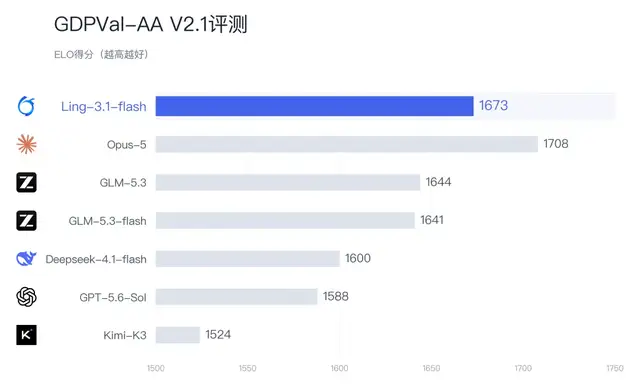
Image source: Bailing Official Account
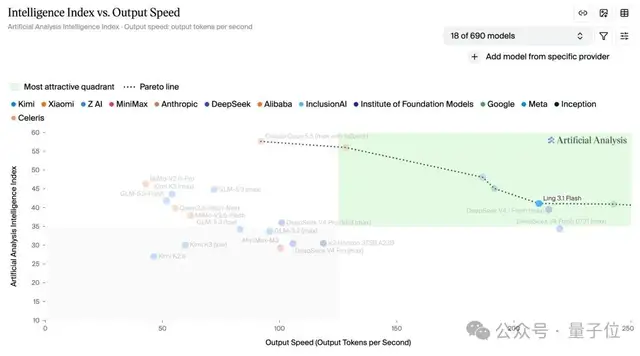
Meanwhile, the latest public benchmarks from Artificial Analysis reveal that Ling-3.1-flash scores an Quality Index of 41, achieves an output speed of approximately 210 tokens/second, and incurs a blended API cost of around $0.19 per million tokens—presenting an optimal balance of intelligence, generation throughput, and cost-efficiency for high-frequency business workloads.
In the specialized healthcare domain, Ling-3.1-flash also ranks among the top performers on HealthBench Professional.
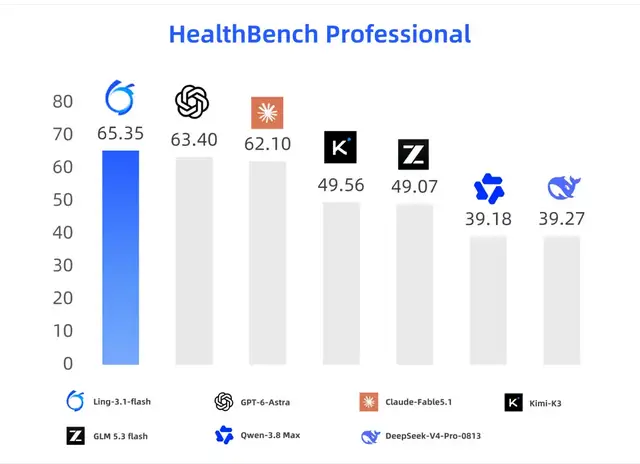
Image source: Bailing Official Account
Furthermore, in technical scenarios like software development and terminal operations, Ling-3.1-flash demonstrates robust environment interaction and engineering execution.
Consider an internal long-running project at Ant to build a native Lua compiler: across an evaluation lasting roughly 17 hours, the model autonomously coded, debugged, and iterated, ultimately attaining a 97.8% pass rate on independent test suites.
When evaluating tech stacks for workplace agents, end-to-end delivery capability and high execution accuracy are primary reasons to favor Ling-3.1-flash.
Hands-on Testing: Ling-3.1-flash in Action
To evaluate its performance in practical business contexts, we put it through a series of hands-on tests.
First, we selected a representative Double 11 e-commerce campaign task:
Imagine you are the e-commerce director for “Ling,” a home storage brand. Based on the provided materials, submit a Double 11 campaign plan covering October 15 through November 11 to executive leadership. This plan will be directly handed off to operations, content, customer service, and warehousing teams for execution.
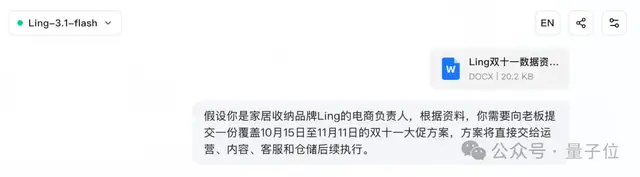
Note: The baseline business background data used in this test was generated with assistance from Codex.
Upon receiving core KPIs, SKU breakdowns, staffing structures, and historical ad spend data, the model began organizing the input and formulating an actionable execution plan.
In the first stage, the model proactively evaluated the feasibility of the initial targets.
Rather than blindly accepting overly aggressive baseline assumptions, it factored in diminishing returns on ad spend, warehouse turnover bottlenecks, and peak fulfillment constraints to propose rational, quantified targets.
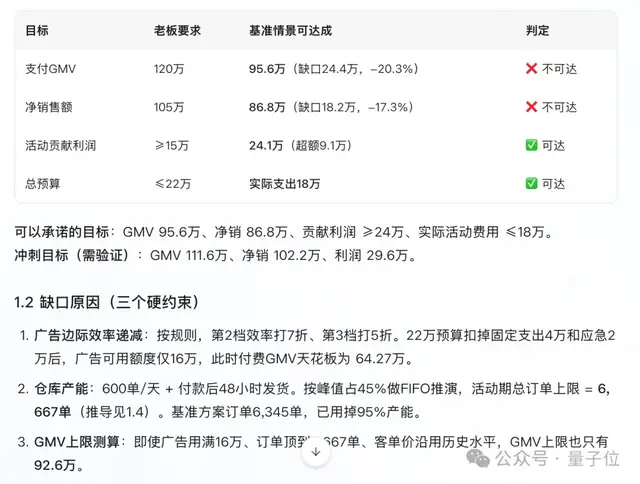
At the same time, it provided several alternative contingency plans to help business teams handle leadership scrutiny and proposal defenses.
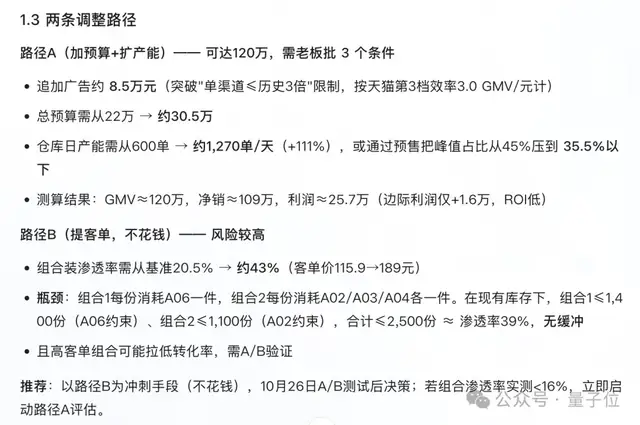
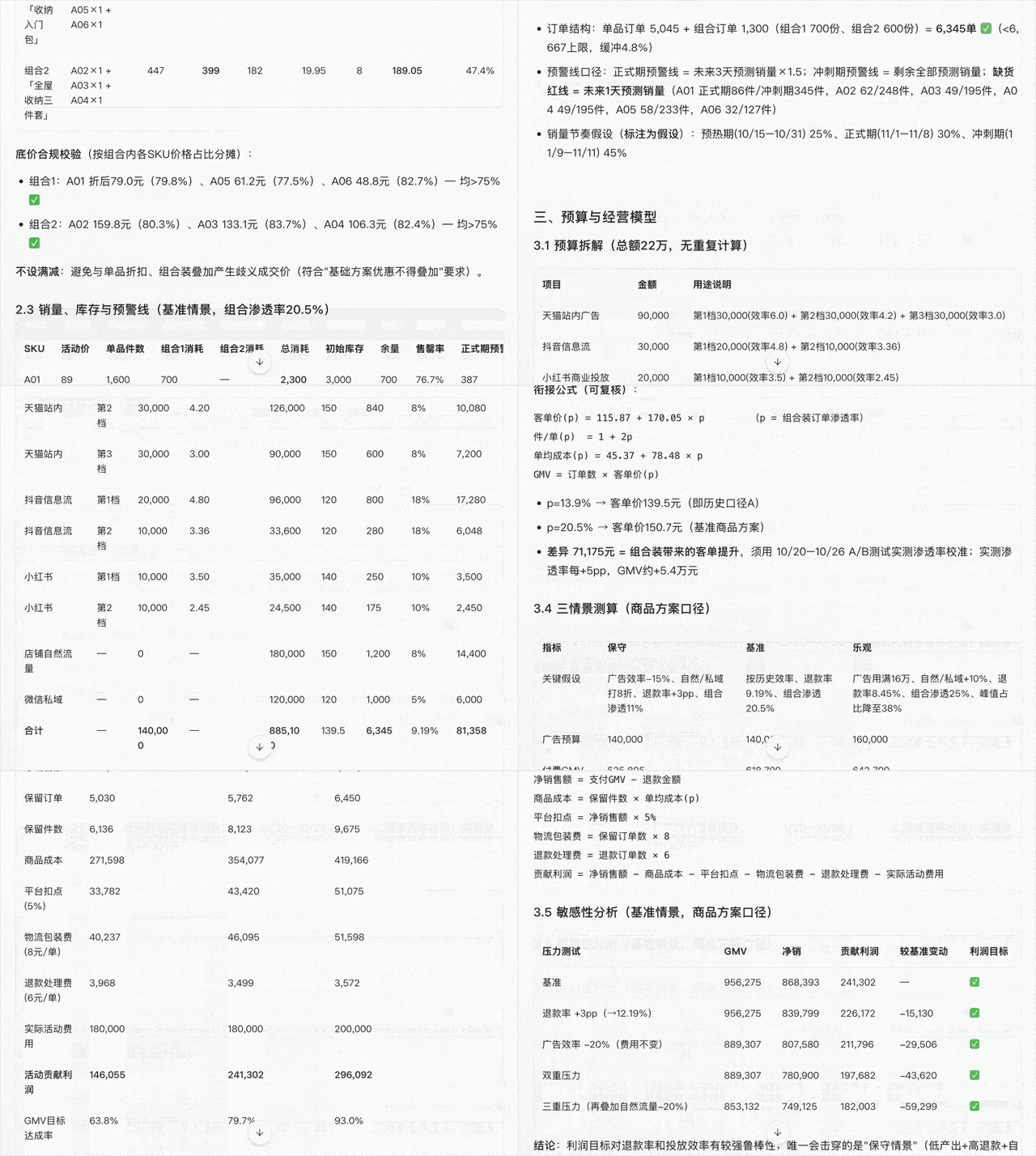
During discount and promotional scheme projections, every calculated metric formed a tight logical loop.
From bundled pricing tiers to channel ad spend allocations, every figure was backed by sound justification, showcasing solid business analysis fundamentals.
Ling-3.1-flash also developed an exhaustive phased rollout schedule, specifying clear prerequisites for every workstream.
Although the prompt restricted the schedule to Double 11 day, the model autonomously added post-campaign debrief milestones and net margin reconciliation workflows—making the entire roadmap exceptionally comprehensive.

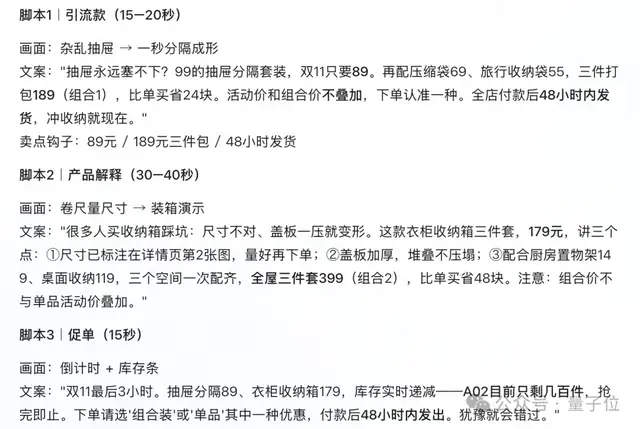
In terms of text generation quality, assets such as short-video hook scripts and conversion-oriented livestream sales copies were generated in one go.
Elements such as shot framing, voiceover scripts, and conversion hooks were fully fleshed out, ready to serve as immediate execution drafts and saving extensive writing time.
At the final stage of delivery, the model proactively ran a consistency cross-check, clearly highlighting critical data points that required human verification and open decisions, ensuring ultimate decision-making authority remained firmly in human hands.
Beyond office automation, clinical consultation assistance is another core strength for Ling-3.1-flash.
We supplied it with a simulated blood lipid profile alongside conversational chief complaints, asking it to compile an organized clinic visit prep sheet.
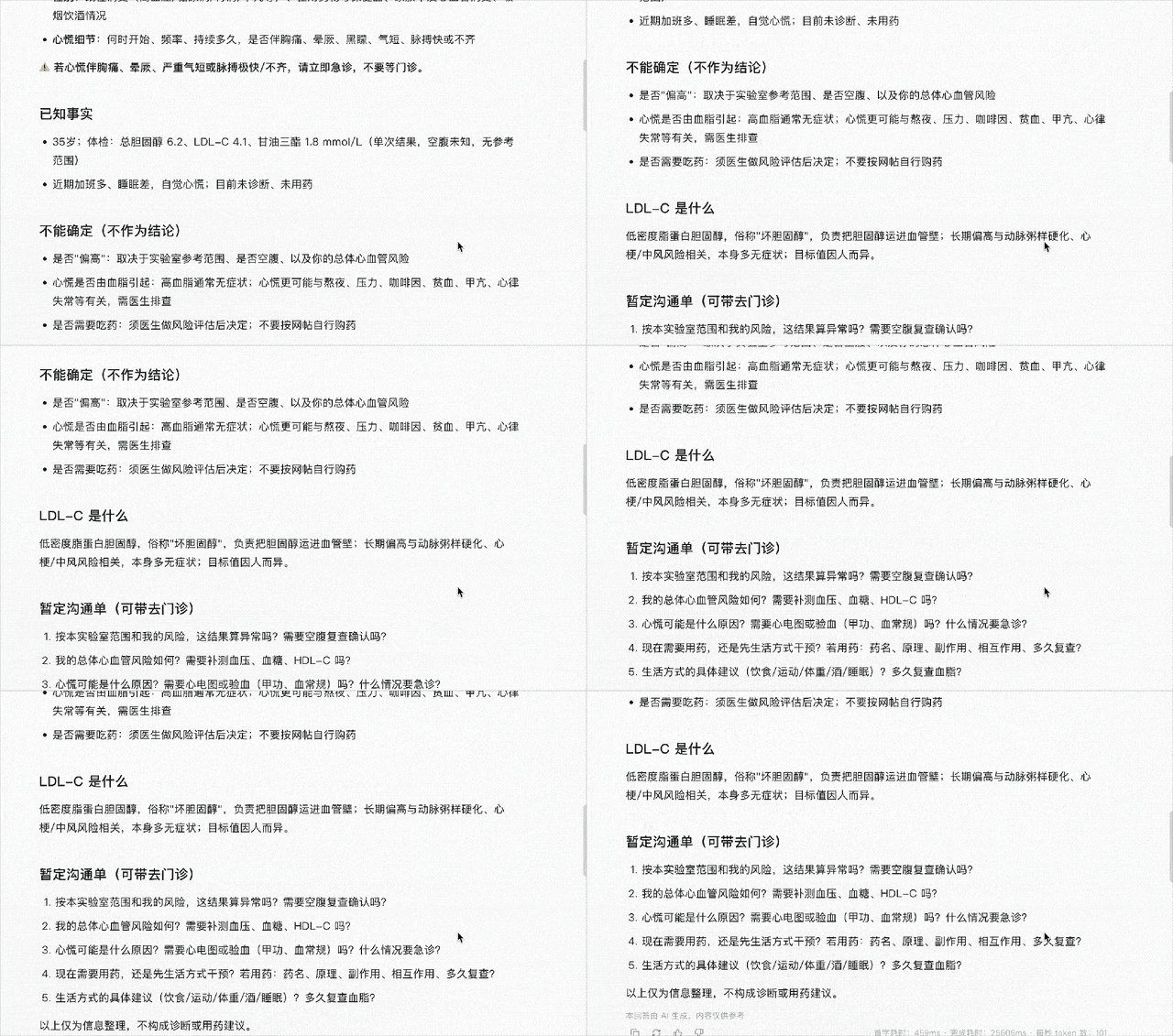
Given incomplete input information, Ling-3.1-flash refrained from jumping to definitive diagnoses. Instead, it systematically flagged clinical details the patient needed to clarify, neatly segmenting findings into “Known Objective Facts,” “Pending Uncertainties,” and “Recommended Questions for the Doctor.”
After guiding the patient to provide key missing details, the model cross-checked the new entries against baseline data and produced a structured medical inquiry checklist.
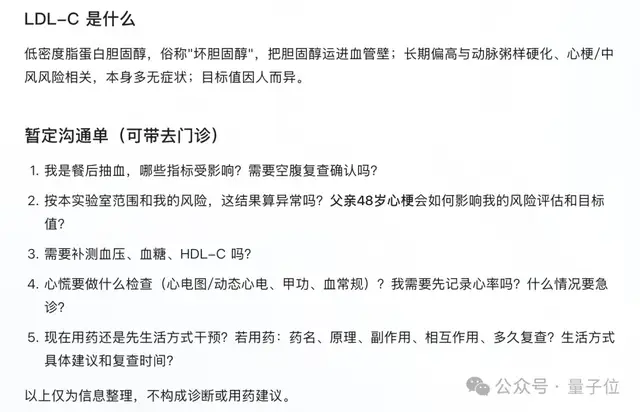
Commendably, the model strictly adhered to medical safety guardrails throughout its reasoning chain, consistently reminding the user to monitor clinical indicators, seek immediate emergency care if critical symptoms arise, and firmly avoiding prescribing medications—strictly positioning itself as a triage and history-taking assistant for clinicians.
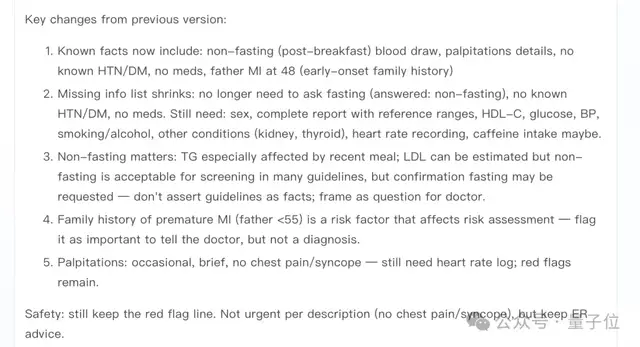
Naturally, Ling-3.1-flash exhibited certain boundary conditions during testing. For example, when ingesting extremely long unstructured text in a single prompt, global attention occasionally drifted.
Therefore, for expansive tasks with numerous variables—such as campaign planning—a “phased delivery” approach is strongly recommended (e.g., using automated scripts to clean and aggregate data first, then prompting the model for step-by-step synthesis).
Single-turn direct generation also has its limitations. If the initial output misses expectations, revisiting task decomposition logic and delivery constraints is far more effective than repeatedly tweaking a single prompt by trial and error.
Additionally, the current version does not natively support visual multimodal inputs, still requiring an upstream vision model for image parsing and bridging, which adds operational complexity and API overhead to the deployment pipeline.
Overall, the model’s delivery maturity across specific enterprise workflows depends closely on how well-structured the underlying business scenario is.
Bailing Takes the Lead into Real Workflows
Looking back across its product iterations, the Bailing team’s roadmap directly addresses a critical inflection point in the LLM industry.
For a long time, the AI community focused heavily on pure code generation and benchmark leaderboards.
Yet as technology enters deeper territory, a fundamental question is being asked across the industry: on the path toward AGI, is coding the only true yardstick?
Xiting, head of Bailing, offered a core observation at the INCLUSION Conference on the Bund: Coding is by no means the only testing ground.
In the team’s view, Bailing’s purpose has always been to tackle real-world productivity challenges, moving model evaluation away from abstract metrics and treating real-world problem-solving as the ultimate benchmark.
Guided by this philosophy, Bailing first deployed its 3.0 series into two high-stakes, low-error-tolerance fields: finance and healthcare.
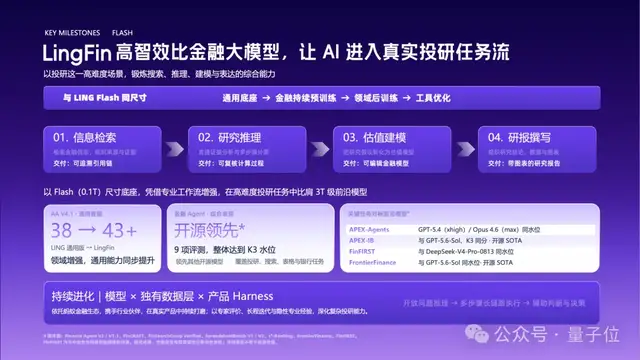
LingFin focuses on high intelligence-efficiency financial applications, transforming research efficiency through financial report breakdown and deep data analysis. Meanwhile, LingSante, built for healthcare, focuses on deep medical reasoning, evidence-based retrieval, and standardized clinical workflow exploration.
Among them, Ling-3.0-flash-Fin (124B total parameters, 5.1B activated) has embedded into live investment research workflows, completing the end-to-end production cycle of “massive data extraction – multi-dimensional cross-analysis – standardized research report generation.”
Its performance in complex investment research rivals 3T-level frontier models, leading the open-source pack in financial Agent evaluations and matching tier-one flagships like GPT-5.4 on core metrics.
Ling-3.0-flash-Sante brings high intelligence-efficiency to specialized healthcare. At 124B parameters, it achieves top-tier results among sub-1.6T models, delivering overall performance on par with multiple ultra-large-scale flagships.
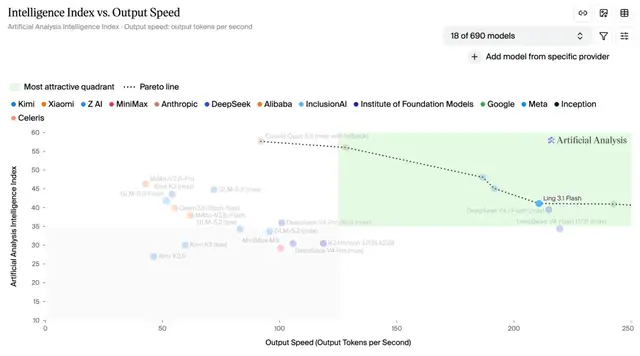
Image source: Bailing Official Account
Unlike generic foundation models that rely solely on shallow instruction fine-tuning, these models have been battle-tested in demanding production environments, refined through long-term real-world business operations and continuous error-correction loops.
From a broader perspective, Bailing is also steering an industry-wide shift in defining “efficiency.”
Historically, the industry primarily measured compute efficiency—focusing on hardware utilization at single points.
Bailing combines compute efficiency, parameter scale efficiency, and token economics into an integrated metric: the intelligence-to-efficiency ratio.

This philosophy is rapidly gaining industry consensus. Over the past six months, frontier labs like Anthropic and OpenAI have aggressively expanded enterprise capabilities for specialized domains like finance and healthcare.
Anthropic’s release of Claude for Financial Advisors, for instance, directly embeds underlying connectors and domain-specific task Skills into real advisor workflows.
While the ultimate market trajectory remains unwritten, “integrating into real workflows” has shifted from an exploratory vanguard effort into the defining direction of the entire industry.
This past year also marked Bailing’s transition from showcasing algorithmic benchmarks to delivering concrete operational value.

With the release of Ling-3.1-flash, Bailing’s technical roadmap comes into clear view:
Upward, continuously expanding the coordination boundaries of agent systems in complex tasks; downward, significantly lowering inference deployment costs for enterprises and developers, translating high intelligence-efficiency into tangible workplace productivity; outward, deeply penetrating specialized vertical industries to uncover indispensable business value across the real economy.
The metric for proving an LLM’s worth is shifting rapidly, and the true contest over enterprise productivity has only just begun.
Ling Studio:
https://ling.tbox.cn
OpenRouter:
https://openrouter.ai/inclusionai/ling-3.1-flash
HuggingFace:
https://huggingface.co/inclusionAI/Ling-3.1-flash
ModelScope:
https://modelscope.cn/models/inclusionAI/Ling-3.1-flash