
October 15, 2026 · Science
Pengfei Tian, Maxwell L. Bileschi, Zoi Tsangalidou, Sukhdeep Singh, and Lucy J. Colwell
Explore scientific workflows in Google Antigravity
Amid the escalating antimicrobial resistance crisis, the development of new antibiotics is increasingly urgent. Yet discovering novel therapies remains a slow, labor-intensive process. Now, powered by our agentic development platform Google Antigravity, this discovery pipeline is significantly streamlined.
Google Antigravity provides an agent-based scientific workbench that empowers biologists to rapidly discover, structurally evaluate, and prioritize high-value candidate targets—consolidating fragmented queries across multiple disparate databases into a single session. Additionally, it helps researchers scan millions of previously uncharacterized proteins in the UniProt database using ProtNLM, a model capable of predicting biological function directly from amino acid sequences.
This technical walkthrough demonstrates how biologists can use Google Antigravity to discover a novel antimicrobial peptide candidate predicted to be active against respiratory pathogens. The identified lead molecule is currently undergoing wet-lab validation.
Finding Novel Antimicrobial Peptides
The rising threat of antimicrobial resistance (AMR) is one of the defining global public health crises of our time, projected to cause roughly 10 million deaths annually worldwide by 2050. Staying ahead of this crisis requires discovering novel therapeutics. Antimicrobial peptides (AMPs)—particularly bacteriocins—show tremendous promise as alternatives to conventional antibiotics. Over evolutionary timescales, they have evolved mechanisms that target critical vulnerabilities in competing bacteria, from cell envelopes to essential intracellular machinery, making it exceptionally difficult for pathogens to develop resistance.
The exponential growth of genomic and metagenomic sequencing has accumulated billions of natural amino acid sequences across global databases. This natural reservoir of data has already yielded globally adopted bacteriocins such as Nisin, as well as recent genome-mined breakthroughs including Darobactin, Dynobactin, and Lariocidin.
Yet many molecules remain buried in the unannotated “dark matter” of protein databases, uncharacterized due to their lack of sequence similarity to known proteins. For instance, UniProt, the leading public resource for protein sequence and functional information, contains millions of sequences deposited directly from genome sequencing projects with unknown functions.
To bridge this gap, Google developed ProtNLM (Protein Natural Language Model)—a deep learning model trained to interpret the underlying evolutionary “grammar” of amino acid sequences. This allows the model to predict biological functions directly from raw protein sequences, assigning high-confidence functional annotations to millions of previously uncharacterized entries in UniProt.
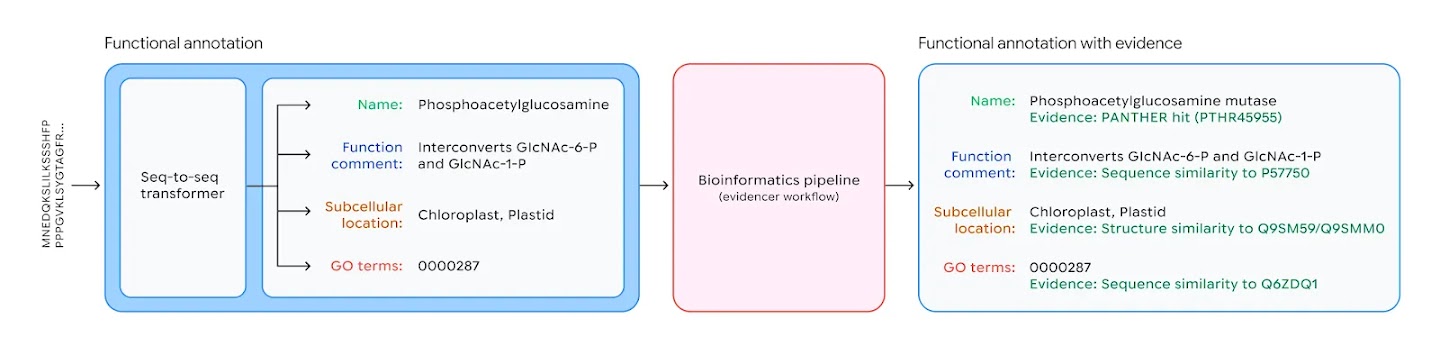
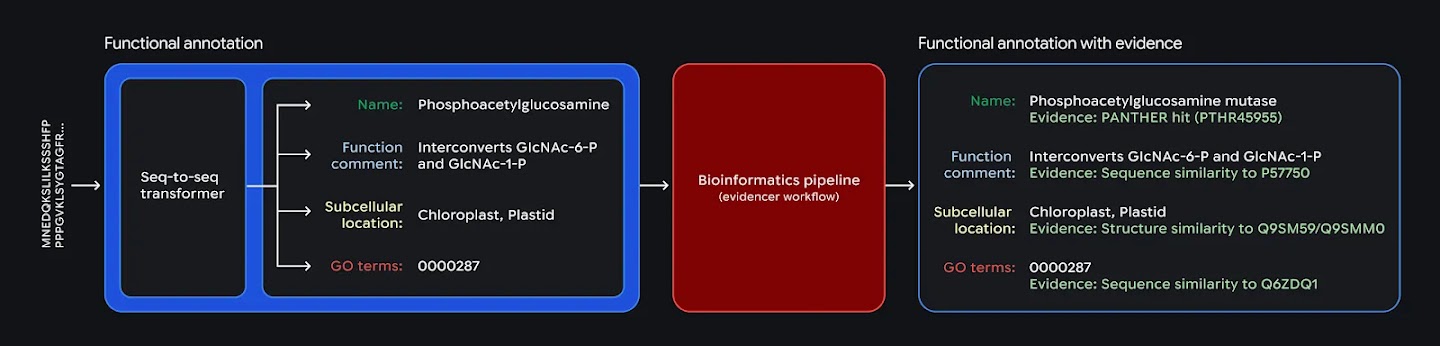
ProtNLM pipeline overview: Translating raw amino acid sequences into natural language biological annotations for unreviewed UniProtKB/TrEMBL entries. The system’s functional annotations span protein names, functional descriptions, subcellular localizations, Gene Ontology (GO) terms, and keywords.
Collaborative Intelligence
Scientific discovery is rarely a one-step process; identifying viable candidate proteins demands human intuition, iterative refinement, and the integration of emerging empirical evidence. Within Antigravity, researchers and AI agents begin by establishing a clear biological objective: identifying and computationally validating novel AMPs in Streptococcus pseudopneumoniae. Across interactive, multi-turn sessions, the researcher guides the scientific strategy—deciding which questions to ask and which evidence to collect—while the agent handles the heavy lifting of multi-database orchestration, structural analysis, and literature synthesis.
Slide 1 of 6
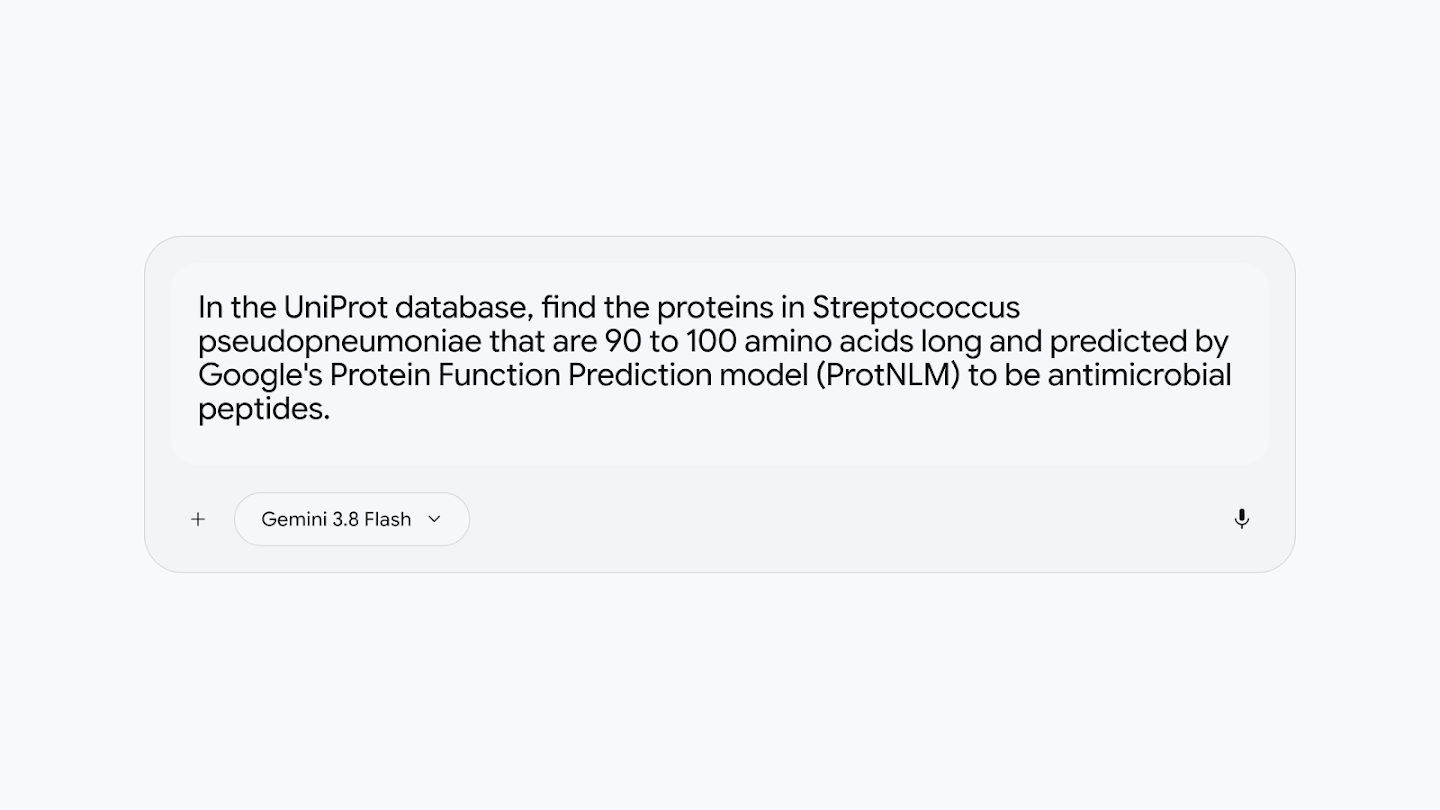
Navigating a vast search space:
The agent queries databases and filters millions of entries down to a prioritized shortlist of candidate molecules. Here, it identifies a 97-amino-acid bacteriocin belonging to the Lactococcin 972 family (UniProt ID: A0A0U0D591).
![Figure 43: Interactive interface display