
From Concept to Cost: How AI Is Rewriting the Production Playbook for Variety Shows
Mengyao reports from OFIS
QbitAI | Official Account: QbitAI
A Chinese take on “MrBeast” has surprisingly been pulled off by an AI variety show creator.
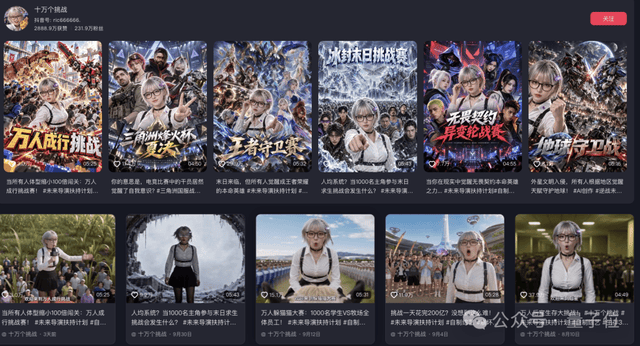
An AI creator known as @十万个挑战 (“100,000 Challenges”) has gone viral across Chinese social media with a series of wildly imaginative competitive challenges:
A single video racked up 1.89 million likes, the series averages over 250,000 likes per episode, the account has amassed more than 2 million followers, and commercial sponsorship quotes have soared to 150,000 RMB.
Entire schools waging war with chalk, gamers battling in a massive brawl, extreme post-apocalyptic survival… if you can imagine it, they dare to produce it:
Meanwhile, the classic variety show X-Change (Bian Xing Ji)—famous for sending rebellious urban teens to the countryside and rural kids to the city, spawning countless internet memes—has received a “cyber reboot” via AI by Douyin account @重塑计 (“Remodeling Project”), quickly breaking into the mainstream.
With just four episodes released, the show averages over 200,000 likes per episode, netting 127,000 followers on the strength of its first three videos alone.
The familiar variety show captions, high-stakes dramatic clashes, and photorealistic characters and sets deliver the exact formula audiences know and love.

From extreme challenges and classic IP reimaginings to unrestrained virtual competitions, AI is spawning an entirely new format of video content: AI Variety Shows.
Digging deeper reveals a shared identity between both breakout creators: they are both LibTV Certified Creators.
Productions that once demanded dozens of crew members and eye-watering budgets can now be produced single-handedly by solo creators armed with nothing more than a personal computer and mature AI tools.

What’s more, content platforms have begun tilting resources toward AI variety creators.
Recently, LibTV partnered with Douyin’s Future Director Initiative to jointly support AI variety show production, focusing on empowering top creators to build brand-new programming.
AI turns imagination into visuals, platforms supply the resources, and creators focus on ideation. The extravagant, high-budget spectacles once reserved for broadcast television can now be realized by everyday creators.
The window of opportunity for AI variety shows has officially opened.
From Concept to Cost: How AI Is Rebuilding Variety Show Production
Neither the overseas MrBeast team nor the original producers of X-Change likely ever anticipated that these viral classics would trigger fresh waves of hype through AI.
On short-video platforms, AI variety shows are booming, with related hashtags on Douyin surging past 28.76 million views.
Shows like 100,000 Challenges, Remodeling Project, and Outrageous Answers Challenge—spanning extreme competitions to IP remixes—are flooding recommendation feeds with bold, distinct styles. Likes in the 100k, 200k, and 300k ranges are commonplace, accompanied by bustling comment sections reminiscent of the early AI short drama boom.
Why are AI variety shows rising so fast and maturing into an independent content medium?

△ Source: Douyin feed
First, the core reality: advancements in generative AI have brought “impossible variety shows”—once confined strictly to imagination—to life.
In traditional live-action variety shows, no matter how ingeniously the rules are crafted, they must ultimately yield to the laws of physics and real-world logistics. Human performers have physiological limits, shoots are constrained by venues, and countless surreal ideas simply cannot be realized in reality, no matter how hard directors try.
In the realm of AI, however, the physical constraints of the real world dissolve into an open playground for creative expression.
Take @十万个挑战: epic spectacles that even MrBeast’s team would struggle to execute practically are brought to life effortlessly via LibTV. Hosts ride mythical beasts mid-air while commentating, contestants effortlessly cast high-level skills, and magic and illusions erupt across the screen with striking visual punch:

△ Source: Douyin account @十万个挑战
In one segment, smartphones conjure up wheels of fire, yachts, and helicopters on demand—competitive variety shows have truly reached a point of “what you think is what you get.”

△ Source: Douyin account @十万个挑战
Scenes impossible to build in the real world are now seamlessly woven by AI into shows packed with dramatic tension and absurd humor.
Beyond wild creativity, however, the real driver behind the scalable rise of AI variety shows is the demolition of two towering barriers: production costs and barriers to entry.
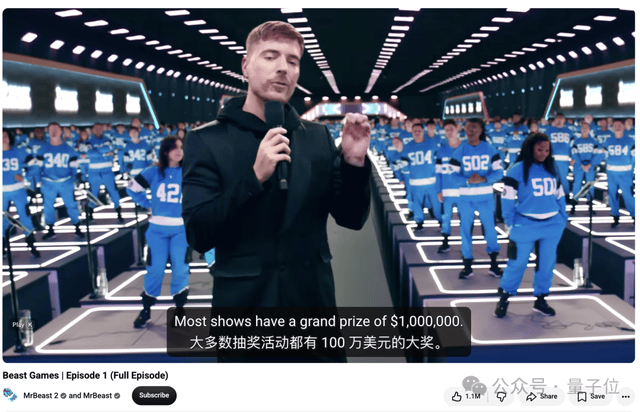
Traditional variety entertainment is quintessentially asset-heavy. Take Season 1 of Beast Games, released in 2024: the show gathered 1,000 contestants for a multi-million-dollar prize pool. Behind that massive scale lay immense funding, sprawling crews, complex venue logistics, and lengthy production cycles. Equipment rentals, set construction, and cast-and-crew management form insurmountable barriers for independent creators.
△ Source: YouTube channel “MrBeast”
Breakthroughs in AI tools are dismantling this high-cost, team-heavy production logic.
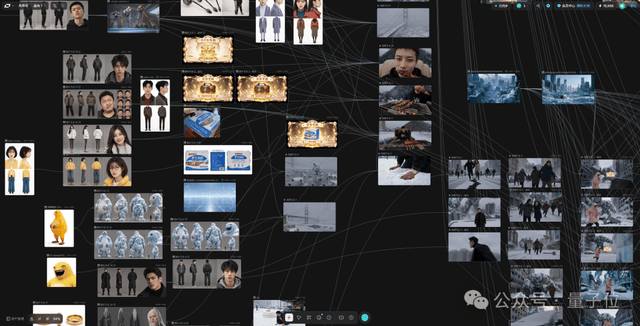
As video generation matures, character design, set staging, camera control, and even multi-camera storytelling can be integrated directly into an AI production pipeline. Workflows that once required multi-department collaboration can now be closed-loop on a single PC, drastically slashing fixed overhead for venues, live shoots, and actors.
The creator behind @十万个挑战 is a prime example: majoring in e-commerce in college with no formal training in film directing or screenwriting, he previously worked as a gaming and esports commentator. It was not until April 2026, when AI video generation took a major leap forward, that he realized ideas once stifled by logistical constraints could finally become reality.
According to the creator, the visual assets and video generation for his shows are largely handled on the AI video generation platform LibTV. The platform’s built-in collaborative features enable multi-user asset reuse, significantly boosting production efficiency.
Currently, a five-minute episode of an AI variety show costs just 2,000 to 5,000 RMB to generate, with a production cycle of typically around one week.
△ Source: Creator @十万个挑战’s LibTV workflow
Even more transformative than cost reduction is the radical shift in trial-and-error dynamics.
Traditional variety shows bear tremendous sunk-cost risks: the heavier the upfront investment, the more crippling the fallout if viewership underperforms.
AI variety shows, by contrast, unlock an agile iterative workflow: prototype concepts in five-minute shorts, then tweak mechanics based on completion rates, engagement, and audience comments. If the reception is enthusiastic, quickly scale it into a serialized IP; if metrics fall flat, pivot immediately without regret.
In an interview, the creator of @十万个挑战 noted: “The cost of trial and error is negligible. If a video underperforms, we can change direction at any time.”
In the traditional entertainment industry, such agility is an unthinkable luxury. Where a failed test once meant millions down the drain, AI creators can now run a genuine market test for just a few thousand RMB.
From Audience Resonance to Self-Sustaining Ecosystems: AI Variety Shows Take Shape
Lower production barriers alone cannot sustain long-term content prosperity. Content must not only be produced; it must retain viewers.
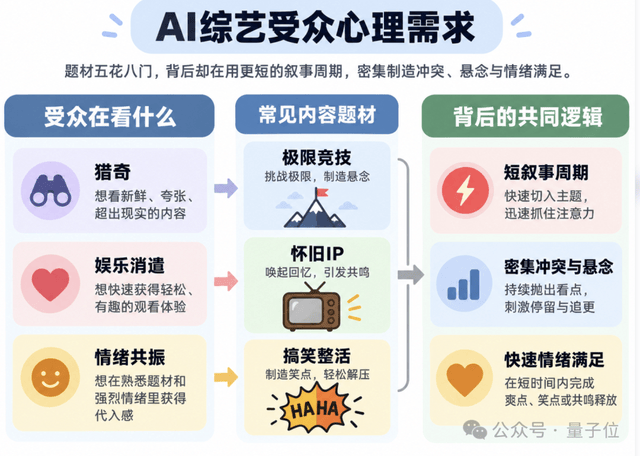
On the consumption side, the appeal of AI variety shows follows established communication theories: delivering a dense concentration of gratification hits and emotional value.
Uses and gratifications theory posits that audiences consume entertainment to satisfy needs for novelty, empathy, and diversion. Whether through extreme competition, nostalgic remakes, or absurd stunts, the underlying logic remains consistent: delivering high-density conflict, suspenseful tension, and emotional catharsis within an ultra-tight narrative rhythm. Generative AI pushes this narrative density to its peak.
△ AI-generated
Take the AI version of X-Change, @重塑计: with just four episodes published, its peak episode gained 448,000 likes, 14,000 comments, and over 158,000 shares.
In one episode, Lu Xiaonao, a foul-mouthed “trash-talker” fluent in internet slang, and Zhao Ruonan, a quick-tempered “brawler” who settles disputes with his fists, are sent together to a remote village for “life reform.” Conflict erupts the moment they meet, while a kindhearted elderly grandfather prepares their beds, looks after them attentively, and even apologizes on their behalf whenever they cause trouble.
The familiar character foils and sharp ideological clashes instantly reignite the emotional resonance of classic social-observation reality TV.

△ Source: Douyin account @重塑计
What is particularly telling is the viewer reaction in the comments: “My heart aches for grandpa,” “Stop bullying the old man,” “Why should grandpa have to take the blame?” Some even remarked: “Thank goodness these are just AI-generated characters, or it’d be too heartbreaking to watch.”
Even knowing full well the scenes and characters are purely virtual renders, audiences remain deeply emotionally invested. The models generate fictional symbols, but viewers immerse themselves in genuine emotions.

△ AI-generated
Moreover, the pacing of AI variety shows fits the distribution algorithms of short-video platforms like a glove.
At roughly five minutes per installment, conflict is introduced in the first 30 seconds, plot twists hit continuously throughout the middle, and cliffhangers hook viewers at the end—priming them for instant binge-watching. Decentralized recommendation algorithms give grassroots concepts without star power or established IP rights a viable shot at breaking through on narrative merit alone.
Where legacy variety shows fought for prime-time broadcast slots, AI variety shows compete for critical dwell time as fingers scroll through feeds.
As content supply proliferates, platforms are stepping in to institutionalize traffic incentives. Douyin’s “Future Director Initiative,” launched in late 2025, spans three major categories: variety entertainment, narrative shorts, and micro-documentaries:

According to official interim data, over 500 works have launched under this support framework, accumulating more than 5 billion total views, with nearly 70 works surpassing 10 million views each.
Building on this momentum, Douyin rolled out the “Creator Self-Produced Variety 3.0 Incentive Program,” introducing ten supportive policies across funding resources, production mentorship, and platform recognition, specifically aimed at safeguarding long-term IP building for individual creators.
Whereas producing a show once required industry credentials and channel distribution access just to get greenlit, platforms are now reallocating distribution power, allowing compelling content to bypass traditional gatekeepers and face market validation directly.
Beyond Viral Hits: Platforms Cultivate Long-Term Sustainability
Beneath the frenzy, realistic challenges remain prominent.
Scoring a viral hit on a single clever concept is no longer rare; the true litmus test of industry maturity lies in sustaining a reliable weekly release cadence and building commercially viable, long-lasting IP.
The industry’s most pressing question: How do indie creators transition from “guerrilla operations” to sustained, professionalized production?
The recent collaboration between LibTV and Douyin’s Future Director Initiative offers a potential blueprint.

Top creator teams including @十万个挑战, @重塑计, @揣了个橘, and @白班乐子铺 have already joined the first cohort of the program.
This partnership model directly targets creators’ two biggest pain points: production capacity and meaningful exposure.
- LibTV serves as technical infrastructure, providing foundational compute quotas, toolchain optimizations, and asset marketing coordination;
- Douyin’s Future Director Initiative supplies platform-wide organic traffic boosts, dedicated campaign hubs, and algorithmic distribution support.
The burden-relieving effect on creators is already evident. The creator behind @十万个挑战 shared that LibTV’s dedicated compute subsidies have effectively offset daily rendering costs. Even with healthy commercial sponsorship revenue, the team still reserves compute capacity for pure creative experimentation. Brand deals fluctuate cyclically, but production costs remain rigid; compute empowerment directly extends a team’s creative lifespan.

This marks a pivotal shift for AI variety shows from wild, unbridled growth to structured operations: tools lower the barrier, platforms shoulder distribution, but the endurance of the content still hinges on the creator’s artistic sensibility.
Discerning which conflicts spark deep resonance, which premises sustain user retention, and which narratives warrant long-term investment still demands the creator’s keen intuition.
The division of labor among the three pillars is crystallizing: tools handle “cost-effective generation,” platforms provide “precision traffic routing,” and creators supply the “aesthetic and narrative core.”
Once this chain operates smoothly, independent teams gain a viable shot at transforming one-off inspirations into evergreen IPs.
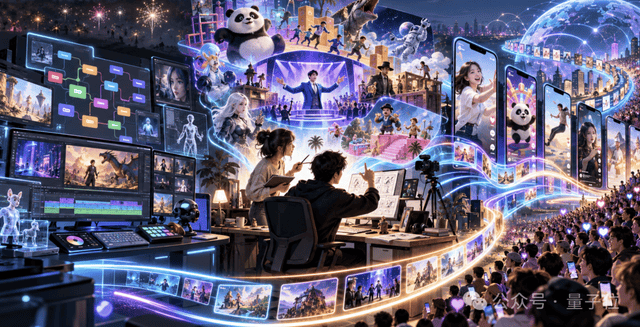
△ AI-generated
The maturity of an emerging content category is not measured by the number of fleeting gimmicks it manufactures, but by whether it can establish a self-sustaining ecosystem where quality creators thrive long-term.
Large-scale productions were once virtually monopolized by top-tier studios. Today, small teams and individuals with compelling storytelling skills have the tools and stage to execute a full closed-loop pipeline—from greenlighting and production to distribution and marketing.
As AI steadily dismantles industrial production barriers, the content industry is returning to its foundational competitive edges: capturing imagination, upholding aesthetic standards, and mastering the craft of storytelling.
Great content is no longer bound by blockbuster “S-tier” budgets or legacy media formats. Within the newly forged narrative spaces of digital generation, the next generation of breakout hits and enduring IPs is already taking root.