
How Third Moment Research runs 10,000 agents for over 36 hours | OpenAI
October 14, 2026
Startups
Using GPT‑6 Astra, GPT‑6.1 Sol, Codex, and Daybreak for cybersecurity, this AI lab builds agents capable of staying focused on tasks for days while continuously self-improving with use.

Company size: Startup
Region: North America
Industry: Technology
Products: API, Codex
- 10,000: Number of concurrently running agents
- 36–48: Duration of a single autonomous research task (hours)
- 97%: Reduction in backtesting time achieved with Codex
- 1 trillion: OpenAI tokens consumed in a single day
Every company has its own unique workflows, tooling, edge cases, and definitions of success. Third Moment Research believes the best agents should master this specialized work and continuously improve the more they are used.
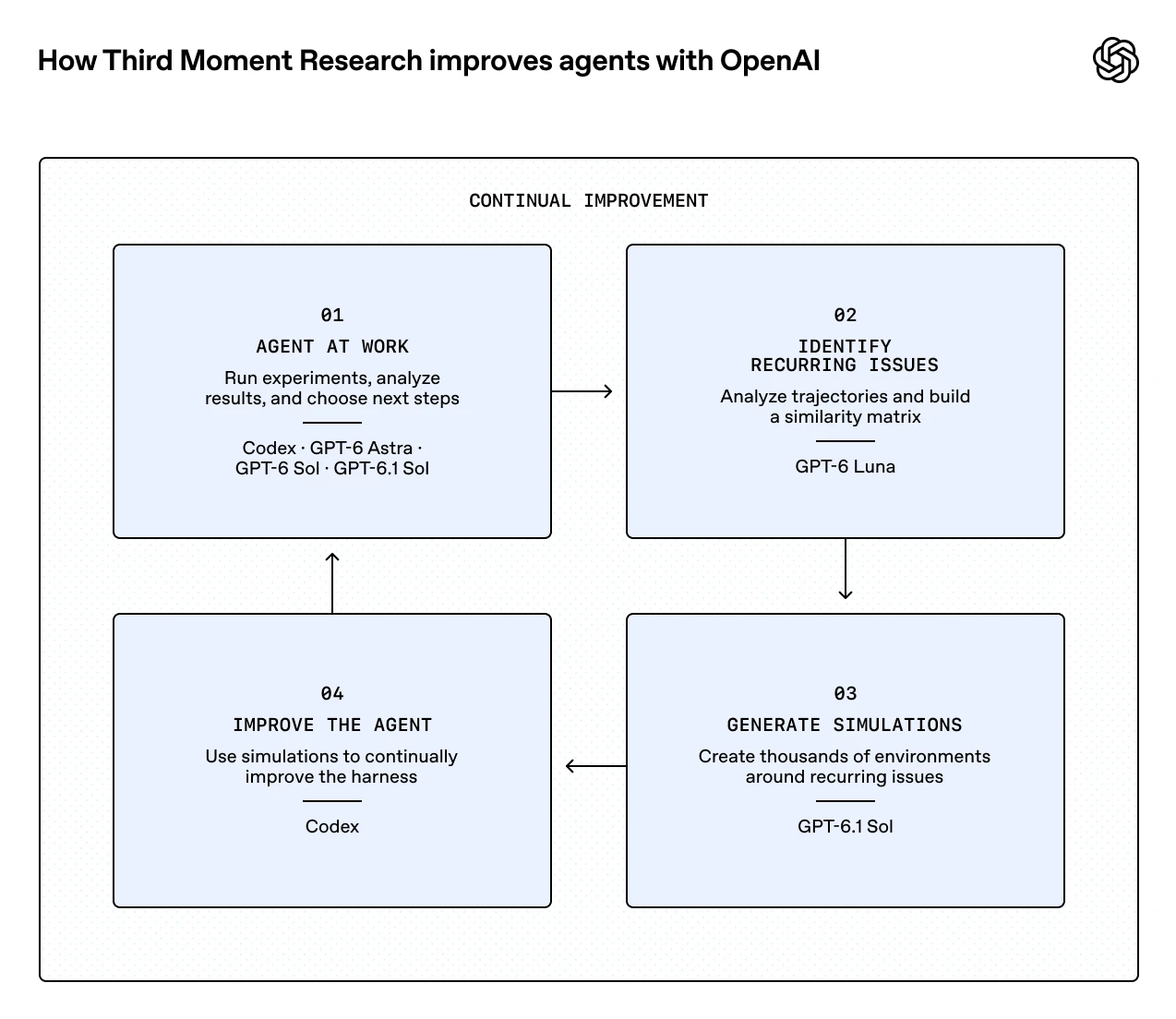
The company is building a self-improving AI system around this concept, leveraging OpenAI’s latest models to understand agent behavior, identify recurring failure modes, and automatically generate thousands of synthetic scenarios targeting those issues. The team uses these scenarios to refine their agents, continually repeating the cycle as new challenges arise.
Codex, GPT‑6 Astra, GPT‑6 Sol, and GPT‑6.1 Sol power the system’s research and compute workloads, enabling Third Moment to run 10,000 agents concurrently on exploratory research tasks lasting 36 to 48 hours. The company also uses Daybreak to stress-test the security of the agents’ environments.
“In a single session, GPT-6.1 Sol can maintain a coherent thread of computational research across days of computation without drifting from its core objective.”
— Adam Khakhar, Co-founder, Third Moment Research
Reducing runtime and token waste with Codex
Given that quantitative finance offers clear metrics for success, Third Moment chose it as one of their early application domains. The field provides a concrete environment to study how agents operate and where they run into bottlenecks. The team uses Codex to identify and resolve issues within the research environment.
In one case, the team paired Codex with GPT‑5.6—the state-of-the-art GPT model at the time—to analyze thousands of recorded simulation trajectories (the agent’s actions and the environment’s responses) alongside timestamps and the codebase.
Codex identified a bottleneck: backtesting trading strategies against a full year of order-level US equity data took hours. While waiting, the agent repeatedly polled to check if the backtest had finished, not only wasting tokens but also cluttering the context window with status checks.
After profiling the backtests and assessing their inputs and usage, Codex identified a caching optimization and a memory-packing technique. It experimented with the solution and deployed the fix to production, cutting backtest runtimes from roughly 3 hours down to about 3 to 5 minutes. This reduced token consumption and context bloat, freeing up more of the agent’s token budget for subsequent experiments.
Keeping agents on task with Codex and GPT‑6
Third Moment equips each agent with the tools, information, and environment required for its specific task. For quantitative research, the team runs the default Codex harness within Docker containers. Agents have access to 1TB of data, documentation, and a research codebase containing feature engineering, GPU-accelerated model training, trading strategies, and simulation modules.
GPT‑6 Astra, GPT‑6 Sol, and GPT‑6.1 Sol supply reasoning capabilities, while the Codex harness provides action tools that allow agents to take steps, formulate plans, set goals, spawn subagents, and compact their context as work progresses.
To prevent agents from terminating prematurely before completing a task, Third Moment treats Codex as a subagent nested inside an outer harness powered by GPT‑6 Sol or GPT‑6.1 Sol. If a task remains incomplete, the outer harness inspects the trajectory and determines whether to retry, abort, or escalate to human review.
“The Codex harness is remarkably general and can be applied across many different domains.”
— Adam Khakhar, Co-founder, Third Moment Research
Within this research environment, agents work to optimize baseline trading systems developed by Third Moment engineers. They test trading strategies against historical data, evaluate whether an improvement is statistically meaningful or merely random noise, and leverage the outcome of each run to decide the direction of the next experiment. According to Adam, their work has already boosted the performance of the baseline trading system.
Sustaining long-horizon research with greater token efficiency
Adam noted that prior to GPT‑5.5, models could only execute user-specified experiments. With GPT‑5.5 and GPT‑5.6, models running in the Codex harness could design follow-up experiments based on prior outcomes. Now, with GPT‑6 Astra, GPT‑6 Sol, and GPT‑6.1 Sol, agents can drill down to root causes through hundreds of experiments run in parallel with subagents.
This breakthrough has helped agents explore research avenues the team hadn’t previously anticipated. In one session, GPT‑6.1 Sol uncovered the impact of non-displayed trades on an exchange, which accounted for an unexpectedly large share of its total volume. “That was a non-obvious finding our research team hadn’t initially considered,” says Adam.
Third Moment evaluates models across dimensions such as optimization, machine learning systems, and quantitative research. It tests frontier model checkpoints at the highest reasoning settings, evaluating their