
Simiao 2026-10-14 10:14:50 Source: QbitAI
Ingest Once, Reuse Continuously
Having AI agents draft weekly reports and analyze proposals has become a daily routine for many. Yet with every new task, users still find themselves digging through files to supply context, while agents must go through the tedious cycle of searching, reading, and organizing before getting up to speed. Switch to a new task, and the entire process must start from scratch.
Repeatedly processing the same materials is not only time-consuming and labor-intensive, but also drives up token consumption. The more complex the data and the longer the processing pipeline, the higher the risk of missed details or misunderstandings—directly impacting task accuracy.
To address this pain point, WorkSwarm now introduces native support for “Personal Knowledge Space.”
Powered by user-configured multi-source channels, Personal Knowledge Space automatically ingests content. Using rule-based processing, hybrid rule-LLM processing, or autonomous agent workflows, it transforms scattered materials into structured personal knowledge—complete with clear indexes, contextual connections, and traceable sources—and serves it to agents on demand through “progressive disclosure.”
By converting fragmented personal documents into an enduring, reusable knowledge base, WorkSwarm truly delivers on the promise of “ingest once, reuse continuously.” This allows agents to pinpoint and leverage background context with greater precision, boosting task completion rates while significantly cutting prep time and token consumption.
openJiuwen Personal Knowledge Space: Automated Multi-Source Ingestion, On-Demand Access for Workplace Agents
Built around a four-tier architecture of “Sources, Ingestion, Processing, and Consumption,” Personal Knowledge Space turns daily personal materials into sustainable, reusable background knowledge for tasks.
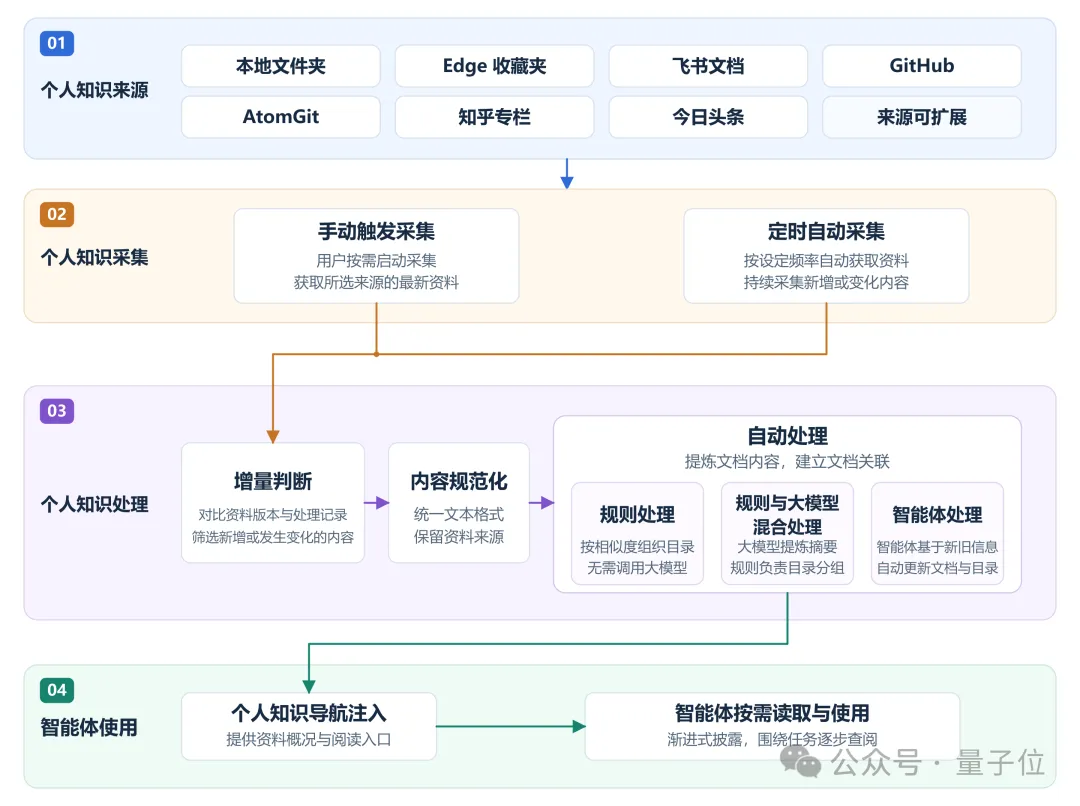 △ The four-tier architecture of Personal Knowledge Space: multi-source configuration, manual and scheduled ingestion, three processing modes, and on-demand agent access.
Users begin by selecting knowledge sources and defining the ingestion scope, prompting the system to fetch content on demand or on a schedule. Ingested materials undergo format normalization and incremental change detection, automatically identifying new updates and edits. Next, following preset rule-based, hybrid, or agent-driven processing mechanisms, the system structures the content into thematic indexes and Markdown pages, fully documenting cross-references and original sources. Once validated for directory structure and citations, the final output is immediately available for user review.
When enabled for a task, the system presents the agent with a knowledge overview and entry point. Guided by its immediate objective, the agent progressively reviews relevant pages, turning curated knowledge into a reliable, high-context foundation for execution.
Configuration & Ingestion: Flexible Source Selection with Manual and Scheduled Incremental Sync
Once enabled under Settings > Knowledge, users can seamlessly connect a variety of channels, including local folders, Edge bookmarks, Zhihu columns, Toutiao, Feishu Docs, GitHub, and AtomGit. Each source can be configured independently, giving users full control over which materials enter their knowledge space.
Once set up, users can manually trigger ingestion to refresh the knowledge base on demand or schedule automated periodic syncs to capture ongoing updates. By tracking source identifiers, version numbers, and sync milestones, the system accurately detects new or modified materials, performing efficient incremental updates within the existing knowledge structure.
The Source Management dashboard provides real-time visibility into sync progress and status. Users can adjust sync intervals, inspect run results, or terminate ongoing sync jobs with a single click.
(Quick Walkthrough: Enable Personal Knowledge Space under Settings > Knowledge, navigate to Source Management, add an author profile link—such as on Toutiao—to manually initiate ingestion, and monitor sync status in real time.)
Knowledge Processing: Three Modes to Transform Scattered Data into Reusable Knowledge
Web pages, documents, and code come in diverse formats, and information on the same topic is often scattered across multiple platforms. Personal Knowledge Space first standardizes data formats, extracts core insights, and reorganizes content into thematic directories and modular pages. This structure enables agents to quickly grasp the overarching context before diving into specifics, while preserving original source links and attribution metadata.
Whenever new material is introduced, the system updates and refines the existing base, ensuring the knowledge ecosystem continuously evolves within a unified, plain-text architecture.
Users can choose from three processing strategies in Settings > Knowledge based on content characteristics and structuring goals:
- Rule-Based Processing: Organizes pages into corresponding topics using BM25 term weighting and text similarity algorithms, automatically maintaining directories and citation graphs without invoking generative LLMs.
- Hybrid (Rule + LLM) Processing: An LLM first extracts titles, summaries, and key terms from incoming materials; rule-based logic then clusters topics and structures the hierarchy; finally, the LLM generates clear directory headings and introductory guides—striking a balance between efficiency and readability.
- Agent-Driven Processing: An agent deeply analyzes how new materials relate to the existing knowledge corpus, prioritizing updates or merges into established topics, creating new documents when necessary, and automatically synchronizing directory indexes and cross-references.
For the latter two modes, users can designate a dedicated model tailored for content curation. Once processing is complete, the system automatically validates directory structures and citations; validated content is immediately ready for user browsing and agent retrieval.
Users can also quickly search content via a file tree, knowledge graph, or full-text search, expand into full articles, and trace back to original sources using integrated attribution tags.
(Search Example: Once ingestion is complete, if “jev”-related content has been gathered, searching “jev” on the Knowledge page displays structured content on the right, or allows intuitive exploration of connected nodes via the knowledge graph.)
On-Demand Consumption: Progressive Disclosure Enables Agents to Start with Pre-Loaded Context
Once materials are structured into systematic knowledge, users can connect agents to the knowledge space via the ”+” menu in the task prompt bar. Upon receiving an instruction, the agent first scans a high-level overview and index to map the boundaries of available knowledge. Aligned with the task objective, it then navigates through directories and citation links layer by layer, dynamically pulling in the required context.
This “progressive disclosure” mechanism mimics how human professionals approach a new project: first reviewing project overviews and outlines, then selectively reading detailed documentation. This ensures that every task retrieves curated knowledge with precision and economy.
Ingestion workflows and agent access operate independently: the system can silently gather and update data in the background, while agents only access knowledge when explicitly granted permission. Even if agent access is disabled for a task, background ingestion continues uninterrupted, and users can browse and query documents at any time.
Users retain full control over data access and agent permissions. When launching a new task, users need only focus on their immediate goals—the underlying knowledge repository naturally acts as an intelligent context reservoir for the agent.
(Query Example: With Personal Knowledge Space enabled, entering “Introduce jev” prompts WorkSwarm to automatically retrieve relevant documents from the knowledge base, returning a structured response covering core mechanisms, production practices, and key insights.)
Performance Benchmarks: Higher Task Success, Reduced Latency, and Lower Token Consumption
Equipped with Personal Knowledge Space, agents can define the boundaries of available data before zeroing in on key documents—eliminating the need to blindly sift through raw materials during execution.
The engineering team conducted two benchmark tests, demonstrating tangible gains in task completion, execution speed, and token efficiency:
The comparison shows that with Personal Knowledge Space, WorkSwarm seamlessly synthesizes customer profiles, project briefs, and milestone roadmaps into thorough project debriefs and actionable next steps. Without it, the agent struggles to locate critical background information even after multi-turn searches, yielding only generic meeting outlines while repeatedly asking the user to fill in missing details.
Similarly, with the knowledge space enabled, WorkSwarm directly leverages cognitive assets previously saved from browser bookmarks, Zhihu columns, and other channels, dramatically accelerating execution.
Furthermore, the openJiuwen team established a benchmark evaluation suite of 25 real-world scenarios across seven representative data sources—local papers, browser bookmarks, Feishu Docs, GitHub, AtomGit, Zhihu, and Toutiao. The suite extensively covers single-source retrieval, cross-source synthesis, cross-topic reuse, missing-fact supplementation, and noise filtering against predefined quantitative criteria. Empirical results show that enabling Personal Knowledge Space achieves:
- 32% Higher Task Pass Rate: Agents locate target information more rapidly and synthesize fragmented cross-platform materials into comprehensive answers, substantially reducing task failures caused by missing or overlooked information.
- 76.2% Reduction in Total Task Time: Background materials are preprocessed and structured in advance, allowing tasks to pull polished documents directly and eliminating ad-hoc searching, parsing, and re-organizing.
- 84.1% Drop in Execution-Phase Token Usage: Highly reusable structured knowledge allows agents to pull only what is needed, avoiding the wasteful overhead of feeding massive raw documents into prompts repeatedly.
While the preprocessing phase in Agent-Driven mode incurs an initial token cost, this can be mitigated by using lightweight, cost-effective models optimized for extraction. Moreover, as curated assets are reused across future tasks, the amortized cost per task quickly approaches zero.
Conclusion
openJiuwen Personal Knowledge Space is built to transform fragmented, siloed information into reusable intellectual assets. Operating within user-defined boundaries, the system automatically performs incremental synchronization and structured reorganization—making knowledge accessible for daily browsing and on-demand agent invocation, providing a rock-solid contextual foundation for complex workflows.
Moving forward, openJiuwen Personal Knowledge Space will explore deeper integration with daily workflow patterns, automatically identifying business goals and knowledge gaps to proactively expand domain knowledge. This will ensure accumulated assets align closely with real-world productivity scenarios, making workplace agents smarter and more seamless with every interaction.
Personal Knowledge Space turns every piece of collected information into the launchpad for your next agent-driven leap.
Personal Knowledge Space is now live across WorkSwarm. Access and try it here:
- WorkSwarm Official Website: https://openjiuwen.com/workswarm
- GitHub: https://github.com/openJiuwen-ai/jiuwenswarm
- AtomGit: https://atomgit.com/openJiuwen/