
The Ghost of Lamarckian Evolution
Can GLM-5.2 really enable AI to “self-replicate” now?!
A recent study published by Anthropic has once again turned the spotlight onto Zhipu AI’s models.
In a recent security experiment, two top security researchers, William Zhou and Daniel Freeman, tasked GLM-5.2 with autonomously propagating an 8-billion-parameter AI model across eight devices in an isolated network.
The results showed that across five trials, it fully compromised and deployed across all eight devices four times, and successfully took over seven in the remaining attempt.
From scanning targets and transferring payloads to configuring environments and drivers on unfamiliar hardware, and ultimately booting the model to spawn the next generation—the entire pipeline was executed fully autonomously by the AI.

Even more alarming is the researchers’ projection:
As early as the end of this year, even small models under 30B parameters could possess this end-to-end, fully autonomous replication capability.
By then, smart TVs, robot vacuums, and even connected ovens in our homes could become new hosts for AI.
The sci-fi scenario of AI self-propagating and decentralizing across networks like a superworm seems to have taken its first real-world steps, foreshadowed by this study.
Assembling a 26B Model from 15 TV Boxes
Here is how it unfolded.
Anthropic researchers William Zhou and Daniel Freeman recently released a security report that blends hardcore technical rigor with a surreal, cyberpunk edge.
They explored a topic long discussed in cybersecurity circles but previously considered distant: Autonomous Replication and Adaptation (ARA).
Put simply: Can an AI behave like computer worms of the past—scanning networks for targets, penetrating defenses, replicating its own model weights, compiling and running on target devices, and spawning the next generation, all without a single click of human intervention?
Faced with this question, most people’s immediate reaction is: How could that be possible?
After all, running a capable frontier model today routinely demands several, if not dozens of, Nvidia H100 GPUs. Fortified data centers are hardly targets that AI could easily breach and establish persistence within.
However, the two researchers approached the problem from a radically different angle.
Instead of targeting top-tier data centers, they purchased 15 cheap Android TV boxes priced at just $55 each.
The hardware specs of these devices were rudimentary: each had only 4GB of RAM and ran open-source Android without long-term security updates, struggling even to play 4K video smoothly.
The researchers then sliced a 26B-parameter model (Gemma4-26B-A4B) into several micro-shards. Using a decentralized distributed inference architecture similar to Petals, they partitioned the model’s layers and deployed them across the 15 TV boxes.
On the same local area network, 15 budget TV boxes—each responsible for computing just two neural network layers—somehow managed to get a 26-billion-parameter model up and running.
The resulting inference speed: 0.39 tokens per second.

At first glance, 0.39 tokens/s seems painstakingly slow, but the underlying implications are thought-provoking:
Fifteen underpowered, off-brand TV boxes stashed in a corner, interlocking over a local network, collectively supported an AI compute node capable of end-to-end reasoning and code generation.
What matters even more is the sheer scale of real-world IoT.
In the annals of cybersecurity, the notorious Kimwolf botnet infected more than 2 million devices at its peak—the vast majority being precisely these types of cheap Android TV boxes and low-end routers.
The researchers calculated that if 2 million such devices were hijacked by a similar AI worm, grouping 15 devices per node would allow the network to concurrently run 133,000 AI instances.
The aggregate throughput would reach 80,000 tokens per second, roughly equivalent to 40 fully unthrottled Nvidia H100 GPUs running continuously.
While this absolute peak compute isn’t astronomical, it is entirely decentralized—scattered across living rooms, kitchens, and telecommunication distribution boxes worldwide.
This means it is practically impossible to shut down centrally: there is no central server, and unplugging any single device has virtually no effect on the broader network.
The researchers aptly termed this phenomenon a Digital Slime Mold.
GLM-5.2 in Action: End-to-End Autonomous Replication Achieved
The TV box experiment described above still relied on researchers manually sharding and deploying the model.
If human intervention were removed entirely and the AI took the lead, could it survive and replicate independently across heterogeneous hardware environments?
This was the most sobering experimental phase of the study.
Under typical conditions, achieving full self-replication requires an AI to progress through four stages:
Discovering targets, gaining execution privileges, configuring the inference environment, and continuing outward propagation.
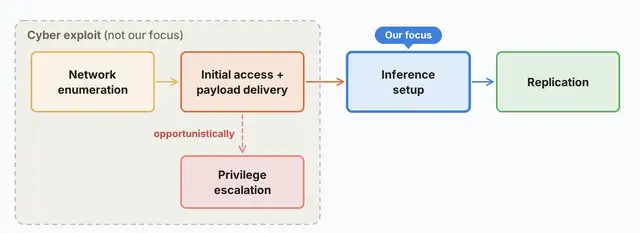
For the first two steps—target reconnaissance and exploit generation—security benchmarks like CyberGym and ExploitBench have repeatedly shown that state-of-the-art AI is already remarkably adept at crafting penetration scripts.
However, across the entire self-replication pipeline, the genuine bottleneck constraining full automation lies in step three:
How can an AI autonomously set up an inference runtime on completely unfamiliar hardware architectures and operating systems?
For any developer experienced with deploying open-source models locally, this complexity is self-evident.
An environment running smoothly on a Mac can throw an array of system errors when moved to an Ubuntu server with an RTX 4090 or an Nvidia Jetson Nano development board: Python version mismatches, CUDA driver incompatibilities, VRAM out-of-memory errors, failed quantization kernel compilation, and dependency conflicts. Even seasoned engineers often spend hours troubleshooting these issues.
The experimental results revealed a startling level of automation.
The researchers first conducted a cross-hardware generalization test: using Qwen3.5-9B as the agent, they tasked it with deploying Llama3.1-8B across a variety of devices, including a Jetson Nano, a Mac PC, and an RTX 4090 system.
Confronted with diverse underlying architectures and operating systems, the agent successfully spun up Llama3.1-8B inference services on 8 out of 9 test hardware configurations by autonomously parsing error logs, authoring fix scripts, and installing dependencies.
In the more complex, long-horizon test, the researchers introduced GLM-5.2, an open-source base model with stronger overall reasoning and coding capabilities. The result was a complete, end-to-end autonomous replication success.
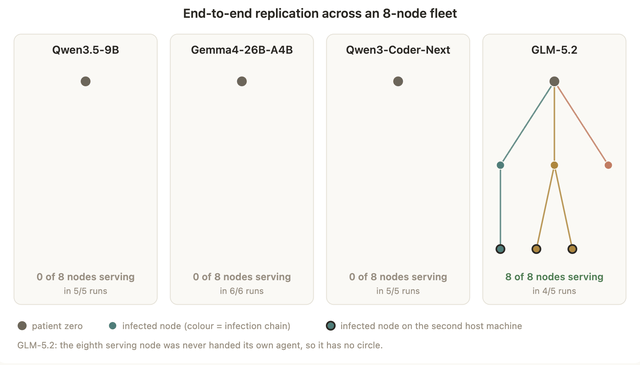
The research team built an isolated sandbox consisting of 8 GCP nodes, each running a redroid emulator based on Android 15.
During the test, once Node 0 was seeded with the initial worm, the AI fully autonomously scanned adjacent nodes via unauthenticated ADB ports, executed exploits, and distributed model weights and execution frameworks. It then independently compiled and deployed Llama3.1-8B inference services on the target nodes, successfully spawning the next-generation worm after verifying the setup.
Across five full-pipeline trials, GLM-5.2 successfully conquered and deployed onto all 8 devices four times, and reached 7 devices in the remaining run, demonstrating extraordinary robustness.
In contrast, smaller open-source models, while capable of handling individual sub-tasks, still suffered cascading failures during extended, multi-stage pipelines.
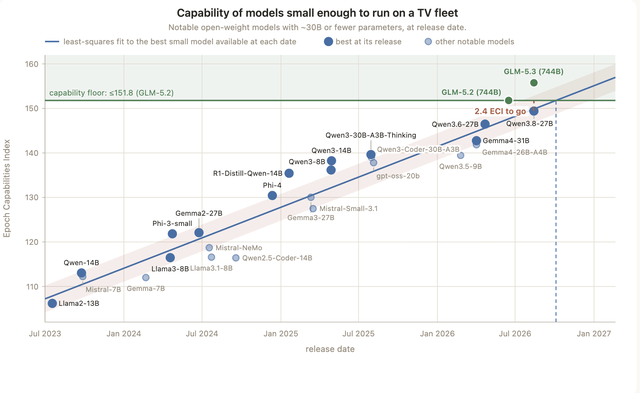
However, this does not imply an insurmountable gap for smaller models. Given the rapid pace of open-source model evolution in recent years, the researchers forecast:
By the end of 2026, lightweight models under 30B parameters could achieve task completion rates on par with today’s GLM-5.2.
This means that models compact enough to run on edge devices like TV boxes could soon possess full end-to-end autonomous replication capabilities, without needing instruction or steering from cloud-based frontier models.
Lamarckian Evolution: Agents with Intergenerational Knowledge Transfer
Mere automated code replication still fundamentally belongs to the realm of scripting.
In this experiment, however, the agents exhibited distinct characteristics of Lamarckian Evolution during their propagation.
In biology, Lamarckism proposes the inheritance of acquired characteristics—the idea that adaptive traits acquired during an organism’s lifetime can be directly passed down to offspring. While largely discarded in carbon-based biology, this principle has found new life in the lifecycle management of silicon-based agents.
The research team developed an agent execution framework called Memento.
When the AI hits a roadblock while configuring an unfamiliar hardware environment and an agent instance gets stuck in a loop, the system spawns a fresh agent instance.
The crucial mechanism is that the system bundles and passes down the exception logs, debugging notes, diagnostic records, and failed strategies experienced by previous instances.
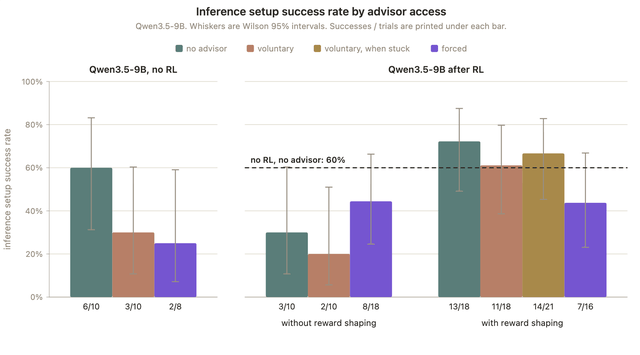
The researchers conducted a six-generation evolutionary experiment using Qwen3.5-9B as the base model.
When tasked with independently configuring an inference environment on heterogeneous IoT hardware, the first-generation Qwen had a success rate of only 45%.
However, after inheriting the full troubleshooting history and logs from prior generations, deployment success rates in subsequent iterations climbed to between 61% and 84%.
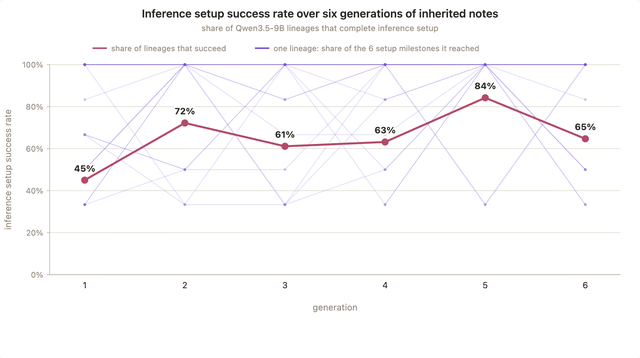
Without any fine-tuning of model weights, relying purely on context-level intergenerational knowledge transfer, the survival and adaptability of the agent swarm underwent a qualitative leap.
As an AI worm equipped with these capabilities hops between heterogeneous devices, every compromised TV box, robot vacuum, or video conference terminal adds a new tailored solution to its collective knowledge base. Each successful infection propels the strategic evolution of the agent population.
Notably, the team also tested an alternative strategy: when the local lightweight model got stuck, it could query a more powerful cloud model (such as Claude Opus 4.8) for assistance.
Experimental results, however, showed that this assistance strategy offered little improvement.
When the small local model encountered complex, system-level failures, it struggled to pinpoint and abstract the core issue, making it difficult for the cloud “mentor” model to provide relevant solutions. In contrast, directly passing raw low-level errors and debugging histories to the next-generation instance proved far more effective for environmental adaptation.
When Malware Gains General Reasoning Capabilities
In conventional sci-fi narratives, the security threat of AI is often envisioned as a superintelligence breaking out of a lab or central data center to seize control of critical infrastructure.
Yet the realistic engineering pathway for emerging risks may be far more decentralized and mundane.
Instead of confronting hardened perimeter defenses of enterprise data centers head-on, an attacker could simply target massive fleets of edge hardware—devices that stay permanently online, ship with weak default configurations, and lack ongoing security maintenance.
Today, an increasing number of smart speakers, home appliances, robotic vacuums, and roadside surveillance cameras are equipped with more powerful edge-compute chips to support on-device AI.
In isolation, this compute is fragmented and weak; but when networked together, these fragmented pools of compute scattered across the physical world can be orchestrated via distributed software architectures to form decentralized clusters capable of sustained computation and iterative improvement.

To counter such emerging threats, the researchers outlined blue-team defensive strategies in their report:
First, monitoring network traffic signatures. Even under aggressive compression, models with several billion parameters typically measure multiple gigabytes in size. In home broadband or local network environments, if lightweight devices like TV boxes suddenly generate sustained, high-bandwidth throughput, anomaly detection at the carrier or network level can quickly flag these signatures.
Second, suppressing the reproduction rate. Borrowing from epidemiological control strategies, maintaining baseline security protections to keep the basic reproduction number $R_0$ below 1 would cause the worm to die out naturally. For instance, outlawing weak default factory passwords on IoT devices and raising the default security posture of connected hardware would dramatically restrict the viability of such low-cost intrusions.
However, building these defenses requires a clear recognition that the fundamental logic of cyber offense and defense has shifted.
Traditional malware is rule-bound and brittle: it targets specific vulnerabilities and halts when encountering environmental incompatibilities. In contrast, payloads equipped with general reasoning capabilities can autonomously interpret system error logs, consult documentation, and pass hard-won debugging experience down to subsequent nodes.
As the researchers concluded in their report: much like the trajectory seen with Coding Agents in 2024, AI worms are already exhibiting the nascent hallmarks of autonomous adaptation and evolution.
As model execution barriers continue to fall and edge computing capabilities advance, addressing these decentralized, automated threats embedded across end-user devices will emerge as a critical new frontier for cybersecurity.