
Wang’s Conjecture Just Extended to Four Dimensions
This July, Hong Wang and Yu Deng were awarded the Fields Medal at the International Congress of Mathematicians (ICM).
As the news made rounds online, Anthropic employee Alek Dimitriev remarked on X:
“This will be the last Fields Medal ever awarded to humans.”

Former Fields medalist Timothy Gowers chimed in shortly after, sharing a similar sentiment:
“There’s a lag time in the process, though, so I suspect they can hold on until maybe 2030.”

Who could have guessed that Gowers might still have been overly optimistic?
On October 7, OpenAI released 722 mathematical manuscripts in one fell swoop, uploading the papers and a portion of their Lean formalizations to GitHub.
Among them, group 074 contained just two papers, directly targeting the very research area for which Hong Wang was awarded the Fields Medal: the Kakeya conjecture.

One claims to prove the three-dimensional Kakeya maximal function conjecture, presenting a strictly stronger version than the result by Wang and Zahl;
The other claims to prove the four-dimensional Kakeya conjecture.
Together, the two manuscripts span 272 pages, with the author field displaying just a single word: OpenAI.
Just as Hong Wang and Joshua Zahl resolved the dimension conjecture for 3D Kakeya sets, AI has swiftly pushed the frontier into four dimensions.
Could this year’s Fields Medal truly be the swan song for human mathematicians?
What Exactly Did OpenAI’s Two Kakeya Papers Achieve?
In 1917, Japanese mathematician Soichi Kakeya posed a classic problem: What is the minimum area swept out by a unit-length needle turning 360 degrees in the plane?
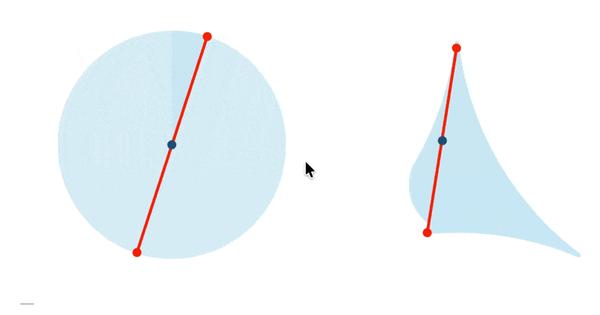
△ Illustration of the Kakeya problem
Abram Besicovitch later provided a counterintuitive answer: the area can be arbitrarily small. Even more startlingly, a set can contain a unit line segment in every direction while possessing a measure (area) of zero.
Since area ceased to serve as a meaningful metric, mathematicians turned to a finer yardstick: “dimension.”
Here, “dimension” transcends the everyday intuition of length, width, and height. To measure sets with exceptionally irregular geometries, mathematicians introduced modern analytical tools such as the Hausdorff dimension and Minkowski dimension to quantify a set’s complexity across varying scales.
A set’s measure (volume) can be 0, yet it can still possess full spatial dimension.
The heart of the Kakeya conjecture posits that in $n$-dimensional space, any set containing a unit segment in every direction must have full dimension $n$.
The crux of the problem lies in characterizing how these infinitely thin line segments intricately intersect and overlap, and whether such overlap could compress the set’s dimension into something strictly smaller.
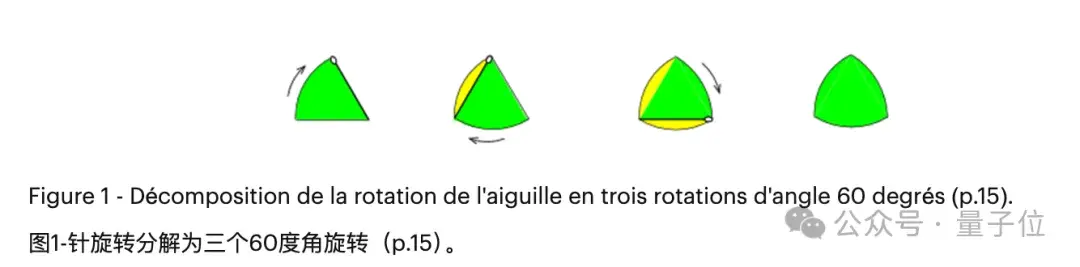
△ Illustration of the Kakeya problem
The two-dimensional planar case was settled by Roy Davies back in 1971; however, the three-dimensional case eluded mathematicians for over half a century until Hong Wang and Joshua Zahl conquered it in February 2025.
As for four and higher dimensions, no proof had ever been produced.
OpenAI’s two newly released manuscripts tackle two central variants of the Kakeya problem.
Paper 1: The 3D Kakeya Maximal Function Conjecture
This paper remains focused on three dimensions, but targets a substantially higher bar of difficulty.
It can be framed as a problem of “controlling tubular overlap”: placing numerous slender tubes in 3D space, each representing one orientation of a needle.
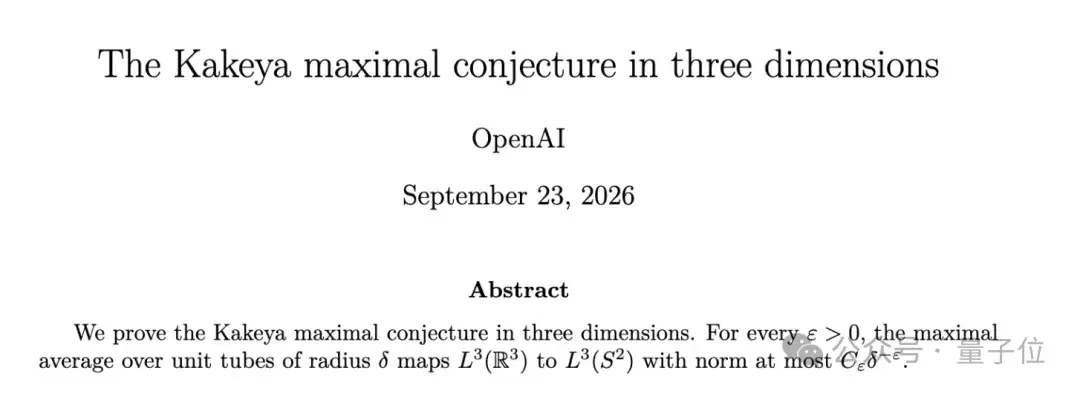
△ Title page of OpenAI’s paper on the 3D Kakeya maximal function conjecture
Mathematicians must analyze how heavily these tubes overlap when pointing in different directions, and whether a uniform analytical estimate can be established to bound that overlap.
Wang and Zahl resolved the “set-theoretic version,” which establishes a lower bound on the spatial footprint occupied by the union of needles;
The “maximal function version” proved by OpenAI operates at a far more demanding analytical granularity:
Thicken each needle into a thin tube. If only a fraction $\lambda$ of each tube is “solid,” does the union of all solid parts guarantee a total volume at least on the order of $\lambda^3$?
As $\lambda$ shrinks and the tubes become sparser, the analytical control becomes exponentially harder. The set-theoretic version requires only a relatively loose power bound on $\lambda$, whereas the maximal function version strictly requires this exponent to match 3.
OpenAI explicitly notes in its introduction that Wang and Zahl’s theorem yields a bound of $\lambda^{K(\varepsilon)}$, and “pushing this to $\lambda^3$” was precisely the natural next hurdle to clear following their result.
This was the central open question left behind by Wang and Zahl—and OpenAI’s 97-page paper claims to have resolved it entirely.
The profound significance of this breakthrough lies in how the Kakeya maximal function translates the “squeezing geometry of anisotropic tubes” into a precisely computable problem in analysis.
It is intimately linked to foundational conjectures in Fourier analysis, long recognized as a crucial mathematical instrument for analyzing waves, frequencies, and spatial concentration phenomena.
As early as 1971, Charles Fefferman constructed a Kakeya set counterexample to prove that the ball multiplier operator in higher dimensions is unbounded on all $L^p$ spaces except $L^2$. Since then, the Kakeya problem has been deeply intertwined with the Fourier restriction conjecture and the Bochner-Riesz conjecture.
Paper 2: The Hausdorff Dimension of 4D Kakeya Sets
In four dimensions, human progress had previously crawled at a snail’s pace:
- In 1995, Wolff used the “hairbrush” technique to prove the dimension is at least 3;
- Guth and Zahl later introduced the polynomial method, pushing the bound to $3 + 1/40$ (roughly 3.025);
- In 2019, Katz and Zahl advanced it to 3.059 using a “planar brush” approach;
- All subsequent gains moved forward by mere hundredths or thousandths past the decimal point.
OpenAI’s 175-page manuscript, however, claims to lock the dimensional lower bound straight at 4.
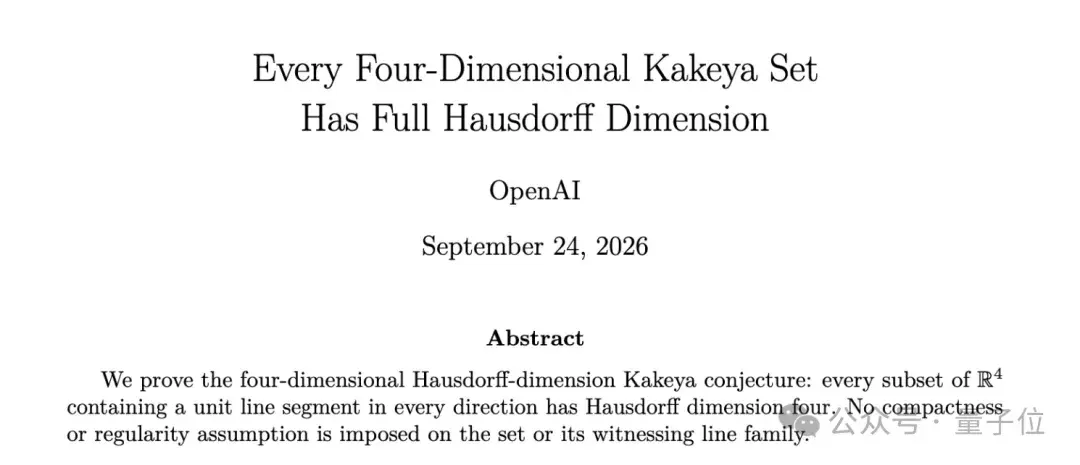
△ Title page of OpenAI’s paper on the Hausdorff dimension of 4D Kakeya sets
Where did the fundamental difficulty lie in four dimensions? Guth previously pointed out in an article that key theorems Wang and Zahl used in their 3D proof no longer hold when extended to 4D.
In higher dimensions, tubes can cluster densely around low-degree algebraic varieties, giving rise to counterexample structures that simply cannot occur in 3D.
The core technique in OpenAI’s 4D paper directly targets this bottleneck: using quadratic polynomials for local fitting across multiple scales to precisely track families of lines that persist in clustering across scales.
Across the entire manuscript, the word “polynomial” appears 213 times.
A notable technical detail is that one of the critical prerequisites for the 4D proof directly invokes a central lemma from OpenAI’s 3D paper. The two papers form an interlocking technical pipeline: the stronger 3D result directly paves the way for the 4D proof.
In a sense, it elevates Wang’s research to an entirely new level: raising the 3D result to the maximal function standard, and breaking through the long-stagnant 3-point-something barrier in 4D to conquer 4 in one go.
Still, the scope of this achievement has boundaries: the 4D paper only proves the Hausdorff dimension version, leaving the 4D maximal function conjecture open; for five and higher dimensions, it offers only an initial lower bound via projection techniques.
More critically, neither of the two core manuscripts in group 074 has been formally verified in Lean, nor have they undergone academic peer review.
OpenAI candidly admits in the repository’s README that some unformalized claims “may contain errors.”
What Foundation Did Hong Wang Lay?
Some have speculated that Hong Wang was merely “fortunate” to secure the Fields Medal just before AI achieved this breakthrough.
Is that really true?
A thorough reading of both OpenAI manuscripts reveals that one of the most frequently cited names is Hong Wang herself.
In the 3D manuscript alone, the name “Wang” appears 23 times.
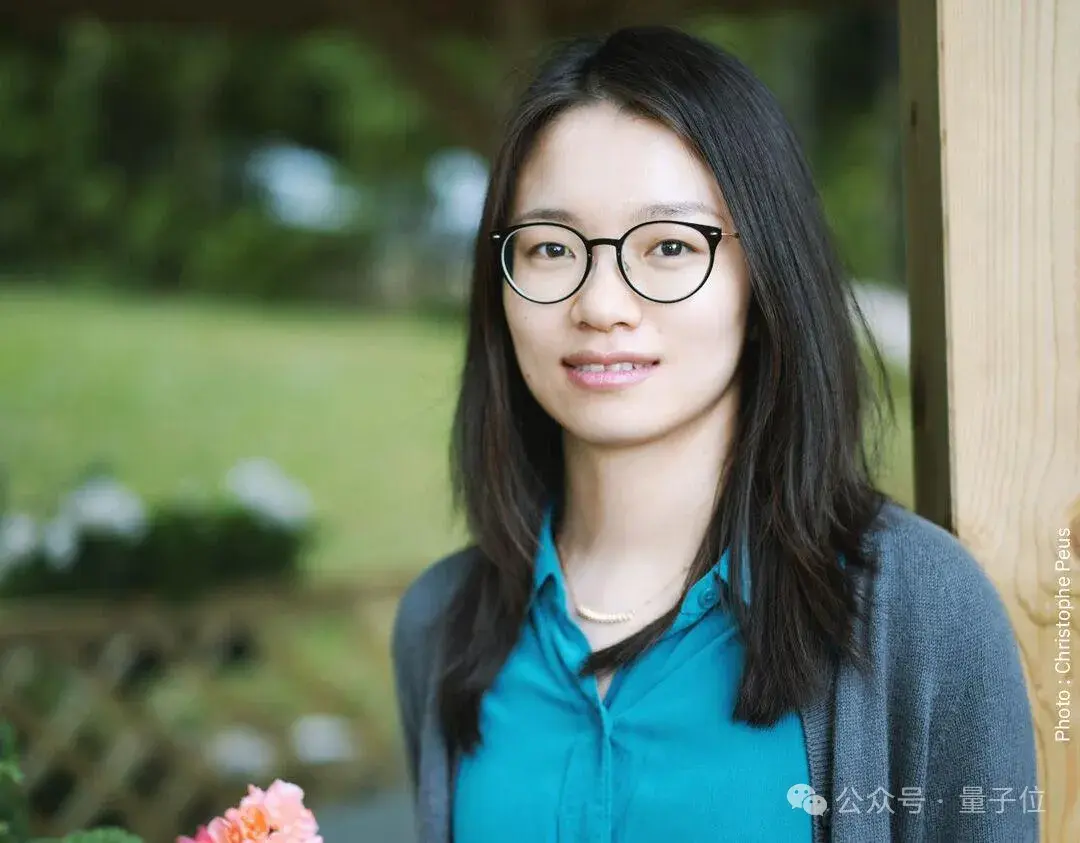
Human mathematicians spent decades scaling the summit of the 3D Kakeya conjecture.
Nets Katz, Izabella Łaba, and Terence Tao had established early on that extreme tube configurations display three fundamental geometric structures: stickiness, planarity, and graininess.
Yet for decades, no one managed to synthesize these structures into a rigorous, complete proof.
Wang and Zahl executed a clear three-step roadmap:
- In 2022, they first resolved the “sticky” Kakeya set case, published in the prestigious Journal of the American Mathematical Society (JAMS);
- In 2024, they proved the Assouad dimension version;
- In February 2025, they published a comprehensive 127-page proof, resolving both the Hausdorff and Minkowski dimension versions of the 3D Kakeya set conjecture.
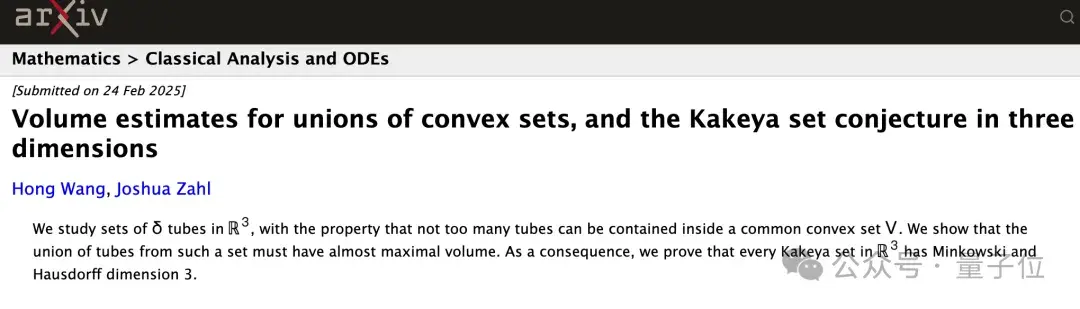
△ Hong Wang and Joshua Zahl’s paper on the 3D Kakeya set conjecture
Nets Katz described it as a “once-in-a-century breakthrough.”
During this time, Wang also joined forces with Kevin Ren to resolve the planar Furstenberg set conjecture, conquering another longstanding open problem in harmonic analysis.
These sturdy foundations constitute the very technical bedrock of OpenAI’s papers.
The 3D paper directly incorporates the simplified proof provided by Guth, Wang, and Zahl (Guth was Wang’s PhD advisor at MIT), while also building upon critical estimates by Ren and Wang regarding planar Furstenberg sets.
The 4D paper, meanwhile, relies heavily on Wang and Zahl’s dot product theorem.
Even if both papers are ultimately verified as sound, they represent extensions and deepening built squarely atop the theoretical scaffolding Wang erected.
More importantly, Wang has consistently maintained a measured, open attitude toward AI’s role in research.
In an interview following the award, she described AI as a “proactive catalyst” for mathematical research, emphasizing that posing questions, abstracting concepts, and framing theoretical structures remain the irreplaceable core mission of human mathematicians.
Shockwaves and Reckoning in the Mathematical Community
The mathematical community is now facing an unprecedented paradigm shock.
Under the traditional academic paradigm, a major mathematical breakthrough follows a lengthy cycle: individuals or teams spend years working through derivations, post preprints to arXiv, peers spend one to two years scrutinizing and verifying, and the community gradually digests the result.
Only after findings are proven bulletproof and withstand years of scrutiny are international accolades finally awarded.
Wang and Zahl walked this rigorous path, pouring four full years of effort from cracking the sticky case in 2022 to receiving the Fields Medal in 2026.
OpenAI, however, dumped 722 manuscripts virtually overnight. Each proposition consumed an average of only around three hours of ChatGPT Pro reasoning compute, with only about 42% of the results formally verified in Lean.
This industrialized, wholesale output has sparked fierce pushback across academia.
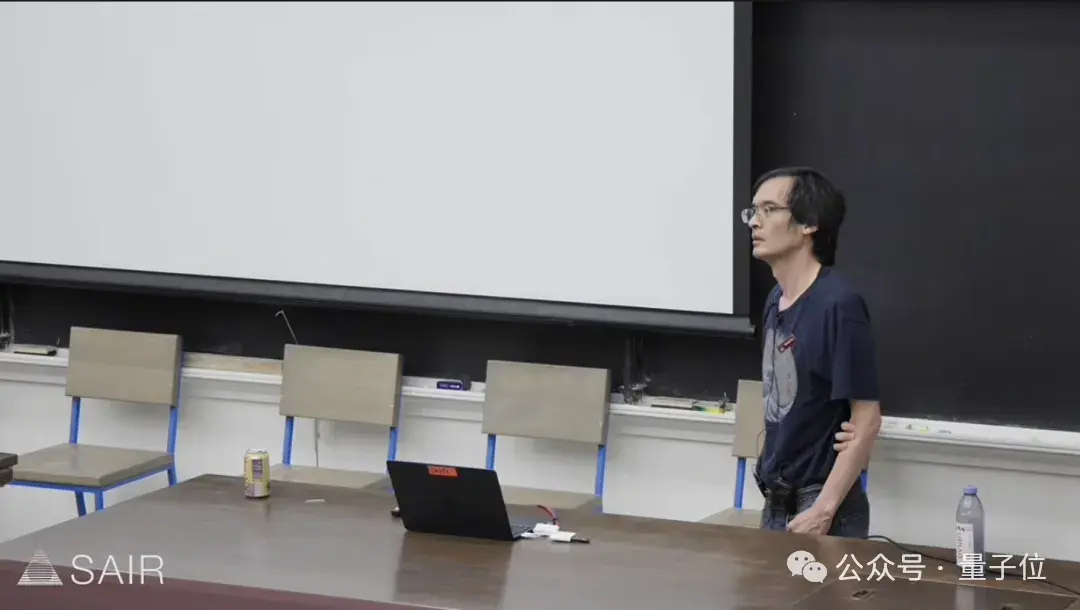
Terence Tao spearheaded a stern joint statement issued by the Association of Human Mathematicians (AHM), calling for a comprehensive review of and boycott against such practices by OpenAI.
The statement pulled no punches:
“The mathematical community never requested this kind of research output. Dumping over 700 manuscripts at once is not a genuine academic contribution; it is an exhibition of technological power.”
The statement concluded by strongly urging all mathematicians to exercise extreme caution regarding—or cease entirely—collaborations with OpenAI, returning instead to a scientific paradigm whose primary aim is deep human understanding.
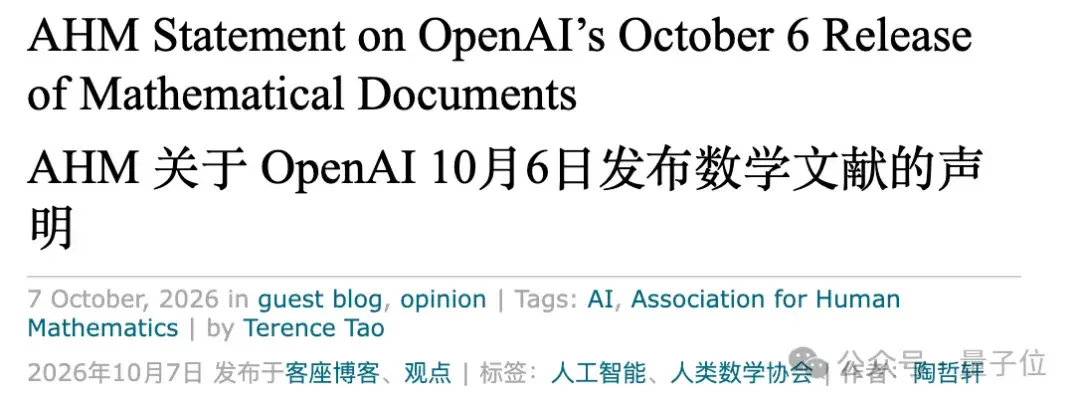
Tao has long been an active champion of AI-assisted scientific discovery; his critique targets commercial entities turning the wholesale cracking of classical academic problems into product marketing campaigns.
In his view, once a mathematical puzzle is conquered overnight by AI, it can never return to an unsolved state; the novel methodologies, theoretical structures, and deep insights that human mathematicians might have developed while grappling with it risk being snuffed out in the cradle.
A more immediate practical bottleneck is that academic peer review is buckling under an unsustainable load.
For a 175-page proof of the 4D Kakeya conjecture, only a handful of scholars worldwide possess the expertise to review it in depth. Who reviews it, how long it takes, and how that labor is credited remain completely without consensus or norms.
The attribution of academic credit and priority conventions are also descending into unprecedented disarray. Scholars dedicated to a subfield for years might wake up to find that the problem they spent years wrestling with has been “claimed” closed by a large language model.


Whether these AI-generated proofs are truly watertight remains to be seen, but many existing research trajectories have already been forced to pivot.
Naturally, dissenting voices exist within academia as well.
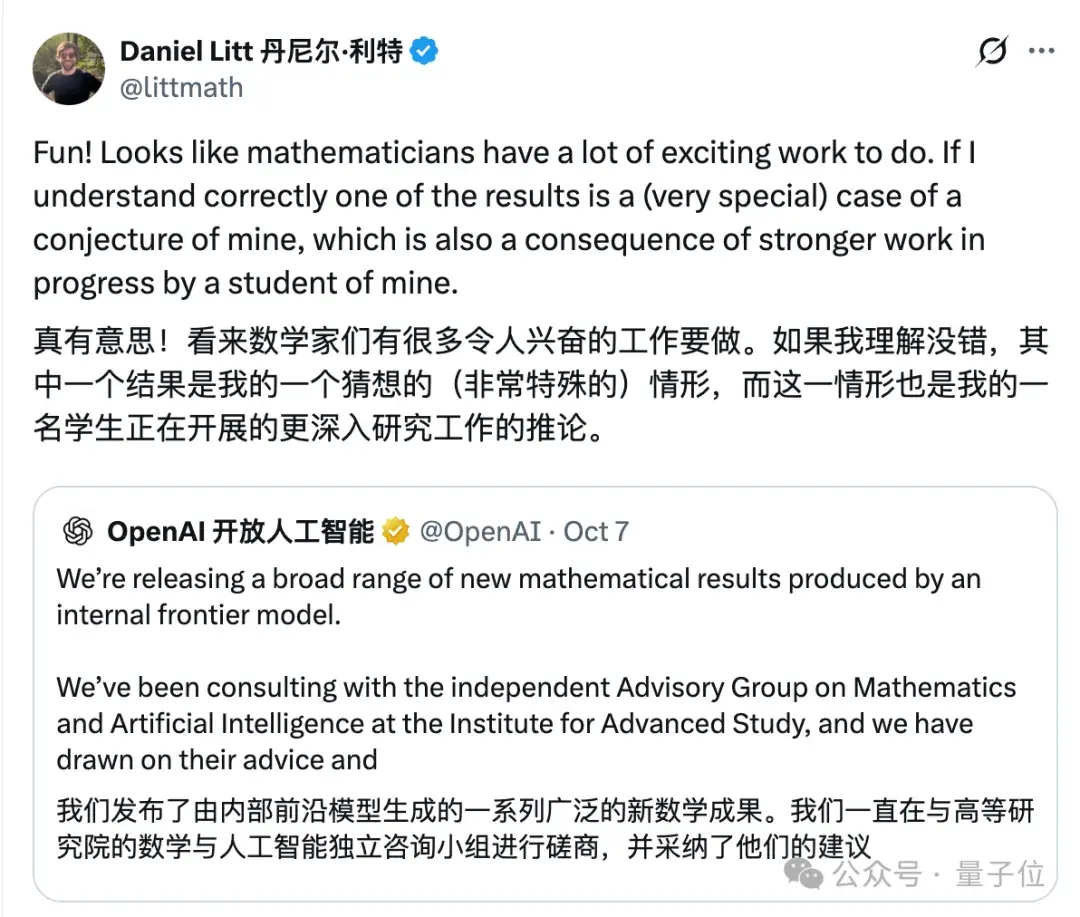
Daniel Litt, an assistant professor of mathematics at the University of Toronto, believes the mathematical community is about to enter an era rich with highly worthwhile new problems to explore.
Yann LeCun echoed this view, writing that mathematics is entering a brand-new era.
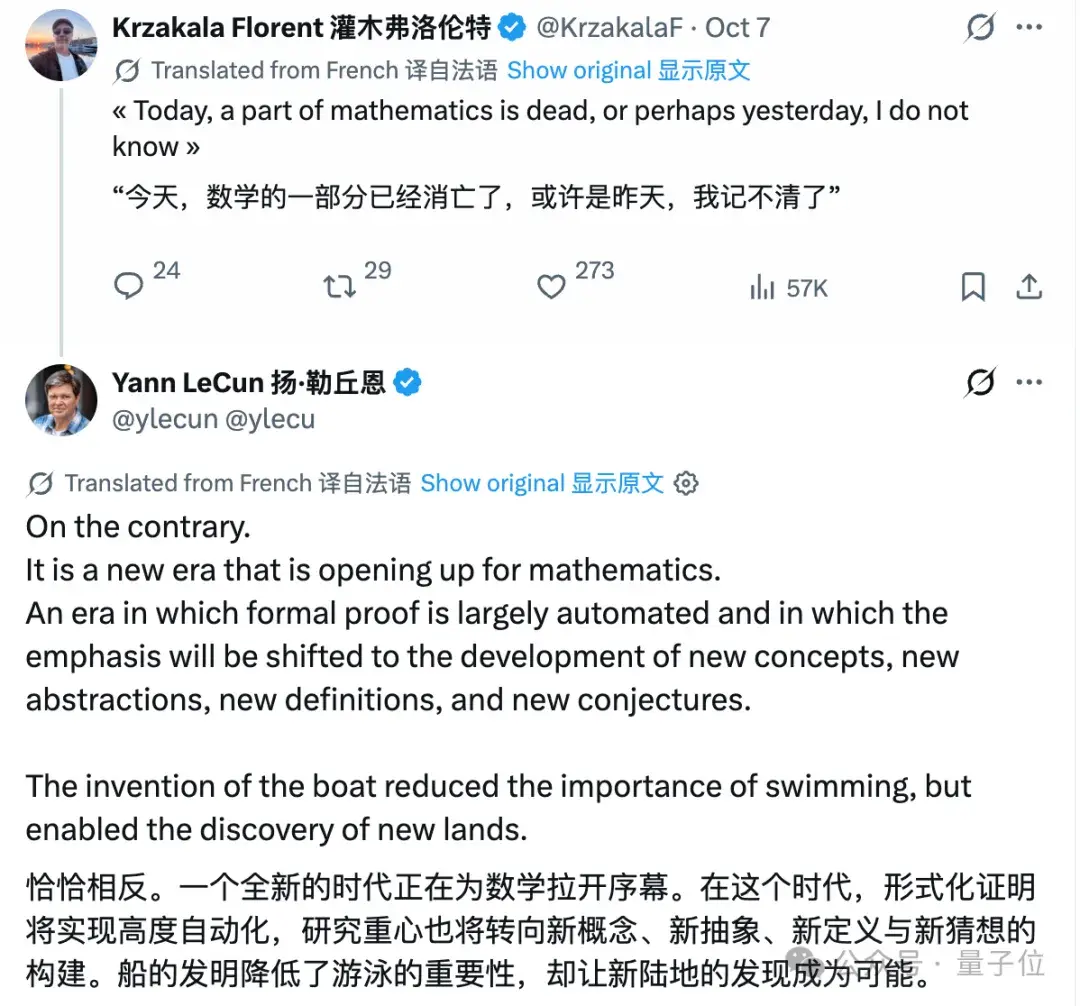
He argues that formal proofs will become highly automated, accelerating a shift in research focus toward higher-order conceptual invention, abstraction, definitional development, and conjecture formulation:
“Steamships reduced the need for humans to swim, yet they brought us to new continents.”
Modern mathematics stands at a historical inflection point where the old order collides head-on with the new. Traditional paradigms face disruption, while new norms have yet to take shape.
Where the road ahead leads remains an open question; yet the laws of scientific progress always point to the inevitability of upheaval and renewal: Past the sunken ship, a thousand sails race on; beyond the withered tree, ten thousand saplings spring to life.
Gowers once predicted that humans could hold out until roughly 2030—and the next Fields Medals happen to be slated for 2030.
When that day arrives, will human mathematicians still take the podium?