
A Multi-Agent Workflow for Generating Academic Paper Drafts
With the sheer volume of academic papers published today, it has become impossible to keep up—yet AI tools that automatically draft research papers continue to pop up in droves.
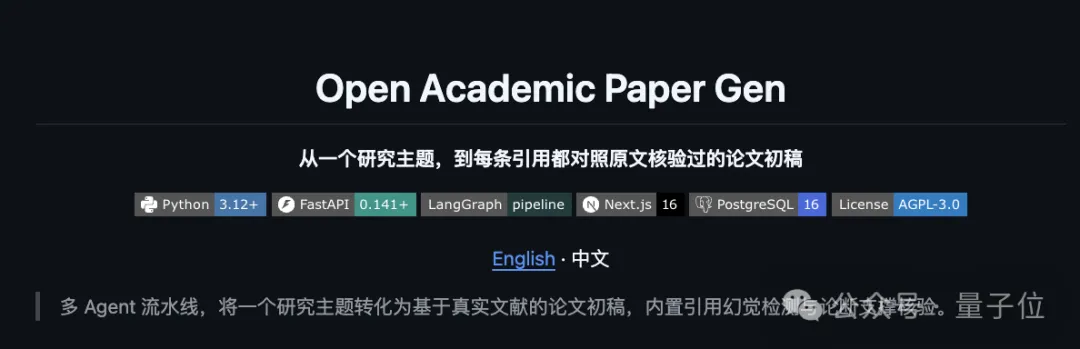
Recently, a new AI paper generation tool surfaced on GitHub: Open Academic Paper Gen.
Don’t scroll past just yet!
Beyond automatically generating drafts with references, Open Academic Paper Gen brings a standout capability: whenever full text is available, it digs into the full paper (emphasis on the entire text, not just the abstract) to uncover evidence and rigorously verify each cited claim one by one.
Frankly speaking, this feature is remarkably practical.
Writing a research paper typically starts from a topic: you continuously organize ideas, track down supporting evidence, and refine your arguments as you read through the literature.
With AI assistance, brainstorming points and finding citation candidates has become blazing fast. But the core pain point remains: sometimes the argument sounds plausible and the cited paper actually exists, but once you read the extracted “claim” in the context of the original paper, you realize the authors were saying something completely different.
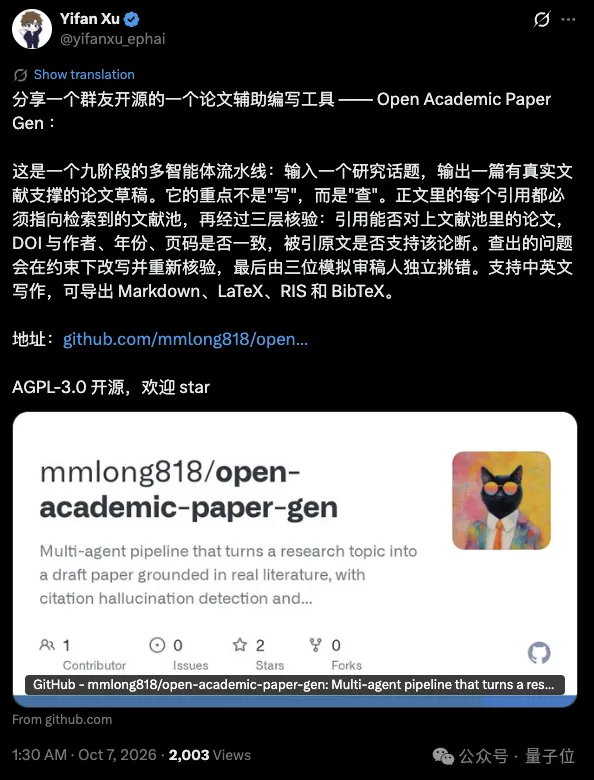
To solve this problem, Open Academic Paper Gen retrieves the full text, pinpoints the relevant paragraphs, and determines whether the paper truly supports the specific claim.
If page numbers are available, the system even annotates the corresponding PDF page in the comments, making it easy for researchers to look it up.
In other words, it doesn’t just check whether the paper exists—it verifies whether the authors actually said that.
A Multi-Agent Workflow for Generating Paper Drafts
Overall, Open Academic Paper Gen is a multi-agent workflow designed to generate first drafts of academic papers. It breaks down the entire process from topic selection to final export into nine stages:
Defining research scope, retrieving literature, cleaning and filtering, analyzing trends, identifying angles, drafting an outline, writing the body text, verifying citations, and exporting the final work.
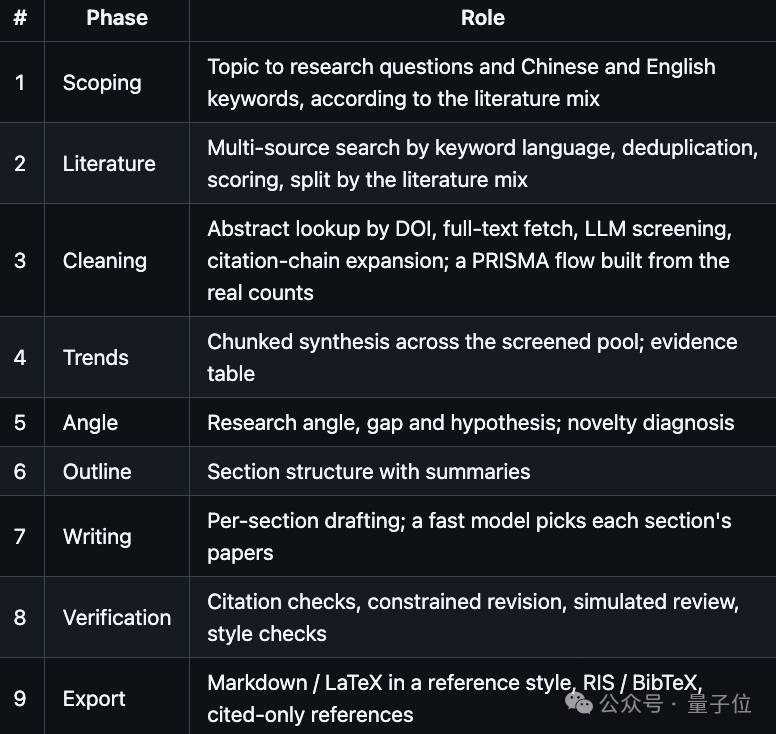
Like other AI academic writing tools, users input a research topic (such as “RSI in the physical world”). The system then breaks it down into concrete research questions, generates Chinese and English search queries, and searches paper databases including OpenAlex, Crossref, Semantic Scholar, and arXiv.
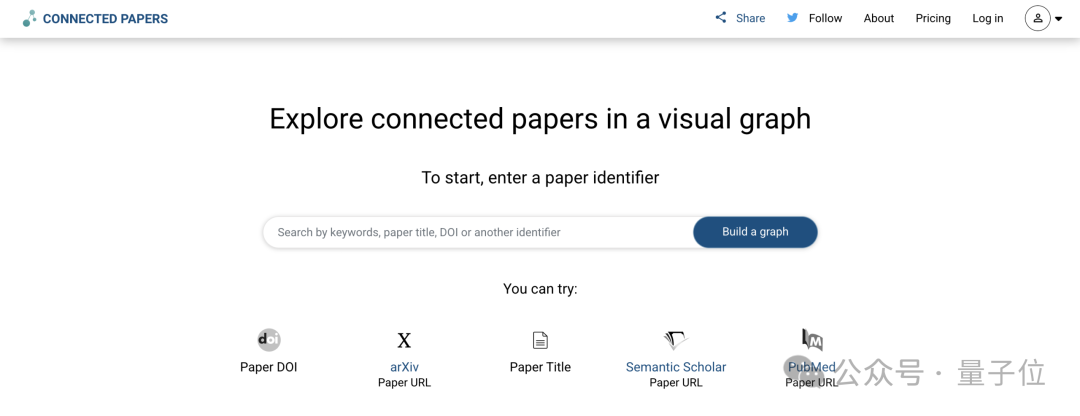
The retrieved papers are deduplicated, scored, and filtered for relevance by the model. For highly relevant papers, the system continues to branch out by exploring their references and subsequent citing works. This “anchor onto one paper, then branch out to gather more” approach is quite similar to Connected Papers.
Next, the collected literature is compiled into an evidence table that systematically summarizes each paper’s research questions, methodologies, experimental data, key conclusions, and limitations.
Equipped with this material, the system analyzes research trends across the field to propose potential angles, academic gaps, and frontier hypotheses.
Here lies another notable feature: Novelty Diagnostics.
Open Academic Paper Gen evaluates the proposed angle across multiple dimensions—problems, methods, datasets, and perspectives—identifying the closest existing work in the literature pool and anticipating potential questions reviewers might raise. (Think of it as having an AI check whether someone already invented ResNet before you convince yourself you just came up with it).
Specifically, these assessments are based strictly on the retrieved literature pool. It’s worth noting that if an idea is absent from the local pool, that does not guarantee no one in academia has ever explored it.
Once the research angle is locked in, the system generates an outline and drafts the paper section by section. After drafting, it enters the citation verification and simulated peer-review pipeline. Finally, the draft can be exported in Markdown or LaTeX format, with references supported in standard formats like RIS and BibTeX.
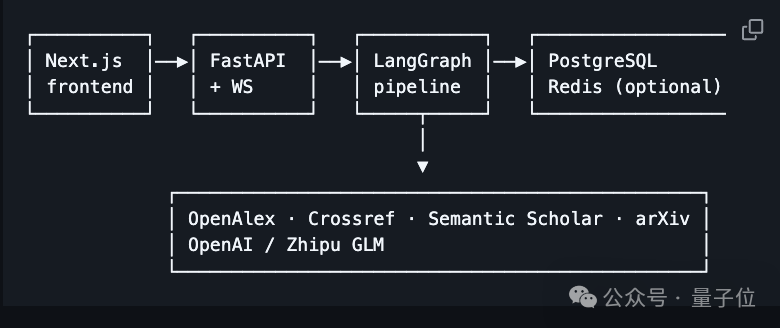
In terms of execution modes, Open Academic Paper Gen defaults to pausing at each critical milestone, waiting for user review, edits, and confirmation before continuing. If you want to benchmark the AI’s autonomous research capabilities, you can switch to fully automated mode and let it run end-to-end hands-free.
Finally, developers looking to try it out should note the model configuration requirements: currently, the project supports OpenAI and Zhipu GLM. However, core steps like claim verification, uncited statement audits, and simulated peer review still require an OpenAI API Key.
How Does It Trace Citations Down to the Sentence Level?
To be fair, automatically retrieving literature, drafting text, and running it through an AI reviewer has become standard practice for many paper-writing projects. Some have also incorporated citation checks and human-in-the-loop validation to mitigate LLM hallucinations as much as possible.
Where Open Academic Paper Gen stands out is its much finer granularity in citation verification and correction. After all, matching references to a draft is one thing; proving that those references rigorously substantiate the claims in the text is an entirely different challenge.
Specifically, it breaks down verification into three layers:
Layer 1: Verify whether the citation exists in the literature pool.
During drafting, every citation marker in the text must correspond to a specific paper in the curated repository. If the model fabricates a non-existent citation tag, the system flags it clearly for easy identification and correction.
Layer 2: Verify literature metadata identity.
For papers with DOIs, the system cross-checks them against Crossref records first; if not found, it queries doi.org directly. If titles, authors, publication years, or other metadata do not match, a warning is triggered.
Layer 3: Verify whether the original text actually supports the claim.
This is where the audit moves beyond surface-level metadata into the actual content of the paper. Once the full text is obtained, the system retrieves paragraphs closely matching the cited claim, pairs them with the paper’s introductory context, and feeds them to the model to assess whether the original text backs up the draft’s statement. If the full text is unavailable, the evaluation falls back to abstracts or excerpts. When page numbers are present, warnings also specify the corresponding PDF page so researchers can double-check directly.
Of course, a lack of sufficient evidence found by the model does not mean the claim has been proven false.
Under Open Academic Paper Gen’s logic, insufficient evidence is marked as “Inconclusive”; papers with too little text to verify at all are marked as “Unverified,” strictly preventing false passes by default.
Overall, compared to generic “one-click paper generators,” Open Academic Paper Gen’s approach of tightly integrating literature organization, evidence localization, and citation self-checks is genuinely clever. In particular, when AI-generated text often feels “plausible yet hard to trust,” having the ability to quickly locate and pull up the original source gives researchers the critical leverage they need to verify the facts.
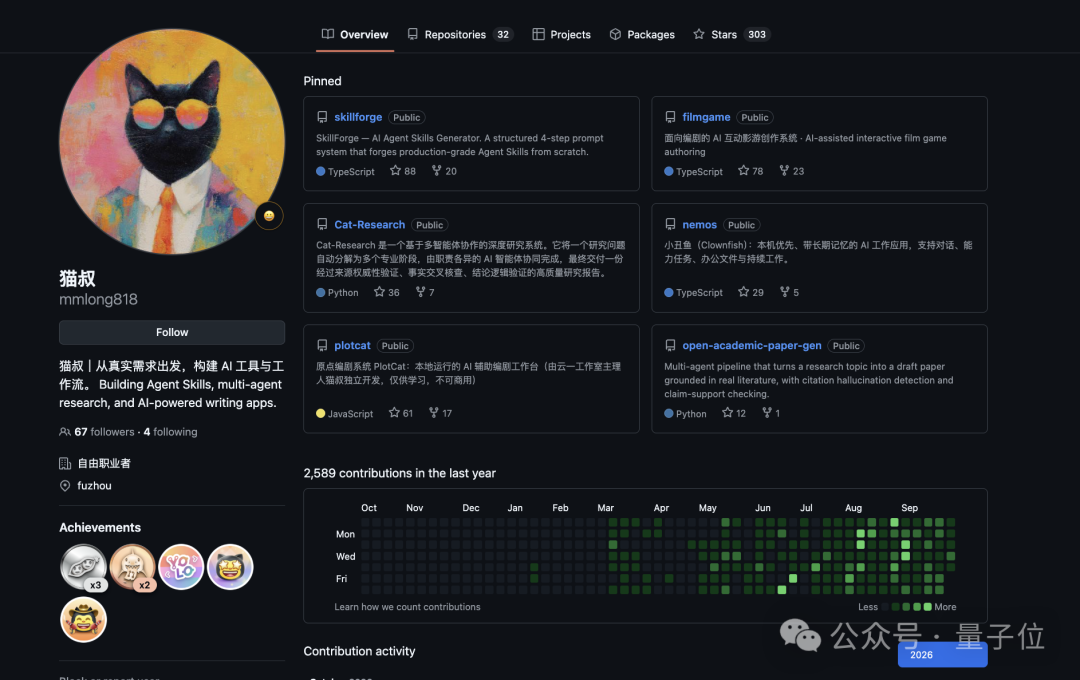
By the way, this project comes from solo developer Uncle Cat (猫叔). In addition to Open Academic Paper Gen, he has previously launched several open-source projects, including AI Screenwriter and AI Research.
References: