
When you think of robotics and AI, what likely comes to mind first are full humanoid robots, such as Figure’s AI-powered machines and 1X’s NEO home robot. While they may well be the future, in 2026, industrial robots may matter even more—and these robots are usually not humanoid.
Standard Bots bills itself as “the largest US-based manufacturer of AI-native industrial robots.” The company recently raised $200 million at a $1 billion valuation in a Series C round co-led by General Catalyst and robotics-focused fund RoboStrategy. Its customer base includes NASA, Amazon, and Lockheed Martin.
We spoke with co-founder and CEO Evan Beard and Head of AI Leif Jentoft to dive deeper into Standard Bots’ AI tech stack and how its models operate under the hood.
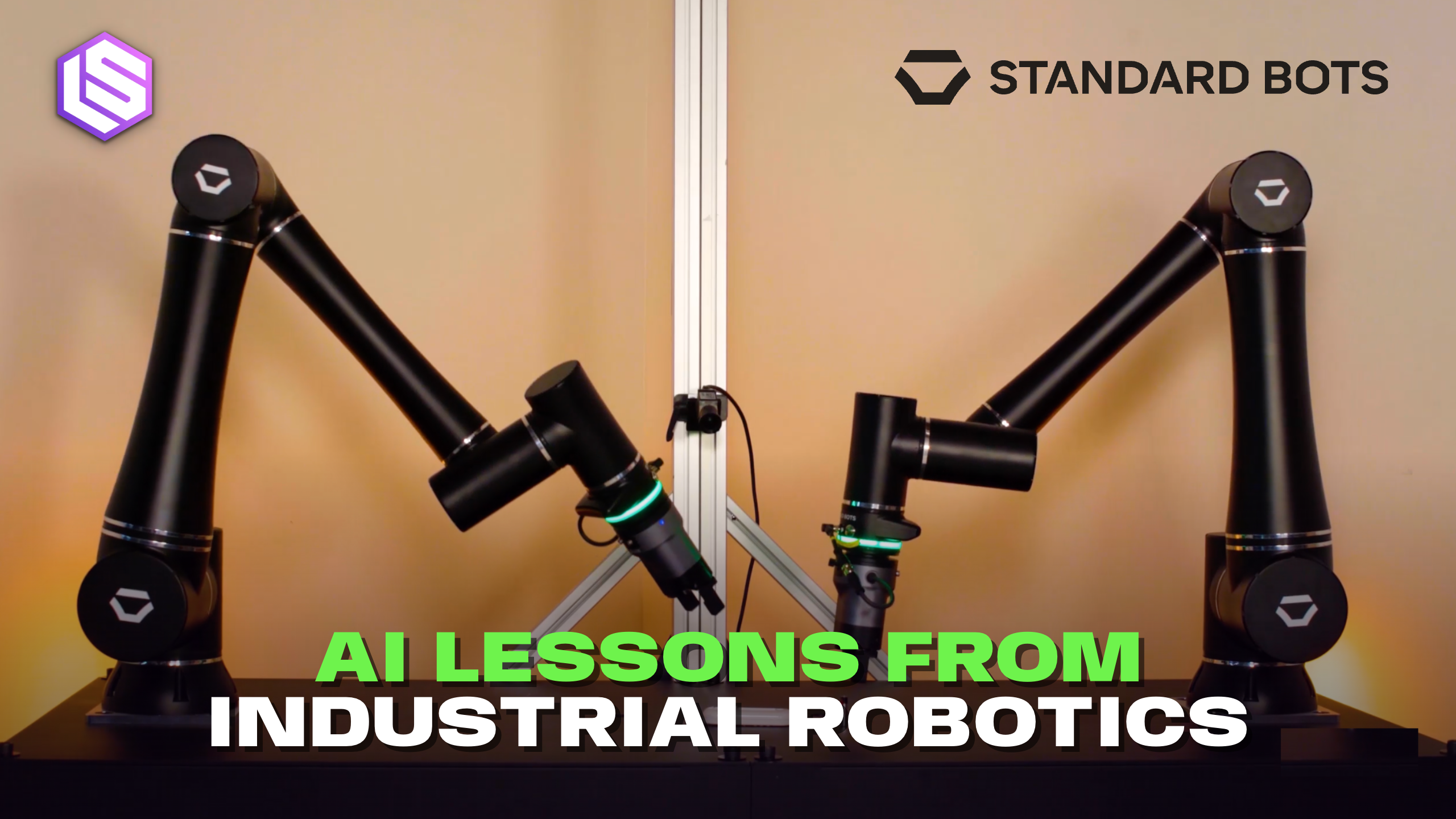
For context, Standard Bots’ industrial arms are engineered for tasks such as machine tending, welding, and assembly. Here is a quick demo from Jentoft:
Pretrained Models and Task-Specific Adaptation
According to Beard, Standard Bots employs a shared base model that customers can adapt via demonstration and fine-tuning. Jentoft added that Standard Bots runs a family of models, including a zero-shot perception system designed for machine tending.
Beard noted that their largest models have parameter counts in the low billions of parameters—quite modest by frontier lab standards.
“We strongly believe that data quality far outweighs raw data quantity,” Jentoft explained. “We focus on extracting maximum value from targeted data, rather than chasing the largest possible dataset.” (This aligns with what Jev creator Diogo Almeida dubbed “the bitterest lesson”, as he recently told us that the right task paired with the right data may matter more than raw compute.)
“Our go-to-market motion gives us proprietary access to the highest-value data,” he added. “In-situ interventions can resolve an edge case with just dozens of examples.”