
0.2 seconds.
That is how long it takes this robot to execute an emergency stop when a human hand suddenly reaches in while it is closing a microwave door.
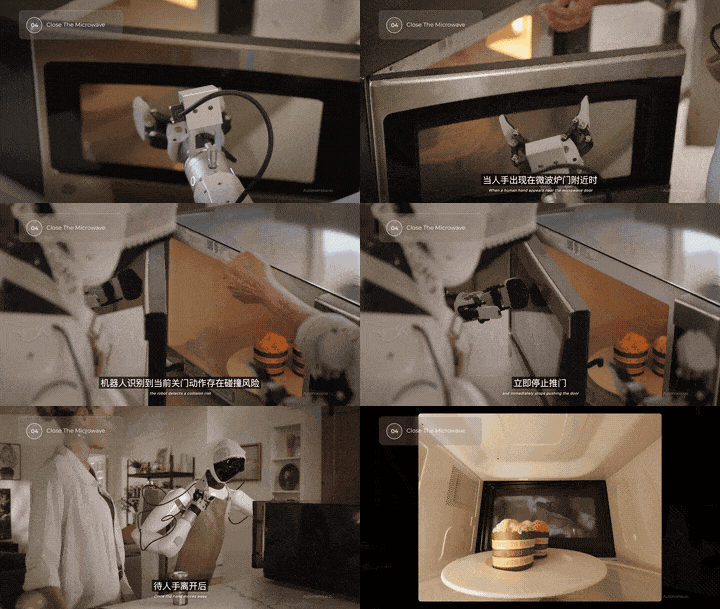
There are even more compelling details:
When a metal can is mixed onto a cake platter destined for the microwave, the robotic arm first picks out the can and sets it aside; only after verifying that the plate is safe does it place it inside the oven.
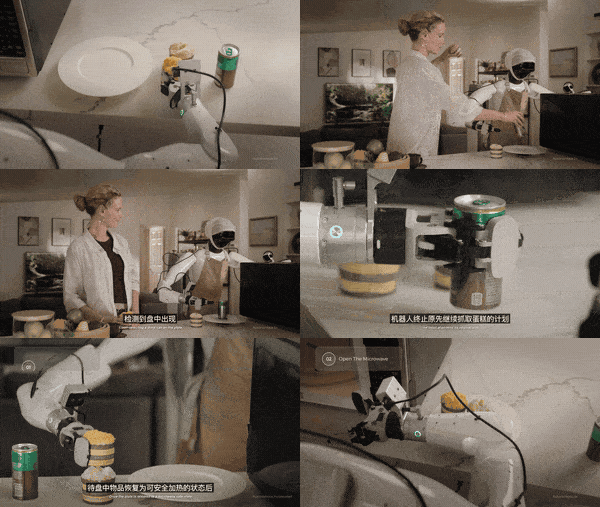
Watching these demos is genuinely eye-opening.
Anyone following the embodied AI space knows the familiar frustration: many robotic demonstrations look dazzling on the surface, but are largely “cheating by rote.” The moment ambient lighting changes, an object is nudged even slightly, or human intent carries subtle ambiguity, the robot either freezes or fails completely.
In these tests, however, even when a high-intensity flashlight is beamed directly into the robot’s visual sensors, it continues operating reliably.
These recordings are neither pre-scripted trajectory playbacks nor statistical lucky guesses. Faced with an ongoing stream of sudden disruptions, the system reasons out a coherent sequence of real-time countermeasures based entirely on an understanding of the physical world’s underlying causal laws.

The system powering this robot is codenamed CRIS-0.
The team behind it is Aether AI, a causal intelligence company founded by Biwei Huang, an Assistant Professor at UC San Diego (UCSD) and a renowned scholar from the CMU causal school.
Earlier reports had highlighted the company’s commitment to causal intelligence. At the time, many assumed that causal AI remained confined to mathematical formulas and thought experiments. Today, Aether AI has delivered a real-world, working demo.
Moving Beyond Robotic Blind Spots: Robots That Understand Causality
In embodied robotics deployments, the toughest challenge is rarely standard operating procedures—it is the ubiquity of unexpected disruptions.
When conventional robots encounter sudden disturbances, they either mindlessly repeat outdated coordinates and cause collisions, or crash entirely. Meanwhile, end-to-end black-box models suffer from severe compounding errors across long-horizon tasks spanning dozens of steps: one wrong move often causes the entire operation to fall apart.
CRIS-0 tackles this bottleneck through causality—shifting the robot from asking “what do I see?” to understanding “why did this happen, and what changes will alter the final outcome?”
Consider the test data:
In a Coffee Preparation benchmark designed to evaluate resilience against unexpected external disruptions, the coffee machine was repeatedly shifted by hand while ambient lighting underwent abrupt shifts as the robot attempted to grasp it. CRIS-0 identified the shifted causal variables and completed real-time replanning in an average of 2 seconds, achieving 9 successful recoveries out of 10 random perturbations.
Crucially, it does not blindly scrap everything and start from scratch.
When the coffee machine is pushed aside, the system continuously tracks the key causal variable: the relative pose of the handle. Once a state deviation is detected, it applies targeted corrections specifically to the approach and grasp phases—without resetting to the initial starting point.
Robustness to disturbances is only the baseline; the true power of causal reasoning shines through in long-horizon autonomous tasks.
In multi-step tasks like living room search-and-tidy routines involving dozens of sequential actions, the system breaks long-term objectives down into atomic, verifiable causal stages, rigorously validating preconditions and postconditions at every transition.
Beyond that, CRIS-0 showcases impressive commonsense reasoning and physical perception:
- Contextual Understanding and Privacy Awareness: When clearing a table, it neatly relocates ordinary books to the coffee table while tucking personal billing statements away into a private drawer;
- Active Interactive Perception: Confronted with two visually identical beverage cans, it lightly grasps and shakes them to gauge their weight and liquid dynamics. Only after verifying a can is empty does it toss it into the trash; cans with remaining liquid are steadily placed back where they belong.
When handling ambiguous instructions, causal mechanisms also drastically improve prompt generalization, enabling deeper personalized intent understanding.
In the Personal Pick and Place benchmark, the system achieved 18 accurate pick-and-place completions out of 20 ambiguous instructions requiring implicit reasoning, such as “Grab me a drink suitable for after a morning run.”
Rather than relying on surface-level keyword matching, it synthesized time, user state, and environmental context to extract the latent causal variable—“post-workout recovery requires energy replenishment while avoiding excess sugar”—and automatically formulated and executed the appropriate manipulation plan.
Dissecting CRIS-0: Turning the Black Box into a Causal Engine
To unpack this technical architecture, we must first answer a fundamental question: Why have traditional robots always felt so clumsy?
The physical world differs fundamentally from the digital realm. When writing code or chatting on a computer, mistakes can simply be undone. In the physical world, however, friction, gravity, rigid-body collisions, and shifting lighting introduce non-negotiable variables at every second.
While traditional end-to-end approaches (such as VLA architectures) excel at fast representation learning, they suffer from a fatal flaw in long-horizon operations: compounding error. A minor deviation at step 1 amplifies at step 2, and by step 10, the entire trajectory is completely warped. Worse still, a single black-box model cannot pinpoint the root cause of an external disruption; it typically either plows ahead blindly along its original trajectory or crashes outright.
Another common approach—using LLM-based agents—provides task decomposition, but its underlying reasoning relies heavily on probabilistic inference across pure text or multimodal tokens. Once the environment changes, the system must first translate visual inputs into text, wait for the model to reason out “what to do next,” and by the time inference finishes, the physical arm may have already collided with an obstacle.
To address these pain points, Aether AI introduced a Causal-Native Agent architecture built around three core pillars:
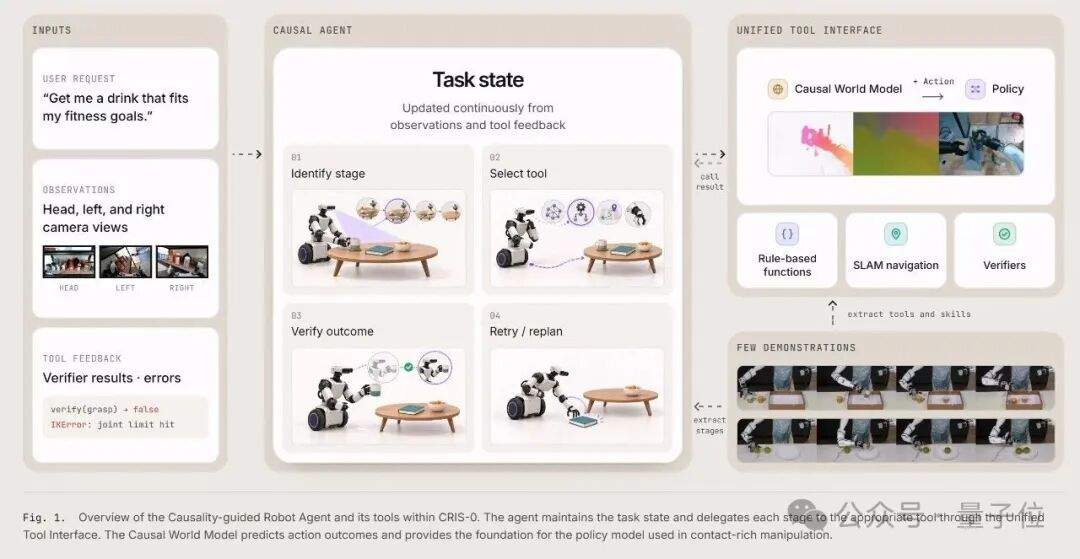
1. Tasks as States: Extracting Physical Causal Variables
This represents the foundational first-principles redesign in CRIS-0: unifying states and causal variables.
Conventional robotic perception systems primarily operate on high-dimensional raw pixels. CRIS-0, by contrast, looks past superficial environmental appearances to track the causal state progress of the task itself.
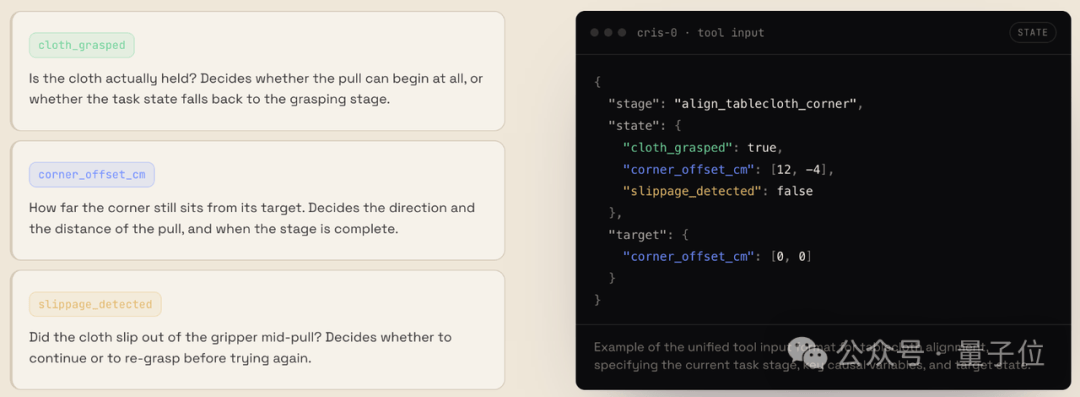
Take spreading a tablecloth as an example: the system does not calculate the 3D coordinates of every pixel across the fabric. Instead, it continuously tracks a small set of core causal variables—whether the cloth is securely held by the gripper, the positional offset of the corners relative to the target pose, and whether slip is occurring during the pull.
If the grip slips, the system immediately recognizes that the causal variable “securely grasped” has failed. It rolls the task state back to the “re-grasp” stage rather than resetting the entire routine from the beginning—and never pulls uselessly at thin air.
In the coffee preparation benchmark, when faced with shifted machines and drastic lighting changes, the system captured shifts in critical causal variables and executed local replanning within an average of 2 seconds, achieving a 90% recovery rate. That is the power of causal variables: when the unexpected happens, the system pinpoint-identifies the failure node and its rollback boundaries.
2. Unified Tool Interface: Rejecting a One-Size-Fits-All Policy
At the execution layer, CRIS-0 employs a modular mechanism driven by tool calls, coordinating specialized modules through a Unified Tool Interface.
The architecture features a high-level Planner responsible for macro scheduling across a diverse underlying toolkit:
- Rule-based functions: Combining visual localization with inverse kinematics to efficiently handle wide-area spatial movement and coarse positioning;
- Policy models: Specialized in contact-rich tasks like pouring liquids and precise insertions;
- Navigation modules (SLAM): Guiding global mobile base navigation;
- Verifiers: Validating physical states at critical transition points;
- Causal World Models (CausalWM): Simulating the downstream physical ramifications of potential actions.
Among these, the Causal World Model (CausalWM) serves as the central linchpin.
While mainstream world models predominantly focus on rendering visually plausible future video frames, CRIS-0’s CausalWM zeroes in on the actual physical impact of actions on the environment.
Its operational mechanic is straightforward yet powerful: given the current state, it forecasts which causal variables a candidate action will alter, and predicts the downstream physical state accordingly.
Before the robotic arm outputs a command, it runs forward simulations: If action B is executed, how will the physical causal variables evolve, and will the target object lose stability? Only when the simulation verifies that the objective can be safely met does the system invoke the Action Head to send commands to low-level controllers.
3. Structured Execution Loops and Built-in Native Safety
These components run cohesively within a closed-loop system.
When tackling complex tasks, the Planner breaks down high-level objectives into a structured execution pipeline: it first calls a rule-based function to rapidly translate the end-effector near the target area, then triggers a specialized policy model to perform high-precision, contact-rich grasping. What was previously an intractable end-to-end challenge is decoupled into a set of high-certainty local subtasks.
This workflow forms a dynamically evolving Task Graph: State Identification → Tool Selection → Execution → Verification → Adaptation.
After every step, verifiers immediately audit physical preconditions and postconditions. If criteria are unmet, an integrated three-tier recovery mechanism kicks in: first attempting localized self-healing, followed by local trajectory replanning, and escalating to human assistance only when strictly necessary. Once a recovery trajectory succeeds under a specific disturbance, that logic is compiled back into the Task Graph to boost efficiency in future encounters.
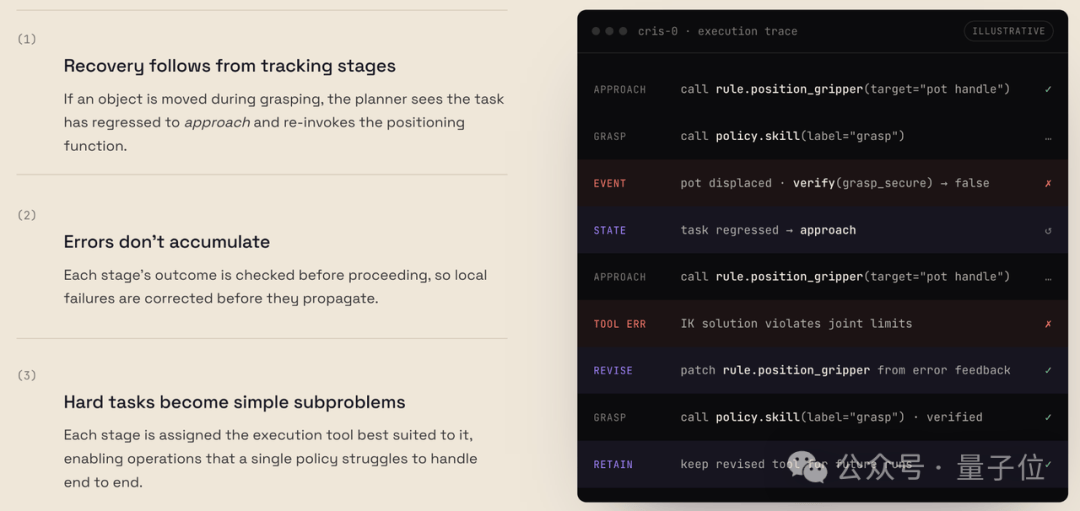
This explains why the system can execute dozens of sequential steps in complex tidying routines without collapsing: because causal states are audited at every single step, local errors are caught and mitigated at inception, cutting off the compounding error chain.
It is also the foundational logic behind the 0.2-second emergency halt.
In CRIS-0, safety constraints are natively embedded into every causal state. During the microwave door-closing phase, an intruding human hand is classified as a hazardous variable that violates safety constraints. The state perception layer detects it instantaneously and triggers the highest-priority braking interrupt within 0.2 seconds. Conversely, if the active task is handing a cup of water to a human, an outstretched hand is classified as an interaction target variable, allowing the cooperative handover to proceed normally.
The system-level capabilities displayed by CRIS-0 build directly upon the team’s sustained academic groundwork.
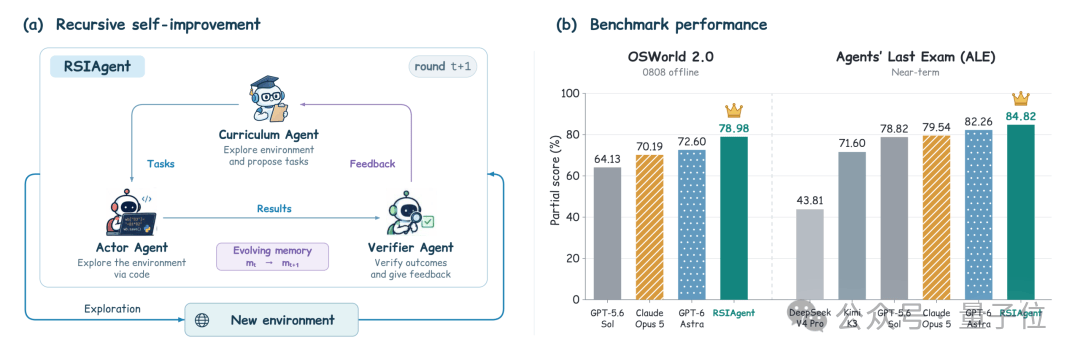
In agent benchmarking, Aether AI’s previously developed causal agent framework, RSIAgent, achieved a 78.98% Partial Score on the OSWorld 2.0 benchmark. Without fine-tuning underlying model parameters, it elevated open-source models’ agent performance above leading closed-source models such as GPT-6 Astra.
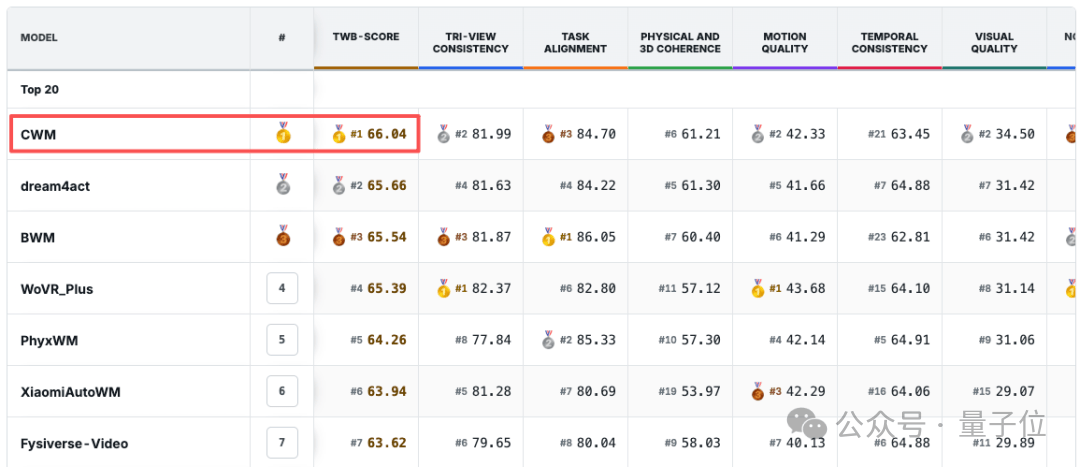
Its first-generation causal world model, CausalWM, also secured the Top-1 ranking on TriWorldBench, a dedicated benchmark for robotic world models.
These two layers form the architectural backbone of this demonstration.
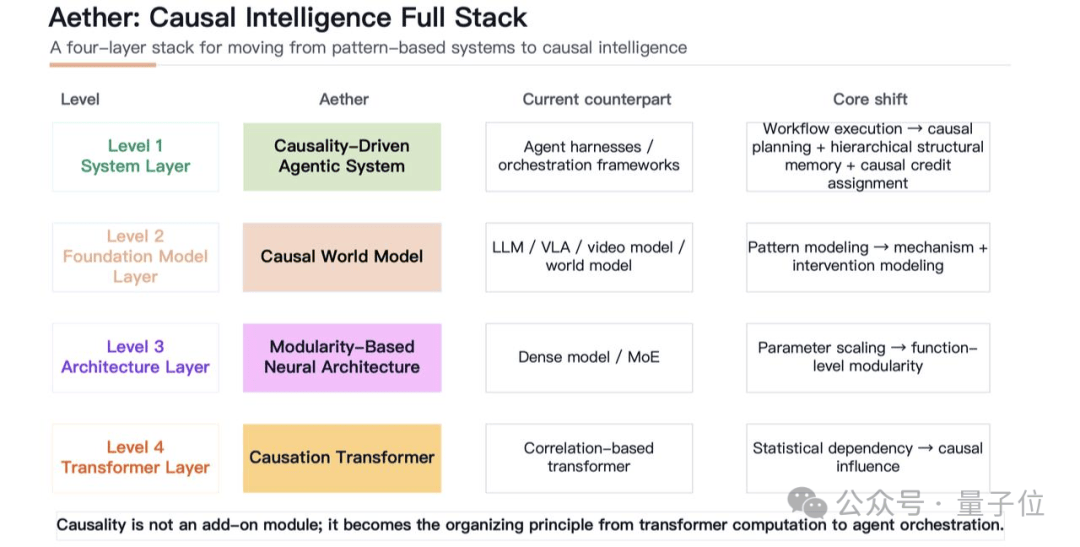
Additionally, the team’s technical roadmap encompasses two ongoing architectural frontiers: modular neural architectures that map to distinct physical mechanisms and can be composed modularly, and the Causation Transformer, designed to capture true causal mechanisms rather than superficial statistical correlations.
The Physical World Doesn’t Care for Rote Memorization
Looking beyond individual robotics demos, the surging industry interest in causal AI stems from fundamental bottlenecks at the heart of embodied intelligence.
The rapid rise of large language models was enabled largely because natural language represents a deeply symbolic, highly abstracted conceptual space created by humans. Broad commonsense principles and logical structures are already baked into surface-level text, meaning high-dimensional statistical modeling paired with massive scale can unlock impressive generalization.
The physical world, however, does not run on statistical extrapolation.
Objective laws like friction and gravity are absolute; they do not bend to token distributions. In an unpredictable, highly dynamic physical reality, relying entirely on surface-level feature fitting will inevitably run into diminishing returns under Scaling Laws.
Given the inherent scarcity of real-world physical interaction data, building truly robust physical systems demands models that reason like scientists: distilling underlying causal mechanisms from limited observations and predicting how specific interventions alter the world. This causality-centric structured modeling is quickly becoming a critical pathway for pioneering a new scaling paradigm in embodied AI.
Causal discovery and causal representation learning demand rigorous mathematical and statistical foundations, making teams that blend deep theoretical chops with complex systems engineering exceptionally rare worldwide.
Biwei Huang has devoted years to this domain, training under CMU causal school pioneers Clark Glymour and Peter Spirtes, as well as distinguished scholars Bernhard Schölkopf and Kun Zhang. The theoretical evolution across three generations of the causal school underpins Aether AI’s foundational technical roadmap today.
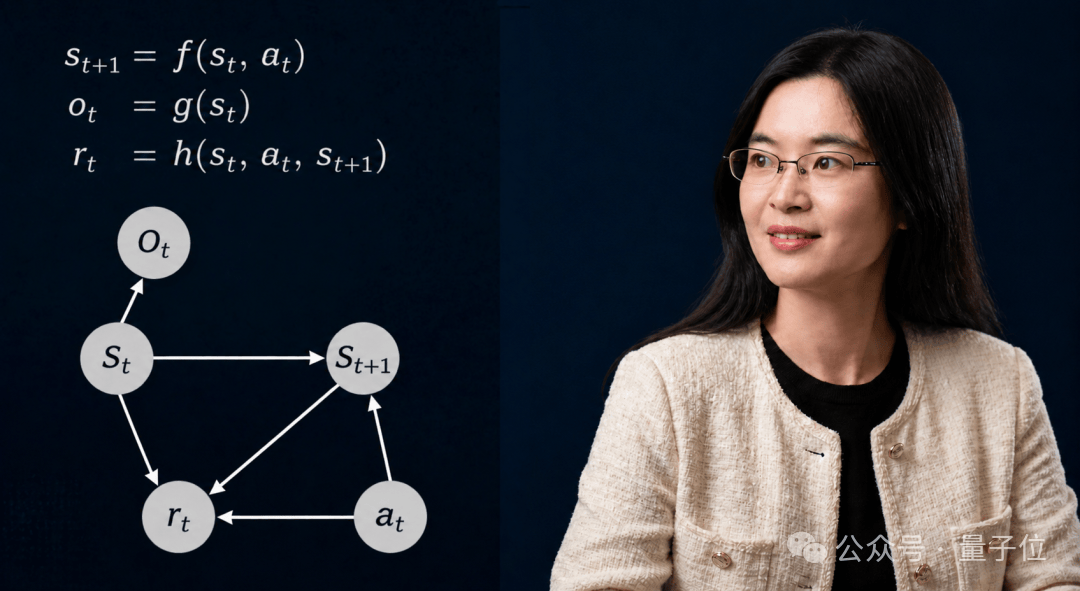
From theoretical validation at Carnegie Mellon University and the Max Planck Institute to real-world deployment on CRIS-0 robotic manipulators, causal AI has made a critical leap into physical interaction.
Once a computing architecture masters extracting causal variables, modeling physical dynamics, and simulating future outcomes before committing to actions, its utility will reach far beyond domestic assistants. In predicting long-term trends across complex dynamic systems, discovering novel materials, and advancing computational biology, causal representation learning holds broad transformative potential.
As artificial intelligence moves beyond the confines of digital chat interfaces to navigate an unpredictable physical reality, causal mechanisms are proving to be the key that unlocks the door.