Taste sets the ceiling.
Jay reporting from Qiaofan Temple
QbitAI | WeChat public account QbitAI
It’s been a long time since I’ve seen an AI competition this refreshing.
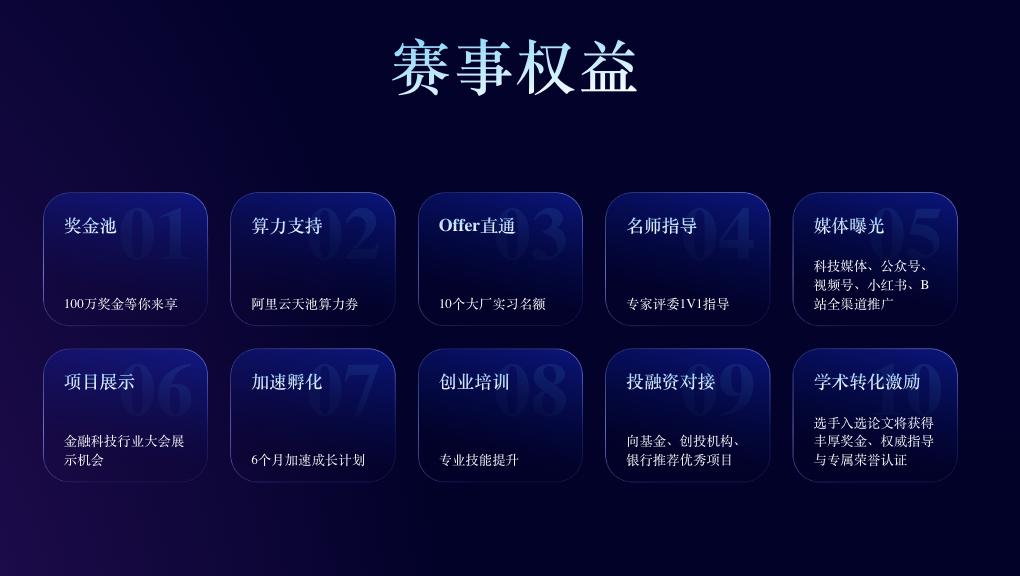
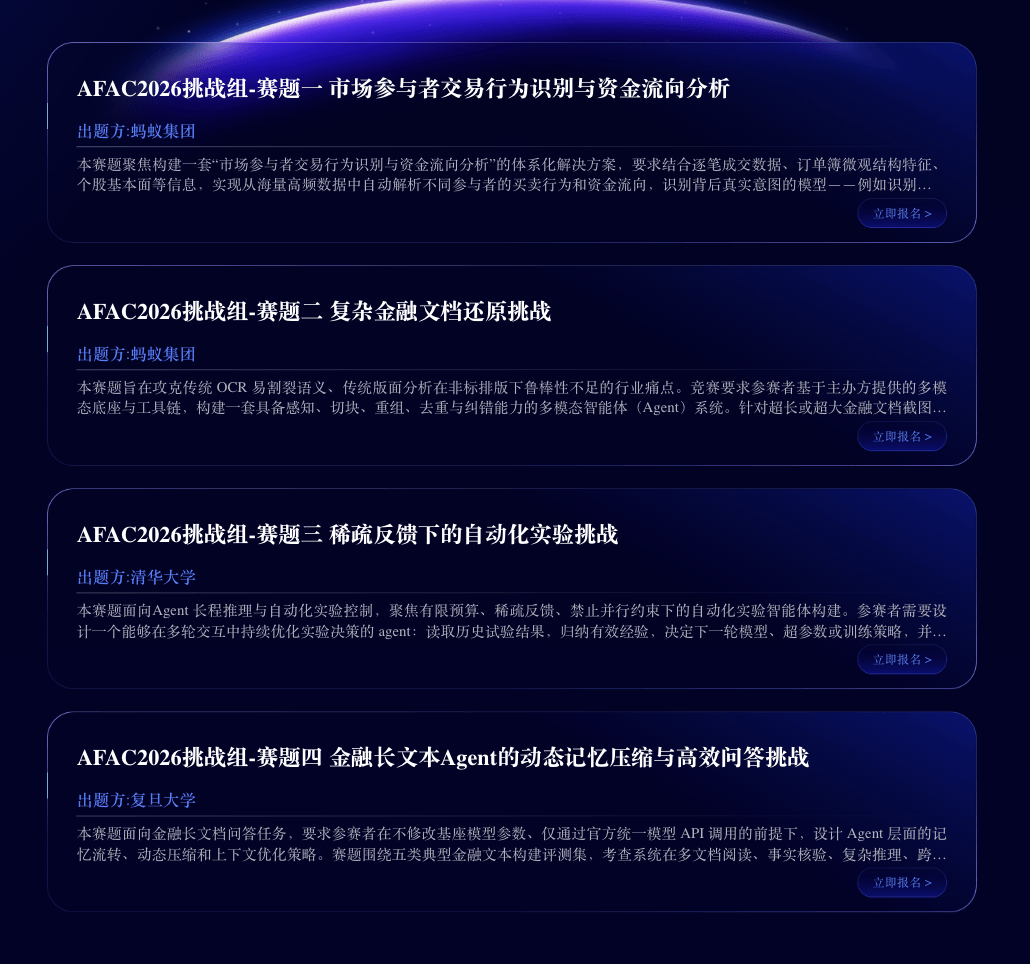
Called the AFAC 2026 Financial Intelligent Innovation Competition, it’s finally not just another boring benchmark for chasing scores. There are four challenges, all grown out of real financial scenarios:
- Reading the tape: identifying institutional trading behavior and capital flows;
- Digesting documents: reconstructing complex insurance PDFs into structured Markdown;
- Running experiments: designing automated experiments under sparse feedback;
- Reading long texts: answering questions on financial long-form documents accurately while controlling token cost.
Yes, they deliberately chose finance, the most “hell-level” training ground of all.
Many people may not realize that even today, after models have advanced this far, vertical financial tasks still haven’t been fully cracked.
Take insurance document reconstruction into Markdown as an example: once you run into large-image, large-document scenarios, the average score on relevant benchmarks can drop below 0.1, and even frontier multimodal models like GPT and Gemini struggle.
Why is deployment in vertical scenarios so difficult?
At the end of the day, this is an engineering problem at the Agent layer. It’s not something parameter scaling alone can swallow.
That is exactly AFAC 2026’s core message: everyone return to foundational research and explore together how models can deliver industrial value under real-world constraints.
To be honest, this may be the most worth watching competition in financial AI this year.
2026 Financial AI Martial Arts Tournament
This year’s challenge track is divided into four arenas—
Challenge 1: Market Participant Trading Behavior Recognition and Capital Flow Analysis

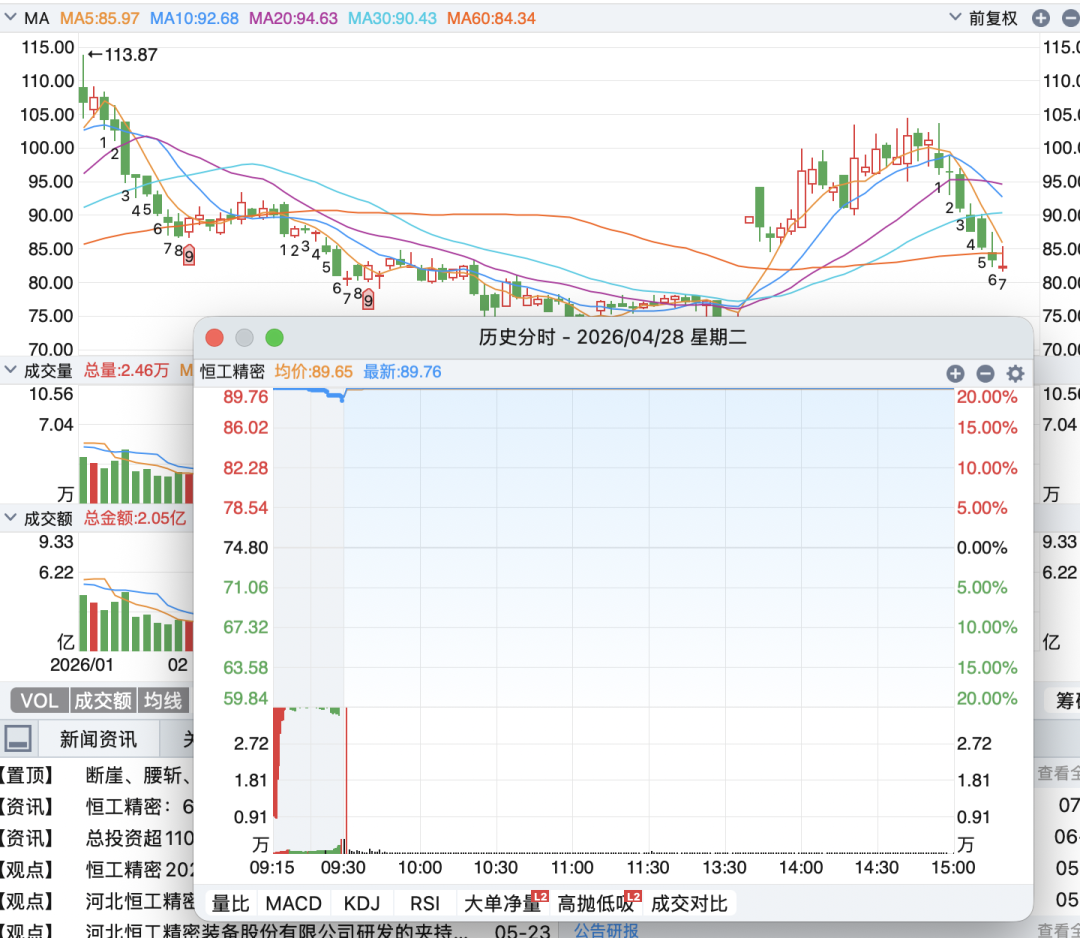
For ordinary investors staring at the tape, the most frustrating thing is this: you never know what that huge order on the other side of the screen is really trying to do.
A stock suddenly surges, large orders flood in, and massive buy orders appear in the order book. You spot abnormal candlestick action and get ready to jump on the move.
But the real purpose on the other side may simply be to lure you in so you can be left holding the bag…
There are people hidden inside the stock market.
How to better identify trading behavior has always been one of the market’s most natural needs.
But that is also exactly where the difficulty lies. In this dark forest, both buyers and sellers are doing everything they can to infer each other’s intentions.
The result is a continuous cycle of confrontation and escalation: when certain capital behaviors are identified, the people actually using those tactics will in turn hide themselves, and may even exploit the market’s awareness of these signals to play a counter-game.
In the view of Ji Han, Head of Investment Research and Advisory Technology for Ant Group’s Wealth Insurance Business Group and AFAC challenge setter, this is what makes this problem so interesting: capital identification has never been just a math problem.
From a trading perspective, placing orders, canceling orders, and splitting orders are essentially a form of communication between you and the opposing side. There is a lot of intent in it, including misdirection and creating false signals.
The strongest competitors win through their understanding of society, business, and even human nature.
Today, the rise of large models gives this game another new weapon. They can discover hidden patterns in high-frequency numerical data that humans have not yet formalized.
Whoever learns to harness and package that capability first will be the one making real money in the stock market.
But simply calling a model is nowhere near enough. Competitors must design their mechanisms on top of a harness framework.
The amount of L2 market data is enormous. If you shove it straight into a model, even a 1M-context window will blow up immediately, causing the attention mechanism to fail.
So participants need to write rules or off-the-shelf code in advance, or let the model call tools to first process the data into a state that is observable, understandable, and judgeable.
At the harness implementation level, there are extremely complex engineering requirements hidden underneath.
Beyond the scenario itself, the evaluation rules for this challenge are also quite interesting.
As a competition aimed at industrial deployment, this challenge does not emphasize “cost optimization.”
Pretty counterintuitive, right? After all, when people talk about deployment, the engineering metric most people care about first is cost.
The challenge setter Ji Han explained it this way:
If the strategy is truly effective, the potential return it brings may make the cost seem trivial.
This is a game of strategy. While you’re agonizing over cost, your opponent is doing everything possible to call the best model.
Every scenario has its own value function; “cost” is not always the deciding variable.
When it comes to reading the tape, your primary goal is to beat your opponent.
Challenge 2: Complex Financial Document Reconstruction
Competitors need to design and implement an end-to-end document parsing system that converts a financial document image into Markdown completely, accurately, and with structure.

Note the three keywords here: complete, accurate, structured.
Financial documents are not ordinary essays. A single insurance document usually contains multi-level headings, dense tables, footnotes, and annotations, and every piece of information must be 100% accurate.

But why do this at all?
Take insurance tables as an example. Life insurance products need to tell Zhang San with great precision how much money he will receive in a certain month of a certain year.
Where does that number come from? Table lookup.
After receiving the request, the broker uses intuition to locate a specific table and cell on page 15XX, then checks how much Zhang San can receive at age 45.
But with so many users, you can’t ask a broker to look up the page and cell every time someone asks a question.
Of course institutions want to structure these documents. The problem is that most financial documents are images or PDFs. Ordinary OCR can recognize the text, but it has no intelligence.
That brings us to the problem of reading order.
Humans can instantly tell the reading order, but machines may read the right column first and then the left column; even if every word is recognized correctly, the meaning still gets scrambled.
Structure is actually a crucial part of semantics.
Large models can solve this problem well, but they also introduce a new constraint — context.
A huge financial document image can contain hundreds of millions of pixels. Just the input alone can blow up the window, let alone an output that may run to hundreds of thousands of words. You can’t expect a model to swallow the whole image in one go.
So you need an end-to-end Agent workflow: first split it up, then call a small model to parse it multiple times, and finally stitch everything back together into a faithful Markdown document.

It’s quite interesting. In the words of Xu Xingzhong, Senior Director of Insurance Intelligent Technology at Ant Group’s Wealth Insurance Business Group and AFAC challenge setter, building this SOP is a bit like Sherlock Holmes solving a case.
When facing a complex system, if you need to improve efficiency or solve training instability problems, you must decompose and analyze it from a foundational research perspective.
This requires researchers to think holistically and to analyze, locate, and attribute causes precisely, just like a detective solving a case.
It’s worth noting that the model base provided for this challenge is FinixDoc-VL, a multimodal model specifically optimized for financial documents.
FinixDoc is an end-to-end intelligent, Agent-style parsing system for financial documents developed by Ant Group’s insurance algorithm team. Its core model, FinixDoc-VL, is trained on a 4B-class Qwen3-VL.
In addition, the team built the financial document hard-case benchmark FinixDocBench and open-sourced part of its subsets, covering difficult real-world business scenarios such as low-quality scans, ultra-long documents, and dense tables. On this benchmark, FinixDoc-VL achieved a composite score of 81.43.

https://huggingface.co/datasets/inclusionAI/FinixDocBench
Challenge 3: Automated Experimentation Under Sparse Feedback

This one is a bit different. It feels more like doing research inside finance.
Participants need to let the Agent conduct machine learning experiments like a researcher and complete graph learning tasks in financial scenarios.
Many people think AI competitions are just about choosing a good model and throwing data at it for training. In reality, it’s more like cooking.
You tweak the heat once and taste it; if it’s too salty, you add less salt next time; if the meat is too tough, you shorten the cooking time. But the problem here is that every taste test has a cost, whether it’s ingredients or time. Your number of attempts is limited, and in the end you still have to serve a dish the customer is happy with.
That’s what “automated experimentation under sparse feedback” means. The challenge requires participants to use financial graph learning as a sandbox, and optimize task performance as much as possible under hard budget constraints.
When I read this, my first association was a phrase from the Vibe Coding world: the bigger the model, the lower the cost.
The rough logic is that a smarter model makes fewer mistakes during execution and outputs fewer tokens. As a result, even if the API unit price is higher, the total cost of completing one task is actually lower.
What I didn’t expect was that Challenge 3 looks at this from a different angle.
Yao Quanming, Associate Professor at the Department of Electronic Engineering, Tsinghua University and AFAC challenge setter, has spent many years on AutoML, with research interests including large-model foundations and data-efficient Agent learning. He said that financial graph learning is not a form that large models are naturally good at. Its search space often lacks coherent semantics, so the language priors of general-purpose models don’t help much here.
We are now in the era where Scaling Law is king. It’s easy for people to get the illusion that AI can encompass everything.
The problem is, is “usable” really enough?
Large models essentially apply the same acceleration to everyone. But in a fiercely competitive market, if your opponent uses only one-tenth of your tokens to do the same thing, your market share will be eaten away immediately.
The best solution may not come from a more expensive API. If there is a better-designed specialized model, maybe 3B parameters are enough.
AGI can burn money freely for the sake of a “story,” but vertical scenarios must pursue the extreme.
For employees, this issue is even more practical:
When you hire someone, there are management, status, and cost issues. If an employee only does work within the scope covered by AI capabilities, they will be replaced very quickly.
On the contrary, someone who can solve problems beyond AI’s limits will have more room to grow in the future.
Challenge 4: Dynamic Memory Compression and Efficient Q&A for Long-Context Financial Agents

This challenge can be understood together with Challenge 2. Both are all about context — Challenge 2 tests input, Challenge 4 tests output.
The organizers will provide a huge volume of long financial documents, and participants need to make the AI answer questions accurately based on this context.
There are two major difficulties:
1. The structure is extremely complex.
Financial documents are full of cross-references, tables, appendices, and annotations. A single negation, a single limiting condition, or a calculation convention buried in an appendix can completely change the final answer.
2. The requirement for “traceability” is extremely high.
The cost of mistakes in financial tasks is enormous. Users must not only accept an answer that “sounds reasonable”; they also need to know which page and which clause it came from.
How do you do it?
Simple chunk-based retrieval easily loses contextual relationships; stuffing the entire document into the model greatly increases hallucinations, and it can easily turn a question about Product A into the terms of Product B.
A more realistic approach is to manage context through Agent engineering. The SOP recommended by the challenge is as follows:
- Document preprocessing: parse PDF or text into a searchable structure, split by chapter, paragraph, and table.
- Document organization and indexing: build keyword indexes and structured field indexes by domain.
- Problem parsing: identify question type, keywords, entities, time, amounts, metrics, and candidate documents.
- Evidence retrieval: don’t give the model the entire book; only fetch the most relevant passages.
- Reasoning and answering: determine whether each option is true or false based on the evidence.
- Answer validation: single-choice must have exactly one answer, multiple-choice must include all correct options, and true/false questions must be filled with A or B.
- Result aggregation: generate a file that matches the required submission format.

But to be honest, when I first saw this SOP, I was a bit puzzled.
Recently I’ve been using Codex together with Obsidian for knowledge base management, and my personal impression is that GPT + RAG can basically eliminate hallucinations.
So, why not just connect to the API of the most advanced model directly?
In response, Guo Hongcheng, Assistant Professor and PhD Advisor at Fudan University and AFAC challenge setter, who has spent years focusing on LLM research and previously worked at Alibaba’s Tongyi Qianwen Lab, added a perspective I had never considered as a consumer:
Context cost control is on a completely different scale in B2B.
Financial institutions are not dealing with one-off Q&A, but with massive volumes of documents. They need to perform ongoing compliance reviews, investment research analysis, customer service assistance, and internal knowledge Q&A. These materials often run to hundreds of pages.
If every request is fed directly into a large model, it may seem like you’re only spending a few more tokens per call; but once you scale that up to daily, monthly, or institution-wide usage, the bill becomes astronomical.
That is also why Challenge 4 includes “token consumption” as one of its evaluation dimensions.
……
And that is the four-track AFAC competition.
Honestly, the amount of information is overwhelming. At first I really didn’t expect that behind every evaluation metric there would be such concrete thinking about real business needs.
The problems themselves are also exquisitely chosen: they are all open-ended questions with no standard answers, and none of them can be brute-forced just by throwing more compute at them.
The best innovation often emerges from this kind of chaotic territory.
Financial AI: a gold mine with its own moat
How were these high-value challenges brainstormed in the first place?
The answer is actually simple: Ant Group personally came in to build the event.
Behind AFAC 2026 stands a challenge committee that combines frontline industry experience with cutting-edge academic vision.
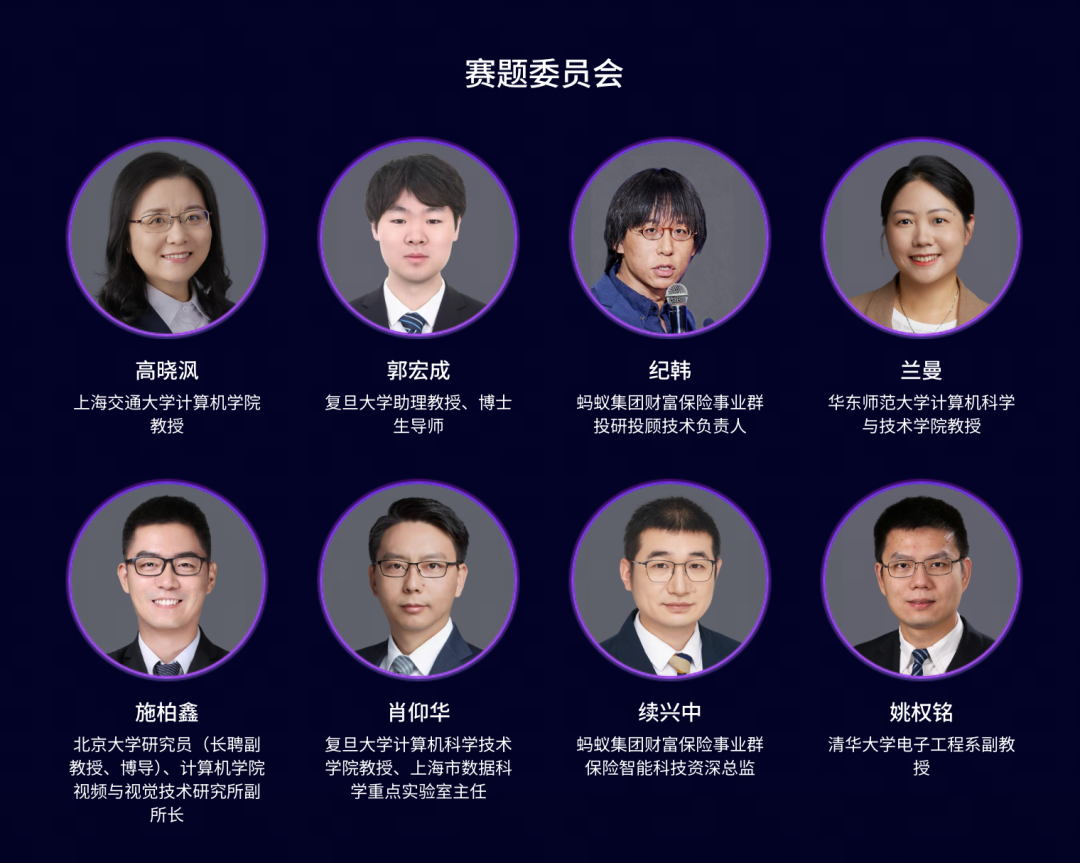
This combination has tremendous energy.
Yin Jun, Vice President of Ant Group, CTO of the Wealth Insurance Business Group, and Chairman of the competition organizing committee, pointed out: AI is extremely hot today, but when it truly lands in industry, especially in finance, the difficulty is still very high.
First, due to compliance, risk control, and other requirements and challenges, the concrete form of “finance + AI” still needs to be explored.
Second, the value that financial AI can create has not yet been proven.
Can the investment generate enough return? What is the upper limit in the long run? None of these has a clear AGI-style standard answer like the narratives around large language models.
Financial institutions face operational pressure, and concerns about value, compliance, and risk all affect how quickly the industry embraces AI.
Academic institutions do not suffer from the “transformation paradox” caused by opportunity cost, but they also find it hard to deeply engage in real financial scenarios, because financial institutions have much stricter confidentiality requirements.
The emergence of AFAC provides a “sandbox” that gets as close as possible to real scenarios, thereby connecting industry and academia.
And when the know-how hidden inside the “black box” is unpacked and real business data is opened up, industry, academia, and research can innovate together around the same target.

That said, Chairman Yin Jun also admitted that from another angle, perhaps it is precisely these difficulties that give vertical-scenario AI its unique appeal.
This is a track with its own moat.
It’s not as cutthroat as general AI, and you don’t need top-tier AI pedigree at the very peak of the pyramid. Compound talents can leverage their own know-how of the financial industry to build a different kind of competitiveness.
And Ant has been supporting this for four years now.
Since AFAC was first held in 2023, it has attracted more than 15,000 teams and nearly 50,000 participants, covering over 600 universities and 400 companies. It was jointly launched by nearly 30 institutions including the China Computer Federation, Peking University, Ant Group, and NVIDIA, and has now grown into one of the top financial intelligence competitions in China and even worldwide.