
Gemni 3.5 Pro, when exactly is it coming out!!!
Jay reporting from Aofeisi
QbitAI | WeChat Official Account
Even though its coding ability is still a mess, Google really does have a couple of tricks when it comes to “multimodality.”
Gemini Omni Flash has officially opened up API access — the video version of Nano Banana.
Muggle-to-wizard “Harry Potter” makeovers are no longer a dream. Just look at these four official digital magic tricks performed with Gemini Omni:
It’s absurd. With this level of consistency and text clarity, who needs green screens or special effects? Just do a live-streamed Doctor Strange.
At the same time, the much-anticipated “banana” has also gotten a “light-speed version.”
Nano Banana 2 Lite: the fastest and most cost-efficient Gemini image model to date.
And that’s no exaggeration — it can generate an image in 4 seconds, and a 1K-resolution image costs only a little over 20 cents.
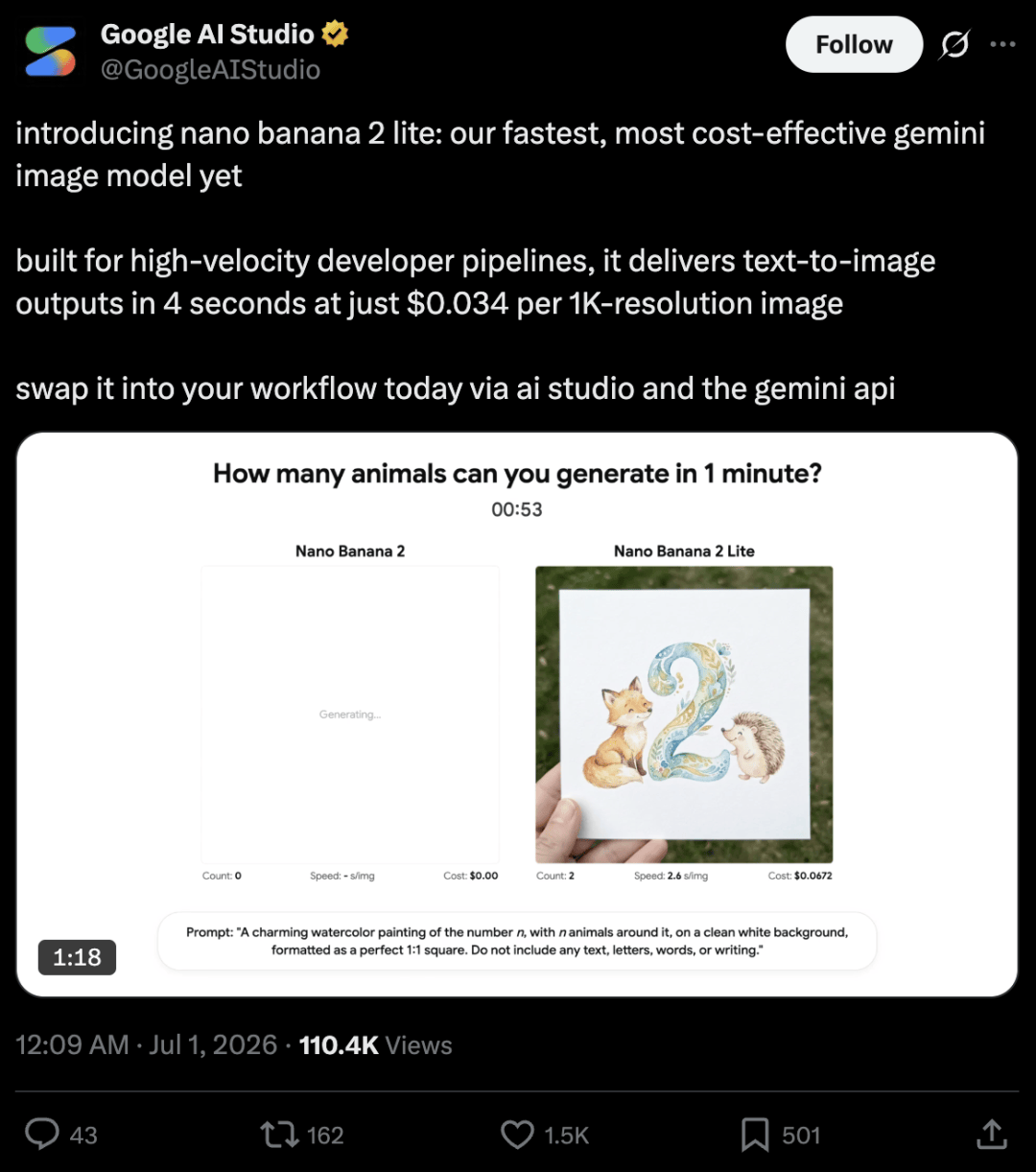
Compared with Nano Banana 2, the speed is seriously next-level.
Not to mention that a single image generation can take on what would keep GPT Image 2 busy for 3 minutes…
No wonder Gemini 3.5 Pro still hasn’t materialized after all this time — so all the time was spent on the long-awaited multimodal stuff, huh, Hassabis!!
Gemini Omni Flash
First unveiled at Google I/O 2026, Gemini Omni Flash deeply combines Gemini’s multimodal reasoning with video generation and editing, immediately drawing a lot of attention.
Now, the model is officially available to developers through the Gemini API and Google AI Studio. It can easily generate and edit high-quality videos based on a range of inputs, including text, images, and video.
Four key capabilities:
- Conversational video editing: modify and refine videos with natural language, like editing a Feishu document.
- Multimodal references: combine image, text, and video inputs while maintaining scene control and consistency.
- Real-world knowledge: tap Gemini’s knowledge of history, biology, narrative logic, and more to build videos, so you don’t have to write three pages of prompts describing architectural style.
- Text and motion synchronization: directly connect text and graphics to video motion with simple prompts.
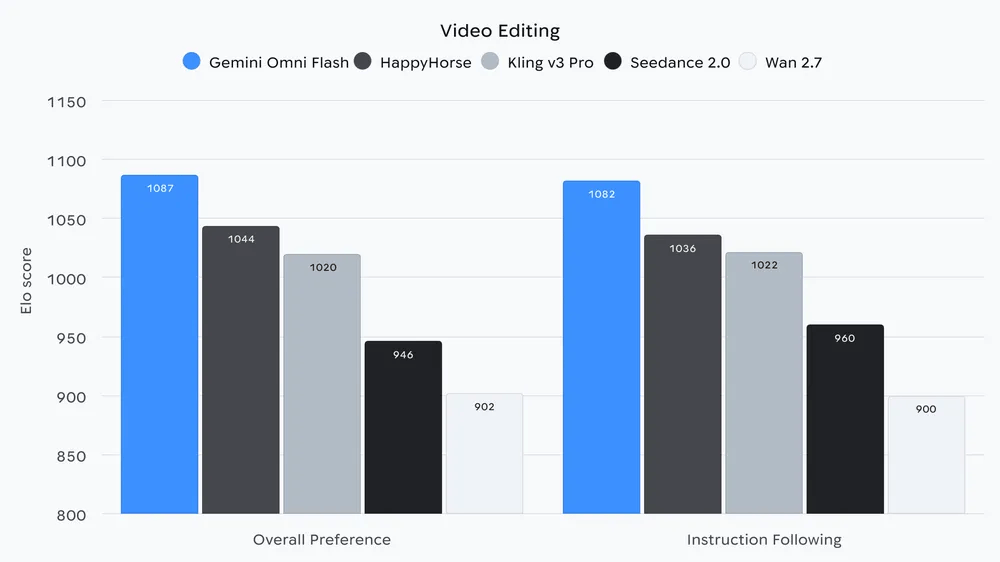
The pricing is also highly competitive: video output costs $0.10 per second, on par with Veo 3.1 Fast.
In terms of positioning, Omni Flash is also a lightweight video generation model, but it places greater emphasis on Gemini’s world knowledge, and its ecosystem is fully aligned with the Gemini stack.
That said, Google is also very upfront and has openly listed a bunch of current limitations:
-
It currently only supports 10-second video generation, with longer videos coming later;
-
Audio reference uploads and scene extension are not yet supported;
-
The API supports reference clips up to 3 seconds long, but the model still cannot properly handle this type of input at the moment;
-
Character consistency during scene changes and camera movement is still limited.
Nano Banana 2 Lite
Nano Banana 2 Lite, also known as gemini-3.1-flash-lite-image, is designed specifically for high-speed processing.
After targeted optimization, it is aimed at real-time scenarios that are extremely latency-sensitive and need to process large volumes of images in a short time — such as bulk generation of e-commerce assets, rapid advertising iteration, and automated content pipelines.
Two core selling points —
- Lightning fast: image generation latency is about 4 seconds, one-fifth that of Nano Banana 2 (which is around 20 seconds).
- Dirt cheap: a single 1K image costs about $0.034, half the price of Nano Banana 2 and one-fourth that of Nano Banana Pro.
They cut the speed, they cut the price, but the image generation and editing capabilities haven’t taken a noticeable hit. Nano Banana 2 Lite still delivers excellent text rendering, and on benchmarks it sits on the same level as models like Grok.
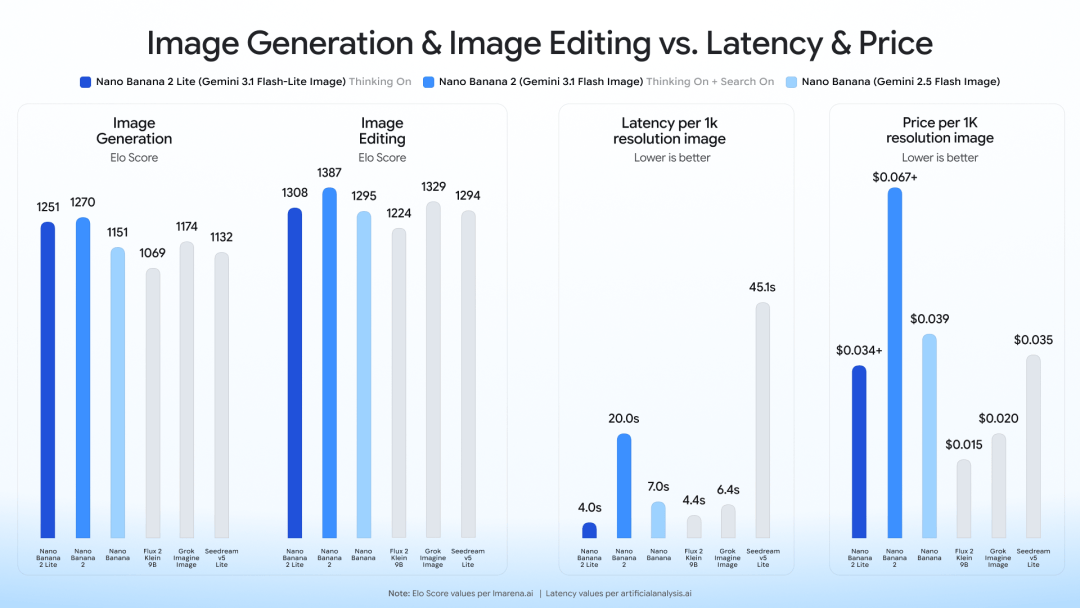
So Google’s advice is: if you’re still being stingy and using the original Nano Banana, upgrade now. The Lite version is already crushing it across all key metrics.
A Perfect Pair
Wait, don’t go yet.
At first, it seemed like this was just the release of two parallel models. But Google says there’s more.
The real magic lies in chaining these models together.
As everyone knows, AIGC creation requires repeated iteration, and asset management is a huge pain.
Now, with these two models, there’s finally no need to keep uploading files over and over again — image generation and video creation can now flow together seamlessly.
Specifically, you can first use Nano Banana 2 Lite to generate images at lightning speed, then feed those images as reference material into Gemini Omni Flash and convert them into videos with one click.
To demonstrate this 1+1>2 workflow magic, Google even built three demo apps:
1. Anywhere
Take a selfie or upload a photo, and NB2 Lite instantly P’s you into dozens of landmarks.
Then tap the image, and Omni Flash turns the static landmark into a dynamic short video.
Cyber tourism has now been fully end-to-end.
2. Space Lift
This one is a little scary — if it gets combined with the Genie world model, it may end up threatening quite a few traditional interior design SaaS companies in the future.
Upload a room photo, and NB2 Lite first generates a variety of interior design styles. Pick the one you like, hit the video button, and Omni can directly give you a cinematic spatial walkthrough.
3. Omni product studio
A blessing for cross-border e-commerce.
Take a white-background product shot, NB2 Lite generates all kinds of contextual product images, and Omni Flash then turns the static images into short e-commerce videos.
From “product” to “ad creative,” the entire pipeline runs automatically.
So, what is multimodality actually good for?
Google has probably been asked this question countless times.
Especially in 2026, when coding is basically synonymous with model intelligence. Every company is going all-in on coding.
Why obsess over multimodality?
Setting aside the AGI narrative, Google’s multimodal models can indeed power a lot of its products in the short term.
The AGI narrative aside, Google’s multimodal stack can clearly empower a lot of its products in the near term — Stitch is one example, Pixel’s built-in photo editing is another, and NotebookLM’s breakout success has also been impressive.
These two new models also reveal even more potential for multimodal applications in vertical scenarios. E-commerce, interior design, short-form video… these are real business needs, and the money is real too.
And with the Android ecosystem behind it, commercialization is basically not something to worry about too much.
Google may not be able to catch up in coding for now, but in the multimodal arena, it might be the only player capable of assembling a full hand.
But…
Gemni 3.5 Pro, when exactly is it coming out!!!

References: