
Advancing the frontiers of Physical AI together.
The results of paper acceptance for ECCV 2026, Europe’s premier computer vision conference, have officially been announced. KE Holdings Technology had three papers accepted, covering key areas of Physical AI, including spatial perception and reasoning, reinforcement learning data generation, and high-fidelity physical simulation. Along with CVPR and ICCV, ECCV is regarded as one of the three top international conferences in computer vision, focusing on academic advances in spatial perception, embodied intelligence, physical simulation, and related fields.
As AI moves from the digital world into the physical world, the industry’s focus is shifting from “whether large models can understand language” to “whether agents can understand space and act in the real world.” Spatial understanding, simulation training, and continual learning are becoming the core infrastructure of Physical AI. The three papers accepted by ECCV this time correspond precisely to the key stages of Physical AI—from perception and learning to action training—systematically showcasing KE Holdings Technology’s achievements across the full “data–simulation–evaluation” pipeline of Physical AI.
KE Holdings Technology explores next-generation Physical AI simulation platforms with NVIDIA, Adobe, and others
“If compute is the most important infrastructure in the large-model era, then in the Physical AI era, simulation and data are becoming the most important infrastructure. Robots cannot learn from the internet the way language models do; instead, they need to continuously perceive, trial-and-error, and interact in environments that obey real physical laws. That is why high-fidelity simulation platforms have become an indispensable data production and training support system for Physical AI,” said Rui Tang, Chief Scientist at KE Holdings Technology.
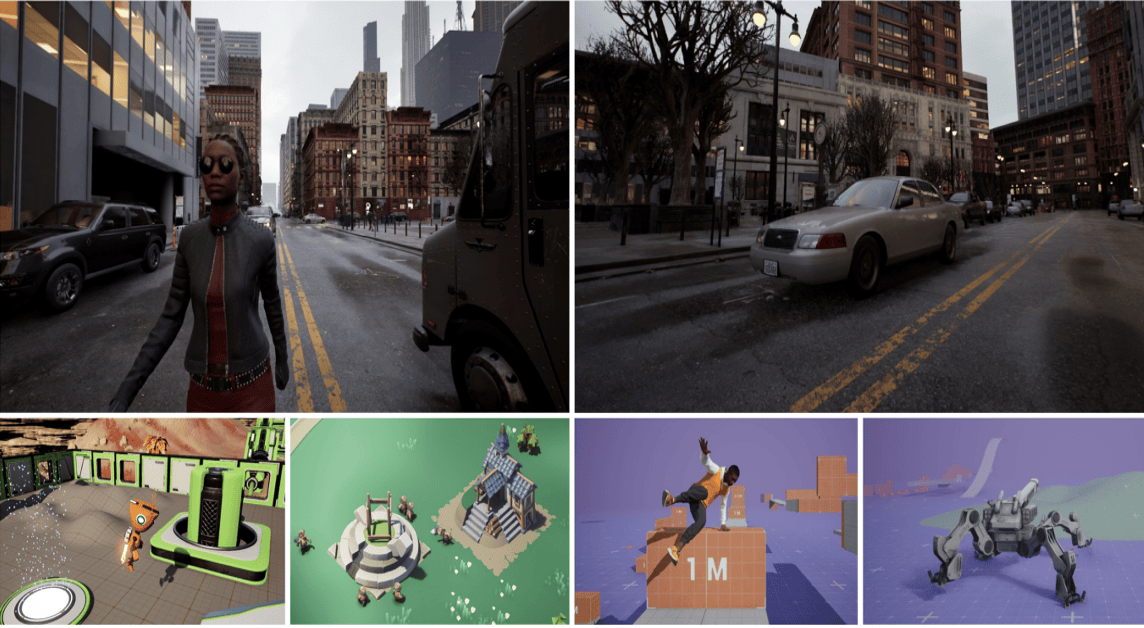
In response to issues such as insufficient programmability in existing simulation tools, low data transfer efficiency, and a lack of large-scale structured scene assets, KE Holdings Technology, together with Adobe, NVIDIA, Apple, Intel, and other institutions, proposed SPEAR to explore the next generation of high-fidelity simulation platforms for Physical AI.
SPEAR combines NVIDIA’s accumulated expertise in the robotics training ecosystem, KE Holdings Technology’s spatial data and structured scene capabilities, and Apple’s and Adobe’s strengths in content assets, connecting the critical chain from “spatial data” to “digital worlds” to “robot training.” Compared with similar simulators, SPEAR exposes more than 14,000 native Python interfaces, enabling highly programmable control. At the same time, it can synchronously output rich physical-property data such as depth maps, surface normals, instance segmentation, semantic segmentation, and material IDs, giving robots more complete environmental perception. More importantly, SPEAR can seamlessly integrate with KE Holdings Technology’s open-source structured 3D datasets, such as InteriorAgent and InteriorGS, whose assets natively include SimReady-standard physical properties like dimensions, collision bodies, and joints, enabling rapid conversion from real spaces to training environments.
Source: SPEAR paper
This means SPEAR is not just a simulation tool, but a data production infrastructure for Physical AI—one that allows the physical world to be digitized, simulated, trained on, and continuously transformed into the data assets needed for robot learning and evolution.
Building a full-chain “data–simulation–evaluation” data flywheel
Large-scale deployment of Physical AI faces a fundamental supply bottleneck: the ability to provide large-scale 3D spatial data is lagging far behind the growth in model training demand.
Syn-GRPO, another paper from KE Holdings Technology, proposes a data self-evolution framework for reinforcement learning that can automatically generate new training images during the training process, fundamentally addressing data scarcity and rigid model convergence. The framework consists of two collaborative modules: one for diverse image generation, which keeps the target object unchanged while replacing the background to create entirely new samples and ensure annotations remain fully accurate; the other redesigns the native GRPO reinforcement learning workflow by adding a diversity reward mechanism, guiding the AI to write image descriptions that can generate diverse answers and continuously produce training materials of increasing difficulty.
However, to fully validate and leverage the value of data, an accompanying evaluation benchmark is also needed.
KE Holdings Technology also introduced WalkerBench, the world’s first interactive spatial intelligence evaluation benchmark based on real street scenes. WalkerBench is a core evaluation tool for the “spatial perception” stage. It covers real street scenes in 161 cities across six continents, with no maps and no GPS—only first-person RGB images are provided to the AI, which must navigate entirely by vision. Evaluation results show that the completion rate of the strongest current AI models is only 24.5%, and performance declines more noticeably as the AI takes more steps. This reveals a fundamental contradiction: the “linear text-memory paradigm” of existing large models cannot truly represent three-dimensional spatial structure.
To address this, the research team proposed the Spatial-IDE framework, which gives AI a dedicated global spatial memory module to solve the underlying mismatch between linear context and 3D space. At present, this framework has already been zero-shot deployed directly on the Unitree G1 humanoid robot, enabling kilometer-scale autonomous navigation on real city streets—demonstrating direct transfer from benchmark to physical world.
A Physical AI data infrastructure taking shape
As AI begins to step out of the screen and into the real world, a new infrastructure stack is being redefined. Competition in Physical AI is shifting from the algorithmic layer to the infrastructure layer, and the gap in 3D data supply has already become a major industry bottleneck.
Built on years of accumulated large-scale structured 3D data and its self-developed spatial intelligence foundation model, KE Holdings Technology officially launched SpatialVerse, a spatial intelligence training platform, in 2024. Centered on two technical paths—3DGS real-scene reconstruction and AI-based 3D generation—the platform leverages high-fidelity rendering, structured spatial data processing, and real-time simulation capabilities to digitize the physical world into trainable data at scale, efficiently and with high quality, systematically addressing industry pain points such as data scarcity and the high cost of trial and error in Physical AI.
From the three ECCV achievements highlighted here, it is clear that, on the basis of continuously building a “simulation data production line,” SpatialVerse is now accelerating the integration of the entire “data–simulation–evaluation” industrial chain, aiming to create a “full-process simulated training ground” for large-scale Physical AI deployment.
On the industry side, SpatialVerse has formed deep partnerships with leading companies including ByteDance, AGIBOT, Galbot, Hesai Technology, Point One, Turing Vision, and Songying Technology. On the academic side, SpatialVerse is working with global technology leaders such as Google, NVIDIA, Adobe, and Apple to jointly advance frontier research in Physical AI.
As the Physical AI era unfolds, KE Holdings Technology is grounded in massive interactive 3D data and foundational capabilities for digitizing the physical world. With structured 3D datasets and real-world-driven world models at its core, it provides the underlying spatial intelligence infrastructure that is trainable, interactive, and measurable for Physical AI applications, accelerating Physical AI from virtual algorithms into real-world scenarios.