
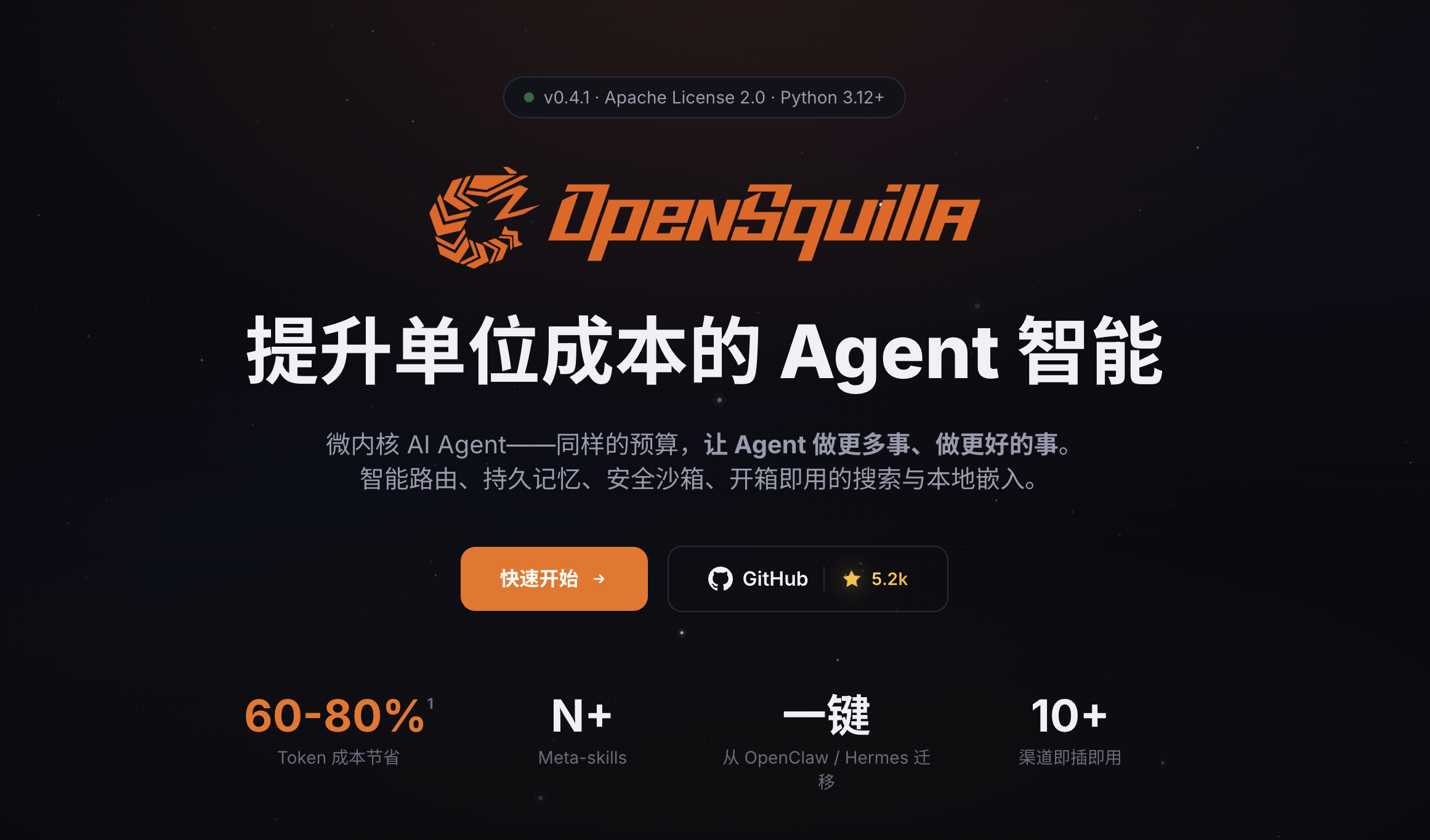
OpenSquilla’s GitHub stars surged into the thousands within weeks of launch
Open-source AI Agent project OpenSquilla recently released version 0.4.0. The core update is the introduction of a coding workflow coding mode, and, for the first time, a “self-verification” mechanism for AI coding: instead of stopping at “I’ve fixed it,” the AI now uses tests to generate verifiable evidence that it has actually made the right change before handing the result back.
This mechanism targets the most difficult bottleneck in AI Coding today: trust. Over the past year, AI coding capabilities have advanced rapidly, but being able to write code does not mean being able to trust it. Most coding Agents finish their changes and hand them over immediately; whether the result is right or wrong still has to be reviewed line by line by humans. This is also the key obstacle preventing AI coding from becoming truly unattended and entering production at scale. Internalizing verification within the Agent itself means the industry’s standard for judging AI coding is shifting from “it claims the fix is correct” to “can it prove the fix is correct.”
Its approach is an independent “red-green regression evidence chain”: first write a test that is guaranteed to fail, to define the problem and prove that it really catches the bug; then implement the feature so the test turns from red to green; finally run the project’s existing test suite to confirm nothing else was broken. Only if all three steps pass is the work considered complete; if any step fails, it is sent back immediately. It also comes with a default automated fix loop — if it does not pass, it keeps automatically reworking the code until it does — as well as isolated workspaces, where changes are made only in a sandboxed copy and merged back into the source code only after acceptance.
In an official demo, Coding mode added a “compute correct gradients” feature to the well-known open-source project micrograd — the minimalist automatic differentiation library created by Anthropic researcher Andrej Karpathy and widely regarded as a top project in AI education circles. A wrong gradient calculation will not necessarily produce an error or crash the model; it will simply cause training to drift off course silently, making it one of the hardest bugs to spot by eye. The demo proceeds in two steps: first, AI completes the above “red → green → regression” process and produces its own evidence; then a human compares micrograd’s new feature side by side with the industry-standard tool PyTorch on the same task, and the forward values and every gradient match to 10 decimal places. In other words, it is not “AI saying it is correct,” but “it matches the official reference answer exactly.” This is also the team’s latest practical step in the Coding track, following the new benchmark claw-swe-bench, toward an agent runtime.
Around the same time, OpenSquilla also launched its first signed and notarized desktop installer package, available for one-click installation on both macOS and Windows, with no command line required.
OpenSquilla positions itself around “improving Agent intelligence per unit cost,” taking Learnable Harness as its entry point and aiming to build the most cost-effective Agent product. Against the backdrop of mainstream Agent frameworks driving up model calls and token costs, it uses local intelligent routing to automatically select models based on task complexity, load skills on demand, retrieve memory on demand, and preprocess tool outputs, reducing costs before the call is even made. According to a previous report by Silicon Star, the provided data shows that its intelligent routing is about 4.4 percentage points more accurate than the general-purpose gateway OpenRouter, while costing about 75% less; compared with flagship models on similar tasks, quality is roughly on par, but cost differs by about 9x. OpenSquilla’s official website states that in routine internal testing scenarios, total cost can be reduced by around 60%–80%.
Jiyuan Ludong founder Wang Yunhe previously led large-model R&D at a top tech company, and the CTO is Han Kai. Within weeks of launch, OpenSquilla’s GitHub stars rose into the thousands; according to public reports, the company completed its first funding round just months after founding, making it one of the few representative players in the Harness and agent-native model space.