
The Next Step for AI in the Physical World
As AI moves from the screen into the real physical world, multimodal models are undergoing a revolutionary architectural shift.
Om AI Lianhui has officially launched VLX, the world’s first edge-side streaming multimodal model series designed for the physical world, introducing the entirely new model architecture of “streaming multimodality” for the first time in the industry. Unlike traditional video understanding models, which split an entire video into frames and process it offline all at once, the VLX series targets continuous video streams in the physical world, enabling millisecond-level real-time perception through streaming encoding and incremental inference with caching. For the first time on the edge, it also completes the full loop of “continuous perception → precise localization → action decision-making.”
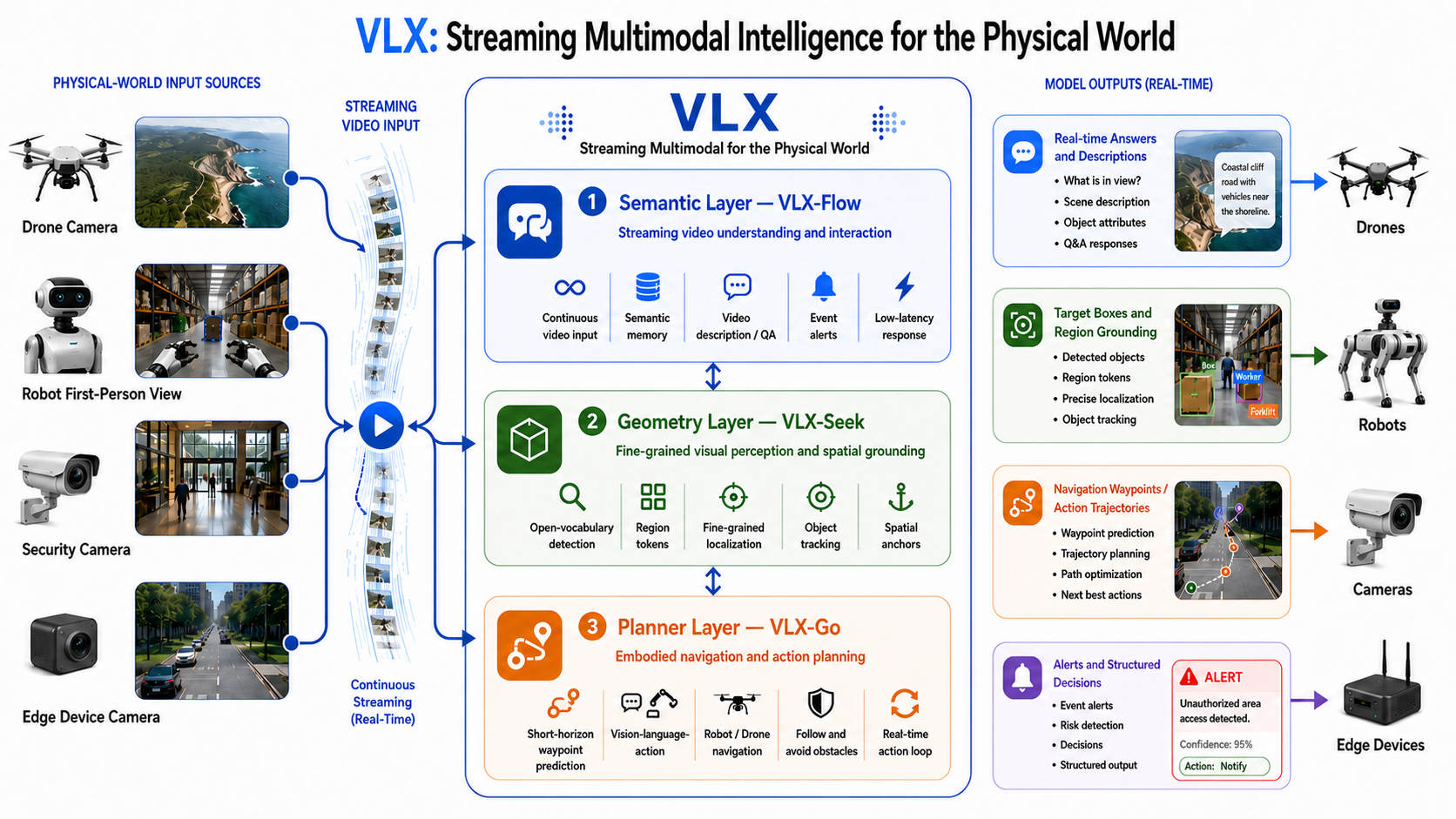
The VLX series consists of three models working together to build a complete capability stack centered on real-time physical intelligence: VLX-Flow handles continuous perception. Through incremental encoding and cached inference, it allows the model to observe the environment continuously like a human, rather than passively waiting for a question; new frames are absorbed at any time, and responses are delivered the moment a query is made. VLX-Seek handles precise localization, innovatively turning coordinate generation into region retrieval—not asking the model to “guess coordinates,” but to “select a region” from candidate areas—providing reliable spatial perception for edge devices. VLX-Go handles action execution, directly converting visual understanding into short-horizon waypoints and motion trajectories that robots can execute, rather than outputting text suggestions, allowing devices to autonomously complete following, obstacle avoidance, and navigation.
Under this new paradigm, visual information does not enter the model as “a single captured frame,” but as a “continuous stream.” The model does not “look first and then speak”; it “understands while looking, and acts proactively when needed.” What this represents is not a “better human-computer interaction experience,” but a qualitative leap in AI’s autonomous work capability.
To meet the demands of physical-world AI, three hard constraints must be confronted head-on: time is continuous, environments change dynamically, and edge compute is resource-constrained. The VLX series is built natively around real-time video streams and edge devices—not by compressing a cloud model and forcing it onto terminals, but by redesigning the architecture from the ground up for edge embodied intelligence. With four core advantages—“fast” (streaming inference, minimum single-stream latency of 0.06 seconds), “small” (lightweight model options covering 0.6B to 10B), “accurate” (fine-grained localization), and “actionable” (a perception-to-execution closed loop)—it enables an edge-side loop from continuous perception to action decision-making.
When multimodal models move from “looking at images and answering questions” to “continuous perception,” and when AI moves from the screen into the real physical world, the VLX edge-side streaming multimodal model series offers a new architectural paradigm for the evolution of physical AI—one that gives every terminal the ability to understand continuously, make decisions instantly, and act autonomously. This is what AI in the physical world should look like.