
Rewrite “How AI Repeatedly Simulates the World”
Yunzhong, from Aofei Temple
QbitAI | WeChat public account QbitAI
Prompt Engineering hasn’t faded yet, but Loop is already taking over the AI narrative.
Over the past two weeks, one of the hottest terms in Silicon Valley’s developer circles has been Loop Engineering.
It refers to a very “Agent-era” idea: stop manually prompting models round after round. Instead, design a looped system that lets AI execute, check, correct, and keep going until the task is done.
The traditional model is centered on prompts; now the shift is toward workflows. That’s also why it suddenly went viral.
And just as everyone was debating “how to get AI to run on its own,” another, harder line of work was heating up fast: Looped World Models (LoopWM), or simply LoopWM.
If Loop Engineering is about “how AI can keep working,” then LoopWM is more like answering a higher-level question:
When AI keeps working, can it also keep understanding, correcting, and reasoning through the world it is facing?
That’s why, although it also has “Loop” in its name, the technical weight and imagination it carries are clearly on a different level.
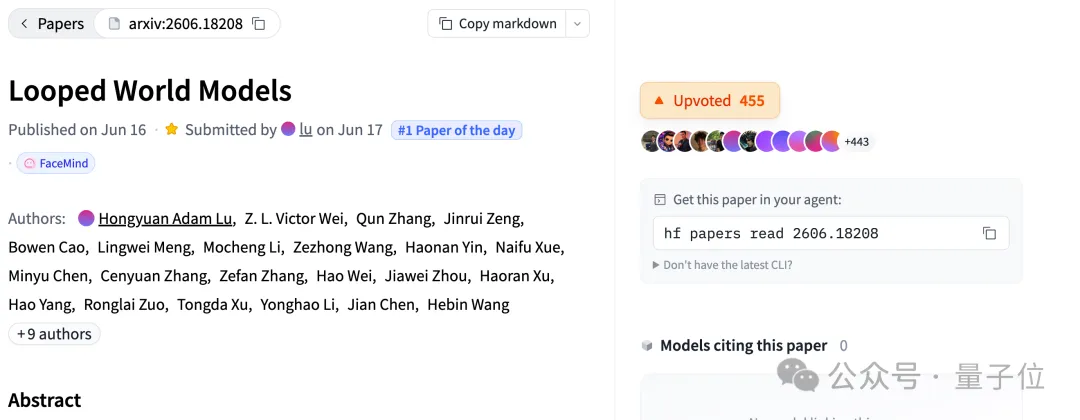
It reached Hugging Face Papers’ No. 1 spot of the day, and has now entered broader public discussion in the AI community.
Why Loop Engineering suddenly got hot
Why did Loop Engineering take off? It’s actually easy to understand.
Because a single round of dialogue is good for Q&A, but not for complex tasks.
If you really want AI to write code, debug, call tools, inspect results, fix bugs, and verify again, it has to enter a closed loop of “action — observation — reasoning — continued action.”
In other words, AI is no longer just “answering you once”; it is starting to keep pushing toward a goal.
That is one of the fundamental logics behind today’s Agent boom.
Google Chrome engineering lead Addy Osmani once put it very plainly:
You shouldn’t be prompting agents yourself anymore; you should be designing the agent’s loop.
In this narrative, humans shift from “the person operating the model” to “the person designing the automation system.”
That’s also what makes Loop Engineering feel so much like a Silicon Valley buzzword: it’s not just a technique, it’s an identity shift.
Humans move from prompt writers to system designers.
But that also creates a new problem. Being able to loop does not mean being able to understand.
An Agent can keep calling APIs, reading logs, tweaking parameters, and trying again and again. But if it does not have a more stable model of environmental state, dynamic change, and causality, it is still more like a “hard-working automatic executor” than a system with genuine world understanding.
That is exactly why LoopWM feels especially important: it is rewriting how AI repeatedly reasons through the world.
This was done by a Chinese startup called FaceMind
Next, let’s dig into who actually did this:
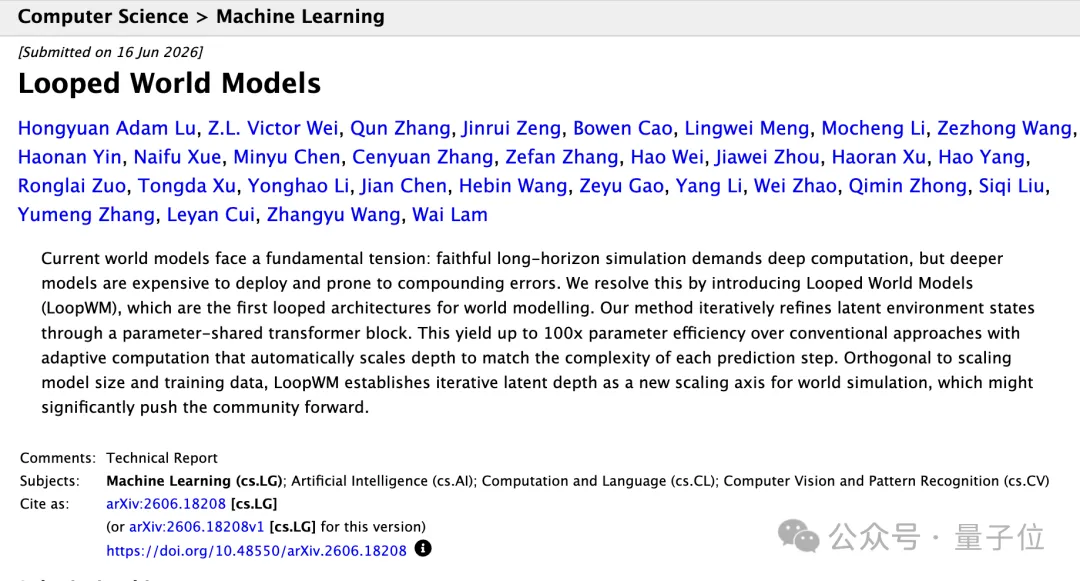
The paper’s authors, FaceMind Research Asia (脸谱心智), are the corresponding institution for this work.
According to reports, the company has completed a tens-of-millions-of-yuan Pre-A round led by StarLink Capital, with existing shareholder 360 making an oversubscribed follow-on investment, and Lu Qi’s MiraclePlus also participating.
The company was founded by post-95 PhDs Lu Hongyuan and Wei Yiran. The team initially focused on on-device multimodal models, and later shifted its attention toward the more foundational research area of world models.
Compared with large models that only generate content, world models place greater emphasis on sustained understanding and prediction of environments, interfaces, and task processes. This is also seen as an important foundation for AI to move toward GUI Agents, embodied intelligence, and robotics scenarios.
In this direction, FaceMind is improving model stability in long-horizon prediction, screen understanding, and embodied tasks through iterative loops and parameter-efficient model architectures, and has already begun validation in simulated embodied environments, GUI Agent environments, and real robot arm environments.
A young company is trying to make “understanding the world” part of the next generation of AI infrastructure.
On this, StarLink Capital partner Li Wenjue said that the FaceMind team’s most outstanding trait is that it combines solid research capability with complex engineering execution ability.
The team’s core members have long been deeply involved in foundational AI technologies. They can both form independent judgments about frontier directions and quickly put research results into real-world validation. “What we value is a team with high talent density, forward-looking technical judgment, and strong execution.”
In Li Wenjue’s view, Lu Hongyuan combines the curiosity of a young researcher with the drive of an entrepreneur, enabling the team to keep tackling difficult problems and turn technical judgment into clear R&D directions.
 △FaceMind founder Lu Hongyuan
This founder profile and team cohesion were important reasons for StarLink Capital’s decision to invest.
Qichi Xi, former pre-investment lead at 360 Group, which invested in FaceMind, said: “Dr. Lu is one of the most outstanding young AI researchers I’ve ever met.”
In his view, Lu Hongyuan is not focused on local optimization, but on the underlying principles and architectural innovation of models.
When the industry was still discussing the concept of world models, FaceMind had already trained world models from scratch and achieved industry SOTA-level results across multiple benchmarks.
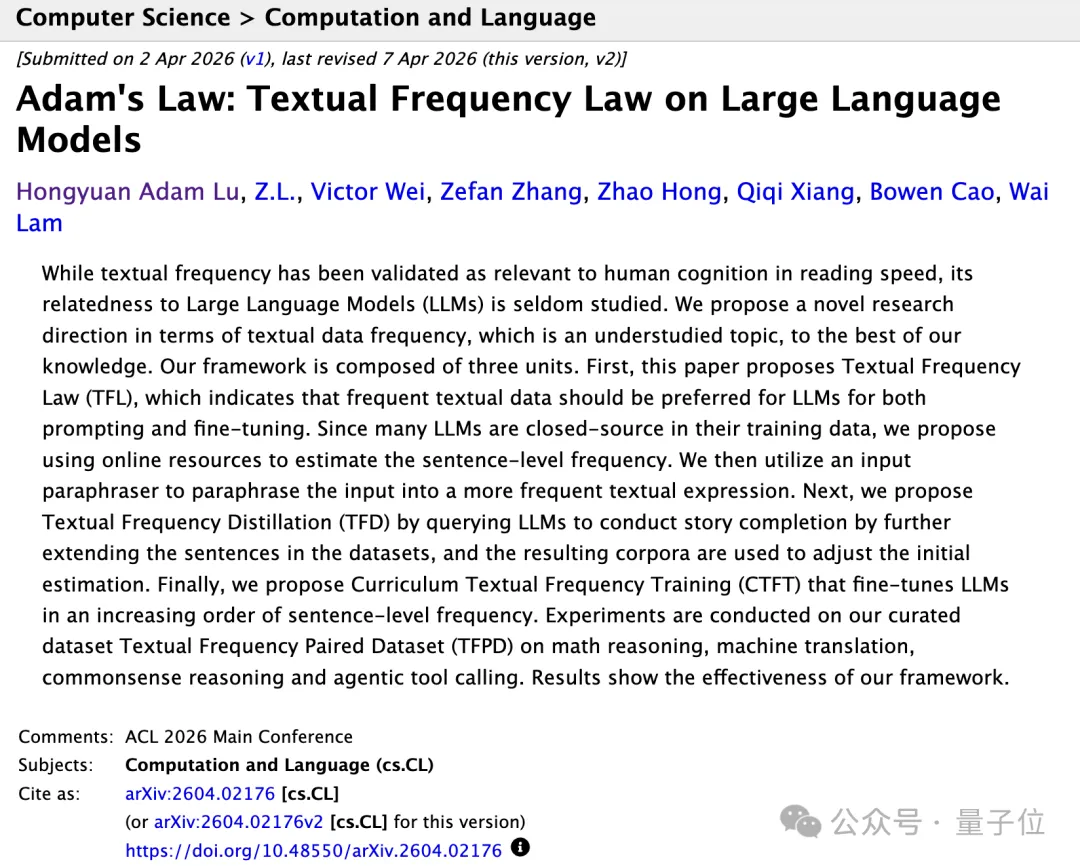
After that, the Adam’s Law proposed by Lu Hongyuan attracted attention and validation from Anthropic, a leading overseas model company. The team’s latest Loop architecture further explores the long-horizon training problem in world models.
“The iteration speed is astonishing. Before every conversation, I first go and read their latest papers and technical reports,” Qichi Xi said with emotion, adding that he truly felt what it means to have “one investment, lifelong learning.”
When asked why it was a Chinese startup that could produce such work, Lu Hongyuan replied:
China is now a country with a very high density of AI talent, and that is one of the main reasons we were able to produce a world model paper that is epoch-making.
FaceMind will also be seen by more international eyes in the future, just as their work was recently liked on X by Accel, an investor in Anthropic/Facebook.
What exactly did the paper do?
Put simply, what LoopWM does is this:
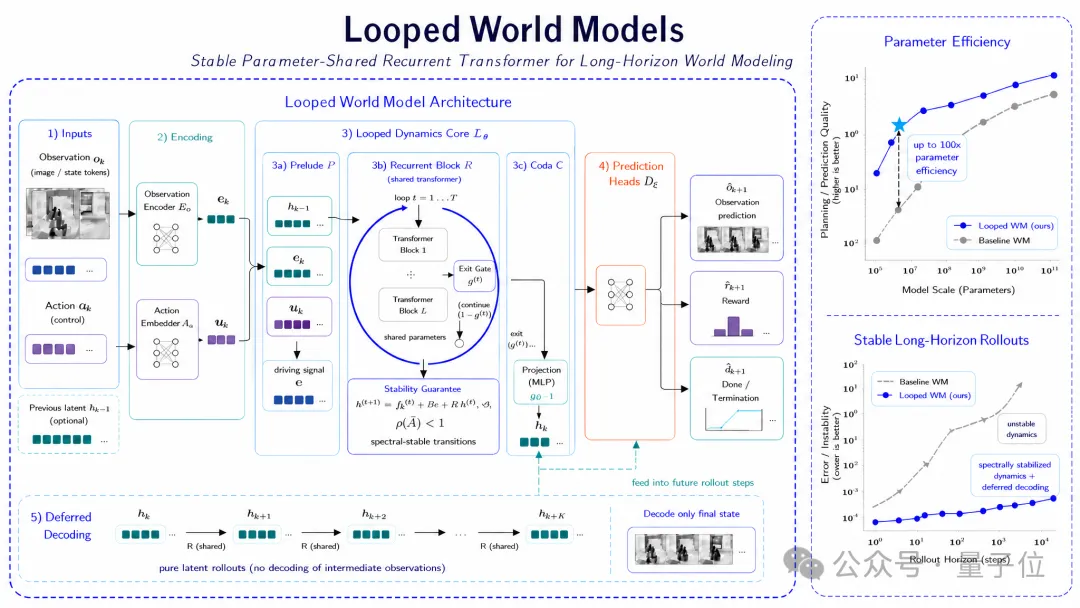
Instead of letting the model “guess” the world state in a single forward pass, it uses a Transformer module with shared parameters to repeatedly refine the latent environment state.
There is a very practical contradiction behind this.
To do high-quality, long-horizon environment simulation, computation has to be deep enough; but once a model gets deeper, both parameter count and inference cost rise sharply.
And the longer the rollout, the more errors accumulate layer by layer, eventually dragging down the whole simulation.
The paper puts it like this:
faithful long-horizon simulation demands deep computation, but deeper models are expensive to deploy and prone to compounding errors.(高保真的长时程模拟需要深度计算,但模型越深,部署代价越高,误差累积的风险也随之上升。)
LoopWM’s idea is to replace one-shot depth accumulation with looped reuse.
Instead of adding a huge number of new parameters each time it gets deeper, it repeatedly refines the same latent state through Transformer blocks with shared parameters.
Simple scenarios run fewer rounds; complex scenarios run more rounds. Computation depth begins to adapt dynamically to task complexity.
The paper summarizes this as a new scaling axis: iterative latent depth, independent of model size and training data.
From now on, making world models stronger will not necessarily depend only on being “bigger”; it can also depend on being better at thinking repeatedly.
The numbers are the most persuasive part. The paper reports:
- Up to 100× improvement in parameter efficiency;
- For simple state transitions, single-step inference FLOPs can be reduced by about 25×;
- In long-horizon rollouts, total compute savings can reach up to two orders of magnitude.
These are not just “nice-to-have” optimizations; they directly target core metrics such as deployment cost, inference efficiency, and long-range stability.
According to the paper, on the ScienceWorld benchmark, LoopWM can match world-model-specific tasks with models that have two orders of magnitude more parameters.
That means it is not “winning with a bigger model,” but winning certain key tasks with a smarter computation method.
This is not just an Agent upgrade; the AI cognition layer is shifting gears
There is a growing anxiety in the AI community:
Being able to talk is not enough, and being able to use tools is not enough either. The real challenge is sustaining reasoning ability across long chains, dynamic environments, and complex feedback.
Loop Engineering answers this by creating a closed loop so AI can drive itself forward.
LoopWM goes one step further: it gives AI a mechanism to repeatedly, stably, and on demand compute the world state as it advances.
The discussion of LoopWM on X also indirectly shows how significant this is.
Community attention did not stop at the slogan “100× parameter efficiency”; it landed on several more fundamental technical terms:
shared transformer block, adaptive compute, spectral stability, deferred decoding, iterative latent depth……
All of these point to the same conclusion: world models may have finally found a more elegant path of evolution than “just keep scaling parameters.”
Over the past year, the biggest change in Agents has been turning AI from an “answering tool” into an “executing tool.”
The change implied by LoopWM goes even further: it takes a step from “execution system” toward “world modeling system.”
The former solves the efficiency problem: how to reduce manual work and increase automation.
The latter solves the upper-bound problem:
When AI truly enters complex environments such as robotics, simulation training, and spatial interaction, what allows it to maintain continuous understanding of the world?
Fei-Fei Li has said that when it comes to spatial intelligence, today’s large language models are good at handling language, but lack a truly grounded understanding of the physical world; and world models are precisely an important infrastructure on the path toward that kind of spatial and physical understanding.
That is where LoopWM matters: it moves the concept of Loop, which originally belonged to Agent workflows, explicitly into the world model itself for the first time, changing the growth logic rather than applying small patches.
Silicon Valley first got excited about Loop Engineering — it is closer to the developer experience and fits the narrative of “letting AI run on its own.”
But if you zoom out over time, the work that may be worth revisiting again and again is actually Looped World Models.
Because it tries to answer whether AI can truly understand the world while operating autonomously. That determines whether the system can grow tomorrow.
Prompt Engineering defines how AI responds to humans, Loop Engineering defines how AI keeps doing things, and Looped World Models may define how AI truly understands the world while doing things.
Paper link: https://arxiv.org/abs/2606.18208