
“Value-for-money model” prices are quietly rising
By Kelexi, from Aofeisi
Quantum Bit | QbitAI Official Account
Claude has just been updated again.
But this time it’s not the flagship model. Anthropic has launched a new value-for-money model: Sonnet 5.
Anthropic describes it as the most “productive” Sonnet so far, capable of planning tasks on its own and calling on the browser and terminal.
Its benchmark performance comes close to the company’s most expensive model, Opus 4.8, while costing only about 60% as much — a true “Opus alternative.”
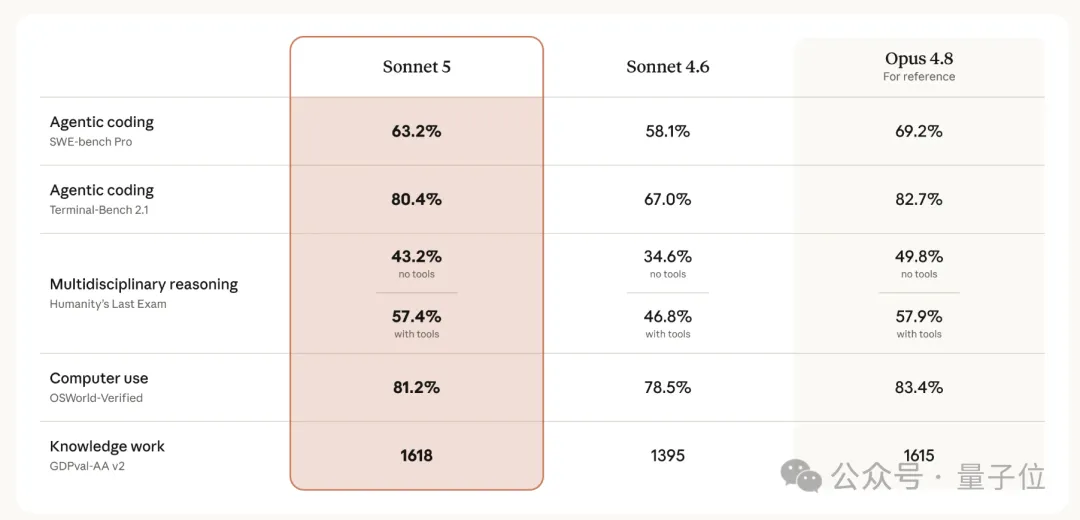
The numbers speak for themselves: on the agentic coding benchmark SWE-bench Pro, it scores 63.2%, up 5 percentage points from the previous Sonnet 4.6.
Its listed price is exactly the same as 4.6’s. From the launch presentation, it looks like capability went up, but the price did not.
Did it really not go up…?
Developer Simon Willison did something simple: he fed the same text into the old and new models and compared the token counts.
He found that although Sonnet 5 appears to be priced the same, the token usage on the bill has secretly increased by 30%.
Well played, Anthropic — this is straight-up switcheroo territory.
An “Opus alternative”
The main focus of Sonnet 5’s upgrade is improved agentic capability.
The model can break down tasks on its own, use tools like the browser and terminal, and complete a multi-step job in one go without dropping the ball. After finishing, it also proactively checks its own output, without needing a reminder.
The benchmarks show clear progress.
On the agentic coding test SWE-bench Pro, Sonnet 5 scores 63.2, compared with 58.1 for Sonnet 4.6 and 69.2 for Opus 4.8. Sonnet 5 sits between the two generations, only 6 points behind Opus.
On the computer use test OSWorld-Verified, Sonnet 5 scores 81.2%, while Opus 4.8 scores 83.4%, narrowing the gap to 2.2 percentage points.
And on the knowledge-work benchmark GDPval-AA v2, Sonnet 5 scores 1618, actually beating Opus 4.8’s 1615 by 3 points.
Feedback from two companies that got early access to the model also supports this picture.
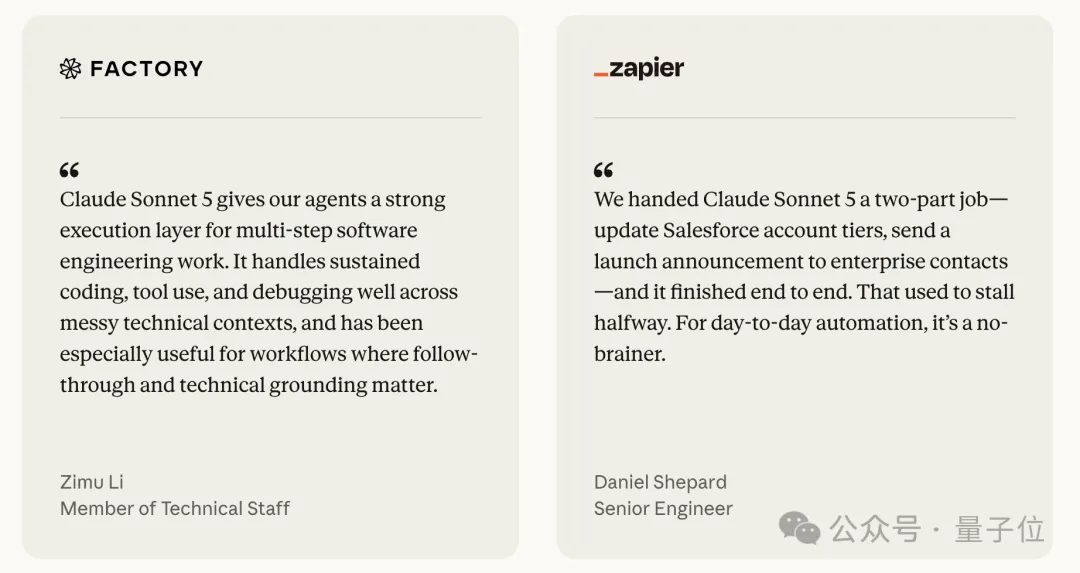
Zimu Li, an engineer at AI coding platform Factory, said Sonnet 5 gives their agents a solid execution layer, allowing them to keep coding, calling tools, and debugging in messy technical environments. It is especially well-suited for workflows that require long-running follow-through and strong attention to technical details.
Daniel Shepard, an engineer at automation platform Zapier, gave a more concrete example: they gave Sonnet 5 a two-part task — first update customer account tiers in Salesforce, then send a product launch announcement email to enterprise customers.
In the past, this kind of task would often get stuck halfway through — for example, the account tiers would be updated but the announcement wouldn’t go out, or vice versa. This time, Sonnet 5 ran both parts from start to finish without stopping in the middle to wait for human handoff.
Shepard put it bluntly: for everyday automation, this is the kind of model you should just use without overthinking it.
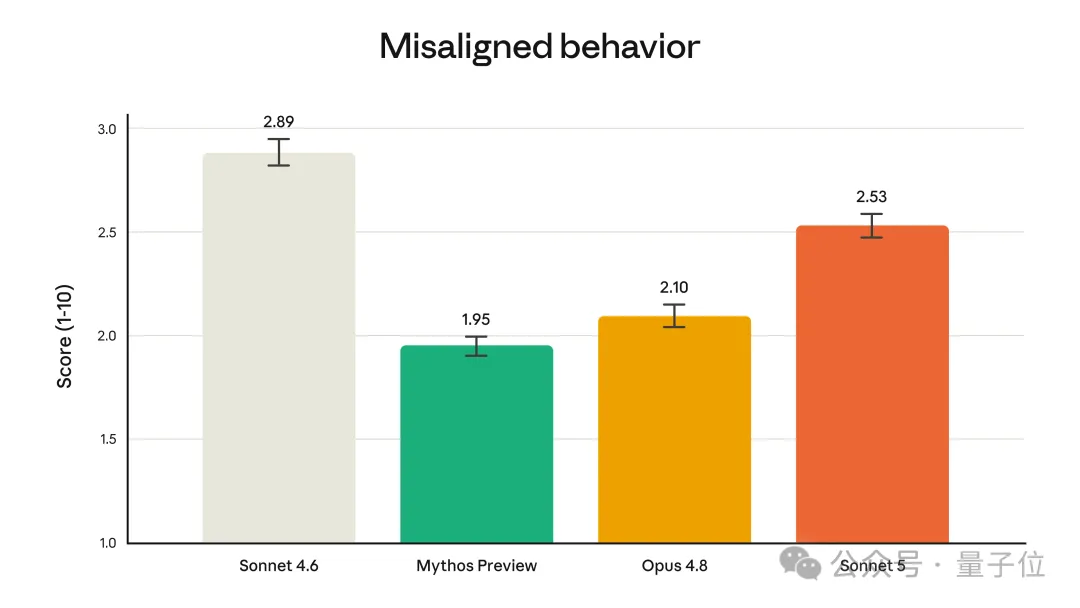
Anthropic’s safety evaluation results, released at the same time, also line up with this theme.
Sonnet 5 has lower hallucination rates and a lower tendency to be sycophantic than Sonnet 4.6, and in autonomous tool-use scenarios, it is also better at resisting hijacking attacks such as prompt injection.
And when you place these performance numbers next to the price, the meaning becomes even clearer.
Opus 4.8 is priced at $5/$25 per million input/output tokens, while Sonnet 5 is $3/$15 — only about 60% of Opus’s price, or just 40% with the limited-time discount available until the end of August.
On paper, it delivers more than 90% of the performance at only 40% to 60% of the cost. In practice, Sonnet 5 is an Opus alternative.
Is Sonnet 5 really cheaper?
Now that we’ve covered performance, the pricing story reveals another side.
Sonnet 5 uses a new tokenizer — the way the model breaks text into tokens.
With the new tokenizer, the same piece of text is now split into more tokens, which naturally pushes the total cost higher.
The person who discovered this was developer Simon Willison.
Instead of stopping at the official claim that “the price hasn’t changed,” he tested several real documents in different languages using a token-counting tool he wrote himself.
For the English version, Sonnet 4.6 produced 2,356 tokens, while Sonnet 5 produced 3,341 — a 42% increase. The Spanish version rose by 33%.
A 4,279-line Python file went from 44,014 tokens to 56,118, up 27%.
Only Simplified Chinese barely changed, from 3,334 to 3,360, an increase of just 1%.
The impact of a tokenizer change can differ by more than 40 percentage points across languages — and that contrast is arguably more worth paying attention to than the price increase itself.
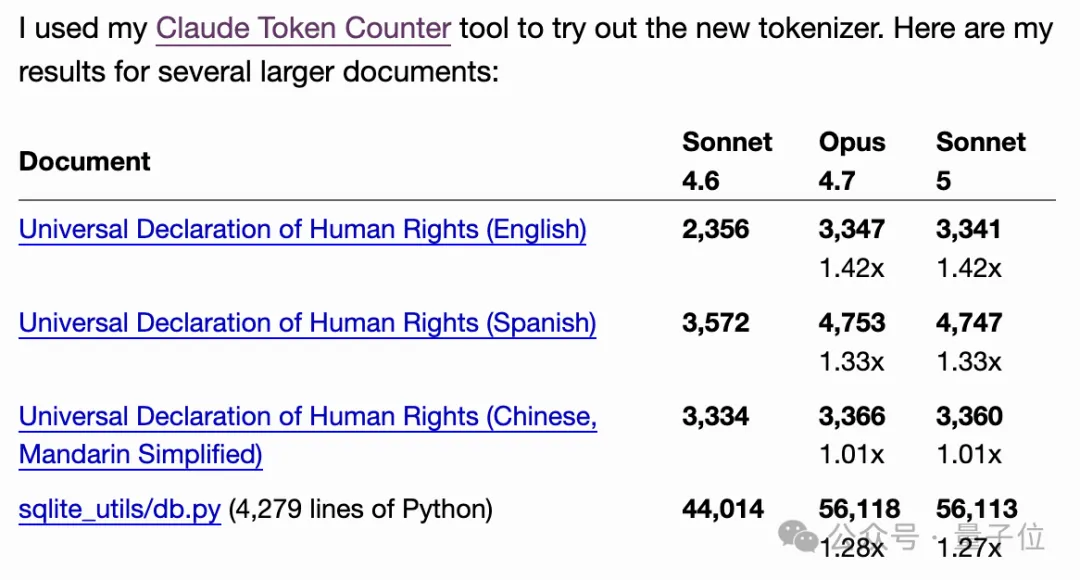
Put these numbers together, and it becomes clear that “the unit price hasn’t changed” is true, but not the whole truth.
For the same English text, you now spend more than 40% more than you did in the Sonnet 4.6 era.
But even so, shouldn’t it still be cheaper than Opus? Developers quickly pushed back on that idea.
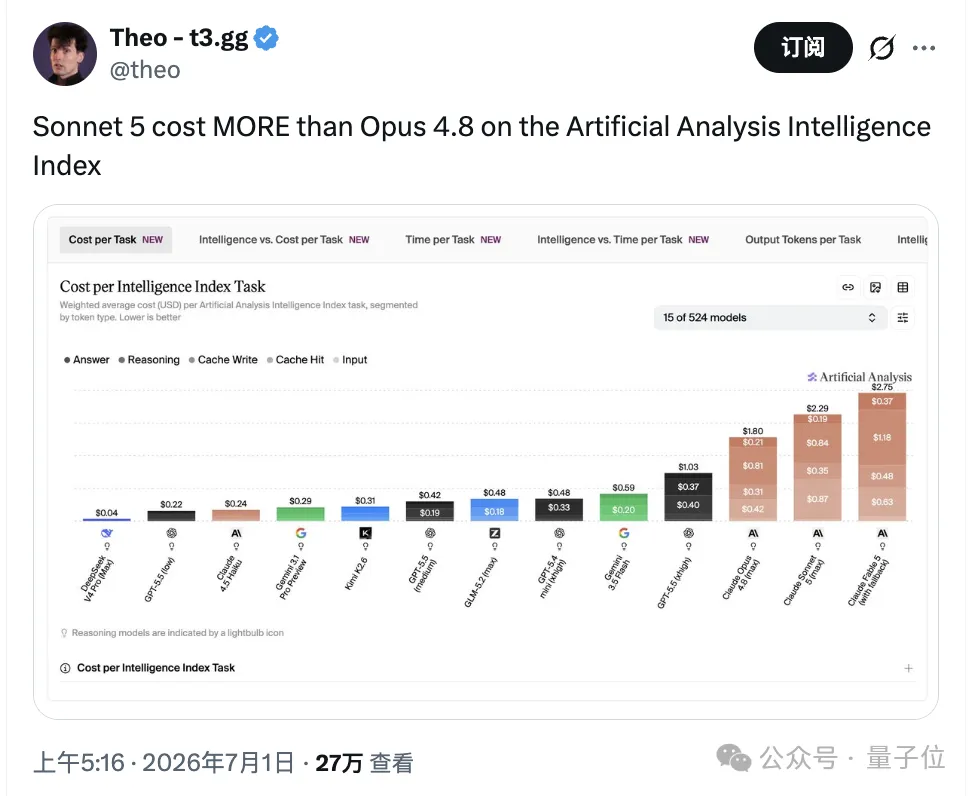
One developer found that in actual use, Sonnet costs even more than Opus.
For a task on the Artificial Analysis Intelligent Index, Opus 4.8 costs an average of $1.8 weighted, while Sonnet 5 costs $2.29 — 27% more.
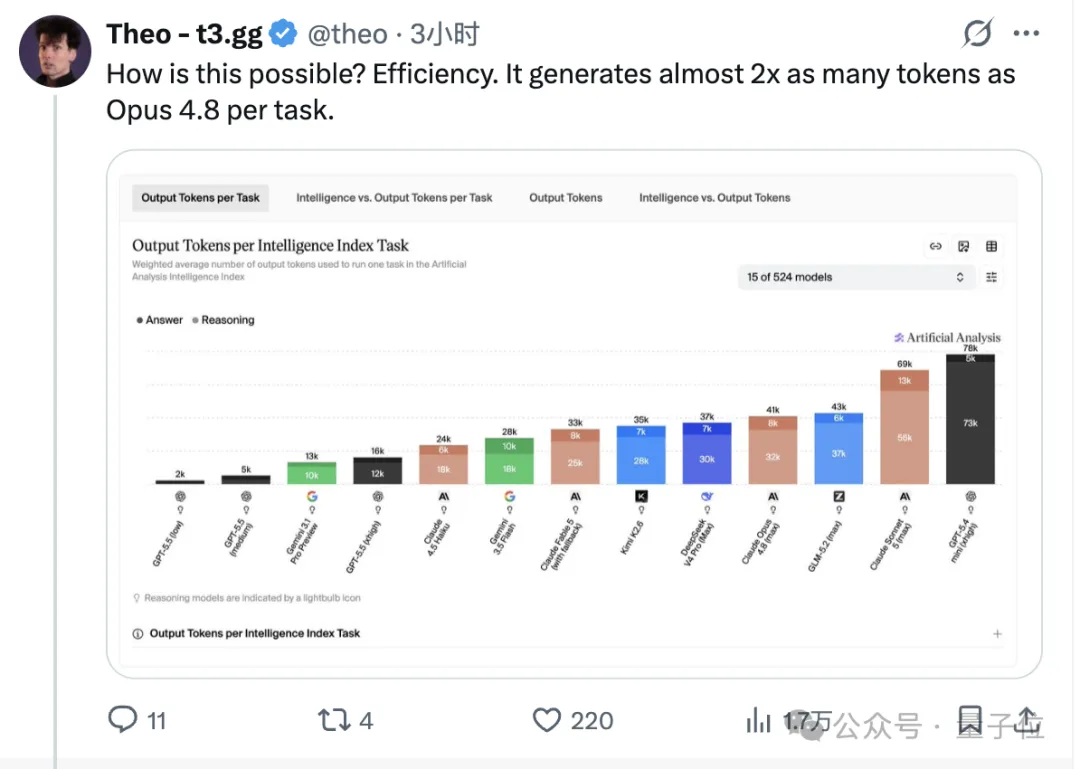
He further found that for the same task, Sonnet 5 consumed up to twice as many tokens as Opus.
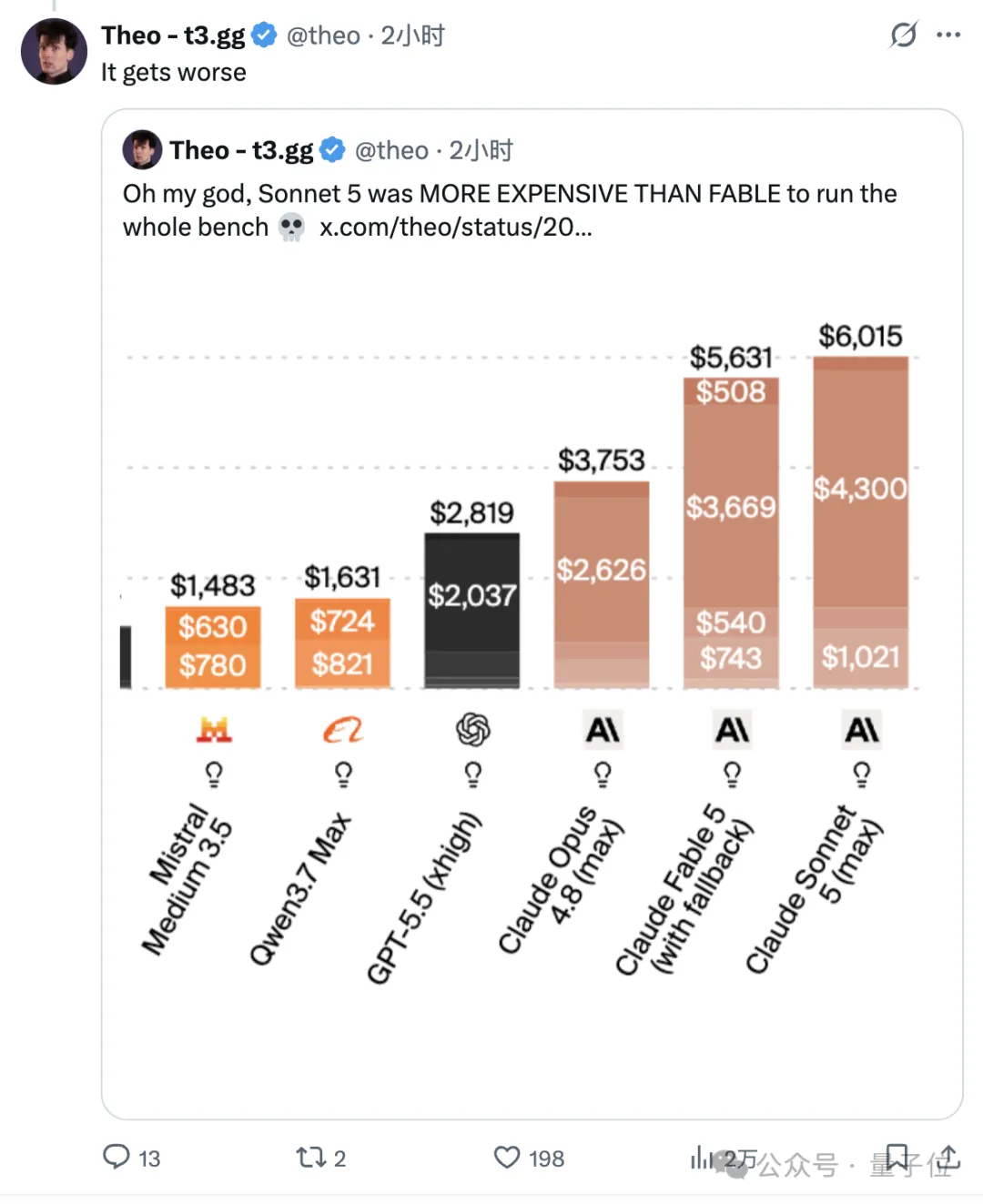
Looking at the cost of running the full benchmark, Sonnet 5 ended up costing 6.8% more than fable.
Fortunately, developers have token-counting tools in hand, which makes it possible to measure this difference precisely. That’s also why Willison was able to put this “hidden price hike” on the table on the very night of the launch.
For ordinary users, the most likely outcome is simply looking at the bill at the end of the month and vaguely thinking, “Why did I spend so much this month?” — and then getting caught out.
How should developers choose?
If we place this “official price cut, hidden price increase” story about Sonnet 5 in the broader industry context, price hikes themselves aren’t unusual over the past couple of years. The real difference is which path a company takes.
In April this year, OpenAI adjusted GPT-5.5 pricing by taking the straightforward route: it directly raised the per-million input/output token price from $2.5/$15 to $5/$30 — a full doubling. Anyone opening the pricing page could see the numbers had changed.
Sonnet 5 took a different route. The price line on the page did not change by a single character; the increase was buried in the technical detail of a tokenizer upgrade, and you wouldn’t notice it unless you measured it yourself.
For developers planning to migrate workflows to Sonnet 5, one thing is more useful than memorizing whether the price table changed: run your own real workloads through a token-counting tool first and estimate the actual cost.
After all, the price sheet can only tell you the unit price. The bill tells you what the upgrade will actually cost.
That quietly rewritten bill and the idea of an “Opus alternative” are really two sides of the same coin.
Sonnet 5 does deliver capabilities that come much closer to Opus at a lower listed price. But this time, behind the phrase “lower price” lies a ruler with a different scale.
Finally, some developers pointed out that if you zoom out, Claude is not the only option.
This developer found that while Sonnet is a value pick inside Anthropic, Zhipu’s GLM-5.2 is roughly on par with Sonnet 5 in performance.
And in terms of price, GLM-5.2’s input price is only 70% of Sonnet 5’s, while its output price is less than half.
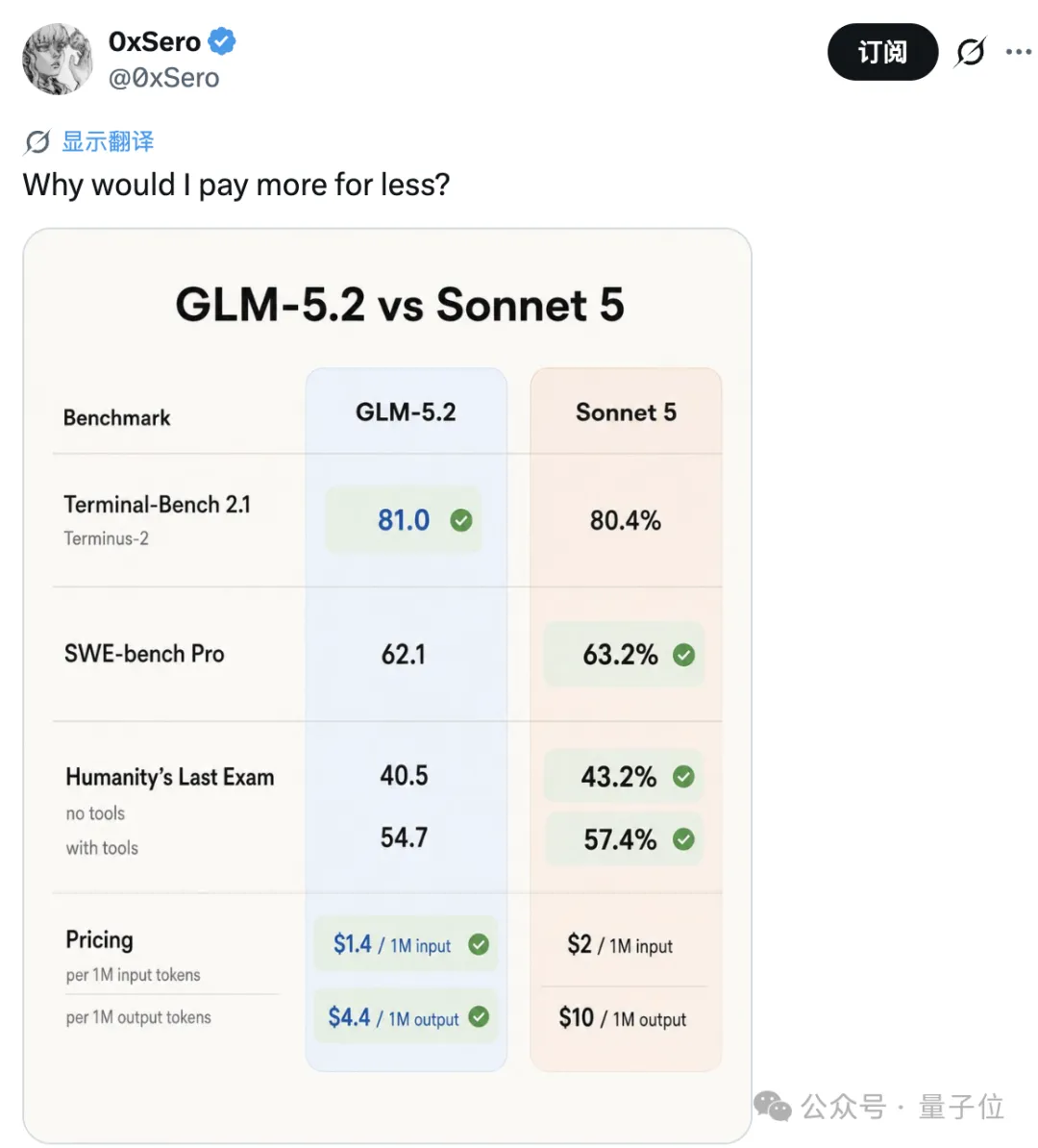
As this developer put it: why pay more for less?
Reference links:
[1]https://www.anthropic.com/news/claude-sonnet-5
[2]https://simonwillison.net/2026/Jun/30/claude-sonnet-5/