
The Future Belongs to These 5 Careers
Jay, reporting from 凹非寺
Quantum Bit | QbitAI Official Account
R&D, product, design, and data science will all disappear. The future belongs to these five careers.
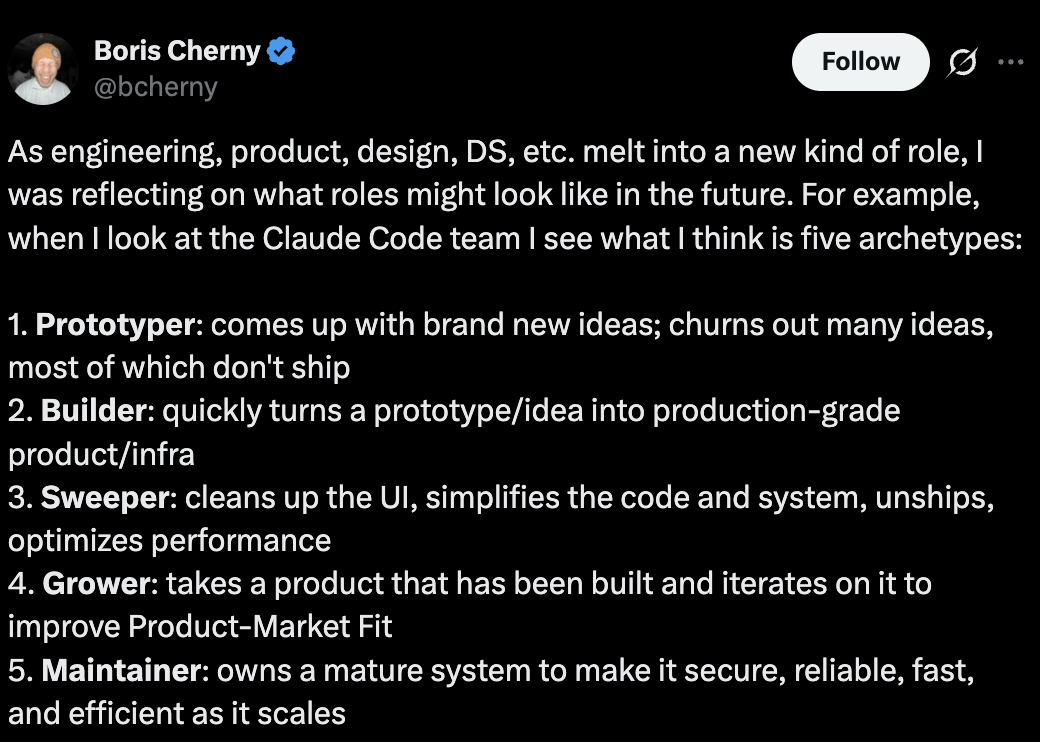
The latest hot take from Boris Cherny, the father of Claude Code, has gone viral across Silicon Valley.
He essentially tossed all traditional functions into the trash and proposed an AI-era “MBTI for the workplace”:
- Prototyper: a wildly imaginative madman. Can come up with a dozen ideas a day and build a pile of prototypes, most of which will never ship. But if one of them hits, it pays for the whole thing.
- Builder: takes a prototype or idea and quickly turns it into a production-ready product or infrastructure. Speed is the core advantage.
- Sweeper: the person who cleans up the battlefield. Simplifies the UI, trims code and system architecture, cuts features that need cutting, and optimizes performance. The least sexy role on the team, but one of the most critical.
- Grower: once the product is built, this person takes over, iterates repeatedly, and hones Product-Market Fit.
- Maintainer: keeps a mature system running safely, reliably, quickly, and efficiently as it scales.
It’s wild. After Claude Code “hunted down” programmers worldwide, Boris is now looking for new jobs for all white-collar workers.
Claude Code Father’s Version of MBTI
These five roles are laid out here, and you may already be wondering: Which one am I?
Unfortunately, Boris didn’t provide a detailed explanation. So I made a little set of cards based on MBTI to help everyone get the idea.
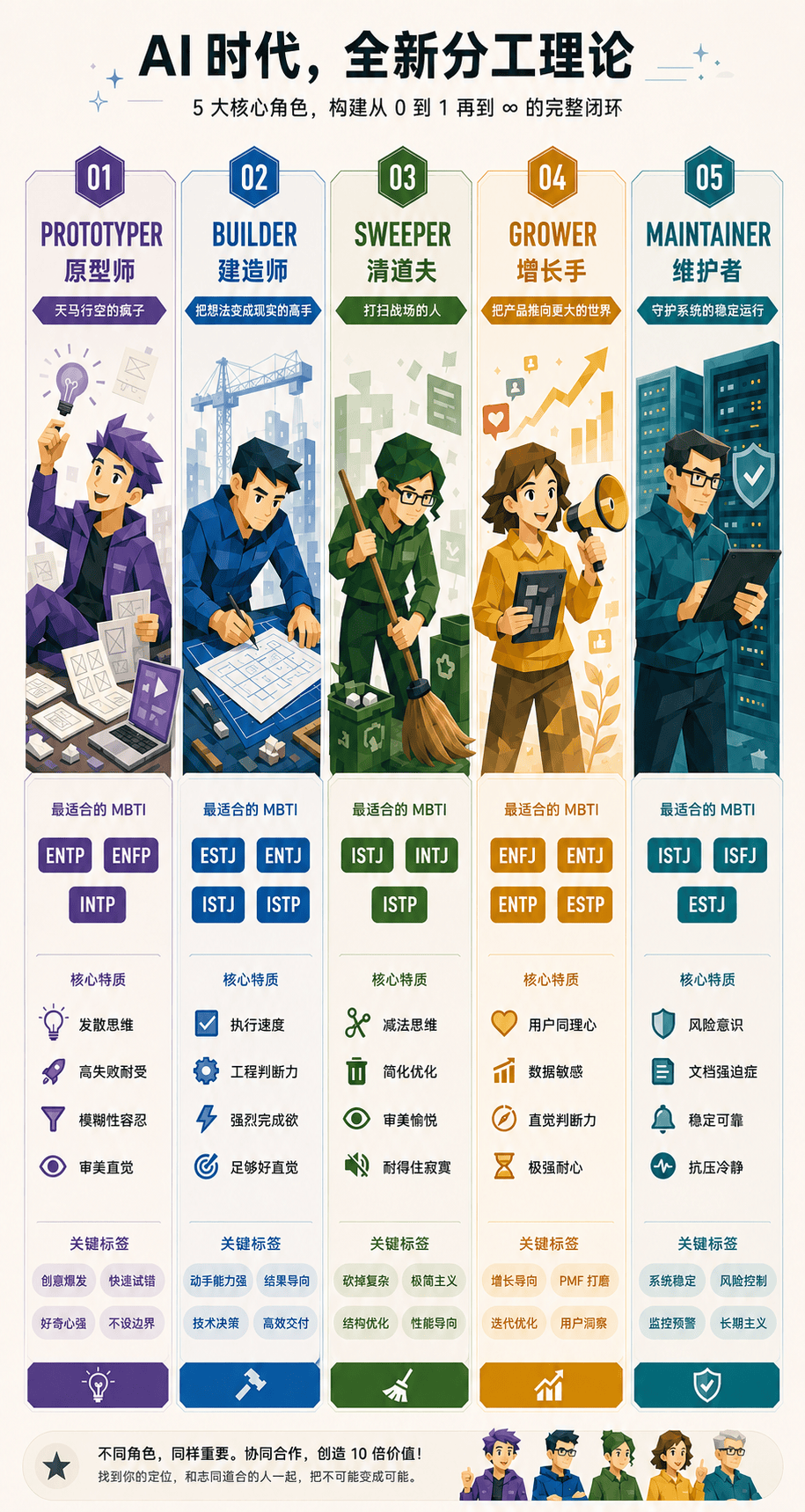
1. Prototyper
Best-fitting MBTI types: ENTP, ENFP, INTP.
A wildly imaginative artist can indeed be romantic, but there’s one prerequisite:
You need an almost “cold-blooded” decisiveness.
Coming up with a dozen ideas a day means you have to get used to discarding your own work and not getting attached to any one prototype.
2. Builder
Best-fitting MBTI types: ESTJ, ENTJ, ISTJ, ISTP.
The core of this role is execution speed and engineering judgment.
Key traits: a strong drive to finish things, and the ability to make technical decisions decisively even when information is incomplete.
3. Sweeper
Best-fitting MBTI types: ISTJ, INTJ, ISTP.
A somewhat “perverse” kind of role (bushi).
Most people get a sense of accomplishment from “what I added”; Sweepers get theirs from “what I removed.”
Key trait: the ability to tolerate working without recognition, because no one’s going to thank you for “removing features.”
4. Grower
Best-fitting MBTI types: ENFJ, ENTJ, ENTP, ESTP.
Somewhat similar to a product manager, but at its core this is a translation role that requires understanding both the product and the user.
Key traits: data-sensitive but not data-worshipping, while also having very strong empathy.
5. Maintainer
Best-fitting MBTI types: ISTJ, ISFJ, ESTJ.
This positioning is pretty brutal: basically the designated scapegoat. When the system is running well, no one notices you; once something goes wrong, everyone comes looking for you.
Key traits: extremely low stimulation needs (able to accept months without anything new), obsessive attention to detail, and most importantly—
a robot-like ability to handle pressure.
At 3 a.m., the phone could ring at any moment.

The above is for reference only. Since this is based on additional analysis of the post, these “labels” are merely the product of Boris’s brainstorming and have no scientific basis.
Still, it’s pretty interesting. It’s a kind of “self-worth anchoring” that may help people gain a clearer sense of where they stand.
That said, before you “slot yourself into the right category,” there are two things worth checking again.
1. These roles do not directly correspond to traditional job titles.
Operations does not equal Grower, and programmer does not equal Builder…
Even if you were a designer in the past, under this new framework you might be redistributed into three different roles.
First principles still depend on what kind of person you are to begin with.
2. The five roles are not isolated from one another.
No need for decision paralysis. People are complex, and may embody parts of multiple role personalities—it’s just that the proportions differ.
So you can pick the roles you’re best at and combine them as needed.
That’s how things work inside the Claude Code team too: many people span two roles, sometimes even three.
On the other hand, a person’s role needs to evolve as the project develops.
Today you’re a Prototyper; tomorrow the project officially kicks off, and you have to become a Sweeper. Later, once the product launches, you switch again into Maintainer mode.
Locking yourself into a single role means that sooner or later you’ll have to hand the project over to someone else halfway through.
That’s also the pitfall to watch most closely in the AI era. Yesterday, Tang Jie from Zhipu AI made a similar point.
With technology still in a phase of rapid iteration, don’t treat any evaluation framework as gospel. Once the underlying assumptions are overturned, you can lose everything.

Still, if we assume these five roles are the raw materials of future organizations, how should managers build teams?
Boris breaks it into three stages:
1. The product is just starting and hasn’t found PMF yet?
You need lots of Prototypers, Builders, and Sweepers.
2. The product is growing and has roughly validated PMF?
Shift the focus to Builders + Sweepers + Growers, with a few Maintainers added in.
3. The product already has strong PMF?
Mainly Sweepers + Growers + Maintainers, while keeping some Builders around.
The product’s lifecycle determines what kind of people you need.
The Flood Is Really Here
Boris Cherny studied economics, dropped out to start a company, taught himself to code, and later served as a Meta principal engineer. He joined Anthropic in 2024 and built the first prototype of Claude Code by himself.
At first, it was just a small command-line tool he wrote while getting familiar with the company’s API. He added a batch process and turned a Python example into TypeScript.
Then he was stunned to discover that the model had learned to use tools.
It felt as if the god of AGI had descended.
From that point on, the gears of fate began turning. Claude Code spread rapidly and kept evolving inside Anthropic, and eventually shipped.
To this day, Claude Code accounts for 4% of all public commits on GitHub, and its annualized revenue has surpassed $250 million.
A tool changed Anthropic’s internal production model.
It also placed Boris in an exceptionally unique observational position.
After all, he was among the first to witness, in real time, the “demolition” of traditional labor division.
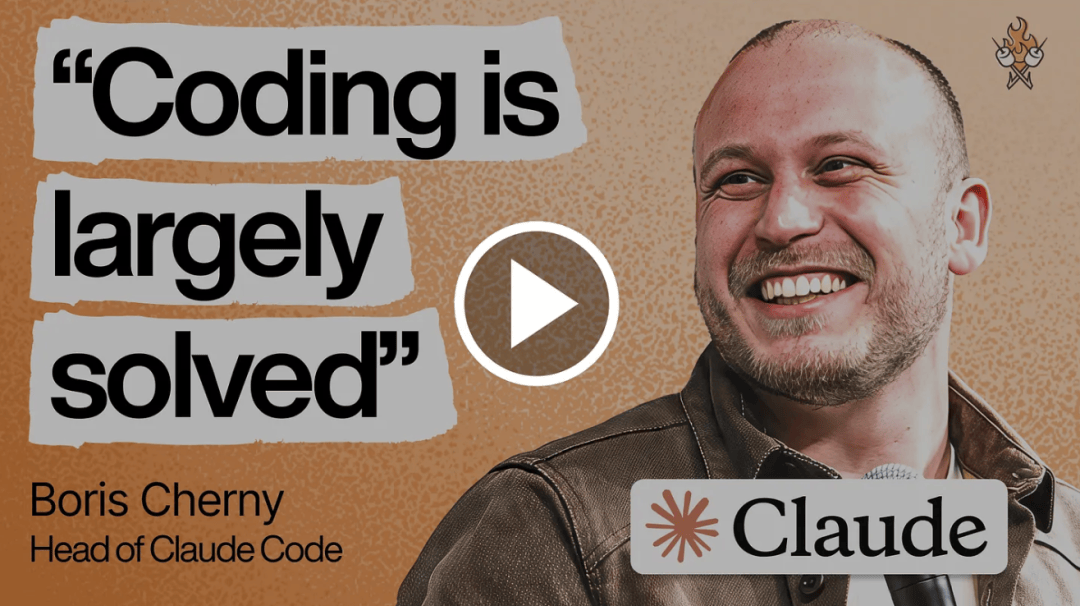
In February, Boris appeared on Lenny Rachitsky’s podcast. A segment of the conversation went like this:
Lenny:
The job of software engineers has already changed. What do you think is the next role to be hit hardest by AI?
Boris:
Product managers, designers, data scientists… eventually, the impact will extend to all jobs that require operating a computer.
If that comes true, it will naturally trigger an unprecedented revolution in organizational paradigms.
In June, Boris was interviewed at Fortune Brainstorm Tech.
The host asked: In a world where fewer and fewer people are writing code by hand, what kind of people are companies actually looking for?
Boris answered with a single word.
Generalists.
This is not empty talk. The Claude Code team’s practices are already quite radical. Every engineer on the team spends nearly every day doing things that would normally fall outside an engineer’s responsibilities.
Product managers write code, engineering managers write code, designers write code, and even finance writes a bit of code…
At the end of the day, AI is lowering the barrier to every skill. In the past, one person couldn’t take on multiple roles at once because the learning cost was too high. Whether design or programming, it took at least several years of training.
Now, models are dramatically narrowing the gap between these capabilities.
So Boris reached the conclusion that the golden age of ADHD has arrived (bushi).
We are living in the golden age of generalists. For those who refuse to be confined to just one domain, there has never been a better time than now.
Of course, this is also a crisis.
The moat is drying up.
The professional barriers countless people have built are being slowly eroded by a model that keeps scaling.
More importantly, all of this is happening too fast.
When Boris said in February that “software engineers are going to disappear,” many people thought he was just selling anxiety.
Four months later, his new post is already discussing replacement plans for all white-collar jobs.
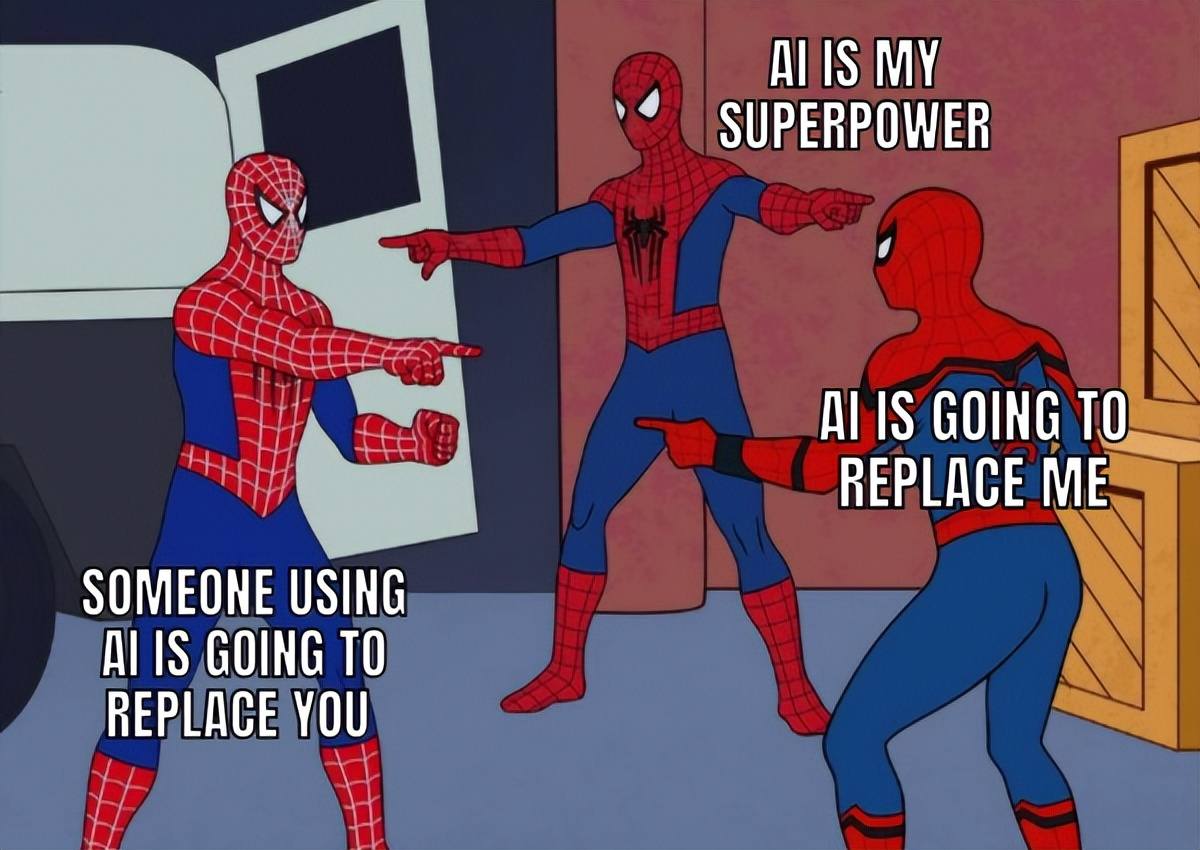
Wait—was that just promoting his own product and telling everyone to brace for doom?
Not so fast. Boris doesn’t mean it that way. As an engineer, he’s just as anxious.
The flood really is coming, and it’s attacking everyone indiscriminately.
But from atop the “Noah’s Ark,” Boris—drawing on the team’s internal transformation experience—offers a self-rescue plan:
Learn how to swim.
Learn How to Swim
In medieval Europe, the literacy rate was below 1%, and scribes were among that tiny minority.
Let alone ordinary people—even kings were mostly illiterate, and had to hire them specifically to handle documents. They were basically elites among elites.
But as we all know, the rest of the story went like this—
Printing press arrives, game over.

That said, I think historical analogies can’t always be taken at face value. People often ignore certain details in order to support a particular point.
In the story of the printing press, there’s a detail that has long been obscured by the grand narrative:
Not all scribes were anxious about the printing press.
This example Boris gave on the podcast left a deep impression on me.
I read a historical source from the fifteenth century about a scribe talking about the printing press.
He was excited, because he didn’t like copying books. For him, illustrating and binding books was more interesting.
The printing press freed up his time.
Under the flood, no one is safe.
But those who know how to swim—
will reach the new continent.
References:
[1] https://x.com/bcherny/status/2071379474277613732?s=20
[2] https://www.lennysnewsletter.com/p/head-of-claude-code-what-happens