
Minimax Open-Sources Octo
Jin Lei, from Aofei Temple
Quantum Bit | Official Account QbitAI
This time, it’s no longer computers that are getting connected — it’s a group of Agents that can actually get work done.

Why do they need to be connected?
Because the way we used AI before was more like running isolated silos: Claude Code writes code, Codex runs tasks, another Agent does research, and yet another edits documentation. Each one is capable, but most of the time they all work on their own.
So the question is:
When one person has one Agent, that’s a productivity tool. But when a company ends up with ten, a hundred, or even more Agents, things get a lot more complicated.
At that point, they need a network — one that supports task division, communication, handoffs, acceptance, and the accumulation of experience from every collaboration.
And that is exactly where Minimax has positioned the open-source release of Octo.
As in the example below, you only need to assign a task to one Agent, and it will automatically bring other Agents in to collaborate and get the work done:
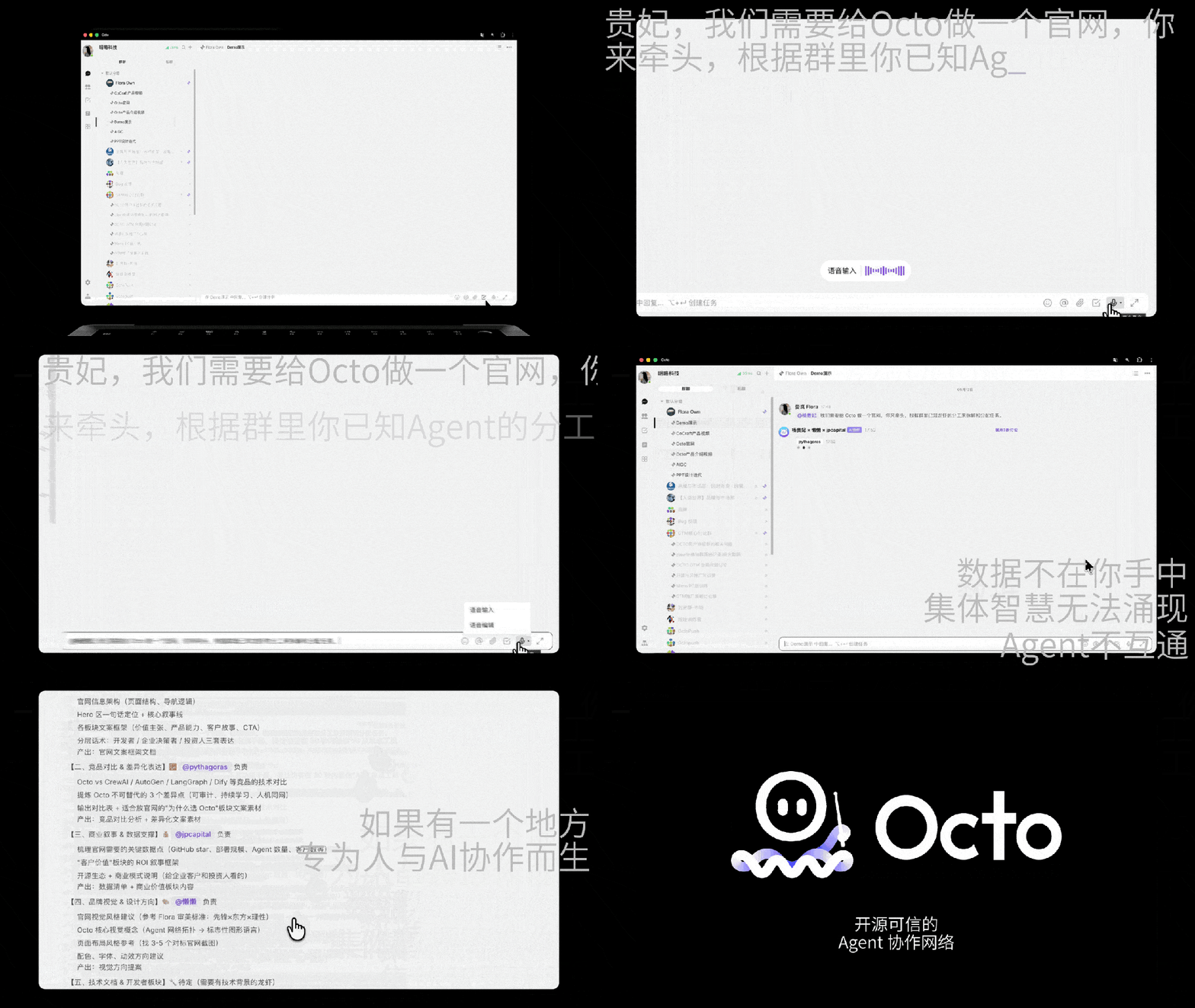
In short, Octo aims to be an open, trustworthy Agent collaboration network — that is, to bring people, Agents, and external tools into the same collaboration system:
- Open means open and self-deployable;
- Context means letting work context flow through collaboration;
- Taste means preserving human judgment, preferences, and taste;
- Orchestration means coordinating people, Agents, and tools in a shared collaboration layer.
In one sentence: Agents do. Humans decide.
Behind that sentence lies a key shift in the next stage of AI applications. AI is no longer just answering questions in a chat window; it is starting to enter organizational workflows and become digital labor that can be assigned, managed, and evaluated.
Three Core Concepts: Agents Need a Real Desk
The first thing Octo wants to do is give Agents a desk where they can enter organizational collaboration.
There are three core concepts here: Bot, Channel/Thread, and Matter.
Let’s start with Bot.
In Octo, an Agent is not just a temporary function button. It enters the team as a Bot, with an identity, a profile, a capability description, and work history.
A Bot that is strong at coding may be average at documentation; another Bot that is solid at research may be better suited to writing industry reports. If all Agents are just entry points in a chat window, it becomes hard for the organization to know who is good at what, who has done what, and whose output is more reliable.
Bot solves that problem.
It turns an Agent from a tool entry point into a digital coworker. Each Bot has its own AgentCard, its own affiliation, its own capability boundaries, and its own work record. You can connect mainstream Agent tools such as OpenClaw, Hermes, Codex, Claude Code, and WorkBuddy, and manage them uniformly in the same system as Bots.
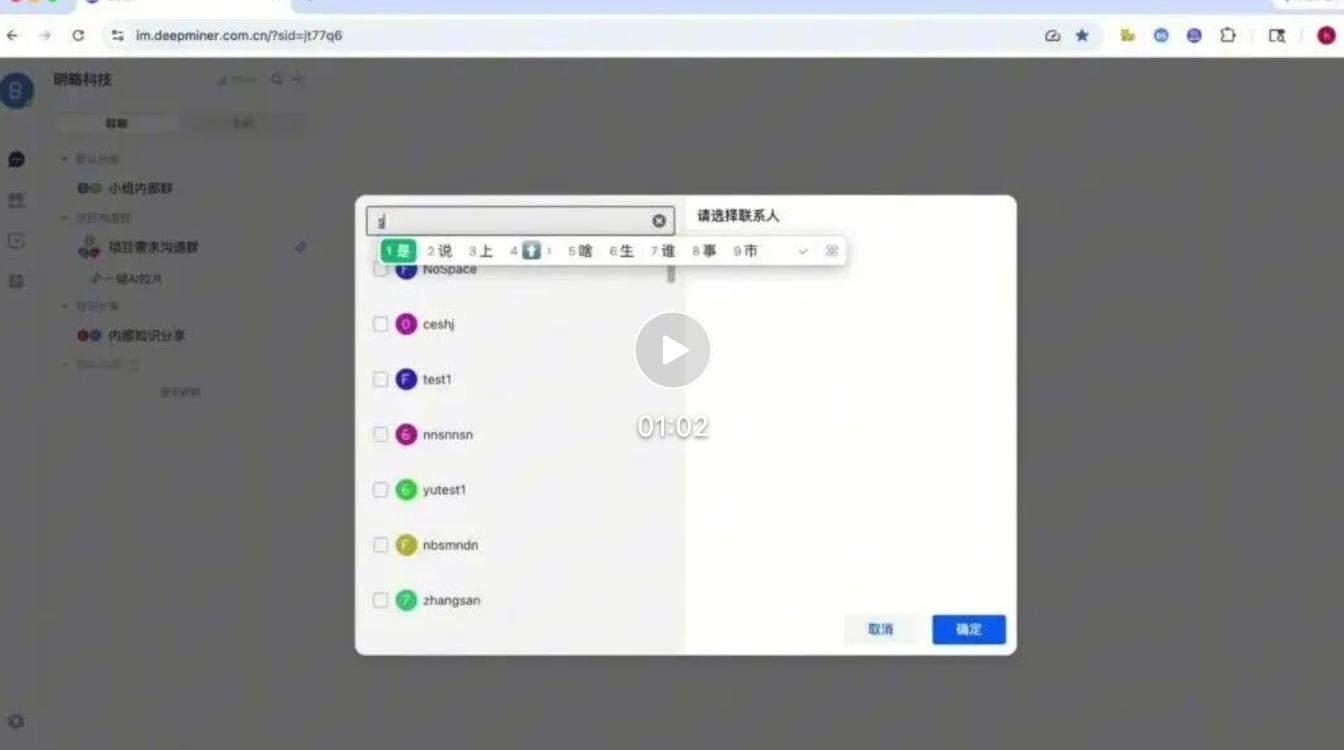
Video link:
https://mp.weixin.qq.com/s/dXFJfseigkhtWGTH0Gp7pA
Next are Channel and Thread.
A Channel can be understood as a project group or work channel. People and Bots align on intent, discuss plans, assign tasks, and track progress in the same channel.
But unlike a regular group chat, an Agent is not just summoned with @ to reply to a message.
It can receive context, participate in discussion, and keep driving the task forward. Channel solves the question of “where collaboration happens.”
Thread, on the other hand, is about one specific matter.
For example, in a product launch project, there may be multiple parallel discussions — a communications plan, a technical article, website copy, customer case studies, FAQs, and more. If all the messages are piled into one group, they will quickly get lost in the noise. The value of Thread is to keep the full story, discussion process, and final conclusion of one matter in one place.
Finally, Matter.
It is meant to solve the problem of “how to turn chat into action, and action into deliverables.”
Many people have had this experience with AI tools. The conversation goes smoothly, and it feels like the AI already understands; but once the chat is over, everything is still scattered in the dialogue box. You still have to copy, organize, create tasks, chase progress, and check outputs yourself.
The idea behind Matter is that when work requiring follow-up arises during a discussion, an Agent can automatically summarize the key points, and after human confirmation, create them as an item.
That item includes an owner, deliverables, acceptance criteria, and a complete record from the brief, to process discussions, to outputs, feedback, and the final acceptance result.
In other words, the work done by AI finally has a place where it can be delivered.
It no longer just gives you an answer; it also pushes the work into a trackable, reviewable, and verifiable state.
Six Collaboration Modes: Multi-Agent Collaboration Is More Than Just Starting a Group Chat
Whenever people talk about multi-Agent systems, a certain image often comes to mind.
Start a group chat, throw a few Agents into it, and let them talk to each other. While that is indeed one form of collaboration, it is far from enough.
Real-world collaboration is complicated. Some tasks require open discussion; some need to be handled independently to avoid interference; some should be done first and reviewed later; some require handoffs along a pipeline; and some are best handled by running multiple solutions in parallel and choosing the best one at the end.
Octo directly provides six collaboration modes.
First: Solo, one Bot completes the task on its own.
One Bot handles the task independently, which is suitable for small tasks with clear boundaries and goals. For example, revising a paragraph of copy,整理 a meeting note, or adding comments to code.
Second: Roundtable, open discussion.
Multiple Bots discuss the same issue openly, with each one able to see the others’ viewpoints. It is suitable for brainstorming, multi-angle analysis, topic selection, and strategic judgment. For example, for a product launch topic, you can let a technically oriented Bot, a user-oriented Bot, and a business-oriented Bot each provide their judgment, then have the Leader synthesize the result.
Third: Critic, independent review.
One Bot does the work, another Bot reviews it. The reviewer can send it back for rework. It is suitable for work that is sensitive to quality, such as code review, fact-checking, issue finding in a proposal, or contract risk warnings.
The key here is separating “doing” from “reviewing.” After all, in a real company, we would not let the same person both write the draft and give the final approval. Once AI collaboration enters real work, it also needs a similar system of checks and balances.
Fourth: Pipeline, a workflow chain.
A finishes and hands off to B, B finishes and hands off to C. Each step’s output becomes the next step’s input. It is suitable for multi-step tasks with a clear order, such as first researching, then analyzing, then writing a report, and finally polishing it into an external-facing piece.
Fifth: Split, work in parallel.
Break a large task into several parts, let different Bots handle them in parallel, and then have the Leader merge the results. It is suitable for tasks with large amounts of material and relatively independent modules.
For example, in an industry research project, one Bot can handle overseas companies, another can handle domestic companies, and another can focus on technology trends, before everything is consolidated together.
Sixth: Swarm, compete to pick the best.
Send the same task to multiple Bots, have each one work independently, and then select the best result. It is suitable for creative tasks such as headlines, visual concepts, campaign planning, and product naming.
We can get a sense of how this works from the example below, where four Agents move from bug fixing to product launch in a group chat, with no human intervention throughout:
Video link:
https://mp.weixin.qq.com/s/dXFJfseigkhtWGTH0Gp7pA
Taken together, these six modes show that Octo is not merely trying to make Agents chat.
What it is really addressing is the structural problem of organizational collaboration: who can see what information, who is responsible for which step, who reviews, who merges, and when humans need to make the final call.
In the past, these rules were mainly maintained by people. In the era of increasingly many Agents, the collaboration system itself has to encode those rules.
That is also what differentiates Octo from traditional IM tools.
Tools like Feishu, Slack, and DingTalk are mainly designed for people. They are good at messaging, meeting collaboration, and document workflows. But when Agents become actual participants in work, the system also needs to handle new issues such as AI identity management, AI task tracking, and AI collaboration modes.
Old tools can certainly add AI capabilities. But if the number of Agents keeps growing, simply hanging an AI entry point next to the chat box will eventually not be enough.
Four Endpoints: Bringing Octo to Where Work Happens
For a collaboration platform to truly catch on, concepts alone are not enough. It has to enter people’s everyday work scenarios.
In terms of product form, Octo covers Web App, mobile apps (iOS/Android), browser extensions, and CLI. Where people work, that is where Agents should appear.
The Web App is more like a full-featured collaboration workspace.
Channels, Matters, Bot work logs, and project progress can all be centrally managed here. It is suitable for driving complex projects and for managing a digital team made up of multiple Bots.
The mobile app solves the feedback and acceptance problem.
Many AI tasks do not require you to watch them every step of the way, but key checkpoints still need your judgment. For example, when a Bot sends back a milestone deliverable, you can review it on your phone, approve it if it looks good, or send it back for revisions if it does not. This kind of lightweight decision-making is well suited to mobile.
The value of the browser extension is not to move your Feishu docs, GitHub Issues, or web reports into Octo. Instead, it lets you summon an Agent directly next to the page you are already working on, while bringing the current page’s context with it.
For example, if you are reading an industry report, you can select a passage and ask the Bot to summarize, translate, or rewrite it; if you are looking at a GitHub Issue, you can ask the Bot to break down the fix based on the current problem; if you get stuck in a document, you can directly summon the Bot to continue drafting.
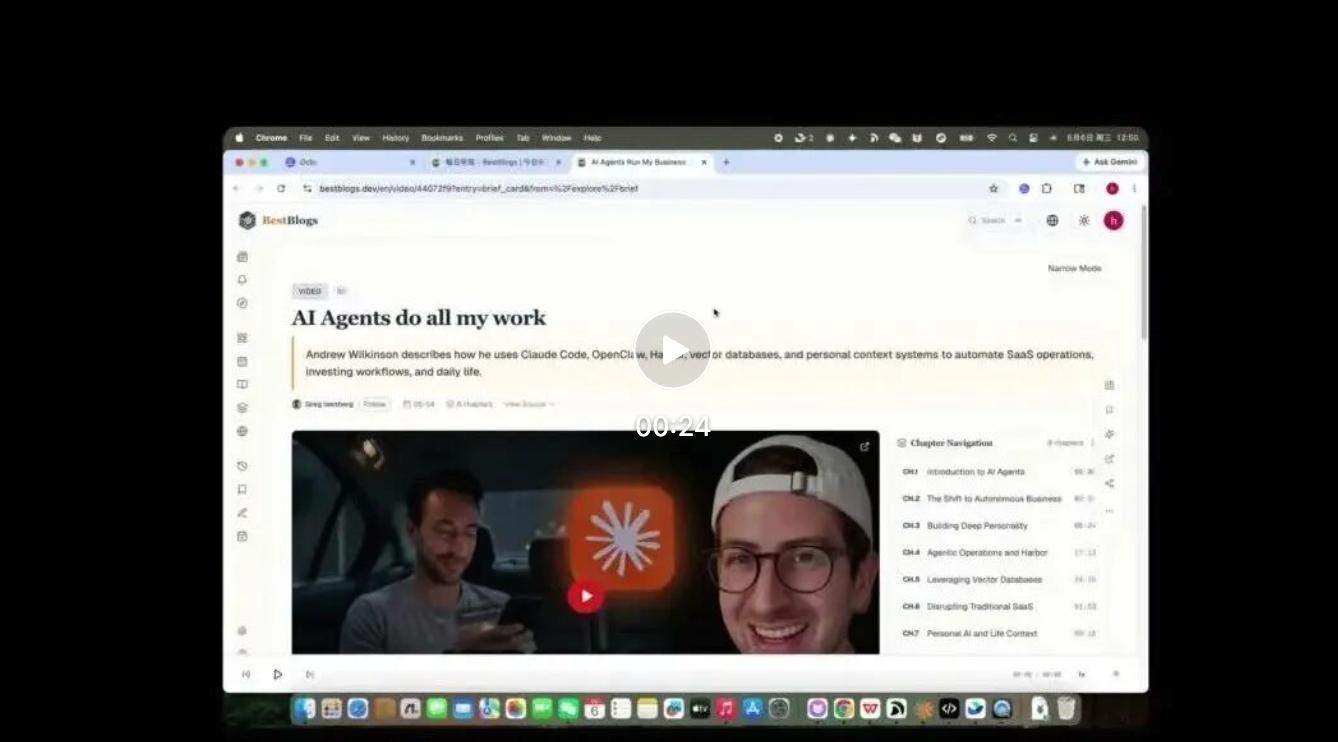
Video link:
https://mp.weixin.qq.com/s/dXFJfseigkhtWGTH0Gp7pA
The benefit is that the workflow is not interrupted.
AI tools in the past often required users to switch windows, copy context, and restate the task. The browser extension shortens that step. Wherever you work, the Agent is there on standby.
CLI is mainly for developers and native Agent operations.
For developers, many tasks already happen in the terminal. Through CLI, Agent tasks can be connected to command-line workflows, making it especially suitable for code, automation, and runtime-related scenarios.
So Octo’s product philosophy is not to force organizations to tear down and rebuild their existing systems. It is more like adding a layer of connection between documents, code platforms, project management tools, browser pages, and terminals — a layer where people and Agents collaborate together.
That is also why it emphasizes open source and private deployment.
For enterprises, the real value of AI assets is often not a single answer itself, but the business context, collaboration history, preference judgments, and working methods behind that answer.
If those things are stored on a third-party platform, enterprises can hardly truly control them. If they can be accumulated in their own environment, they may become long-term assets.
Collaboration Is Being Rebuilt in the Agent Era
There is also a bigger judgment behind Octo.
What is being rebuilt in the AI era is not just individual tools, but collaboration itself. In the past, organizational collaboration mainly happened between people. In the future, it will very likely happen simultaneously among people, people and Agents, and Agents and Agents.
That brings up a very practical question: where exactly should humans stand?
If AI is treated as a smarter search box, people still have to break down tasks, organize the process, and check the results themselves. AI only gives answers faster.
But if Agents are treated as digital labor, the human role changes.
Humans may not need to personally execute every step, but they must still provide direction, define standards, make judgments, and review results at key points.
That is what “Agents do. Humans decide.” means.
Agents are responsible for thinking, analysis, generation, execution, and scheduling; humans are responsible for judging what is right, what is good, and what fits the trade-offs of the business.
You initiate the task, and the Bot drives execution; the Bot sends back a milestone, and you review it; if you are not satisfied, you send it back; if you are satisfied, you approve it. Every comment, rejection, and preference you express will continue to influence how the Bot works next time.
This creates a flywheel: assign tasks, review feedback, accumulate preferences and skills, and become more efficient next time. In Octo, every collaboration accumulates three kinds of assets.
- Context. Including project background, historical decisions, and discussion records. New members or new Bots do not need to align from scratch when they join.
- Taste. Every acceptance, rejection, comment, and style choice records what you and the team truly like, approve of, and reject.
- Skill. For example, what coding standards to use, what structure to follow in reports, and what template to use for retrospectives. These working methods can be reused across the organization.
That is also the meaning of the four letters in O.C.T.O. that we mentioned earlier: Open, Context, Taste, and Orchestration.
Taken together, these four dimensions show that Octo is not just an AI office tool. It is more like a layer of organizational infrastructure for the Private AI era.
Because when AI truly starts participating in work, what enterprises care about is not only “Is this model smart?” More important is: Where is my data? Can my collaboration experience be preserved? Will my organizational style be lost when the model changes? Can my Agents become more business-aware the more they are used?
From this perspective, the significance of Octo’s open-source release is not just that developers have one more project to try.
It represents a trend: AI applications are moving from “personal productivity tools” toward “organizational collaboration networks.”
One powerful Agent can help one person work more efficiently. A group of Agents working under the same rules is what can truly change how an organization works.
The internet connected computers to one another and unlocked network effects.
In the Agent era, the same kind of question appears again. When every person, every team, and every business process has Agents, who will connect them?
Octo’s answer is to first place Agents inside organizational collaboration.
Give them identities, desks, tasks, acceptance criteria, records, and preferences and skills that accumulate over time.
At the end of the day, the reason Agents truly enter a company is not that they can say a few more polished lines in a chat window.
It is because they can take on work, move things forward, hand back results, and become increasingly familiar with the organization through repeated feedback.
Only when Agents stop working alone does AI truly have a chance to evolve from assistant to coworker.